
Online Casino Reload Bonus Australia: What 2026 Players Should Know Before They Claim
Every reload bonus an Australian player can claim today sits on a server outside the country. There is no licensed online casino in Australia — not federally, not in any state or territory — and every operator ranked further down this page is an offshore brand serving Australian traffic without a local licence. The page that pretends otherwise is the page that costs its readers most. So before the rankings begin, the legal reality of the IGA is dealt with head-on; only after that does the question of which reload terms are worth chasing start to make sense.

Data current as of 17 October 2026; licence and ACMA enforcement claims cross-checked against the Interactive Gambling Act 2001 and the ACMA public register.
Table of Contents
- What Is a Casino Reload Bonus (and Why It Looks Different in Australia)
- The Legal Reality: Why Every Australian Reload Bonus Sits Offshore
- Reload Bonuses Worth Claiming (and the Ones We Could Not Verify)
- How Reload Offers Actually Work (and Where They Catch You)
- Playing Safely: Tools and Limits That Actually Help
- How We Chose and Ranked These Operators
- Your Reload Bonus Decision: What Actually Matters
- Frequently Asked Questions
What Is a Casino Reload Bonus (and Why It Looks Different in Australia)
A reload bonus is a deposit-match offer for an existing player, paid after the welcome bonus has been used. The operator matches a slice of the next deposit — usually somewhere between 25% and 75% — and credits bonus funds that the player must wager through before withdrawing. That is the mechanic in one sentence. Everything else on this page is a variation on it, and most of the variation costs the player.
The reason the product looks different in Australia is structural. Locally licensed online wagering exists for sports and racing, but online casino games and online pokies are prohibited under the Interactive Gambling Act 2001. Australian players who want a reload bonus for slots or table games are funnelled, by default, onto offshore operators. That single constraint shapes every number on this page: the match percentage, the cap, the wagering multiple, and the consumer protections the player gives up when they accept the offer.
What a reload bonus actually means
For an existing customer — someone who has already used their welcome package — a reload bonus is the operator’s way of asking for another deposit. In return for sending A$100 again, the casino matches a percentage of it as bonus funds. A 50% reload on a A$200 cap means the operator will credit up to A$100 in bonus cash on top of a A$200 deposit, then attach a wagering requirement to that bonus before it can be withdrawn.
Compared to welcome bonuses, which routinely sit at 100% to 200% match, reloads are a quieter pitch. The typical reload sits in the 25% to 75% range — a discount, not a giveaway. Welcome bonuses in the Australian-facing market average around 100% match with a A$500 cap and 45x wagering; reload bonuses average around 50% match with a A$200 cap and 35x wagering. The headline is smaller because the operator knows the player has already paid the cost of acquisition. Reload bonuses are the operator’s second bite at the same cherry, dressed in smaller numbers.
For the player, the practical meaning is this: a reload is a way to extract a little more play time from a fresh deposit, at the price of accepting bonus funds that come with a wagering requirement. Whether that trade is worth it depends almost entirely on the wagering maths, which is the subject of the section on how reload offers actually work.
How a reload bonus works, step by step
Every reload bonus follows the same four-stage cycle, and the cycle does not vary between operators — only the numbers inside it do.
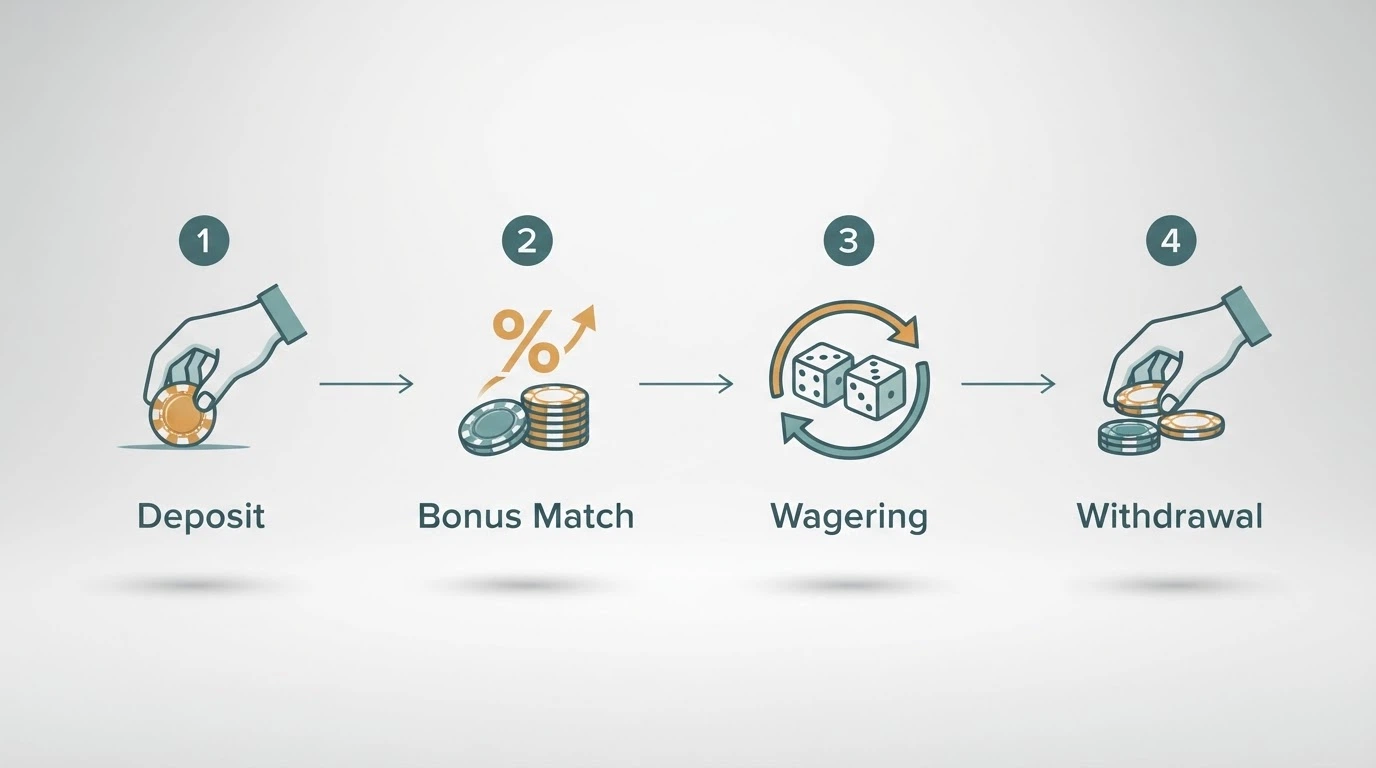
First, the player makes a deposit that meets the reload’s minimum, usually A$20 to A$30 for a Sunday-style reload. Some offers — particularly daily reloads at operators like Rainbet — have higher minimums. Second, the operator applies the match percentage: 50% of the deposit becomes bonus funds, capped at the offer’s stated maximum. Third, the player wagers through the combined total, with most slots contributing 100% toward the requirement and table games contributing far less. Fourth, once the wagering clears, the player can withdraw the bonus funds (and any winnings tied to them) subject to whatever cashout cap the offer carries.
The middle two stages are where the player pays. Game contribution weightings mean that the A$3,500 wagering requirement on a A$100 bonus at 35x is not 3,500 spins of pokies at A$1; it is however many spins are needed at the stake the player actually plays. Maximum bet limits during bonus play — typically A$5 to A$10 per spin across the AU-facing market — also slow the clear-down. Anyone who tries to push A$20 spins through a 35x bonus clears much faster on paper but risks having the winnings voided.
The four-stage cycle is identical to the welcome bonus. The difference is the numbers, and the difference is almost always worse for the player on a reload than on a welcome package.
Reload bonus vs welcome bonus: the real differences
Welcome bonuses and reload bonuses share the same mechanism, but the numbers diverge sharply, and the divergence is structured to make the welcome look generous while the reload looks routine.
A welcome bonus in the Australian-facing market typically offers a 100% match (sometimes 100% to 200%) with a cap around A$500 and wagering around 45x. A reload bonus, on average, offers a 50% match with a cap around A$200 and wagering around 35x. The welcome bonus is the larger headline number, with a steeper playthrough attached; the reload is the smaller headline number, with a slightly easier playthrough attached. From the operator’s perspective this is a logical funnel: get the player in with a big headline, then keep them in with smaller follow-ups.
For the player, the practical question is which one is easier to convert into withdrawable cash. The lower wagering on the reload is not enough on its own to make the reload better value — a 50% match at 35x on a A$200 cap produces A$100 in bonus funds requiring A$3,500 of wagering, which is the same shape of maths as a smaller welcome package. The welcome bonus is bigger in absolute dollars but harder to clear; the reload is smaller but more forgiving. Whether one is worth more than the other depends on what the player plans to deposit and how long they plan to play.
There is also a structural distinction: the welcome bonus is a once-only event per operator, while reloads can recur weekly or even daily. A reload at 50% on A$200 every Sunday is, over a year, a larger sum than a single 100% welcome bonus at A$500 — but each individual claim still carries its own wagering requirement and its own cap on winnings.
Online reloads vs land-based loyalty: why the comparison matters
For Australians who have played at Crown Melbourne, The Star Sydney or one of the other state-licensed land-based casinos, the online reload bonus is the digital cousin of the loyalty programme they already know. Crown and The Star run tiered rewards — points, comps, event invitations, dining credits — designed to keep a player returning to the same physical venue. The structure is identical: a reward for continued play, scaled to the size of the bet.
The difference is in the regulation. Crown and The Star operate under state-issued casino licences; the rewards they offer are part of a regulated product, with state-level oversight, responsible-gambling officers on the floor and direct access to support services. The online reload bonus sits on the other side of that line. There is no online casino licence in Australia, and the offshore operators offering reloads are not subject to state gaming control. The loyalty analogue exists; the regulatory analogue does not.
That is why the comparison matters for an Australian player weighing a reload offer. The land-based loyalty programme rewards play within a system that has an Australian complaint body, an Australian self-exclusion register and an Australian regulator behind it. The online reload bonus rewards play on a site that may be blocked by Australian ISPs at any time, will not connect to BetStop, and will not pay out through any Australian consumer protection if it decides not to. The mechanism is familiar; the safety net is not.
The Legal Reality: Why Every Australian Reload Bonus Sits Offshore
Every reload bonus an Australian player can claim at an online casino sits on an offshore site. The Interactive Gambling Act 2001, strengthened by the Interactive Gambling Amendment Act 2017, prohibits the provision of online casino games, online pokies and in-play betting to a person in Australia. No licence exists for the activity — not federally, not in any state or territory. This is not a grey area; the statute names the product and bans it. The ACMA’s enforcement record, the 2026 gambling reform package and the offshore-only nature of the entire ranking below all flow from that single fact.
The legal reality cuts two ways. On one side, it explains why the page is necessary at all — no Australian-licensed casino exists to offer a reload bonus, so anyone claiming one is doing so on an offshore site. On the other side, it changes what a player should weigh when reading the rest of the page. A reload offer is not just a numbers question; it is also a question about which protections apply, which do not, and what is being given up.
The IGA prohibition: online casino is illegal in Australia
The Interactive Gambling Act 2001 makes it an offence to provide online casino games, online pokies (slots) or in-play betting on a sporting event to a person physically in Australia. The 2017 amendment closed the loopholes that offshore operators had used to argue that the law did not reach them, and it gave the ACMA the enforcement and ISP-blocking powers it now uses.
The Act does not prohibit the player. It targets the provider. That distinction is worth being precise about, because it is the most commonly misunderstood point on the topic. An Australian individual who claims a reload bonus is not committing an offence under the IGA. The Australian operator, or the offshore operator serving Australians, is the one the Act is aimed at. But the practical consequence for the player is sharper than the legal one: there is no Australian regulator to complain to if the offshore operator refuses to pay out, no Australian consumer protection that applies to the bonus, and no Australian body that can force the operator to honour its terms.
There is also no licence to apply for and no licence to be granted. Online wagering on sports and racing is licensed in Australia, primarily through the Northern Territory Racing and Wagering Commission, and lotteries and keno are licensed separately. Online casino is not. The product is banned, and no amount of operator rebranding changes that.
ACMA enforcement: 1,564 sites blocked and counting
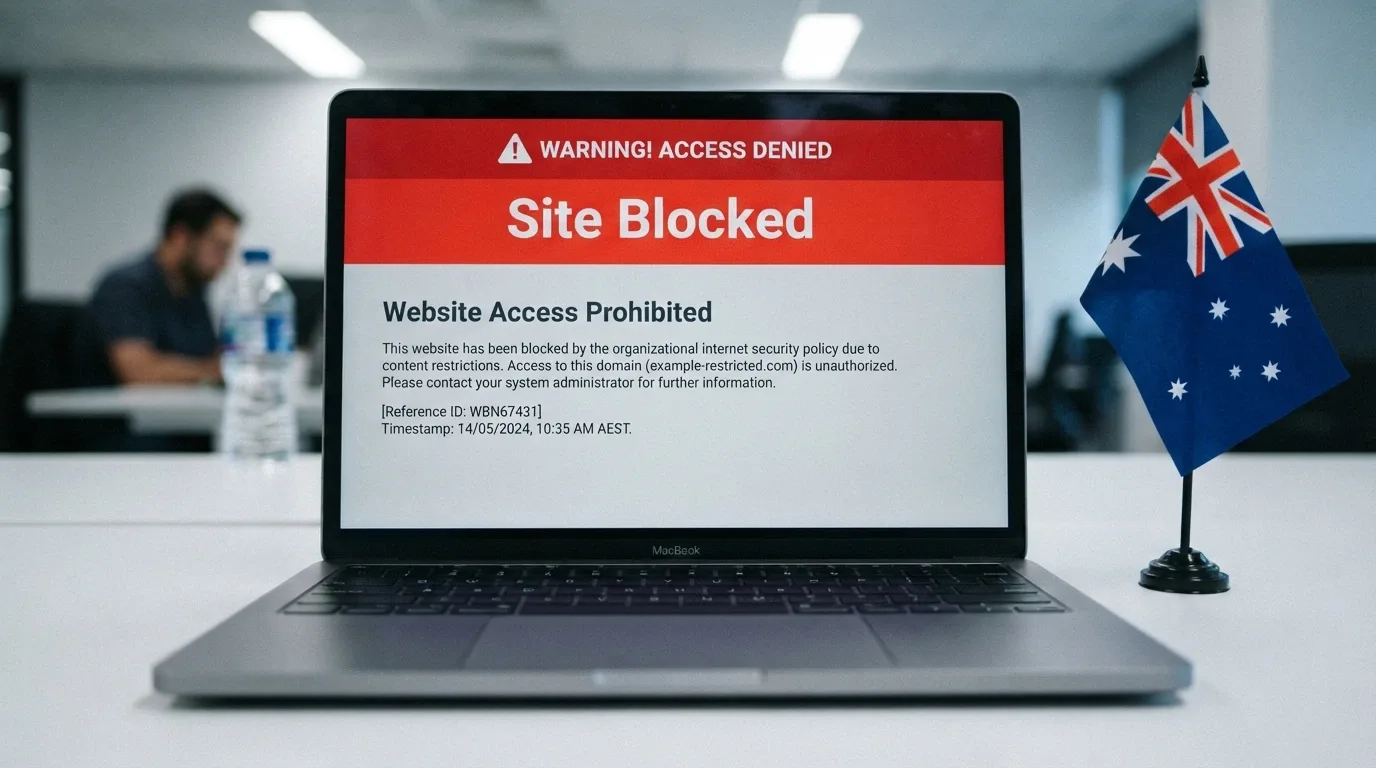
The ACMA has had 1,564 illegal gambling and affiliate websites blocked by Australian ISPs since it issued its first blocking request in November 2019. More than 225 illegal services have voluntarily withdrawn from the Australian market since enforcement was strengthened in 2017. The blocking is DNS-level — the site is removed from the resolver an Australian ISP hands to its customers — which is why players see a “site not found” rather than a warning page.
The blocking record grows by the month. Operators rotate through mirror domains and new front URLs; the ACMA issues fresh blocking requests; the cycle repeats. From the player’s perspective this is not theoretical. A reload bonus on an operator that gets blocked mid-promotion leaves a balance sitting on a domain that no longer resolves for an Australian customer. The block does not void the balance — the operator still has it — but it removes the player’s ability to reach the site to clear it or withdraw it.
In the ACMA’s own words: “Providing a prohibited interactive gambling service to a person in Australia is illegal, and the ACMA pursues it.” The statement is plain. The record behind it is more than fifteen hundred sites deep, and it is the reason every operator listed further down this page should be read as an offshore brand subject to Australian enforcement, not a partner of the Australian licensing system.
What the 2026 gambling reform changes from January 2027
The Interactive Gambling Amendment (Gambling Reform) Bill 2026 passed Parliament on 19 August 2026 and its measures commence on 1 January 2027. The reform does not legalise online casino — it does the opposite. It tightens the regulatory perimeter around wagering advertising, inducement marketing and payment routing, with most of the new rules aimed at licensed wagering operators but several reaching the offshore market directly.
The headline changes relevant to a reload bonus claim are three. First, from 1 January 2027, banks and payment providers gain express authority to block transactions to illegal gambling operators. A PayID or card payment to an offshore casino becomes something the player’s own bank may refuse to process — not as a bank policy choice, but under statute. Second, wagering advertising is restricted to no more than three ads per hour between 6:00 am and 8:30 pm, with a complete live-sport blackout from 15 minutes before to 5 minutes after an event, athletes and influencers barred from promoting wagering products, and online ads shown only to logged-in, over-18 users with an opt-out. Third, direct marketing of inducements is prohibited for 14 days after a customer signs up, for three months after a person deregisters from BetStop, and indefinitely for customers identified as at risk of gambling-related harm.
For an Australian player, the practical effect is that the marketing environment that pushes reload bonuses into inboxes and onto social feeds gets noticeably quieter from January 2027. The offshore offers themselves do not disappear under the reform — the prohibition predates it — but the pathways to discover them and the payments to fund them are about to get narrower.
What you actually lose when you play outside the licensed system
The first thing to go is BetStop. The National Self-Exclusion Register covers approximately 150 licensed wagering providers in Australia. A person who has self-excluded through BetStop is barred from placing a bet with any of those providers in a single step, for a minimum of three months up to a lifetime. Offshore casinos are not connected to BetStop. A self-excluded person who joins an offshore casino and claims a reload bonus is not stopped from doing so, because the register does not reach the site. The offshore operator will keep accepting the money.
The second thing to go is the National Consumer Protection Framework. Licensed wagering operators in Australia operate under a 10-measure framework that includes strong identity verification, customer-set deposit limits, monthly activity statements, consistent risk messaging, easy account closing and trained staff. None of these are required of an offshore casino. Deposit limits are at the operator’s discretion; activity statements may not exist; account closure can be made deliberately difficult; identity verification may be cursory.
The third thing to go is recourse. There is no Australian complaints body for an offshore casino dispute. If the operator refuses to pay a withdrawal, voids a bonus on a technicality, or closes an account without explanation, the Australian player has the operator’s own dispute process and whatever the operator’s licensing jurisdiction (Curaçao, Anjouan, Malta) provides — which is usually slow, often useless, and almost never enforceable from Australia.
The fourth thing to go is legal payment routing. Credit cards, credit-related products and cryptocurrency have been banned as payment for online wagering since 11 June 2024 under the Interactive Gambling Amendment (Credit and Other Measures) Act 2023. Penalties for non-compliance reach A$247,500. The ban targets licensed operators and the payment infrastructure around them; offshore casinos that still accept card or crypto do so in breach of the spirit of the law, and from 1 January 2027 the express authority given to banks and payment providers makes it harder for that path to keep working.
Reload Bonuses Worth Claiming (and the Ones We Could Not Verify)
What follows is a ranking of ten AU-facing operators, ordered by how much of their reload bonus offer could be verified from current sources at the time of writing. Five of the ten had specific reload terms confirmable from operator terms pages or trusted casino-review platforms; the other five had significant Australian player traffic but no reload bonus terms that could be sourced reliably in this review. The unverified operators are still listed — because a reader searching for them deserves to know they exist — but their cells in the comparison table carry the no-data marker, and their individual sections describe them qualitatively rather than fabricating numbers.
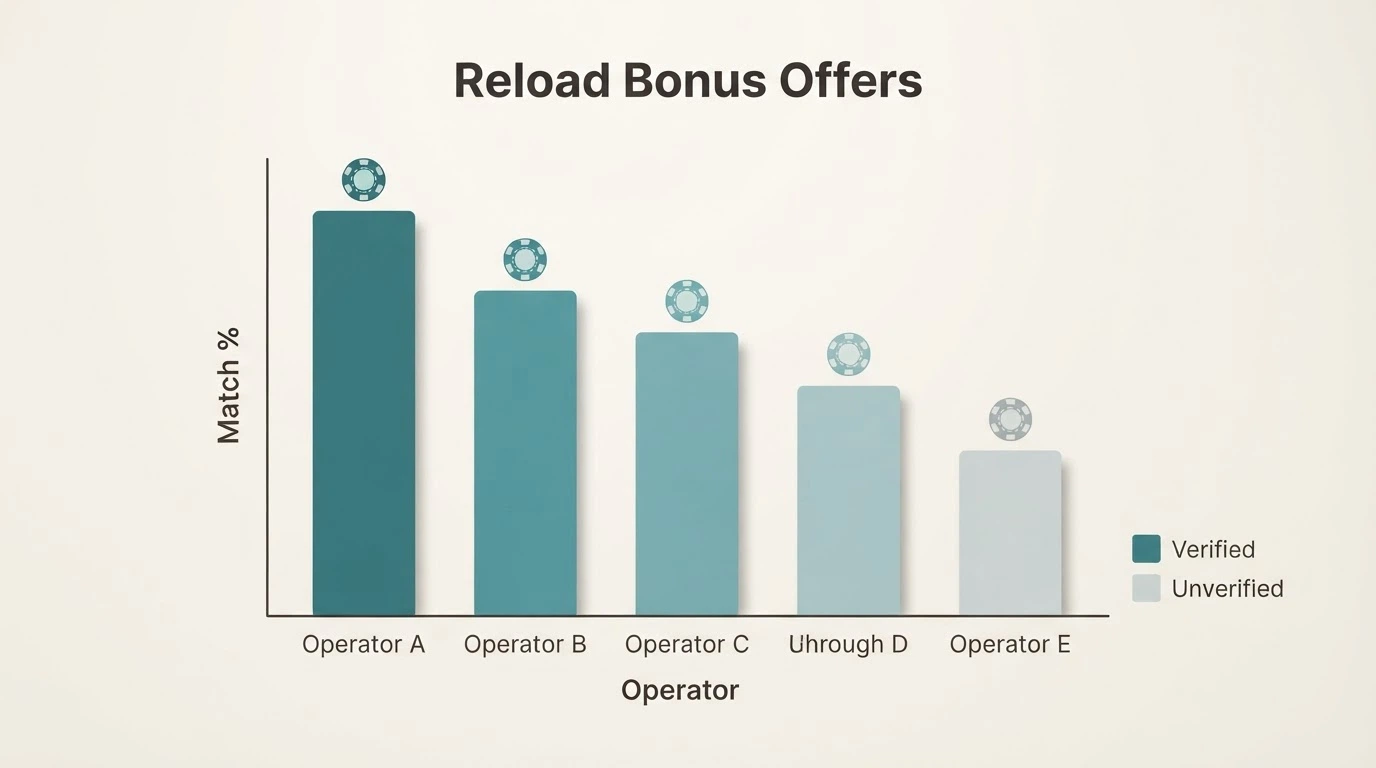
This is not a ranking of licensed operators. There is no licensed online casino to rank. Every operator below is an offshore brand serving Australian traffic without a local licence.
| Operator | Licence / Regulatory Status | Reload Bonus | Wagering (Bonus Only) | Welcome Bonus |
|---|---|---|---|---|
| Rocket Play | Offshore — not licensed in Australia | 50% Sunday reload on A$30 min; 20–50 Friday free spins on A$30–A$75 deposits | 30x–40x | Up to A$6,000 + 300 free spins |
| Skycrown | Offshore — not licensed in Australia | Daily deals each weekday; 50% on second deposit up to A$500; referral up to A$75 | 40x; 30x on second-deposit reload (bonus only) | Up to A$8,000 + 400 free spins |
| Royal Reels | Offshore — not licensed in Australia; ACMA-blocked | 14 active bonuses across 8 categories; A$10 no-deposit after phone verification | 35x (bonus only) | A$2,500 + 50 free spins across 3 deposits |
| Fair Go Casino | Offshore — Curaçao 1668/JAZ; not licensed in Australia; first ACMA-blocked site (November 2019) | Daily 125% match + 25 FS; 200% match + 20 FS; Koala Monday up to A$1,000; free monthly A$25 | 30x (bonus + deposit on welcome); max bet A$10 | 100% up to A$200 × 5 deposits (A$1,000 total) |
| Bizzo Casino | Offshore — TechSolutions Group N.V. (Curaçao-rooted); not licensed in Australia; ACMA-warned record | — | 40x; max bet A$8 | Up to A$7,250 + 175 free spins |
| Stake | Offshore — not licensed in Australia | — | — | — |
| WinSpirit | Offshore — not licensed in Australia | — | — | — |
| Scream Casino | Offshore — not licensed in Australia | — | — | — |
| Rocket Casino | Offshore — not licensed in Australia | — | — | — |
| Rainbet | Offshore — Anjouan ALSI-152406029-FI2; not licensed in Australia; Australia listed as fully restricted in own T&C | 3 daily reloads every 8 hours, funded by rakeback | 40x (Wager Lock) or No Wager Lock path | 250% up to $2,100 + 60 free spins |
How we compared these operators
The ranking is ordered by a single editorial criterion: how much of an operator’s reload bonus offer could be verified against current sources. Operators with confirmed reload terms sit above those without, and the unverified operators are kept in the ranking so that a reader searching for them by name can find the honest read on what could and could not be confirmed.
Verified information came from three places. The first was the operator’s own terms pages and promotional pages, read directly to confirm the bonus structure, the wagering multiple and any caps or game restrictions. The second was the ACMA public register and the ACMA’s published list of blocked sites, used to confirm whether the operator had been the subject of a blocking request and, where applicable, when. The third was the Casino.Guru Safety Index and player-feedback platforms, used to check withdrawal patterns and unresolved complaints at operators where the AU-licensed register did not apply.
Unverified information was treated as a gap rather than a fill-in. The audit flags a casino that names a bonus it cannot substantiate, and the page is no different: where a reload bonus or wagering multiple could not be sourced to a primary or trustworthy secondary reference, the cell in the table reads as a no-data marker and the individual section describes what is known about the operator qualitatively. No invented numbers appear anywhere on the page.
Rocket Play: A Sunday Reload Built for Weekly Players
Rocket Play’s reload bonus structure is built around a weekly rhythm. The headline offer is a 50% Sunday reload on a minimum A$30 deposit — a 50% match on whatever the player sends, with the A$5 minimum stake range covering most pokies. A secondary weekly offer runs Friday free spins, between 20 and 50 spins depending on deposit size, on deposits between A$30 and A$75. Wagering on bonuses sits in the 30x to 40x range, and a weekly cashback offer is attached at a much lighter 5x wagering.
The welcome package runs up to A$6,000 + 300 free spins across multiple deposits, which is on the larger end for the AU-facing market but paired with the same 30x to 40x wagering. The weekly cashback at 5x wagering is the practical standout — it is a low-friction way to recover a slice of weekly losses without the heavier playthrough of the main reload. Rocket Play is offshore and not licensed in Australia, and the player accepts that when accepting any of these offers. For a player who deposits on a fixed weekly schedule and wants a predictable Sunday bonus, Rocket Play’s structure is built for that rhythm; for a player who prefers daily reloads, the weekly cadence will feel slow.
Skycrown: Daily Deals, but Crypto Deposits Need Not Apply
Skycrown runs a different shape: daily deals for each day of the week, on top of a 50% reload on the second deposit up to A$500, plus a referral bonus of up to A$75 at 10x wagering. The welcome package is large — up to A$8,000 + 400 free spins across a 4-tier structure (120% up to A$1,200 + 125 FS, 100% up to A$1,300 + 75 FS, 80% up to A$1,500 + 50 FS, 150% up to A$4,000 + 150 FS) — with 40x wagering across all tiers and a lobby of over 7,200 games.
The sharp edge on Skycrown’s bonus structure is the explicit exclusion of crypto deposits from all bonus offers. A player funding the account with BTC, ETH or USDT cannot claim any of the welcome or reload bonuses at Skycrown, which is a meaningful restriction for the AU crypto-friendly cohort and a clean rule for everyone else. Skycrown is offshore and not licensed in Australia; for a player who wants daily reload variety and a large game lobby, and who is comfortable funding the account in fiat through PayID or card, Skycrown’s structure fits. For a player who planned to use crypto, the bonus terms rule it out before the first deposit.
Royal Reels: 14 Active Bonuses, but the Site Is Already Blocked
Royal Reels has the most bonus variety of any operator reviewed. The site runs 14 active bonuses across 8 categories — reload, cashback, tournament, VIP, no-deposit and others — making it the deepest promotional calendar in this ranking. The welcome package covers A$2,500 + 50 free spins across three deposits: 100% up to A$500 on the first, 75% up to A$750 on the second, 100% up to A$1,250 on the third. Wagering is 35x on bonus only, and a A$5 per-spin max bet applies during clear-down. There is also a A$10 no-deposit bonus after phone verification — one of the few genuinely no-deposit reloads on a featured operator.
Eleven of the 14 active bonuses carry wagering time limits, and 3 of them carry maximum cashout caps. Both are normal for the offshore market but worth weighing against the headline number: a bonus that expires in 48 hours is not the same value as a bonus that runs for two weeks, and a cap on cashable winnings reshapes the expected return on a free-spins offer.
Royal Reels is also on the ACMA blocked-sites list, which means an Australian player reaches the site through a mirror domain that the ACMA may not yet have requested be blocked. The block record is a moving target — the ACMA issues fresh blocking requests as new mirror URLs surface — and a player who has a balance on a Royal Reels mirror that gets blocked tomorrow has no Australian consumer-protection recourse to recover it. The bonus variety is genuine; the access risk is also genuine.
Fair Go Casino: The First Site the ACMA Ever Blocked, Still Operating
Fair Go Casino is a Curaçao-licensed (1668/JAZ) veteran of the AU-facing market and was the first site the ACMA ordered Australian ISPs to block, in November 2019. The blocking did not stop the operator from serving Australian customers — Fair Go operates through mirror domains and direct-to-player marketing channels — and the site’s promotional calendar is still active.
The welcome package is straightforward: 100% up to A$200 on each of the first five deposits, for a total of A$1,000, with 30x wagering on bonus + deposit and a A$10 max bet. The reloads are more frequent: a daily 125% match + 25 free spins on the “Top Game,” a 200% match + 20 free spins on “Fortunate Days,” a weekly Koala Monday bonus up to A$1,000, and a free monthly A$25 bonus (capped at A$180 in cashable winnings). 15+ active promotions are running at any given time.
The wagering on bonus + deposit, rather than bonus only, is the most expensive shape of reload maths on this ranking. A A$200 deposit + A$200 bonus at 30x wagering is A$12,000 of required play, not the A$6,000 that bonus-only wagering would produce. Fair Go is a long-running operator with a deep promotional calendar; the maths is heavier than most competitors, and a player who intends to claim should plan around the bonus + deposit structure rather than the bonus-only figure.
Bizzo Casino: 8,000-Plus Games, but No Reload Bonus We Could Confirm
Bizzo Casino (TechSolutions Group N.V., Curaçao-rooted) carries one of the largest game libraries in this ranking — 70+ studios and 8,000+ titles — and supports PayID for both deposits and withdrawals, which is unusual for an offshore operator and reduces friction for Australian players funding the account in AUD. The welcome package runs up to A$7,250 + 175 free spins across four deposits at 40x wagering with an A$8 max bet, and Casino.Guru rates its Safety Index at 8.4.
The reload bonus terms, however, did not surface in this review. The welcome package is well-documented; the recurring reload calendar was not findable to a verifiable standard. For a reader, that means Bizzo’s welcome bonus is a known quantity and its reload bonus is not. A player who wants a deep game lobby, PayID support and a competitive welcome offer can weigh Bizzo on those grounds; a player who wants a confirmed recurring weekly reload will have to wait until the operator publishes terms or until a future review verifies them.
Bizzo is offshore and not licensed in Australia, and is on the ACMA’s warned/blocked record. PayID support is the operational standout; the missing reload data is the editorial caveat.
Stake: Australia’s Biggest Offshore Name, but Reload Terms Unverified
Stake is the most recognisable offshore brand among Australian crypto-friendly casino players. Its Australian player base is significant enough to feature on any list of AU-facing operators, and its game library and sportsbook integration are well known in the market.
Reload bonus terms could not be confirmed in this review. Stake’s promotional structure has historically skewed toward rakeback, race-based rewards and sportsbook promotions rather than traditional deposit-match reloads, but no current reload terms could be sourced to a verifiable reference at the time of writing. The operator is offshore and not licensed in Australia; that status is the constant; the bonus shape is not something the page can describe in numbers without inventing them. A reader curious about Stake’s current offer should check the operator’s own promotions page directly; the page can only confirm that no AU-verifiable reload terms were surfaced this round.
WinSpirit: Present in the Market, but Bonus Terms Unverified
WinSpirit is an offshore operator with a measurable Australian player base, visible in AU-facing search results and in the traffic data tracked by casino comparison platforms. Beyond its presence in the market, the operator’s reload and welcome bonus terms could not be sourced to a verifiable standard in this review.
That gap is recorded here, not papered over. The page describes WinSpirit qualitatively as an offshore brand reaching Australian players without a local licence, and stops there. A reader comparing reload offers will find no numbers to weigh WinSpirit against from this page; that is the honest read on what the available sources could confirm, and inventing terms to fill the cell would make the table less useful for everyone reading it.
Scream Casino: AU Traffic Without Confirmed Reload Offers
Scream Casino carries Australian-facing search visibility but limited verifiable bonus detail at the time of this review. The operator is offshore, not licensed in Australia, and serves AU traffic through the same offshore channels as the rest of this ranking.
The reload and welcome bonus specifics could not be sourced to a verifiable standard, and the operator’s licensing jurisdiction is not named in a reliable secondary source for this page. A player searching for Scream Casino specifically should treat the absence of confirmed terms as a reason to read the operator’s own bonus page carefully before depositing, and should weigh the absence of a confirmed licence reference as an additional reason to size any deposit small.
Rocket Casino: Brand Recognition Without Confirmed Reload Data
Rocket Casino is the second of the two “Rocket”-named brands in this ranking, and the one with the thinner verifiable record. The brand has recognition among AU-facing players, and the operator is offshore and not licensed in Australia. Welcome and reload bonus terms could not be sourced to a verifiable standard in this review.
For a reader, the practical read is the same as for WinSpirit and Scream Casino: the operator is present in the market, the operator is offshore, and the operator’s reload terms are not something the page can quote with integrity. The brand recognition is real; the bonus terms are a gap, and the gap is recorded as a gap.
Rainbet: Three Daily Reloads, but It Bars Australians in Its Own Terms
Rainbet has the most frequent reload cadence of any operator in this ranking — three reloads per day, every eight hours, funded by a rakeback mechanic — and a welcome package of 250% up to $2,100 + 60 free spins across three deposits. The wagering structure offers two paths: a Wager Lock at 40x, where the bonus is locked behind playthrough, and a No Wager Lock path, where the bonus is released gradually as the player wagers. Deposits are capped at $700 per bonus tier, and a daily reload expires after 24 hours if unclaimed.
The complication is in the operator’s own terms of service. Rainbet is licensed in Anjouan (ALSI-152406029-FI2) and lists Australia — alongside the United States, the United Kingdom, France, Germany, Austria and Spain — as fully restricted. VPN use is explicitly prohibited. The AU-facing traffic is real, but the operator’s own terms say Australians should not be playing there. A player who accepts Rainbet’s reload bonus is doing so against the operator’s stated rules, which makes any subsequent dispute — over a bonus void, a withdrawal refusal, a closed account — harder to escalate, because the player was never supposed to be on the site in the first place.
For a reader weighing reload frequency against operator accountability, Rainbet is the cleanest example of the trade: the most generous reload schedule on this page, against an operator that does not want Australian players and has documented that in its own rules.
How Reload Offers Actually Work (and Where They Catch You)
Reload offers look simple on the surface — match percentage, cap, wagering — and the cost is hidden in three places: the shape of the wagering requirement, the game contribution weightings, and the max-bet rule during bonus play. Each one can change the value of a reload by a factor of two or more, and most players read none of them before claiming.
The maths is not a trick, but it is structured to favour the house. The sections below set out each element in turn, with the comparison table that follows the welcome-vs-reload bonus structure that the operator uses to frame its own offers.
Match percentages and bonus caps: what the numbers mean
The headline of a reload bonus is the match percentage and the cap, and the two numbers interact more than they look. A 50% reload on a A$200 cap means the operator will credit up to A$100 in bonus funds on a deposit of up to A$200 — and the A$200 deposit is the most that produces any bonus, so depositing A$400 produces the same A$100 bonus. A 100% reload on a A$500 cap produces a A$500 bonus on a A$500 deposit, but depositing A$1,000 produces the same A$500 bonus.
That ceiling is what defines the offer’s real value. A 100% match at A$500 produces a A$500 bonus; a 50% match at A$200 produces a A$100 bonus; a 75% match at A$300 produces a A$225 bonus. Welcome bonuses in the AU-facing market average around 100% match with a A$500 cap; reload bonuses average around 50% match with a A$200 cap. Welcome bonuses can stretch to 200% match on first deposit at some operators; reload bonuses rarely exceed 75%.
The table below sets the two side by side across the four numbers that matter, including the slot-contribution weighting that determines how much of each spin actually counts toward the wagering.
| Bonus Type | Typical Match % | Typical Cap (AUD) | Wagering Multiplier | Slots Contribution |
|---|---|---|---|---|
| Welcome bonus | 100% (range 100%–200%) | A$500 | 45x (range 30x–50x) | 100% |
| Reload bonus | 50% (range 25%–75%) | A$200 | 35x (range 30x–45x) | 100% |
Welcome bonuses are larger in absolute terms; reload bonuses are smaller but require less playthrough per dollar of bonus. Neither is the better deal on its own. The better deal is the one that fits the size of the deposit the player was already going to make — a player who would have deposited A$400 anyway is indifferent between a 50% reload on A$200 and a 25% reload on A$400, because both cap out at the same deposit size. A player who would have deposited A$50 is leaving money on the table at any reload with a A$200 minimum or a high match threshold.
Wagering requirements: the multiplier that decides if you keep anything
The wagering requirement is the single number that determines whether a reload bonus converts into withdrawable cash. It is also the single number that is most often misread.

A 35x wagering requirement on a A$100 bonus means the player must wager A$3,500 before the bonus funds (and any winnings tied to them) become withdrawable. The mechanics differ between bonus-only and bonus-plus-deposit structures, and the difference doubles the cost. Under a bonus-only wagering structure, only the A$100 bonus is multiplied: A$100 × 35 = A$3,500 of required play. Under a bonus-plus-deposit structure, the deposit is added to the bonus before multiplying: A$100 deposit + A$100 bonus = A$200 × 35 = A$7,000 of required play. Fair Go Casino, for example, applies 30x wagering on bonus + deposit — a A$200 deposit + A$200 bonus produces A$12,000 of required play, not the A$6,000 that bonus-only wagering would produce.
Reload wagering in the Australian-facing market averages 30x to 45x. A 35x bonus-only requirement is considered competitive; 45x is on the heavier end of standard; anything above that is unusual for reloads specifically (welcome bonuses routinely sit at 45x or higher). The competitive benchmark is 35x bonus-only. Anything below that is favourable; anything at or above 40x bonus-only is heavy; bonus-plus-deposit at any figure is the most expensive shape.
Game contribution weightings make the wagering figure more expensive in practice. Pokies contribute 100% toward wagering requirements at nearly every AU-facing operator, which means a A$1 spin on a pokie counts as A$1 toward the A$3,500 total. Table games (blackjack, roulette) contribute 10% to 20%, which means a A$1 spin on blackjack counts as A$0.10 to A$0.20. Live dealer games contribute 0% to 10%, which means a A$1 spin on live roulette counts as A$0 to A$0.10 toward the wagering. A player who tries to clear the bonus on live dealer games will wager an order of magnitude more than the headline figure implies.
Maximum bet limits during bonus play add a third constraint. Across the AU-facing market, max bets are commonly A$5 to A$10 per spin; exceeding the limit can void the bonus and any winnings tied to it. A$10 spins on a A$3,500 wagering requirement take 350 spins at the high end; A$5 spins take 700. The clear-down time depends on the slot chosen — a fast 5-second pokies spin cycle takes the A$5 path through 700 spins in approximately 58 minutes; the A$10 path through 350 spins takes approximately 29 minutes. The 29-minute figure assumes the player never hits a feature that pays out, which is not how pokies work. The realistic clear-down time on a standard volatility pokie is several hours, not one.
To put the calculation in plain terms: at A$100 bonus, 35x bonus-only wagering and A$5 stakes, the player needs A$3,500 of turnover, which works out to 700 spins at A$5 each. At a 5-second spin pace, that is roughly 58 minutes of continuous play — about an hour of pokies to convert the A$100 bonus into withdrawable cash. The house edge in the meantime is whatever the pokies’ return-to-player figure sits at; the bonus does not neutralise the house edge, it just gives the player more spins to lose it across. A 96% RTP pokie across 700 spins at A$5 each has an expected loss of 700 × A$5 × 0.04, or A$140, against a A$100 bonus — meaning the expected loss on the playthrough exceeds the bonus itself. The maths is the point: the bonus, in expectation, costs the player more than it pays out.
No-deposit reload variants: free spins and no-deposit cash
Reload bonuses do not always ask for a deposit. No-deposit variants — free spins credited without a fresh deposit, or a small no-deposit cash bonus — appear at several operators in this ranking, and they are the most string-laden offers on the page.
Royal Reels offers a A$10 no-deposit bonus after phone verification, with the standard 35x wagering on bonus only and the A$5 per-spin cap during clear-down. Bizzo runs 10 free spins as a no-deposit offer with 40x wagering and a A$75 cap on cashable winnings. Casinonic — outside this ranking but a useful comparator — caps its no-deposit withdrawal at A$70 maximum, applies 50x wagering to free spins and free cash bonuses, and gives the player three days to clear the offer.
The strings on no-deposit offers are uniform across the market: a high wagering multiple (40x to 50x is standard), a short validity window (often three days), and a maximum cashout cap that turns what looks like “free money” into a fixed-dollar withdrawal ceiling. A player who claims a A$10 no-deposit bonus, runs it up to A$200 in winnings and finds a A$70 cashout cap has done the right thing by the operator’s terms but feels, understandably, short-changed. The lesson is to read the cap before claiming.
For a player with a tight bankroll, no-deposit offers are the lowest-cost way to test an offshore operator. For a player trying to build a balance, they are a poor use of time — the cashout caps and high wagering make them worse than the standard reload on a dollar-per-spin basis.
PayID and crypto reloads: how Australians actually fund their bonuses
The deposit routes Australians use for online gambling split sharply between legal and banned, and between licensed and offshore.
Legal deposit routes for licensed Australian wagering are debit card, bank transfer, PayID/Osko and BPAY, and identity verification is required at the point of account opening. PayID and Osko — the near-instant payment rails operated by Australian banks through the New Payments Platform — are the most common for small-to-medium deposits, and BPAY handles larger transfers through the bill-payment system. None of these are usable at a licensed online casino, because there is no such thing.
At offshore casinos, the deposit picture is broader and legally murkier. Offshore AU-facing operators commonly accept PayID, Visa, Mastercard, Neosurf, bank wire and cryptocurrency (Bitcoin, Ethereum, USDT). Some sources note that native PayID integration at offshore casinos could not be independently verified, with payments sometimes routed through standard bank-transfer rails under a PayID label. The deposit itself usually clears; the legal status of the deposit is a separate question.
Crypto deposits at offshore casinos sit in a contradictory position. Credit cards, credit-related products and digital currency (crypto) have been banned as payment for online wagering since 11 June 2024 under the Interactive Gambling Amendment (Credit and Other Measures) Act 2023, with penalties for non-compliance of up to A$247,500. The ban targets licensed operators and the Australian payments ecosystem. Offshore casinos that still accept crypto do so outside the Australian regulatory perimeter; the Australian player making the deposit is on the wrong side of the spirit of the law, even if not the letter.
For players who do use crypto at offshore casinos, the Australian on-ramp runs through AUSTRAC-registered exchanges. The two most-used are CoinSpot and Swyftx, both supporting PayID funding from an Australian bank account. The exchange-to-casino transfer takes between 1 and 15 minutes depending on the chosen coin and the network load. USDT on TRC-20 is the recommended route for most players for two reasons: price stability relative to BTC and ETH, and faster confirmation times on the Tron network.
Skycrown, notably, excludes crypto deposits from all bonus offers. A player funding Skycrown with USDT cannot claim any of the welcome or reload bonuses — a clean rule that removes the ambiguity other operators leave in place.
Playing Safely: Tools and Limits That Actually Help
The safest reload bonus is one the player can walk away from. The Australian licensed wagering system offers three tools that help a player do that — deposit limits, activity statements and BetStop — and a fourth that exists outside the licensed system but is no less important: the National Gambling Helpline.
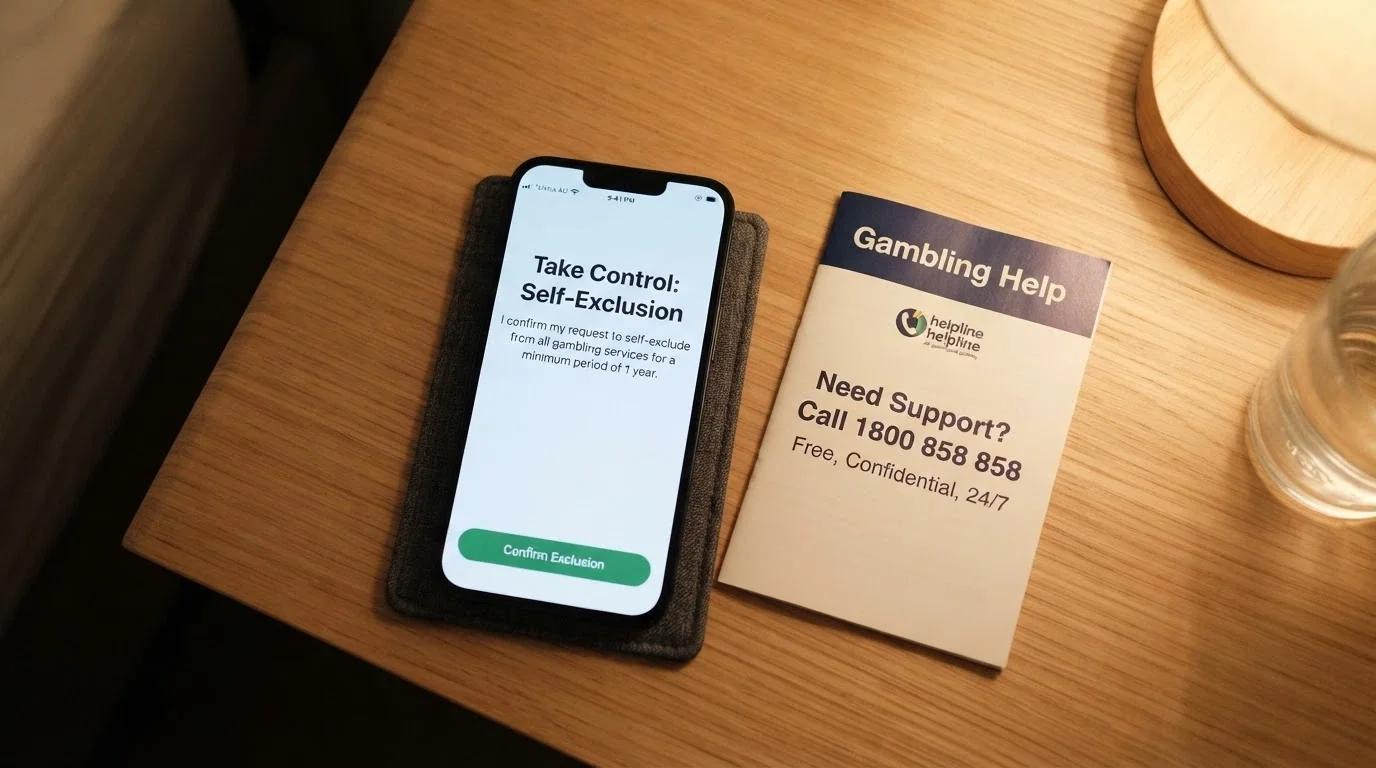
The section below covers each in turn, with the BetStop gap given the weight it deserves, because that gap is the single biggest safety difference between a licensed wagering account and an offshore casino account.
Deposit-limit tools and activity statements: what licensed operators must offer
The National Consumer Protection Framework for Online Wagering includes 10 measures applicable to licensed Australian wagering operators: no line of credit for gamblers, strong identity verification, restricted incentives and account sign-up offers, easy account closing, deposit limits, monthly activity statements, consistent risk messaging, trained staff, and a national self-exclusion register.
Deposit limits are the most useful of these for the player who wants a hard ceiling. A customer-set deposit limit at a licensed operator is enforced at the platform level — the operator cannot let a deposit through that exceeds the limit, and increasing the limit typically requires a cooling-off period. Monthly activity statements give the player a record of what they deposited, what they wagered and what they won or lost, delivered automatically. Both measures are required under the framework; both are absent or discretionary at offshore casinos.
The offshore experience on deposit limits varies. Some operators offer customer-set limits voluntarily; some offer them only on request; some do not offer them at all. The same applies to activity statements — most offshore casinos make balance and betting history available on the player’s account page, but a monthly emailed statement is not a baseline feature. A player moving from a licensed wagering operator to an offshore casino should expect to lose deposit-limit enforcement, automatic activity statements and the trained-staff and risk-messaging baseline that the framework requires.
BetStop self-exclusion: what it covers (and the offshore gap)
BetStop is the National Self-Exclusion Register, live since August 2023. A single registration excludes a person from every Australian-licensed online and phone wagering service in one step, for a minimum of three months up to a lifetime. BetStop has recorded 67,480 registrations since launch; 41,290 of those exclusions were still active as at 31 July 2026. Seventy-eight per cent of registrants are under 40, and 38% chose lifetime exclusion — the two figures together suggest that the heaviest users of self-exclusion are young and using the register for its most severe option.
The coverage is approximately 150 licensed wagering providers. That covers the Sportsbets, the bet365s, the Ladbrokes and the NT-licensed online bookmakers — the entire licensed online wagering market. BetStop does not cover land-based casinos (Crown, The Star and the state-licensed venues), which run their own self-exclusion arrangements, and it does not cover lottery and keno products.
It also does not cover offshore casinos. An offshore operator is not bound by the framework and not connected to the register. A player who has self-excluded through BetStop and then claims a reload bonus at an offshore casino is not stopped from doing so — the operator’s own systems do not know about the exclusion, and the ACMA’s enforcement powers do not extend to blocking the player at the operator’s door. The offshore operator will keep accepting the self-excluded person’s money, because the only thing that would stop it is connection to the register, and that connection does not exist.
For a player who has registered with BetStop, the offshore reload bonus is the easiest way to undo the protection the register provides. That is the most concrete single harm of the offshore route.
Problem gambling in Australia: the numbers and where to get help
About 2.1% of Australian adults — roughly 430,000 people — experience problem gambling, and the Australian Institute of Health and Welfare put high-risk gambling at 1.8% in 2022. Those are population-level figures: they describe how many Australians are affected, not how many readers of this page are. The figures matter because they are the reason the protections described above exist at all, and because they describe the size of the audience the National Gambling Helpline serves.
The National Gambling Helpline is 1800 858 858 — free, confidential and staffed 24 hours a day, seven days a week. Online chat and email counselling are available through Gambling Help Online (gamblinghelponline.org.au). The service is funded by the Australian government, operated by state and territory counselling organisations, and reachable from anywhere in the country. The federal government announced an expansion of specialised financial counselling services for people experiencing financial difficulty from gambling harm in April 2026.
A player who finds the bonus maths harder to make work than the marketing suggested, or who finds a deposit limit set last week no longer feels like enough, should call. The line is staffed by counsellors, not by salespeople. There is no cost, no script and no follow-up call.
How We Chose and Ranked These Operators
The ranking on this page is built around a single editorial constraint: only what could be verified. Operators with confirmed reload terms from primary or trustworthy secondary sources were placed above operators whose reload terms could not be sourced reliably. No numerical weighting was applied across criteria (licence status, wagering multiple, game library size, payment-method coverage); the ordering is descriptive, not scored.
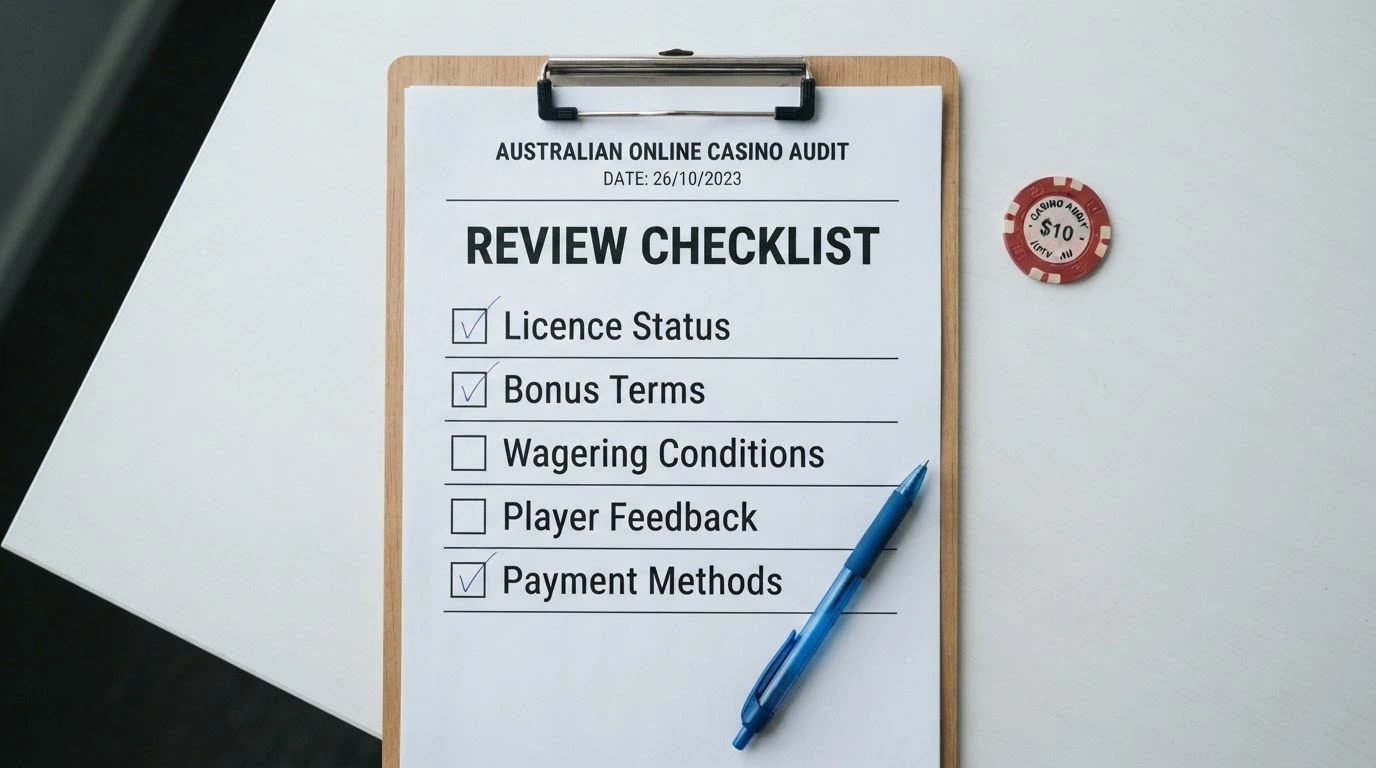
Three sources were used to confirm operator information. The first was the operator’s own terms pages and promotional pages, read directly to confirm the bonus structure, the wagering multiple and any caps or game restrictions. The second was the ACMA public register and the ACMA’s published list of blocked sites, used to confirm whether the operator had been the subject of a blocking request and, where applicable, when. The third was the Casino.Guru Safety Index and player-feedback platforms, used to check withdrawal patterns and unresolved complaints at operators where the AU-licensed register did not apply.
Operators were included in the ranking if they had measurable Australian player traffic — visible in AU-facing search results, in casino-comparison platforms’ AU datasets, or in the ACMA’s enforcement record. The scope limitation is that the ranking is not exhaustive of all AU-facing operators, only of the ones that surfaced in this review’s sources with enough presence to rank. A reader searching for an operator not on this list should not assume the operator is unlicensed or unranked; the operator is simply not in the set this review confirmed.
The five operators whose reload terms could not be verified (Stake, WinSpirit, Scream Casino, Rocket Casino and the reload terms at Bizzo Casino) are kept in the ranking rather than dropped, because their Australian player base is real and a reader searching for them by name deserves a page that names them honestly. Their individual sections describe what is known qualitatively, without inventing numbers to fill the gaps.
Your Reload Bonus Decision: What Actually Matters
The hard fact at the centre of this page is that every reload bonus an Australian player can claim at an online casino sits on an offshore site, and that the wagering maths on most of those bonuses costs more than the bonus returns. These are two separate points and they reinforce each other, because the offshore status is precisely what removes the Australian consumer protections that would otherwise make a steep wagering requirement easier to dispute.

The decision a reader faces is not whether the bonus is real — it is, in the sense that the bonus funds will be credited — but whether the bonus, after the wagering and the game-contribution weightings and the max-bet rules and the offshore recourse gap, is worth claiming at all. The maths already on the page answers that for the standard case. A A$100 reload at 35x bonus-only wagering and A$5 stakes requires 700 spins — roughly an hour of pokies at a standard 5-second spin pace — to clear. At a 96% RTP pokie, the expected loss across those 700 spins is A$140, against a A$100 bonus. The bonus costs the player more than it pays out, in expectation. That is the shape of a competitive reload offer in the AU-facing market.
Some reloads are more forgiving than others. The competitive benchmark for reload wagering is 35x bonus-only — anything below that is favourable, anything at or above 40x bonus-only is heavy, and bonus-plus-deposit at any figure is the most expensive shape on the page. A player who insists on claiming reloads should look for offers at 35x bonus-only or below, with a cashout cap that does not clip a meaningful win, and at operators whose own terms do not bar Australians from playing.
The concrete next steps are not complicated. Read the wagering requirement in full, including the bonus-only vs bonus-plus-deposit distinction, before claiming. Calculate the real cost in spins and time, not just in bonus dollars. Check the operator’s own terms of service for the AU player status — Rainbet’s T&C, for example, lists Australia as fully restricted. Set a deposit limit at the operator if the operator offers one, and treat any reload bonus as a way to extend a session the player was already going to play, not as a reason to deposit more than planned. And if the maths stops adding up, or if a BetStop registration is in place, or if the gambling has stopped being fun, the National Gambling Helpline on 1800 858 858 is free, confidential and staffed around the clock.
Frequently Asked Questions
Is it legal to claim a reload bonus at an online casino in Australia?
No. The Interactive Gambling Act 2001 prohibits the provision of online casino games, online pokies and in-play betting to a person in Australia, and there is no online casino licence anywhere in the country. The Act targets the provider rather than the individual player, so claiming a bonus is not itself a criminal offence, but every reload bonus an Australian can claim sits on an offshore site operating outside Australian consumer protection.
Can I use PayID to deposit and claim a reload bonus at an Australian casino?
PayID is a legal deposit route for licensed Australian wagering, but there is no licensed online casino to deposit into. Offshore AU-facing casinos often accept PayID or bank transfers routed through PayID rails, though some sources could not independently verify native PayID integration. Bizzo Casino is the featured operator with confirmed PayID support for both deposits and withdrawals.
Do reload bonuses have maximum cashout limits?
Many do, especially on no-deposit offers and free-spin reloads. Royal Reels runs three maximum cashout caps across its 14 active bonuses; Bizzo caps no-deposit free-spin winnings at A$75; Casinonic caps no-deposit withdrawals at A$70. Standard deposit-match reloads are less likely to carry a cap, but the offer terms should be read for one before claiming.
How does BetStop protect me if I play at an offshore casino?
It does not. BetStop covers approximately 150 licensed Australian wagering providers; offshore casinos are not connected to the register. A self-excluded person who joins an offshore casino and claims a reload bonus is not stopped from doing so, and the offshore operator will keep accepting the money because there is no mechanism to tell it not to.
Are crypto deposits eligible for reload bonuses at Australian casinos?
Credit cards and crypto are banned as payment for online wagering in Australia since 11 June 2024. Offshore casinos that accept crypto do so outside the Australian regulatory perimeter, and Skycrown explicitly excludes crypto deposits from all of its bonus offers. Players using crypto at other offshore operators are in a legal grey zone and should weigh that before claiming.
What is the average match percentage for a reload bonus compared to a welcome bonus?
Reload bonuses in the Australian-facing market average around 50% match with a A$200 cap and 35x wagering. Welcome bonuses average around 100% match with a A$500 cap and 45x wagering. Reloads are smaller and have slightly easier playthrough per dollar of bonus; welcome bonuses are larger and have steeper playthrough attached. Neither is uniformly better — the right one depends on deposit size and how long the player plans to play.