
Casino VIP programs in Australia: the tier ladder, the bonus arithmetic, and the licensing reality
17 October 2026 · Australian Communications and Media Authority (ACMA) registry check and the Interactive Gambling Act 2001 prohibition on providing online casino products to people in Australia.
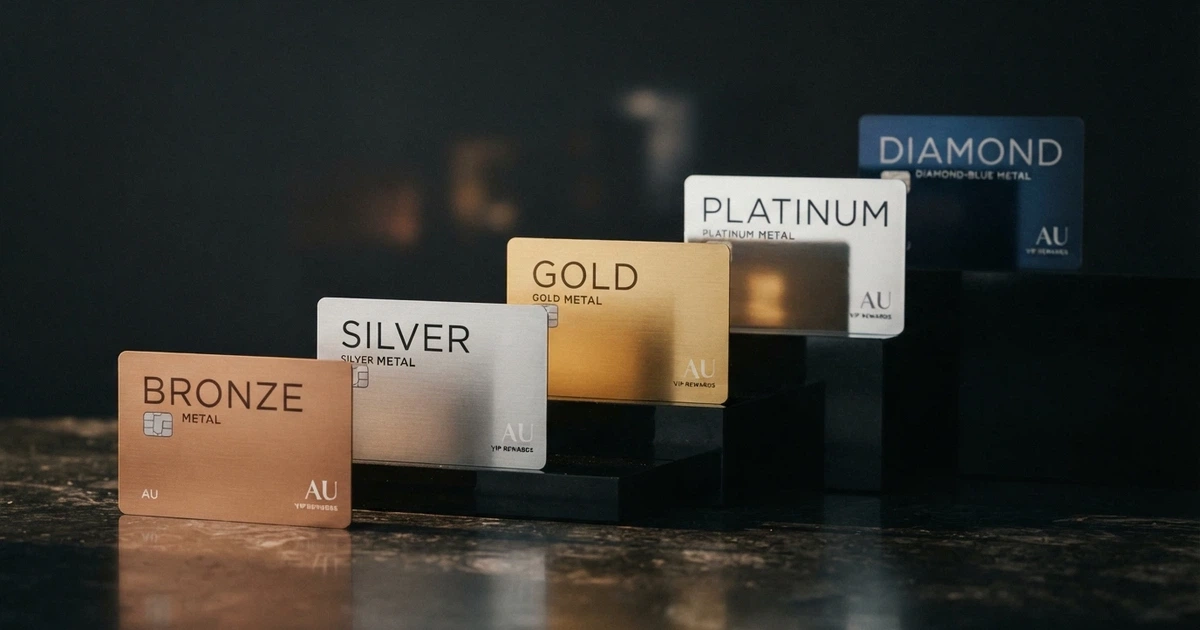
A “VIP program” at an Australian-facing online casino looks like a loyalty gift: the longer you stay, the more the house gives back. The shape underneath is the opposite. Tier thresholds are denominated in wagered dollars, cashback is paid on net losses, and bonuses arrive with wagering multiples that multiply the headline figure into something most players will never clear. The Interactive Gambling Act 2001 makes it an offence to provide online casino products to anyone in Australia, so every VIP program on this page runs from an offshore operator that holds no Australian licence. A reader weighing these offers is therefore comparing products that are simultaneously unregulated in Australia and engineered to push play volume up — the same direction harm-minimisation rules try to push it down.
This page reads those programs on their own terms first, then says plainly who each one suits, who it doesn’t, and where the Australian protection framework stops helping.
Table of Contents
- The VIP tier ladder is a turnover engine, not a loyalty gift
- 10 VIP programs Australians use — none of them licensed here
- Big-number VIP bonuses shrink once wagering is applied
- High-volatility pokies sell the 50,000x dream; the RTP keeps the house ahead
- Crypto VIP programs are the blind spot of Australia’s payment ban
- There is no licensed online casino in Australia — and no recourse
- The protections stop exactly where the offshore VIP market begins
- How we evaluated these VIP programs
- Chase a VIP tier only if you can afford the expected loss
- Frequently asked questions
The VIP tier ladder is a turnover engine, not a loyalty gift
VIP programs deliver excellent value for certain players and are irrelevant or even counterproductive for others. The “certain players” are a narrow band: people who already plan to wager a fixed amount, who prefer cashback over matched deposits, and who can absorb the variance of high-volatility slots without the cashback covering it. For everyone else, the tier ladder pays the operator to keep them at the tables.
A VIP program rewards wagered volume, not loyalty or tenure. The closer the program is examined, the less it resembles a club and the more it resembles a rebate scheme with cosmetic perks bolted on. The program is specifically designed to increase play volume through cashback, bonuses, and tier incentives — the opposite direction from harm minimisation. That is the engine, and it runs in every tier on every ladder on this page.
Tiers are priced in wagered dollars, not time
Entry to each tier is a wager or deposit threshold, not a tenure milestone. A documented six-tier program illustrates the shape: Bronze is automatic on signup at 1× cashback; Silver sits at roughly A$1,000 of lifetime wagering for 1.2× cashback; Gold at roughly A$5,000 for 1.5× plus a personal manager; Platinum at roughly A$25,000 for 2×; Diamond by invitation only at 2.5×; and Royal above that, also by invitation only, with custom bonuses negotiated individually. Across the wider market the ladder follows the same Bronze→Silver→Gold→Platinum→Diamond climb, with cashback running 3–5% at the entry tier and 15–25% at the top.
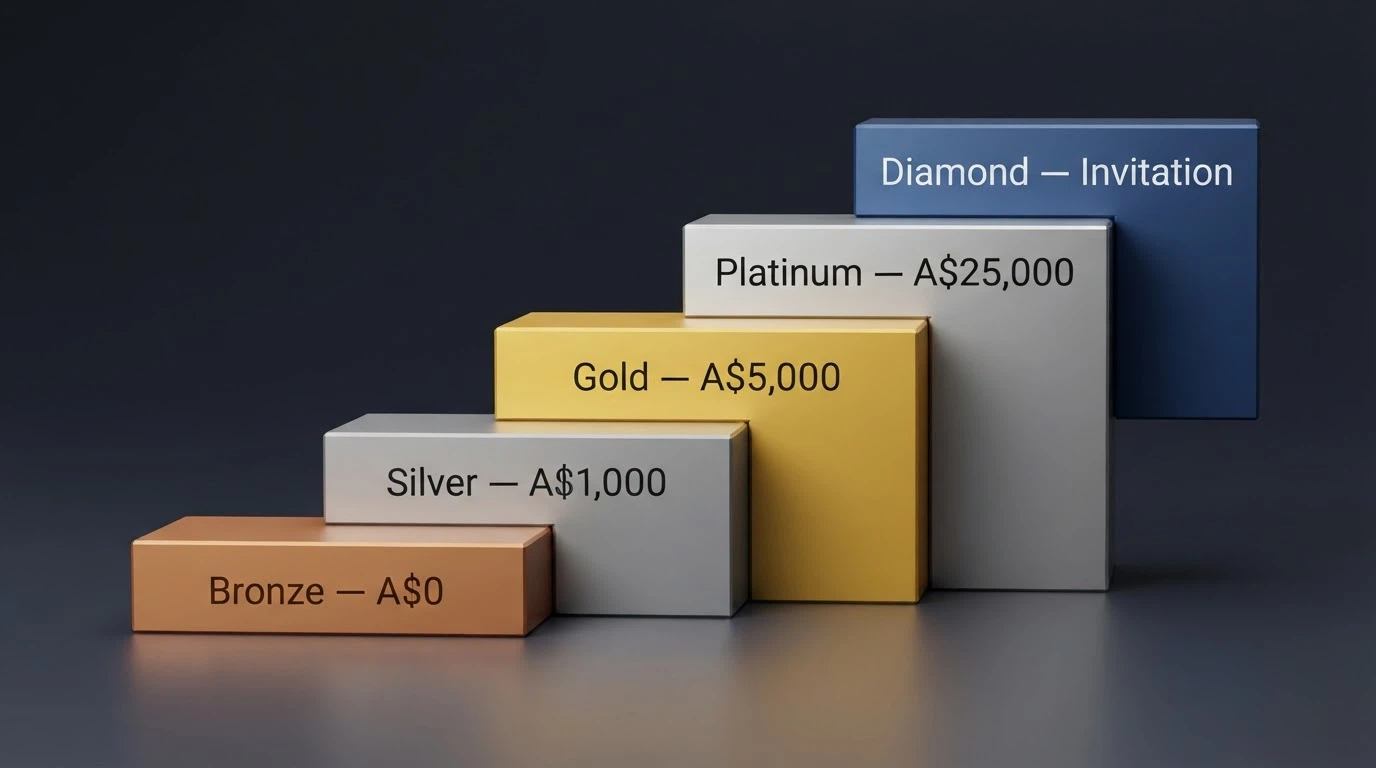
| Tier | Entry threshold (documented six-tier program) | Cashback multiplier (documented six-tier program) | Rocket Play weekly cashback % |
|---|---|---|---|
| Iron | — | — | 7% |
| Bronze | Automatic on signup | 1× | 7.5% |
| Silver | ~A$1,000 lifetime wagered | 1.2× | 8% |
| Gold | ~A$5,000 lifetime wagered | 1.5× | 8.5% |
| Platinum | ~A$25,000 lifetime wagered | 2× | 9% |
| Diamond | Invitation only | 2.5× | 10% |
A reader reading that table should notice what is missing: there is no time-based entry. A player who sits on the site for a year wagering nothing has not moved. A player who wagers the Platinum threshold in a fortnight has. Tenure is a marketing gloss; volume is the entry fee.
Rocket Play splits its ladder into two parallel structures worth distinguishing. Lifetime levels (Quark through Alloy) never expire, which means a player’s progress survives the seasonal reset. Seasonal levels (Bronze through Diamond on the seasonal track) expire after three months and require reconfirmation — a quieter way of saying “if you stop wagering, you fall back”. The two-track design is not generosity; it is a way of converting past play into a sunk-cost reason to keep playing in the current quarter.
Stake prices its ladder in dollars wagered rather than deposited, with Bronze at US$10,000, Silver at US$50,000, Gold at US$100,000, and Platinum I at US$250,000. The cash it returns is rakeback on every bet, weekly boosts, and reload bonuses from Platinum up. A wager-based ladder rewards volume exactly as a deposit-based ladder rewards deposits — the only difference is which number the marketing copy uses.
Comp points convert your play into cents, slowly
Comp points are the program’s quiet currency, and they convert slots play into redeemable value at a rate that almost no one reads. Woocasino credits one comp point per A$50 wagered on slots; table games and live dealer games do not earn points. The exchange rate is 130 comp points for A$1.25 — A$1 of redeemable value for roughly A$5,200 of slot turnover. A player who reaches the lowest reward tier (10 free spins for 25 points) has wagered A$1,250 on slots. A player chasing the top tier (A$150,000 for 5,000,000 points) has wagered A$250,000,000 on slots, and the reward carries 3x wagering on top. Comp-point exchange bonuses carry a softer 1x wagering with a one-month window — the program’s only meaningful nod to a player who wants their comps back as cash rather than as more turnover.
The slot-only earn rate is the structural point most readers miss. A table-game player, even a high-stakes one, accumulates nothing on this currency. Live dealer play, the segment most often marketed to “high rollers”, earns zero comp points. The program is, mechanically, an incentive to keep slot players on slots.
Cashback and bonus refunds are the benefits that matter
Weekly cashback is the benefit that survives the closest reading. Rocket Play’s ladder runs Iron at 7%, Bronze at 7.5%, Silver at 8%, Gold at 8.5%, Platinum at 9%, and Diamond at 10%. A different documented program climbs from 5% at the entry tier (Demigod) to 7% (Divine) and 10% at the top (Titan), with maximum cashback caps of A$5,000 at the lower two tiers and A$25,000 at the top. Slots cashback carries 3x wagering; live casino cashback carries 5x — a meaningful difference, because the live segment is the one where the cashback looks most generous in the headline.

Bonus refunds run daily rather than weekly, and are a separate product from cashback. Rocket Play’s refund program covers up to A$1,000 per day at Bronze and up to A$2,000 per day at Diamond, returning up to 25% of daily losses. These refunds are, in plain terms, a soft cap on the worst a single bad day can cost — capped, not eliminated, and paid back in bonus funds that the player wagers again.
The marketing word for both is “protection”. The arithmetic word is “rebate”. A 10% weekly cashback on a A$10,000 net-loss week returns A$1,000, of which A$3,000 must be wagered again before withdrawal if it arrives as a slots bonus. The protection is real. The full restoration of the loss is not.
The host, the lounge, and the account access
The personal manager arrives at Gold in the documented six-tier program — roughly A$5,000 in lifetime wagering — and is the perk most readers picture when they hear “VIP”. In practice, a personal manager is a single contact point who can resolve withdrawal issues, expedite bonus credits, and arrange the occasional tailored promotion. The perk is real, the value is uneven across operators, and the relationship is not a consumer-protection relationship: it is a customer-retention relationship, and the two run in opposite directions when a player wants to reduce their play.
The lounge, the high-limit room, and the priority-withdrawal queue sit at higher tiers or behind invitation. They are status symbols with limited cash value. Priority withdrawals save time; high-limit rooms let a player bet larger amounts without a table limit complaint. Neither is a benefit that justifies climbing the ladder for its own sake.
10 VIP programs Australians use — none of them licensed here
The comparison below lists every operator on this page and the only fact that varies between them: whether any of them holds an Australian casino licence. The answer, across the entire list, is no. The Interactive Gambling Act 2001 makes it an offence to provide online casino, online pokies, or in-play sports betting to a person in Australia — no licence for online casino exists anywhere in the country, federally or in any state or territory. Every operator below is offshore and unlicensed for the product this page covers.

| Operator | Legal status in Australia |
|---|---|
| Rocket Play | Offshore — no Australian casino licence |
| Skycrown | Offshore — no Australian casino licence |
| Stake | Offshore — no Australian casino licence |
| Royal Reels | Offshore — no Australian casino licence |
| WinSpirit | Offshore — no Australian casino licence |
| Scream Casino | Offshore — no Australian casino licence |
| FairGO | Offshore — no Australian casino licence |
| Rainbet | Offshore — no Australian casino licence |
| Bizzo Casino | Offshore — no Australian casino licence |
| Rocket Casino | Offshore — no Australian casino licence |
A reader scanning this table is reading it correctly: there is no “Licensed in Australia” cell to fill, because no licence exists for the product. The only licensed Australian wagering services are sports and racing bookmakers, and they do not offer casino games or VIP casino programs of the kind this page compares.
Rocket Play
Rocket Play runs a six-tier ladder (Iron through Diamond) split between lifetime levels that never expire and seasonal levels that reset every three months and require reconfirmation. The two-track design rewards sustained volume but quietly penalises any player who takes a quarter off — the seasonal track drops back while the lifetime track holds. Weekly cashback climbs from 7% at Iron to 10% at Diamond; daily bonus refunds run from A$1,000 at Bronze to A$2,000 at Diamond, returning up to 25% of daily losses. The cashback and refunds are the program’s strongest benefits, and both are paid in bonus funds that carry their own wagering. Rocket Play is, on the numbers, the strongest rebate program in the featured set.
Skycrown
Skycrown runs six levels from Bronze to Diamond Elite and leads the featured set on its welcome offer: A$8,000 plus 400 free spins, with 40x wagering. The library claims 10,000+ games, which is a marketing number rather than a VIP benefit, and the withdrawal ceiling is A$75,000 per week. The welcome bonus is the headline; the daily play is what the wagering actually costs — and at 40x on A$8,000 the required turnover is A$320,000 before any of the bonus converts to withdrawable cash. Skycrown suits a player with a large first-deposit bankroll who wants the matched-cash headline and is willing to grind the turnover.
Stake
Stake prices its VIP ladder in dollars wagered: Bronze at US$10,000, Silver at US$50,000, Gold at US$100,000, and Platinum I at US$250,000. The benefits are rakeback on every bet, weekly boosts, and reload bonuses from Platinum upward, and the platform accepts crypto as well as fiat. The wager-based entry means a low-deposit player can climb the lower tiers by sheer volume; a high-deposit low-volume player cannot. Stake is the strongest fit in the featured set for a crypto-comfortable player who plans to play a lot.
Royal Reels
Royal Reels is offshore and holds no Australian casino licence — the Interactive Gambling Act 2001 prohibits the product, so no licence exists anywhere for it. The site’s VIP specifics were not confirmed during research, and no tier, cashback, or bonus figures are stated here as a result. A reader should treat Royal Reels the way this page treats every brand on this list: an offshore operator outside the Australian consumer-protection framework, with no BetStop coverage, no local recourse, and no ACMA pathway to escalate a dispute. For a player already comfortable with offshore play and choosing Royal Reels for a personal reason, the licensing reality is no worse than the rest of the set; for a player choosing it because they thought it was Australian-regulated, the licensing reality is the whole answer.
WinSpirit
WinSpirit is offshore and holds no Australian casino licence. Like Royal Reels, its VIP specifics were not confirmed, and this page supplies no tier, cashback, or bonus figures to make up for that gap. The product is prohibited under the IGA 2001; the operator runs on its own house rules. A player weighing WinSpirit against any other brand on this list is comparing like with like on the licensing axis — they are all outside Australian protection — so the choice comes down to library, payments, and personal preference. A reader looking for a locally regulated casino is in the wrong market entirely; the regulated Australian casino product does not exist online.
Scream Casino
Scream Casino is offshore and holds no Australian casino licence. VIP specifics were not confirmed in research, and no figures appear here. Scream Casino sits in the same position as WinSpirit and Royal Reels — an offshore operator outside the Australian framework, with the same gap to BetStop and the same absence of local recourse. The deciding factors between these unlicensed brands are library, payment methods, and the player’s own preference; on licensing, they are equal, and that equality is the one thing this page cannot resolve.
FairGO
FairGO is offshore and holds no Australian casino licence. The product is prohibited in Australia; FairGO runs on its own terms. VIP specifics were not confirmed, and this page supplies no tier or cashback numbers for it. A player already playing offshore and choosing FairGO over another brand is making a library-and-payments decision, not a licensing one. A reader who assumed FairGO was Australian-regulated should treat that assumption as the answer to whether it suits them — it isn’t, and no operator on this page is.
Rainbet
Rainbet is an offshore crypto-friendly brand with no Australian casino licence. Like Stake, it accepts crypto, which in this market is itself a signal that the operator sits outside Australian rules — credit cards, credit-related products, and digital currency are banned as payment for online wagering since 11 June 2024, and an operator that accepts crypto is running on the other side of that line. VIP specifics were not confirmed. Rainbet suits a crypto-comfortable player who accepts the offshore framework; it does not suit a reader looking for a regulated casino product.
Bizzo Casino
Bizzo Casino is offshore and holds no Australian casino licence. VIP specifics were not confirmed, and no tier or cashback figures appear here. The licensing reality is identical to the rest of the set. A player choosing Bizzo over another brand on this list is choosing on library, payments, or familiarity, not on protection — and that is a choice this page can describe but cannot resolve.
Rocket Casino
Rocket Casino is offshore and holds no Australian casino licence. VIP specifics were not confirmed, and no figures appear here. The product is prohibited under the IGA 2001. Rocket Casino sits alongside WinSpirit, Scream Casino, FairGO, and Bizzo Casino — five brands the page is honest about describing without inventing specifications for. The licensing equality across the set is a fact, not a recommendation: a reader looking for protection cannot find it here.
Big-number VIP bonuses shrink once wagering is applied
The headline number on a VIP bonus is what the marketing copy shows; the number that decides what the bonus is worth is the wagering multiplier. A welcome bonus of A$8,000 with 40x wagering means A$320,000 of required turnover before any of the bonus converts to withdrawable cash. The expected cost of clearing that turnover, on a representative slot at 96% RTP, is roughly 4% of the turnover — A$12,800 of expected loss on the A$320,000 playthrough. The bonus pays out A$8,000. The arithmetic, fairly run, returns a number well below the headline.
Australian-facing offshore casinos commonly set wagering between 30x and 50x on bonus funds. The 30x end of that range is the friendliest a player will meet on a meaningful welcome offer; the 50x end is common on no-deposit and free-spin packages. The multiplier is the single most important number on the bonus page, and it sits in the fine print.
Welcome and deposit-match bonuses front-load the promise
Skycrown’s welcome package leads the featured set at A$8,000 plus 400 free spins, with 40x wagering. The required turnover is A$320,000. On a representative slot at 96% RTP, the expected loss on that turnover is A$320,000 × (1 − 0.96) = A$12,800. That is the cost the house expects to keep from clearing the bonus; the bonus itself is A$8,000. The arithmetic, fairly run, costs the player more than the bonus returns on average. The bonus still has value — it converts a portion of the expected loss into bonus cash rather than pure loss — but the conversion is partial, not full.
The high-roller comparison sharpens the picture. A A$1,500 deposit at a high-roller match can earn a 200% bonus up to A$3,000, with 25x–35x wagering. The required turnover at the friendliest end is A$75,000; the expected loss on slots at 96% RTP is A$3,000. The bonus pays A$3,000. The arithmetic at this end of the range roughly balances. The high-roller match is the rare VIP offer where the expected cost and the headline bonus are close enough that a player can take it on the numbers, before considering cashback and free-spin value.
A regular welcome bonus of A$20–A$100 with up to 100% match sits at the bottom of the ladder on size, but the wagering multiplier is usually lower too. A player with a small bankroll gets more per dollar deposited; a player with a large bankroll gets a bigger number that costs more to clear.
No-deposit bonuses come with low cashout caps
No-deposit bonuses are the headline a player meets first and the offer that pays out least. A documented no-deposit ladder climbs from A$150 at Bronze (25x wagering) to A$350 at Silver (25x), A$650 at Gold (15x), A$1,500 at Platinum (15x), and A$3,750 at Diamond (15x). The wagering on the lower three tiers is the steepest on this page; the cashout caps at the top end can still be modest. No-deposit bonus cashout limits at Australian-facing casinos typically cap at A$50–A$150, and wager-free free spins carry a maximum-win cap of A$200. A player who clears a A$3,750 Diamond no-deposit at 15x wagering (A$56,250 turnover) and hits the cashout cap discovers the bonus paid for the wagering but not for the win. The caps are the only line of the no-deposit terms that matters in practice.
Wagering requirements decide what the bonus is actually worth
The 30x–50x range is where the bonus lives or dies. At 30x on a A$1,000 bonus, the required turnover is A$30,000; the expected loss at 96% RTP is A$1,200, which is roughly the size of the bonus itself. At 50x on the same bonus, turnover is A$50,000 and expected loss is A$2,000 — twice the bonus. The arithmetic turns a “free A$1,000” into a A$1,000 gift that costs A$2,000 to unwrap, which is the opposite of what the marketing copy suggests.

Game contribution is the second number that decides the cost. Slots usually contribute 100% to wagering requirements; table games may only count 10–20%. A player who plans to clear a bonus on blackjack rather than slots multiplies their actual turnover by five to ten times — A$30,000 of slot-equivalent turnover becomes A$150,000–A$300,000 of blackjack turnover, with the expected loss scaling to match. The wagering requirement reads as a single number on the bonus page; the actual cost depends on the game the player intends to clear it on.
High-volatility pokies sell the 50,000x dream; the RTP keeps the house ahead
The slots marketed hardest to VIP players are high-volatility titles with multi-thousand-times max wins. The max-win number is the headline; the RTP near 96% is what the slot actually pays back over volume. A 100,000x max win at 96% RTP is a slot that pays back A$96 of every A$100 over time, with the occasional spin paying out a multiple of the stake that the long-run average does not. The marketing word is “dream”; the arithmetic word is “variance”.
The VIP pokies with the biggest max-win multipliers
| Slot title | Provider | RTP | Volatility | Max win |
|---|---|---|---|---|
| Bonanza Megaways | Big Time Gaming | 96.00% | High | 12,000x |
| Gates of Olympus 1000 | Pragmatic Play | 96.50% | High | 15,000x |
| Gonzo’s Quest Megaways | Red Tiger / NetEnt / BTG | 96.00% | High | 21,000x |
| Sugar Rush 1000 | Pragmatic Play | 96.53% | High | 25,000x |
| Gates of Olympus | Pragmatic Play | 96.50% | High | 5,000x |
| Trigger Happy | Big Time Gaming | 96.58% | High | 50,000x |
| Razor Returns | Push Gaming | 96.16% (96.55% with Push Bet) | High | 100,000x |
| Sugar Rush | Pragmatic Play | 96.50% | High | 5,000x |
The cluster above is the segment most heavily promoted to VIP players, and the RTPs sit within a tight band: between 96.00% and 96.58%. A reader comparing two slots on this list is comparing max-win figures that differ by an order of magnitude against RTPs that differ by less than one percentage point. The max-win number is a story about a single spin; the RTP is the story about every spin.

Trigger Happy at 96.58% RTP and a 50,000x max win is the slot that pays back the most in steady play while offering one of the bigger headline multipliers. Razor Returns at 96.16% RTP and 100,000x max win is the slot with the largest multiplier in the list; the Push Bet feature raises the RTP to roughly 96.55% at the cost of an extra stake per spin. Sugar Rush 1000 at 96.53% and 25,000x sits between those two on both axes. Gates of Olympus at 96.50% RTP and a 5,000x max win is the same provider, the same RTP band, with a fraction of the max win — a reminder that the headline multiplier is a design choice, not a quality measure.
Live dealer tables and high-limit rooms
Live dealer tables are marketed to high rollers as the “real casino” segment, and the VIP framing is heavier here than on slots. The mechanics, however, run in the opposite direction for the player. Slots cashback carries 3x wagering; live casino cashback carries 5x. Table games and live dealer games do not earn comp points. Table games may count only 10–20% toward bonus wagering. Every line of the VIP program that matters — cashback wagering, comp points, bonus contribution — treats live play less favourably than slot play, despite the marketing copy that suggests the reverse.
A high-limit room is a table that accepts larger bets; it is not a different game with a different house edge. The house edge on a live blackjack table sits near 0.5% with basic strategy, on a live roulette table near 2.7% European or 5.26% American, on a live baccarat table near 1.06% banker or 1.24% player. The numbers are unchanged by the VIP framing. The high-limit room is a convenience feature for players who want to bet larger amounts without table-limit friction, not a benefit that changes the math.
Game variety and provider breadth
A “10,000+ games” claim is a marketing number that scales with the operator’s licensing deals, not a measure of VIP benefit. The provider mix matters where a player has a preferred studio — Pragmatic Play’s Drops & Wins network, Big Time Gaming’s Megaways catalogue, Evolution’s live lobby — and the breadth of the mix is the only part of the claim that affects play. Two operators with identical claimed library sizes can feel different in practice if one has a thin live lobby; the headline figure doesn’t show that.
Skycrown’s 10,000+ claim is the largest in the featured set. The claim is not a VIP tier, and it is not a cashback rate. It is a measure of how many titles a player can browse before settling on one — useful, but not what the VIP program pays for.
Crypto VIP programs are the blind spot of Australia’s payment ban
Credit cards, credit-related products, and digital currency are banned as payment for online wagering since 11 June 2024. The ban was written to cut off the funding routes that hide gambling spend from a person’s bank statements and that circumvent the credit-and-debt line that Australian consumer law draws. The operators that accept crypto are sitting on the wrong side of that line by design. They reach Australian players anyway, because the offshore framework has no Australian enforcement on the payment side.
Which offshore brands take crypto deposits
Stake accepts crypto as a funding route, with a VIP ladder priced in wagered dollars: Bronze at US$10,000, Silver at US$50,000, Gold at US$100,000, and Platinum I at US$250,000. The wager-based entry means a crypto-funded player climbing to Gold has wagered US$100,000 in volume, not deposited that amount. Rainbet is a second offshore brand accepting crypto deposits. Together, the two are the crypto-friendly end of the offshore VIP market that Australians actually use.
Crypto deposits are marketed as faster and more private than debit card or bank transfer. The privacy pitch is real: a crypto deposit does not appear on an Australian bank statement, does not trigger a bank’s gambling-block rule, and does not require an ID check the way PayID and BPAY do. The pitch is also why the payment method is banned. A funding route designed to be invisible to a player’s own bank is a funding route designed to bypass the consumer protections a bank would otherwise apply.
Crypto is banned — and its acceptance is the tell
An operator that fails to enforce the credit and crypto payment ban faces penalties of up to A$247,500. The penalty sits with the licensed Australian operator that processes the payment, not with the offshore casino that receives it. From 1 January 2027, banks and payment providers gain express authority to block transactions to illegal gambling operators — a closure of the funding routes that crypto currently exploits. For now, the ban sits on the licensed side of the border and the offshore casinos operate on the other side. An Australian player depositing crypto at Stake or Rainbet is using a payment method Australia has decided not to allow for wagering, and is doing so at an operator that accepts it precisely because it sits outside Australian rules.
There is no licensed online casino in Australia — and no recourse
Online casino is prohibited in Australia. The Interactive Gambling Act 2001 makes it an offence to provide online casino, online pokies, or in-play sports betting to a person in Australia, and there is no licence for online casino anywhere in the country — not federally, not in any state or territory. The Australian market for the product this page covers is structurally closed. Every VIP program on this list exists because operators in other jurisdictions offer it to Australian customers across the border, and because the Australian enforcement framework targets the providers, not the players who use them.

No licence exists — the IGA prohibits the product
The IGA’s prohibition is on the provider, not the player. The individual player is not prosecuted under the IGA; the Act targets the operator offering the product. A reader reading this page is not at legal risk from playing at an offshore casino. The reader is, however, outside the consumer-protection framework that licensed wagering in Australia provides — and that is the practical cost of choosing any operator on this list.
The Interactive Gambling Amendment (Gambling Reform) Bill 2026 passed Parliament on 19 August 2026; its measures commence 1 January 2027. From that date, banks and payment providers gain express authority to block transactions to illegal gambling operators. The funding routes that currently keep the offshore market open to Australian players will close in part. The product remains prohibited; the difference is that the money will be harder to move.
ACMA’s blocklist and penalties
The ACMA has had 1,564 illegal gambling and affiliate websites blocked by Australian ISPs since November 2019, and more than 225 illegal services have withdrawn from the Australian market since 2017. The blocklist grows, the operators rotate, and the offers keep surfacing under new domains. In 2025–2026, the ACMA issued over A$5.4 million in penalties to wagering companies for email and SMS advertising breaches — the inducement side of the market, where licensed operators push bonuses through channels that the offshore market exploits from outside the framework.
From 1 January 2027, no more than three wagering ads per hour between 6:00 am and 8:30 pm, and no wagering advertising from 15 minutes before a live sporting event until 5 minutes after it ends. The advertising cap applies to licensed wagering operators. The offshore VIP programs this page covers sit outside it.
Offshore means no recourse if things go wrong
No Australian consumer protection covers an offshore casino. No BetStop registration excludes from one. No ACMA pathway escalates a refused withdrawal or a voided win. A site can be blocked by ACMA at any time, with a player balance still on it, and the player has no Australian forum to argue the case in. This is the cost of choosing an offshore VIP program, and it is a cost the welcome bonus does not pay for.
BetStop binds only Australian-licensed wagering services — an offshore casino is not connected to the register and will keep accepting a self-excluded person’s money. The register covers the licensed bookmakers (sports and racing). The offshore VIP market is not on the same network. A player who has registered with BetStop and continues to receive VIP offers from offshore casinos is receiving them because the offshore framework has no obligation to honour the Australian exclusion. That is the gap, plainly stated.
The protections stop exactly where the offshore VIP market begins
Australia has the harm-minimisation infrastructure for licensed gambling: BetStop, deposit limits, activity statements, the National Gambling Helpline, Gambling Help Online. None of it reaches the offshore VIP market. A player who sets a deposit limit at a licensed bookmaker still has full access to every operator on this list. A player who registers with BetStop is excluded from the licensed bookmakers and from nothing else.
About 2.1% of Australian adults — roughly 430,000 people — experience problem gambling; the Australian Institute of Health and Welfare put high-risk gambling at 1.8% in 2022. The harm is real, and it is concentrated in the segments of the market where the VIP incentives push hardest — high-volume play, cashback rebate loops, and the bonus-wagering treadmill. The protections below are the Australian answer to that harm, and they apply to the licensed market only.
BetStop doesn’t reach the offshore VIP casino
BetStop launched on 21 August 2023. By 31 July 2026, the register had 67,480 registrations, of which 41,290 exclusions were still active — over 60% of registrants had not lifted their exclusion. 78% of registrants were under 40; 38% chose lifetime exclusion. The numbers describe a register that is working for the licensed market it covers.
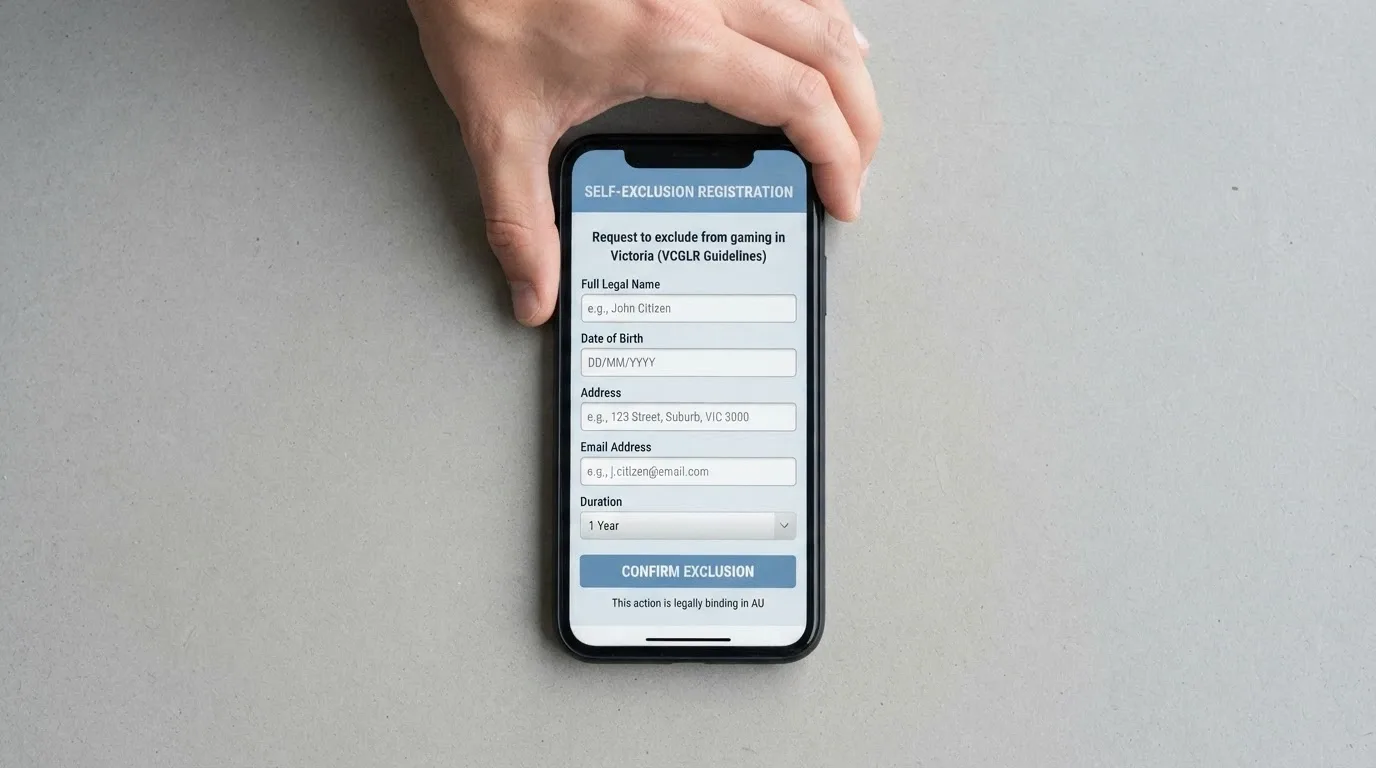
Registration takes about 10 minutes online via myGov with 100-point ID verification. The process is built around Australian identity infrastructure, which is why it cannot reach an offshore casino that does not verify Australian identity documents and that registers players under the email address and crypto wallet of their choice. The exclusion is comprehensive within its scope and silent outside it.
Deposit limits, session limits, and where to get help
The Australian harm-minimisation tools that apply inside the licensed market are:
- Deposit and session limits at licensed wagering operators, customer-set under state and territory conditions that vary between jurisdictions.
- Activity statements showing time and money spent, available from licensed operators.
- Take-a-break functionality for short-term exclusion at a single licensed operator.
- Multi-layer self-exclusion combining BetStop (licensed wagering), Gamban (a software block on gambling sites), a bank gambling block (most major Australian banks), and an accountability partner.
Outside the licensed market, none of the operator-side tools apply. A player who wants to set a deposit limit at Rocket Play or Skycrown is asking an offshore operator to honour a self-imposed ceiling the operator has no Australian regulatory obligation to enforce. The tools that exist are the player’s own: Gamban on the device, a bank gambling block on the funding side, and the support services below.
- National Gambling Helpline: 1800 858 858 — free, confidential, staffed 24 hours a day, 7 days a week, Australia-wide.
- Gambling Help Online at gamblinghelponline.org.au — online chat and counselling.
- National Debt Helpline: 1800 007 007 — for financial harm from gambling.
How we evaluated these VIP programs
This page rates the VIP and loyalty programs at every casino it reviews, focusing on tier progression fairness, comp point conversion rates, withdrawal speed for VIP players, the quality of personal account management, and the tangible value of high-roller bonuses. The numbers behind those ratings come from the operators’ own VIP pages, from regulator and enforcement data where it exists, and from public bonus terms.
The first check on every operator on this list is the IGA prohibition — no Australian online casino licence exists, so the licensing column is uniformly “offshore, no Australian licence”. The second check is the ACMA enforcement data: 1,564 sites blocked since November 2019, with the blocklist rotated and republished. Where an operator’s VIP specifics could not be confirmed, this page says so rather than filling the gap with an inferred figure. The ranking order reflects how much VIP detail was confirmed for each operator, with Rocket Play, Skycrown, and Stake ahead of the rest on that basis. A reader using this page to compare offers should weight the confirmed specifics above the qualitative descriptions of the unconfirmed brands.
Chase a VIP tier only if you can afford the expected loss
VIP programs deliver excellent value for certain players and are irrelevant or even counterproductive for others. The arithmetic in the wagering section above is the test: the expected cost of clearing a bonus, on the house edge the slots pay, is most often higher than the bonus itself. A welcome package that costs A$12,800 in expected losses to clear and pays A$8,000 in bonus cash is a negative-EV offer dressed up as a gift. The player who can afford the A$12,800 in churn and who values the bonus cash at its face value is making an even trade. The player who cannot is paying the operator for the privilege of clearing the bonus.
The reader who fits the VIP market is narrow. They have a bankroll large enough to absorb the turnover at the documented wagering multiples, a preference for cashback and rakeback over matched-deposit bonuses, and an acceptance of the offshore framework’s lack of recourse. They are using an operator like Stake or Rocket Play where the ladder and the cashback are well-documented, and they are climbing the ladder on volume they would have wagered anyway. The reader who does not fit is paying the rebate scheme for volume they would not otherwise have produced. The cashback then becomes the cost of the volume, not a return on it.
The offshore framework is the final line. BetStop binds only Australian-licensed wagering services — an offshore casino is not connected to the register and will keep accepting a self-excluded person’s money. The protections that work for the licensed market stop at the licensed border. A player choosing any operator on this list is choosing to step outside that border and to accept the gap in protection that comes with it. The choice is the reader’s. The arithmetic and the licensing reality are this page’s job to put on the table.
Frequently asked questions
What is the difference between a VIP cashback bonus and a regular casino bonus?
A regular casino bonus is a matched-deposit offer — the operator adds a percentage of the player’s deposit as bonus funds, which carry a wagering requirement (commonly 30x–50x) before they convert to withdrawable cash. A VIP cashback bonus is a rebate on net losses over a period — typically weekly — paid as bonus funds with their own (usually smaller) wagering requirement. Cashback returns part of what the player has already lost; a matched deposit adds to what the player has deposited. The two are different incentives with different shapes: one rewards depositing, the other rewards playing.
Do Australian-licensed wagering operators offer VIP programs like offshore casinos do?
No. Licensed Australian wagering operators hold state or territory licences (most commonly Northern Territory) that cover sports and racing wagering, not online casino. The VIP programs this page describes — cashback tiers, comp point conversion, personal managers, high-roller matched deposits — are products of offshore casino operators that accept Australian players across the border. A reader looking for an Australian-licensed VIP casino is looking for a product the Australian market does not offer.
What happens to my VIP status if a casino site gets blocked in Australia?
The operator’s domain is blocked by Australian ISPs, but the player’s account, balance, and VIP status sit on the operator’s own servers, not on the blocked domain. A player who has already registered and reached a tier keeps that tier on the operator’s books. The practical effect of the block is that the player can no longer reach the site through an Australian ISP without a workaround, and any balance on the account is reachable only through that workaround. There is no Australian pathway to recover funds from a blocked offshore site.
Is it against the law for me, as a player, to use an offshore VIP casino?
No. The Interactive Gambling Act 2001 targets the provider, not the player. The individual player is not prosecuted under the IGA. A player using an offshore VIP casino is not at legal risk in Australia. The player is, however, outside the Australian consumer-protection framework: no BetStop coverage, no local recourse for a refused withdrawal or voided win, and no ACMA pathway to escalate a dispute.
Can I use crypto deposits to access higher VIP tiers at an online casino?
Yes — Stake and Rainbet, both offshore operators, accept crypto and price their VIP ladders in wagered dollars, which a crypto-funded player can climb through volume as easily as a fiat-funded one. The trade-off is that credit cards, credit-related products, and digital currency are banned as payment for online wagering in Australia since 11 June 2024, so using crypto to fund a wagering account sits on the banned-payment side of the Australian line. From 1 January 2027, banks and payment providers gain express authority to block transactions to illegal gambling operators, which will narrow the crypto funding route further.
Can I lose my VIP status — and what are the “seasonal” levels some programs use?
Yes. Rocket Play splits its ladder into lifetime levels (Quark through Alloy) that never expire and seasonal levels (Bronze through Diamond) that expire after three months and require reconfirmation. A player who stops wagering for a quarter drops back on the seasonal track while holding their position on the lifetime track. Other operators use tier-down rules that downgrade a player who fails to meet a monthly wager threshold. The marketing copy tends to frame seasonal levels as “fresh starts”; the structural reality is that they reset a player’s progress if play lapses.