
Best casino apps in Australia: how the offshore market really works in 2026
Search the Australian App Store for a real-money pokies app and you will come back empty. There is no Australian-licensed casino app. Every casino app that takes Australian players does so from offshore — Curaçao, Kahnawake or similar jurisdictions — and exists in a regulatory gap the Interactive Gambling Act 2001 was written to close. This page ranks the offshore sites Australian players actually use in 2026, the bonus maths behind each welcome offer, and the consumer protections an Australian leaves behind the moment they sign up.

Verified as of 13 September 2026 against the ACMA enforcement register, ATO guidance on gambling income and the operator terms pages cited throughout.
Table of Contents
- Why there is no licensed casino app in Australia — and what it costs you
- How Australian players really access casino apps: the offshore landscape
- The best casino apps available to Australian players in 2026
- Getting your money out: why withdrawals at offshore casino apps test your patience
- Why your 2026 casino bonus is smaller than it looks
- Free-play and demo casino apps: try every pokie without risking a cent
- Crypto casino apps: playing outside the Australian payment rules
- Android, iPhone and iPad: how casino apps work on your device
- Responsible gambling at offshore casinos: the tools you get and the ones you don’t
- How we evaluated these casino apps
- Is an offshore casino app worth the risk?
- Frequently asked questions
Why there is no licensed casino app in Australia — and what it costs you
The Australian market for online casino games is structurally shut. The Interactive Gambling Act 2001 — the IGA — makes it an offence to provide online casino games, online pokies or in-play sports betting to a person physically in Australia. No licence exists for online casino anywhere in the country: not federally, not in any state or territory. Every app on a ranking of “best casino apps” in Australia is, by definition, an offshore operator.
The IGA prohibition: what the law actually says
The Interactive Gambling Act 2001 is short on exceptions. It lists the prohibited interactive gambling services — online casino games, online pokies and in-play sports betting — and makes it an offence to provide any of them to a person physically in Australia. What it permits is narrower than the headlines suggest: wagering on a race or sporting event placed before the event begins, plus lotteries and keno, both licensable through state and territory regulators. Everything else — the spin of a virtual reel, the deal of an online blackjack hand — sits on the prohibited list, with no carve-out for offshore operators and no carve-out for crypto-funded casinos.
The Parliament tightened the net in August 2026. The Interactive Gambling Amendment (Gambling Reform) Bill 2026 passed on 19 August 2026, and its measures take effect from 1 January 2027. The changes do not legalise online casino. They restrict the advertising the legal wagering industry can buy: wagering ads on free-to-air television capped at three per hour between 6:00 am and 8:30 pm; a live-sport blackout running fifteen minutes before to five minutes after a sporting event between 5 am and 8:30 pm; direct marketing of inducements banned for fourteen days after a customer signs up, three months after they deregister from BetStop, and indefinitely for anyone flagged as at risk. Athletes, celebrities and influencers are barred from promoting wagering altogether. A national Wagering Advertising Opt-out Register, to be administered by the ACMA, sits underneath the new rules.
Offshore operators advertising welcome bonuses to Australians are breaking the prohibition itself, not a rule layered on top of it. The IGA targets the provider — not the player. No Australian has been prosecuted for signing up and playing at an offshore casino. That is the legal shape an Australian player walks into: a statute that bans the product, an enforcement regime that targets the people selling it, and a market that has filled the gap from outside the country’s jurisdiction.
ACMA enforcement: 1,564 sites blocked and counting
The Australian Communications and Media Authority is the body that turns the prohibition into action. Its main tools are formal warnings, civil penalty proceedings, and the power — granted under the Interactive Gambling Amendment Act 2017 — to direct Australian internet service providers to block illegal sites.
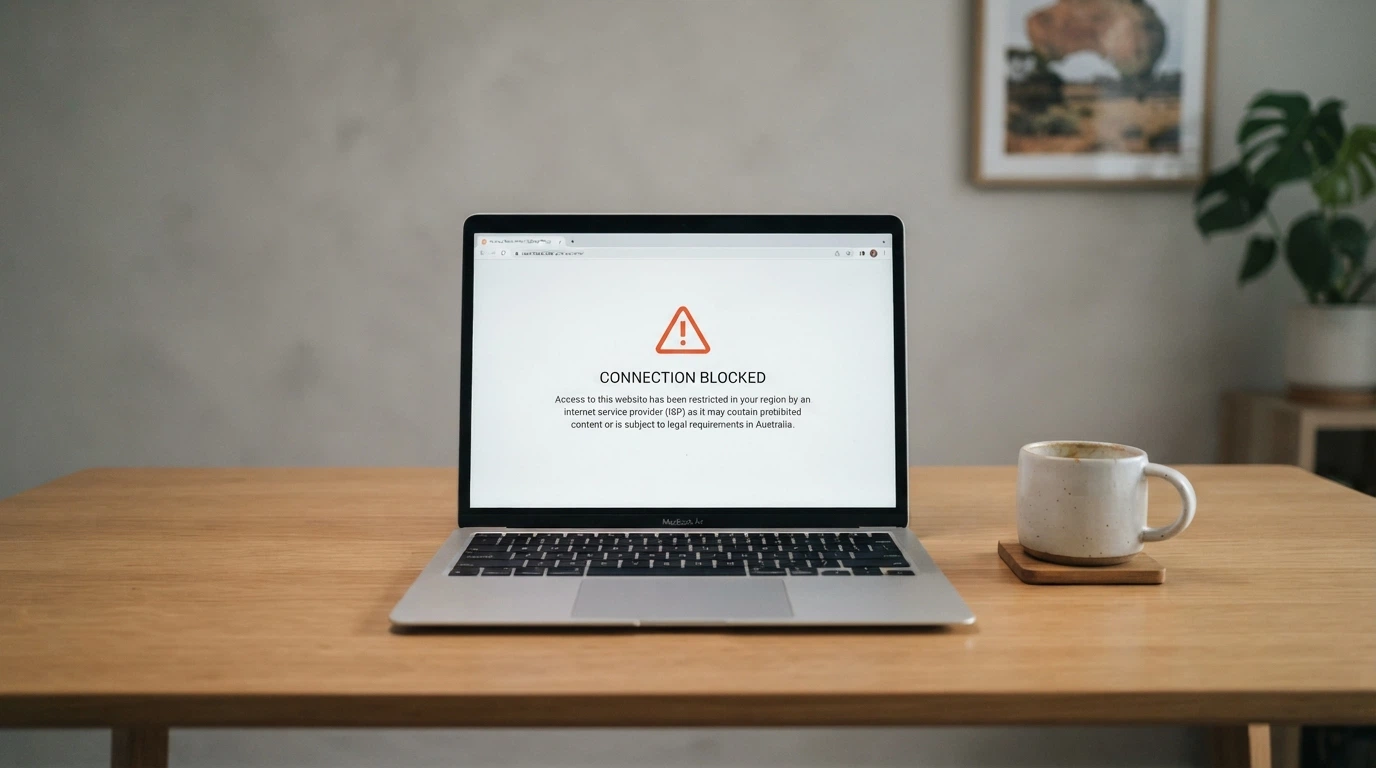
The numbers are large. Since November 2019 the ACMA has had 1,564 illegal gambling and affiliate websites blocked. More than 225 illegal services have voluntarily withdrawn from the Australian market since 2017 rather than face the regulator’s actions. The most recent quarterly release covers October to December 2025: 23 investigations into 45 sites, producing 69 findings of breach — 38 for providing a prohibited interactive gambling service, 26 for providing an unlicensed regulated service, and 5 for illegal advertising.
The payment ban, in force since 11 June 2024, sits alongside the blocking regime. Credit cards, credit-related products and digital currency — cryptocurrency in plain English — cannot lawfully be used to fund an online wagering account in Australia. The penalty for an operator that fails to enforce the ban is up to A$247,500 per breach. From 1 January 2027, banks and payment providers gain express statutory authority to block transactions to illegal gambling operators outright. The architectural pressure on the offshore model is increasing, not decreasing.
A blocking notice is what an Australian player sometimes meets instead of a casino lobby. ACMA enforcement is the reason a domain that worked last week does not work this week. It is also the reason an offshore casino can disappear mid-session, with the player’s balance sitting inside an account the Australian authorities have no power over.
The protections you give up when you play offshore
Australian consumer law is what an Australian-licensed wagering operator carries by default. The offshore operator carries nothing comparable. The gap is wide, and it shows up in three concrete places.
First, BetStop — the National Self-Exclusion Register launched on 21 August 2023 — covers every Australian-licensed online and phone wagering service. One registration excludes a person from every one of them. Offshore casino apps are not connected to the register, and the offshore operator does not see the registration. A person who has self-excluded to manage a gambling problem can deposit at an offshore casino the same day.
Second, no Australian consumer-protection body — no state regulator, no ACMA enforcement wing — has jurisdiction over a Curaçao-licensed operator. If the operator refuses a withdrawal, voids a winning spin, or simply stops answering email, the Australian player has no formal recourse.
Third, a blocked site does not pay out outstanding balances. The 1,564 blocked sites include affiliate sites and mirror domains, and a player whose balance sits inside one of them has no Australian avenue to recover it.
There is no licensed online casino to anchor to. Crown and The Star operate land-based casinos in Melbourne and Sydney under state licences, but those licences govern the physical premises — the gaming floors, the cashier cages — not an online product. The licensed anchor a person might assume exists does not, and the gap between the assumption and the law is exactly where the offshore industry operates.
How Australian players really access casino apps: the offshore landscape
Australian players who want to spin a pokie on their phone are not using an app they downloaded from a store. There is no Australian-licensed real-money pokies app — none in the Apple App Store, none in Google Play — and the ACMA has blocked hundreds of offshore casino sites while new mirrors appear weekly. What an Australian player uses instead is a website that behaves like an app, opened through the mobile browser.

The access model has three forms, and they are not equally common. HTML5 browser play is the default: an Australian player opens Chrome on Android or Safari on iPhone, types the operator’s URL, signs in, and plays. The site stores the login via cookies or a progressive web app shortcut, and the next visit looks and feels like a native app. On Android, the operator may also offer an APK — an Android application package, sideloaded from the operator’s own website rather than from Google Play. On iOS, the App Store rules prohibit real-money casino apps, so Safari is the only route; Apple’s policy is stricter than Google’s on this point.
The operators themselves are offshore entities. Hollycorn N.V., Scores55 Tech B.V. and similar Curaçao-registered companies behind the brands on this page are not Australian. None of them is licensed by an Australian state or territory regulator. The Australian-licensed wagering operators — Sportsbet, TAB, Bet365, Ladbrokes — offer sports and racing, not casino. The casino product category is structurally offshore in Australia, and the access model on a phone is whatever the offshore operator has built.
Browser, PWA or APK: the three ways a casino app reaches your phone
HTML5 browser play is the route every featured operator supports. The casino lobby runs in the browser — Chrome, Safari, Firefox, Samsung Internet, whatever the phone ships with — using the same HTML5 standards that run YouTube and Google Maps. The site detects the screen size, lays out the games in a touch-friendly grid, and processes deposits and withdrawals through the browser. No installation, no storage cost, no App Store approval process. The catch is that the browser tab sits among the other open tabs, and an aggressive phone operating system can kill background tabs to save memory.
Progressive web apps — PWAs — are the halfway house. The operator’s website prompts the player to “add to home screen”, which installs a launcher icon and a stripped-down browser window that opens directly into the casino. The PWA looks like an app in the launcher and on the home screen, but it is still running through the browser engine. For most players the experience is indistinguishable from a native app.
APK sideloading is the Android-only third route. The operator hosts an Android application package — the file format Android uses to install software — on its own website. The player downloads the APK, accepts a security warning, and installs it directly. The benefit is a permanent install that does not depend on the browser. The risk is that the APK has not been vetted by Google Play, and the player is trusting the operator’s own security practices. Not every operator offers an APK; most leave the player on the browser or the PWA. iOS users do not have the option. Apple’s rules prohibit real-money casino apps in the Australian App Store, and an operator cannot sideload onto an iPhone without a jailbroken device.
Pokies, tables and live dealer: what you can actually play
The pokies catalogue is where the offshore operators differentiate. SkyCrown’s lobby carries more than 7,200 games; Royal Reels lists around 1,800, of which roughly 1,400 are pokies; Fair Go’s RTG-powered library holds around 280. The number matters less than the mix, and the mix is dominated by the same providers whose games appear on licensed European sites: Pragmatic Play, NetEnt, Play’n GO, Red Tiger, Nolimit City, Hacksaw Gaming.
The titles with verified RTP figures span the return spectrum from Mega Joker’s 99.00% in supermeter mode down to Book of Dead’s default 96.21% — and Book of Dead is the cleanest warning in the lobby. Play’n GO ships the same title at six different return settings: 96.21%, 95%, 92%, 91.2%, 87.2% and 84.2%. The lower-RTP versions are not a separate game. They are the same reels, the same bonus round, with a smaller expected return. A player cannot tell from the title screen which version they are playing; the operator chooses the setting.
| Pokie | Provider | RTP | Volatility | Max win |
|---|---|---|---|---|
| Gates of Olympus | Pragmatic Play | 96.50% | High | 5,000x |
| Blood Suckers | NetEnt | 98.00% | Low | 900x |
| Starburst | NetEnt | 96.09% | Low | 500x |
| Gonzo’s Quest Megaways | Red Tiger | 96.00% | High | 21,000x |
| Book of Dead | Play’n GO | 96.21% (default) | High | 5,000x |
| Mega Joker | NetEnt | 99.00% (supermeter) | — | — |
The high-volatility titles — Gates of Olympus, Gonzo’s Quest Megaways — are the ones with the headline max-win figures (5,000x and 21,000x respectively). Low-volatility titles such as Blood Suckers and Starburst pay smaller amounts more often. Both patterns sit inside the same wagering requirements, which is the relevant point: wagering contributions count 100% on pokies across the featured set, while table games contribute 10–20%. A player clearing a bonus on blackjack is grinding twice as hard for the same turnover credit.
The best casino apps available to Australian players in 2026
Ten offshore operators carry the ranking below. None is licensed in Australia. The table arranges them by headline offer value, but the ranking that follows weighs wagering fairness and licence transparency alongside the dollar figure, because a bigger number under worse terms is rarely a better deal.
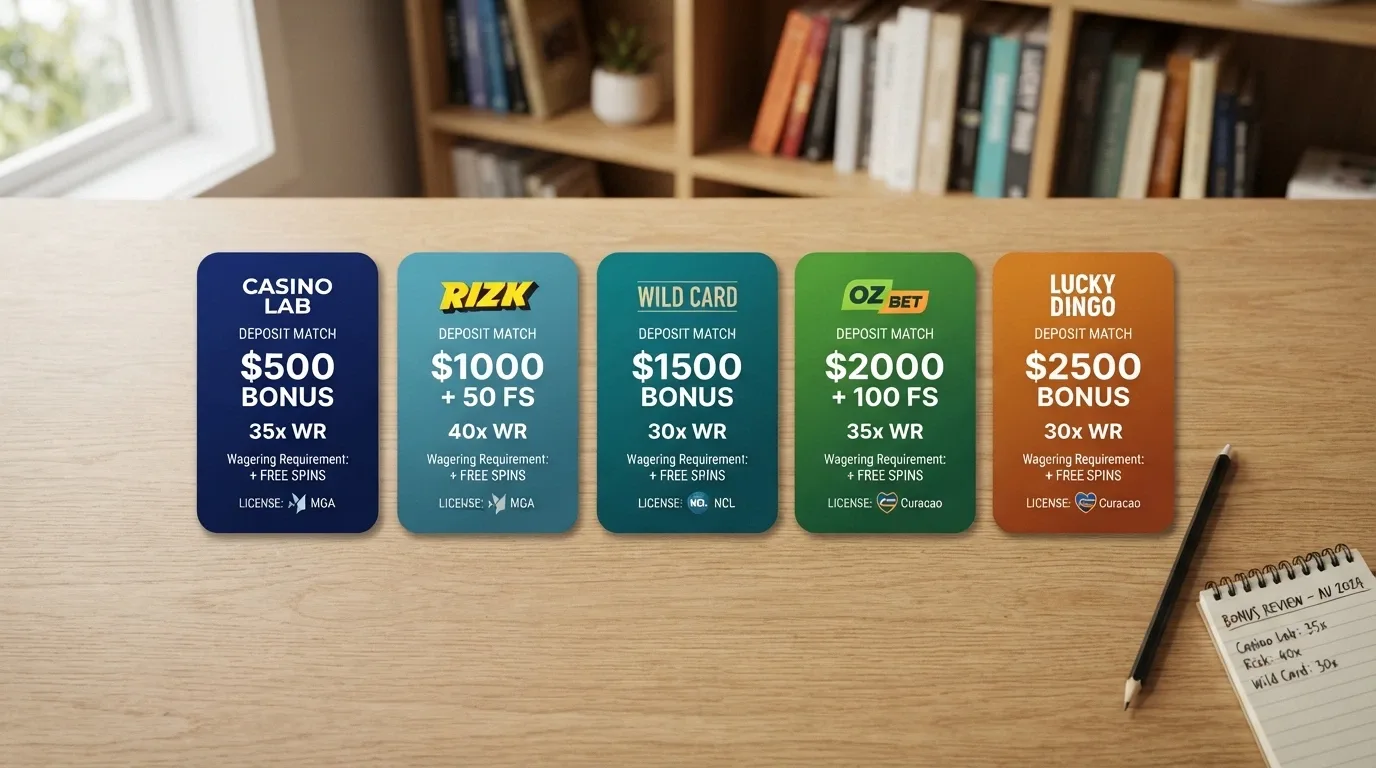
| Operator | Licence / jurisdiction | Welcome offer (max AUD) | Wagering | Free spins |
|---|---|---|---|---|
| SkyCrown | Curaçao (number not confirmed against register) | Up to A$8,000 + 400 FS | 40x | 400 |
| Neospin | Curaçao (number not confirmed against register) | Up to A$11,000 + 300 FS | 40x | 300 |
| RocketPlay | Curaçao GCB OGL/2024/1307/0748 | Up to A$2,000 + 100 FS | 30x–40x | 100 |
| Royal Reels | Not confirmed against register | A$2,500 across 3 deposits | 35x (bonus only) | 50 |
| Stake | Curaçao (exact number not confirmed) | None — 0x rakeback from day one | N/A | 0 |
| Fair Go | Not confirmed against register | Up to A$1,000 (5 × A$200) | 30x (deposit + bonus) | 0 |
| Rainbet | T&Cs explicitly restrict Australia | US$2,100 + 60 FS | 40x or gradual release | 60 |
| Bizzo Casino | Curaçao (number not confirmed against register) | Not confirmed | Not confirmed | Not confirmed |
| WinSpirit | Not confirmed against register | Not confirmed | Not confirmed | Not confirmed |
| Scream Casino | Not confirmed against register | Not confirmed | Not confirmed | Not confirmed |
Welcome-offer totals sit on a wide scale, from Rainbet’s US$2,100 ceiling to Neospin’s A$11,000 cap. Most numbers in the table are dollar amounts, but two are not: Stake carries no welcome offer at all, and three operators in the lower half of the table could not be confirmed against a licence register for this review. The order in the table is not the order a player should choose — that comes from the operator-by-operator entries below.
SkyCrown: the biggest game library on the list
SkyCrown runs the largest lobby of any operator on this page: more than 7,200 games across pokies, table games and live dealer. The welcome package runs across four deposits, totalling up to A$8,000 in bonus money plus 400 free spins. Wagering is 40x on both the bonus amount and any free-spin winnings, and the whole package carries a 14-day validity from the date of each qualifying deposit.
The headline figure is large. The wagering multiplier is the market standard — Australian-facing casino apps commonly run between 30x and 50x — but a 14-day window on a four-deposit package means the player needs to clear each stage’s turnover inside a fortnight. The free-spin value at A$0.10 to A$0.20 each puts the 400-spin headline at somewhere between A$40 and A$80 in raw value, before the 40x multiplier applies to anything won on them. Crypto deposits fund play but do not qualify for the bonus — a player funding in Bitcoin is on the rakeback or reload side of the operation, not the welcome side.
The 7,200-title library matters if the player intends to spread play across providers rather than chasing a single pokie’s bonus round. Pragmatic Play, BGaming, Betsoft and Yggdrasil are all present, alongside smaller studios. The licence jurisdiction is Curaçao, operated by Hollycorn N.V., though the exact Curaçao Gaming Control Board licence number could not be confirmed from the register for this review — a gap worth flagging on an operator of this size. For a player who plans to use the welcome package across all four deposits and rotate across providers, SkyCrown offers the largest catalogue on this page. However, the 14-day clearance window on the A$2,000 first-stage bonus is unforgiving for anyone looking to complete the wagering requirement on a single title.
Neospin: the largest headline welcome offer at A$11,000
Neospin carries the largest headline welcome figure of any operator on this page: up to A$11,000 plus 300 free spins across four deposits. Wagering is 40x on the bonus amount, the validity window is 14 days per stage, and the minimum deposit at each stage is A$30. The maximum stake during wagering is capped at A$7.50 per spin or hand.
The headline is real. The conditions are tight. A$7.50 per spin is the ceiling during the 14-day clearance window, which rules out the high-volatility max-bet patterns a player might otherwise use to chase a 21,000x Gonzo’s Quest Megaways hit. The minimum A$30 deposit at each stage means the full A$11,000 ceiling requires four qualifying deposits totalling at least A$120 — modest by casino-app standards but a real commitment at the lower budget levels. The 40x on a bonus amount scales linearly with what the player claims: a player who takes only the first deposit’s bonus and stops is clearing far less turnover than a player who runs all four stages.
Beyond the welcome package, Neospin runs a Daily Cashback offer paying up to 20% with a 3x wagering requirement. The 3x multiplier is unusually low — most cashback offers on the featured set carry a multiplier closer to 10x — and cashback with a 3x turnover is closer to withdrawable money than to bonus credit. For a player who plans to deposit the maximum across four stages and play through the bonus deliberately, the A$11,000 ceiling is the largest on this page; for a player who plans to deposit once, the smaller welcome packages on RocketPlay or Fair Go are a closer fit to the budget. Curaçao-licensed, operated by a Softswiss-based platform; the exact licence number could not be confirmed for this review.
RocketPlay: the only operator with a confirmed Curaçao licence number
RocketPlay is the only operator on this page whose Curaçao Gaming Control Board licence was verified against the register for this ranking: OGL/2024/1307/0748, operated by Scores55 Tech B.V. The licence is the headline trust signal — verifiable, current, and named on a public register — and the welcome offer is correspondingly modest.
The typical welcome package is a 100% match up to A$200 plus 50 free spins, with 30x wagering on the bonus amount. The total bonus ceiling is A$2,000 across two deposits — the second deposit tier goes up to 200% up to A$1,000 in some versions of the offer — and the wagering requirement ranges between 30x and 40x on the bonus amount depending on the deposit tier. 30x is at the lower end of the 30x–50x market range for Australian-facing casino apps, which means a player clearing a A$200 bonus is committing to A$6,000 in turnover rather than the A$8,000 a 40x multiplier would impose. The lobby runs into the thousands of titles, though the exact count was not tabulated against a per-provider list.
For a player whose decision criterion is regulatory verification — a name on a register rather than a footer on a website — RocketPlay is the closest match on this page. A A$200 bonus at 30x is genuinely cheaper to clear than a A$1,000 bonus at 40x, and the player who values the licence number above the headline dollars gets what they pay for here.
Royal Reels: 1,400 pokies and a rare no-deposit bonus
Royal Reels carries one of the two no-deposit offers in the featured set: A$10 free, no deposit required, with 30x wagering on any winnings and a A$200 maximum cashout. The headline welcome pack is A$2,500 across three deposits — 100% up to A$500 on the first, 75% up to A$750 on the second, and 100% up to A$1,250 on the third — with 35x wagering on the bonus only and a A$5 per-spin cap during the clearance window.
The no-deposit offer is small in absolute terms. A$10 of house money with a A$200 cashout cap is a trial token, not a starting bankroll — the cashout ceiling cuts any extended run short. But it is genuinely free, and that distinguishes Royal Reels from the eight other operators in the ranking who do not extend a no-deposit path at all. The A$15 free chip at Fair Go is the only other no-deposit offer in the set, and it carries a heavier 60x wagering requirement and a tighter A$180 maximum cashout.
The game library totals roughly 1,800 titles, with around 1,400 pokies. Average RTP across the top 50 most-played pokies is 96.4%, which sits in the same band as the broader market. The 35x wagering on bonus only — rather than 35x on deposit plus bonus combined — is a friendlier multiplier than most on this page. The A$5 per-spin cap is tighter than Neospin’s A$7.50 ceiling. Royal Reels is the right operator for the player who wants to try a pokie on house money before committing a deposit. The A$10 token is small, but it is genuinely free — and it is the only entry on this page that lets a player test the lobby at zero cost.
Stake: no welcome bonus — 0x wagering rakeback instead
Stake does not run a welcome bonus. Instead, the operator offers a rakeback model — cashback on every bet, paid from the first wager, with zero wagering requirement on the cashback amount. The model inverts the standard casino math: rather than the house keeping the player’s bonus until a 30x or 40x turnover is cleared, the house returns a slice of the theoretical house edge as withdrawable cash on every spin.
The cost is real, and it is a cost most welcome bonuses obscure. A 100% match bonus at 40x looks like free money on the headline; the expected loss in clearing that bonus at a 96.4% RTP is A$15,840 on an A$11,000 bonus — calculated as the required turnover of A$440,000 multiplied by the 3.6% house edge. The player does not see that figure in the terms. With Stake’s rakeback, the same A$11,000 turnover produces a small but real cashback payment that the player can withdraw immediately, because there is no multiplier standing between the cashback and the cashier.
Stake’s lobby runs the standard mix of providers, though the exact provider list was not tabulated against a per-studio catalogue. The Curaçao licence is referenced but the exact number was not confirmed against the register. The expected loss per dollar wagered is the same as any other operator; what Stake does is return a slice of it without a multiplier attached. Stake replaces the traditional bonus contract with immediate rakeback, cutting the wagering requirement entirely.
Fair Go: five-deposit match with a A$15 no-deposit alternative
Fair Go’s welcome package is a 100% match up to A$200 redeemable across five deposits, totalling up to A$1,000 in bonus money. Wagering is 30x on deposit plus bonus combined, and there is no maximum cashout on the deposit bonuses. The library is SpinLogic / RealTime Gaming-powered and totals around 280 pokies — a small catalogue by the standards of this page.
The 30x multiplier on deposit plus bonus combined is friendlier than it sounds. A player depositing A$200 and claiming the full match carries A$400 in qualifying amount, and 30x on A$400 is A$12,000 in turnover — versus A$16,000 at 40x on the same deposit, or A$8,000 at 40x on a bonus-only calculation. The five-stage structure lets a player walk away after one or two stages without forfeiting anything other than the unredeemed portion of the package. The A$15 free chip no-deposit bonus — 60x wagering, A$180 maximum cashout — is the alternative for a player who wants to test the platform without committing funds, though the 60x multiplier and the cashout ceiling are tighter than Royal Reels’ A$10 no-deposit path.
The SpinLogic / RTG catalogue is the operator’s clearest limitation. Pragmatic Play, NetEnt and Play’n GO are the providers that dominate the pokies rankings on this page; Fair Go’s library is largely drawn from a single studio’s output, and the headline titles elsewhere — Gates of Olympus, Blood Suckers, Gonzo’s Quest Megaways — are not in the lobby. For a player loyal to RTG-style pokies, or anyone who values a no-maximum-cashout welcome package, Fair Go is the right fit. A player who wants Gates of Olympus or Blood Suckers in the lobby is asking the wrong operator.
Rainbet: a welcome package with a critical restriction
Rainbet’s welcome package totals 250% up to US$2,100 plus 60 free spins across three deposits, with a choice between a Wager Lock path at 40x or a No Wager Lock path that releases the bonus in stages. The numbers are competitive with the larger packages on this page — and the restriction that makes them irrelevant to most Australian readers is sitting in the terms.
Rainbet’s terms and conditions explicitly list Australia as a fully restricted jurisdiction. The 250% headline and the No Wager Lock option are designed for jurisdictions the operator does serve; an Australian who signs up, deposits and wins is in a position the operator has signalled it does not intend to honour. The practical risk is account closure with funds frozen, voided winnings on bonus play, or refusal at withdrawal — outcomes the offshore regulator in Curaçao has limited practical power to remedy.
The package is a useful comparison point. 250% across three deposits at 40x wagering or a No Wager Lock gradual release is the kind of structure Australian-facing operators do not offer, and the structure exists because Rainbet’s actual customer base sits in the jurisdictions where the operator is licensed to take bets. Rainbet belongs on this page as a structural comparison, not as a destination. The Wager Lock versus No Wager Lock mechanism is one of the more interesting in the wider offshore market, and it is worth understanding — but the Australian restriction in the terms is the binding fact.
Bizzo Casino: large library, adjustable-RTP providers
Bizzo Casino is Curaçao-licensed and carries a large game library, with several of the same providers that appear across the rest of this ranking. The welcome offer runs as a bonus-plus-free-spins package, but the exact dollar figure, percentage match and free-spin count could not be confirmed from the operator’s terms page for this ranking — a gap that means the package cannot be compared line-by-line against SkyCrown’s or Neospin’s headline numbers.
The library is the operator’s strength and the reason a player might shortlist Bizzo at all. The same studios whose pokies appear elsewhere — Pragmatic Play, Play’n GO, Nolimit City, Hacksaw Gaming — are present here, alongside others. Some providers on the Bizzo platform offer adjustable RTP versions of their titles, meaning the same pokie can run at multiple return settings depending on the operator’s configuration. A player cannot tell from the title screen which version is loaded, and a 96% version and a 92% version of the same game are not the same product.
For a player shortlisting by library size and provider mix, Bizzo has the catalogue. The terms-page gap means the bonus offer cannot be ranked with confidence, and the licence number could not be confirmed from the Curaçao register for this ranking. The honest verdict is that Bizzo sits in the middle of the table for a reason: the library is a draw, the bonus is unconfirmed, and the licence gap is the kind of thing a player doing due diligence should resolve before depositing.
WinSpirit: unconfirmed licence and bonus details
WinSpirit is an offshore casino app accepting Australian players, and that is the verified extent of what could be established about it for this ranking. The licence jurisdiction was not confirmed against a public register, the welcome bonus could not be verified against the operator’s terms page, and the game-provider list was not tabulated to a level that would let the lobby be compared against SkyCrown’s 7,200 titles or Royal Reels’ 1,400-pokie count.
The data gap is itself the headline. A player evaluating WinSpirit on the basis of what could be confirmed is not evaluating the operator — they are evaluating the absence of verifiable information. That is a real signal in the offshore market: an operator that publishes a Curaçao licence number on its footer, that names its operating company, that lists its bonus terms in plain English, is offering the player a small but concrete piece of due-diligence material. An operator whose terms page could not be reached, or whose licence number is not on the register, is offering none of it. WinSpirit is listed for completeness, not for ranking.
Scream Casino: the least verified entry in the set
Scream Casino is the least verified entry in the featured set. The licence jurisdiction was not confirmed against any public register for this ranking, the welcome bonus could not be confirmed against the operator’s own terms page, and the game-provider list could not be tabulated. The operator appears on the broader Australian-facing offshore market, which is how it earned a place in the ranking, but the due-diligence material that would let it be ranked with confidence is not on the page.
The honest framing is that an Australian player choosing to deposit at Scream Casino on the basis of this page is choosing to deposit at an operator whose terms could not be verified. The operator may be licensed and may offer competitive bonuses — many offshore operators in this position are — but the player is not in a position to check, and the offshore regulatory structure means that “may be” is the operative phrase. RocketPlay is the only operator on this page with a licence number confirmed against the Curaçao register for this review; the rest are operating from jurisdictions whose registers could not be reached during research. The honest recommendation is that any player shortlisting from this list should treat the unconfirmed entries as research targets rather than candidates, and should not deposit at an operator whose terms and licence status cannot be independently checked before they fund the account.
Getting your money out: why withdrawals at offshore casino apps test your patience
Depositing at an offshore casino is the easy half. Withdrawing is where the model shows its seams. The legal deposit routes in Australia are debit card, bank transfer, PayID/Osko and BPAY — and an operator that asks for a credit card or cryptocurrency is signalling, in the ACMA’s own framing, that it sits outside Australian rules. The same gap that lets an offshore operator take Australian players means no Australian regulator can compel it to pay them out.
Deposit routes that work: PayID, debit cards and the crypto loophole
PayID and Osko are the fastest legal AUD routes for funding an account. A PayID transfer is settled through the New Payments Platform in seconds, and an Australian bank account linked to a mobile number or email address can fund a casino deposit without the operator ever seeing a card number. Debit cards work, though the issuing bank may decline a transaction coded to a gambling merchant. Bank transfer is the slowest but the most universally accepted. BPAY — the bill-payment system Australian banks have run since the late 1990s — is offered by some operators and processes like any other bill payment.
The credit-card and crypto ban, in force since 11 June 2024 under the Interactive Gambling Amendment (Credit and Other Measures) Act 2023, is the signal worth reading carefully. The prohibition applies to operators licensed in Australia. Offshore casinos are not bound by it, and most of them happily accept Visa, Mastercard and a range of cryptocurrencies — Bitcoin, Ethereum, Litecoin, USDT. An Australian player funding an account with a credit card is not in breach of Australian law; the operator is. But the player is also depositing at an operator the Australian regulator considers outside its rules, and the protections the ban was designed to enforce — dispute resolution through the card issuer, chargeback rights on fraudulent transactions — are weakened when the merchant is offshore.
Minimum deposits across the featured set run from A$5 to A$30 depending on the operator and the payment method. PayID and crypto deposits tend to sit at the lower end of that range; debit card and bank transfer minimums are typically higher. The minimum is rarely the binding constraint for a player — the bonus-eligible deposit is, and that runs higher (Neospin’s A$30 per stage is the highest minimum-deposit threshold in the featured set).
Withdrawal speeds, KYC and the verification hurdle
KYC — Know Your Customer — is the verification hurdle every legitimate payment processor requires, and every offshore casino that wants to pay out cleanly has to clear it. The standard package is a government-issued photo ID, a proof of address dated within the last three months, and a payment-method verification — a screenshot of the e-wallet account or a photo of the card showing the player’s name. The verification is done once, before the first withdrawal, and a player who has it ready submits it on day one and is paid on day one.
The processing time is the second variable. Featured-operator payouts are typically quoted in hours to days — the e-wallet withdrawals at the faster end, the bank transfers at the slower. The offshore model adds an extra layer: the casino’s own processing time, then the payment processor’s clearance window, then the bank’s posting window. A withdrawal requested on a Friday evening can sit in the queue over a weekend, and the clock starts again on Monday.
The risk is the refused withdrawal. Offshore operators can — and do — decline payouts on the basis of bonus-term violations, irregular play patterns, or simply by deciding a player is not a customer they want to retain. The Australian player has no regulator to appeal to. A Curaçao-licensed operator sits outside the jurisdiction of the ACMA, the state gambling regulators, and the Australian Financial Complaints Authority. The dispute-resolution pathway is whatever the operator’s own terms say it is, which is usually the operator’s own decision. While those who engage with the bonus terms early can usually expect a standard verification flow, ignoring the conditions risks an unexpected block during payout.
Which casino apps actually pay: payout reputation
No Australian authority compiles a payout-complaint registry for offshore casinos. The data a player has access to is player forums, affiliate review sites and the ACMA’s blocking list — which lists the operators that have failed to honour the IGA’s prohibition, not the operators that have failed to honour withdrawals. Distinguishing between the two requires reading the forums carefully.
The structural risk is concrete. The ACMA has blocked 1,564 illegal gambling and affiliate sites since November 2019, and the blocking action does not include a payout to players with open balances. A site can be blocked mid-session with a player’s balance still inside it, and the Australian authorities have no mechanism to compel the operator to release the funds. The IGA targets the provider — not the player — but neither does it protect the player’s wallet. A player who chooses to play at an offshore casino is choosing an operator whose Australian-facing presence is conditional, not contractual.
Player-forum evidence on payout reliability across the featured set is mixed. RocketPlay’s verified Curaçao licence and the absence of public complaint patterns give it the strongest reputation read. Stake’s long-running presence in the offshore market and its transparent rakeback model earn it a comparable trust position among forum readers. The smaller and unverified operators — Bizzo, WinSpirit, Scream Casino — do not have a forum footprint that can be reliably summarised. For a player who treats payout reliability as the primary decision criterion, the only safe framing is the structural one: an Australian player at an offshore casino has no Australian backstop if a withdrawal stalls, and that is the price of the offshore route regardless of the operator.
Why your 2026 casino bonus is smaller than it looks
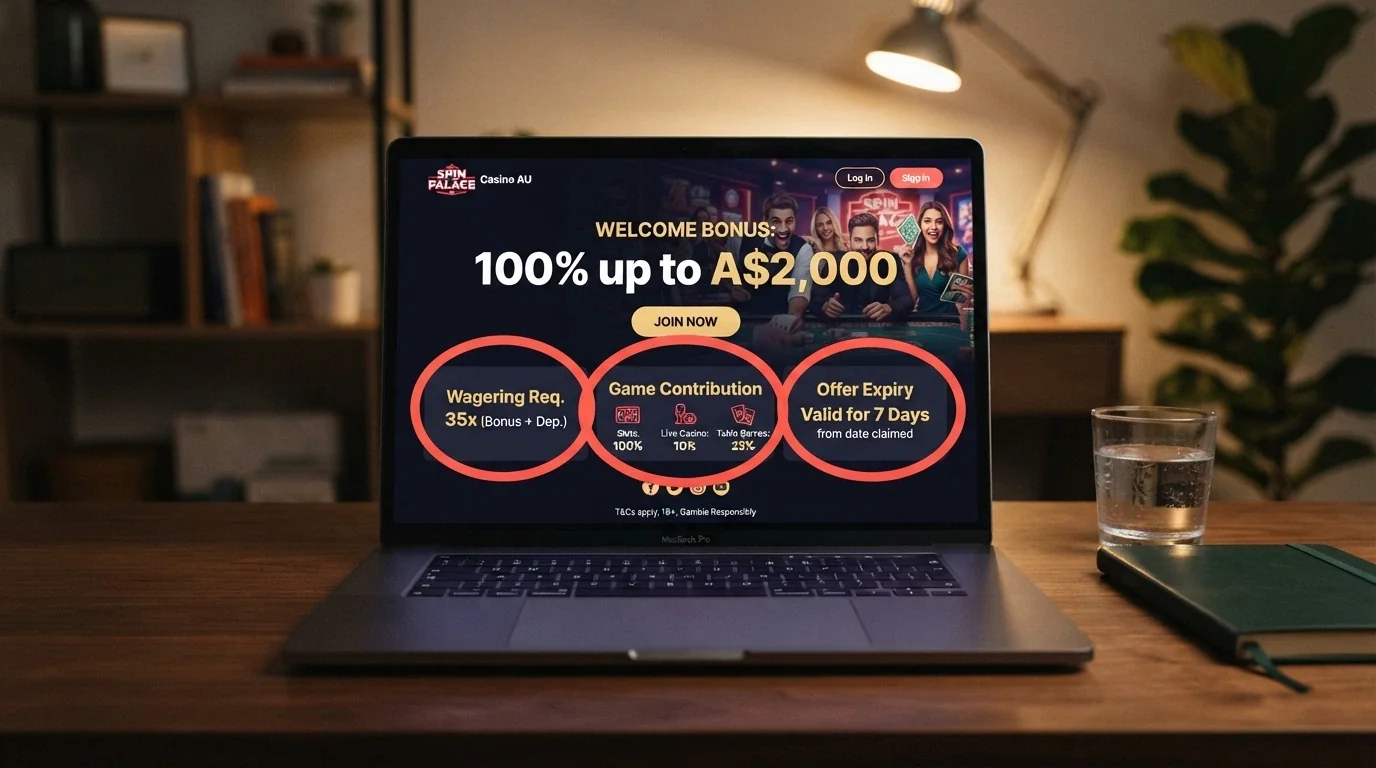
A welcome bonus is a turnover obligation dressed up as a gift. A 100% match up to A$2,000 with a 40x wagering requirement is not A$2,000 of free money — it is A$80,000 of bets the player must place before any withdrawal is allowed. The bonus figures that lead the table above look like prizes; they read better as the entry price of a clearance contract.
Welcome and sign-up bonuses: the match-deposit maths
A match-deposit bonus is structured around three numbers: the match rate (100%, 200%, 250%), the bonus cap (the maximum bonus the operator will credit), and the wagering multiplier (the number of times the bonus must be turned over before withdrawal). The player’s expected cost is a function of all three.
Take Neospin’s headline: up to A$11,000 plus 300 free spins across four deposits, with a 40x wagering requirement and a 14-day validity window. A player depositing at each stage to claim the full A$11,000 bonus is committing to A$440,000 in qualifying turnover — A$11,000 multiplied by 40 — to clear the bonus. At an average pokie RTP of 96.4%, the expected loss on that turnover is A$15,840 (A$440,000 multiplied by the 3.6% house edge). The “free” A$11,000 carries an arithmetic cost of roughly A$15,800 in expected losses before any withdrawal is permitted.
The same calculation runs differently on smaller bonuses. Royal Reels’ three-stage welcome pack totals A$2,500 in bonus money at 35x wagering on bonus only — required turnover of A$87,500, expected loss at 96.4% RTP of A$3,150. Fair Go’s five-stage pack at A$1,000 total in bonus money at 30x on deposit plus bonus combined — assuming the player deposits the full A$200 at each stage — produces A$12,000 turnover per stage and an expected loss of A$432 per stage. The wagering multiplier is not the only number that matters: a smaller bonus at a lower multiplier can be cheaper to clear than a larger bonus at a higher multiplier, and the player’s choice of how much of the package to claim is itself the most consequential decision in the whole bonus contract.
The maximum-stake rules during wagering are the second variable. Neospin caps the stake at A$7.50 per spin during clearance; Royal Reels caps it at A$5; other operators cap it lower. The cap is there to prevent a player from running a single A$1,000 spin to clear a A$10 wagering requirement in one bet — but it also prevents the player from running the high-volatility patterns a bonus clear might otherwise invite. A 21,000x max-win pokie played at A$0.20 per spin does not pay differently from one played at A$7.50, but the latter runs through the bonus thirty-seven times faster.
No-deposit bonuses and free chips: the catch behind free money
No-deposit offers are the smallest line items in the featured set, and the two that exist — Royal Reels’ A$10 and Fair Go’s A$15 — are best read as trial tokens rather than starting bankrolls.
Royal Reels’ A$10 no-deposit carries 30x wagering on any winnings and a A$200 maximum cashout. A player who wins A$300 on a free spin can only withdraw A$200; the surplus is forfeit. Fair Go’s A$15 free chip carries 60x wagering on winnings and a A$180 maximum cashout. The Fair Go multiplier is heavier — a player who wins A$200 on the chip must turn over A$12,000 before withdrawal is permitted — and the cashout ceiling is tighter. Both are designed to let the player test the platform without committing a deposit, not to provide withdrawable cash.
The absence of no-deposit offers across the rest of the featured set is not a gap. It is the norm. SkyCrown, Neospin, RocketPlay, Stake, Rainbet, Bizzo Casino, WinSpirit and Scream Casino do not extend a no-deposit route — and that is consistent with the broader Australian-facing offshore market, where no-deposit offers have largely been replaced by deposit-match packages because the cost of converting a no-deposit player into a depositing one is high enough that operators prefer to fund the match instead.
For a player who values testing before committing, Royal Reels’ A$10 token is the cheaper of the two trial offers on this page; the A$15 chip at Fair Go is a larger nominal amount but the heavier 60x wagering and tighter A$180 cashout cap make it harder to actually clear.
Free spins: what 400 spins are actually worth
Free-spin value at Australian-facing casino apps sits between A$0.10 and A$0.20 per spin, which means a 100-spin package is worth somewhere between A$10 and A$20 in raw face value — before any wagering requirement applies to winnings. SkyCrown’s 400 free spins carry a face value of A$40 to A$80; Neospin’s 300 sit at A$30 to A$60; RocketPlay’s 100 at A$10 to A$20; Royal Reels’ 50 at A$5 to A$10; Rainbet’s 60 at A$6 to A$12. Stake and Fair Go extend no free spins as part of the welcome package — Stake because the model is rakeback rather than bonus, and Fair Go because the no-deposit path is a free chip rather than spins.
The wagering on free-spin winnings is the multiplier that determines whether the face value translates into withdrawable cash. SkyCrown and Neospin both apply a 40x multiplier to free-spin winnings, which means a player winning A$20 from a spin package must turn over A$800 before that A$20 can be withdrawn. At 96.4% RTP across A$800 in turnover, the expected loss on clearing the free-spin winnings alone is roughly A$29. A player who is clearing both bonus money and free-spin winnings under the same 40x multiplier is paying for the privilege twice.
The honest reading is that free spins are a marketing number dressed in operational language. A “400 free spins” headline reads as a giveaway; the A$40 to A$80 face value multiplied by a 40x wagering requirement on the winnings is the more accurate description of what the player actually gets.
Free-play and demo casino apps: try every pokie without risking a cent
Most offshore casino platforms carry a demo or free-play mode that lets a player load any pokie and spin for pretend money. No account is required, no deposit is taken, and the gameplay is identical to the real-money version — same reels, same bonus rounds, same pay tables. The feature is a universal piece of the offshore platform model rather than a competitive differentiator, and it is the cheapest way to learn a pokie’s mechanics before committing real money.
The distinction worth drawing is between demo mode at a real-money casino and a free-to-play social casino app. A social casino app is a separate product: no real money at stake, virtual coins that cannot be cashed out, no connection to a real-money lobby. A demo mode inside a real-money casino is a feature of that casino — it exists to let a player test the games the casino offers. Most featured operators on this page extend demo play across the full pokie library without requiring an account, which is the safest way to test a title’s volatility and bonus frequency before any deposit.
Crypto casino apps: playing outside the Australian payment rules
Bitcoin and crypto deposits at offshore casinos exploit the gap the Australian payment ban was designed to close. The Interactive Gambling Amendment (Credit and Other Measures) Act 2023 made crypto a banned payment method for online wagering in Australia, effective 11 June 2024. The penalty for an operator that accepts crypto from an Australian customer is up to A$247,500 per breach. The ban binds operators licensed in Australia; offshore casinos accepting Bitcoin, Ethereum, Litecoin or USDT from Australian accounts are not bound by it.
SkyCrown is the confirmed crypto-accepting operator in the featured set, with the explicit caveat that crypto deposits do not qualify for the welcome bonus — the player can fund and play, but the bonus is paid on fiat deposits only. Other operators in the broader offshore market accept crypto by default; the regulatory pressure on them is light because none of them is licensed in Australia and the ACMA’s blocking power reaches the website, not the payment rails.
The trade-off for the player is speed and anonymity against the regulatory reality. Crypto deposits settle in minutes, do not require a bank account, and do not generate a transaction record the way a PayID or BPAY payment does. They also fund an account at an operator the Australian regulator considers outside its rules, with no dispute pathway through the Australian Financial Complaints Authority if a withdrawal is refused. The credit-card and crypto ban is a signal worth reading: an operator that accepts either is signalling, by the ACMA’s own definition, that it sits outside Australian rules.
Android, iPhone and iPad: how casino apps work on your device
Every device an Australian player carries runs a casino app through the browser. The native download model that defines the App Store and Google Play experience does not apply to real-money casino apps in Australia — there are no Australian-licensed casino apps to download from either store, and the offshore operators cannot place their apps in the Australian version of either marketplace. The browser is the only route, and the route is the same on every device.

Android casino apps: APK sideloading and browser play
Android offers two access routes. The default is Chrome-based browser play — the same HTML5 lobby that runs on every other device, optimised for the Android browser engine, no installation required. The second route is direct APK download from the operator’s own website, bypassing Google Play entirely. The player downloads the APK file, accepts a security warning from Android, and installs the application manually. The benefit is a permanent install with its own launcher icon, its own notification handling, and its own memory budget. The risk is that the APK has not been vetted by Google Play’s security review, and the player is trusting the operator’s own development practices.
APK availability is operator-specific and was not tabulated across the full featured set for this review. A player considering the APK route should check the operator’s website directly — most feature the download link in the footer or in a “mobile app” section, and a missing link usually means the operator does not offer an APK and is browser-only.
iPhone and iOS casino apps: Safari is your only option
Apple’s App Store rules prohibit real-money casino apps in Australia, which means an iPhone or iPad player has exactly one route to a casino app: Safari. The HTML5 lobby runs through Safari in the same way it runs through Chrome on Android, with the same games, the same account and the same deposit methods. The PWA path — saving the operator’s site to the home screen as a launcher icon — is the closest the iPhone gets to a native app, and the experience is close enough that most players do not notice the difference.
The iOS constraint is structural and uniform. Every featured operator on this page runs through Safari on iPhone; none of them offers an iOS-native download, and none will while Apple’s Australian App Store policy holds. For a player locked to iPhone, the choice between operators comes down to library, bonus terms and payout reputation — not the device.
iPad casino apps: the same Safari model on a bigger screen
iPad play is identical to iPhone — the same Safari-based access route, the same account, the same bonus terms. The larger screen is the only meaningful difference: live dealer tables and table games with detailed layouts read better on a 10-inch display than on a 6-inch phone screen, and the multi-column game grid makes browsing the lobby easier. There is no iPad-specific app in the App Store, no iPad-only bonus, and no operator that treats the iPad as a separate platform. For a player using a tablet as their primary device, the experience is the same as the phone — only larger.
Responsible gambling at offshore casinos: the tools you get and the ones you don’t
Australian-licensed wagering services carry deposit limits, BetStop registration, take-a-break tools and a 24/7 helpline as part of the licensing condition. Offshore casinos carry whatever their own terms page says they carry — and what the player gets depends on the operator, not on a regulator.

Deposit limits, session timers and self-exclusion: what offshore apps actually offer
Some offshore operators provide deposit limits, session timers and operator-level self-exclusion voluntarily. Others provide little beyond the age verification every operator runs. The Australian player has no way to tell from the marketing page which model an operator follows, and no regulator to complain to if the model is absent. Age verification — minimum 18 for all commercial gambling in Australia — is the one universal gate.
BetStop, launched on 21 August 2023, is the national self-exclusion register covering every Australian-licensed online and phone wagering service. One registration excludes a person from every one of them. The number of Australians who have registered is substantial: 49,382 by 30 September 2025, with 31,838 active exclusions at that date; 53,308 by 1 December 2025, with 34,266 active. Around 77% of registrants report a better quality of life after self-excluding; 79% report improved mental health; 96% stopped or decreased their betting. The mechanism works.
The mechanism does not reach offshore casinos. An Australian who registers with BetStop is excluded from every Australian-licensed wagering service, and the offshore operator does not see the registration. The deposit the self-excluded player makes at an offshore casino the next day is processed without flag. BetStop is the most concrete single harm of the offshore route, because it is the place where Australian harm-prevention infrastructure ends and a person with a self-exclusion problem can keep playing.
Where to get help
- National Gambling Helpline: 1800 858 858 — free, confidential, staffed 24/7. The first call to make at any level of concern.
- Gambling Help Online at gamblinghelponline.org.au — live chat, email, self-help resources. Online counselling requests rose 67% in the 2023–24 financial year, reflecting both the level of need and the accessibility of the channel.
- BetStop — National Self-Exclusion Register — minimum exclusion period three months, maximum lifetime. Effective at Australian-licensed operators; not effective at offshore casinos.
- AdStop (from 1 January 2027) — a new national Wagering Advertising Opt-out Register, administered by the ACMA, that lets Australians opt out of wagering advertising across the licensed industry.
Harm prevalence sits behind every number on this page. Roughly 2.1% of Australian adults — around 430,000 people — experience problem gambling. Risky gambling increased from 13.7% in 2024 to 19.4% in 2025. More than half of Australians who gambled in the past 12 months — 56.1% — did so mainly online. The market the offshore casino apps serve is not a fringe; it is the majority of Australian gambling activity. That is why the tools above exist, and why a page about offshore casino apps needs to name them.
How we evaluated these casino apps
The ranking is built from publicly available material: the ACMA enforcement register, the ACMA’s quarterly action reports, the BetStop statistics releases, the operator terms pages, the Australian Taxation Office guidance on gambling income, and competitor reviews on the Australian-facing affiliate market. No operator was contacted for this review; every figure on this page was sourced from a public document or a verifiable operator page.
The criteria that ordered the ranking are five: bonus value, wagering fairness, licence transparency, game range and AUD support. They are not weighted numerically — the ordering reflects editorial judgement on how those criteria combine for the Australian reader. Bonus value alone would rank Neospin first; wagering fairness alone would rank RocketPlay or Fair Go first; licence transparency alone leaves only RocketPlay. The ranking tries to read what each operator offers as a whole, and to be honest about the operators for whom a confident ranking is not possible.
The limitations of the ranking are explicit. No Australian casino licence exists, so every operator here is offshore and unlicensed in Australia. Curaçao licence numbers were confirmed against the register only for RocketPlay; the other Curaçao-licensed operators carry a footer-claim licence that could not be independently verified for this review. Three operators in the ranking — Bizzo, WinSpirit, Scream Casino — could not be confirmed at all on the bonus, licence or provider questions, and are presented as unverified entries rather than as ranked candidates. Withdrawal times, payout reliability and provider counts were not tabulated to per-operator precision across the set.
The ranking is a snapshot. Bonus terms change, licence registrations change, and the ACMA blocking list is updated continuously. The ten operators named here were active and accessible at the time of this review; a player shortlisting from the ranking should treat the operator’s own terms page as the binding document, not this one.
Is an offshore casino app worth the risk?
The legal reality is settled. Online casino is prohibited in Australia. Every app on this page exists because the offshore operator is doing what the IGA makes an offence: providing a prohibited interactive gambling service to a person in Australia. No Australian has been prosecuted for using one. No Australian is likely to be. That is the legal shape of the choice.
The bonus maths is harder. A “free” A$11,000 welcome package carries an arithmetic cost of A$15,840 in expected losses at 96.4% RTP, calculated as the A$440,000 required turnover multiplied by the 3.6% house edge. A “free” A$8,000 package carries an expected loss of roughly A$11,520 on the same basis. The marketing language calls these bonuses; the arithmetic calls them turnover contracts with a house edge baked in. The reader who walks into the bonus thinking they have been handed A$11,000 of free money is reading the headline instead of the contract.
The protection gap is concrete. No Australian regulator can compel an offshore operator to pay out. BetStop does not reach offshore casinos. A blocked site does not refund balances. The credit-card and crypto ban is the signal worth reading: an operator that asks for either is signalling it sits outside Australian rules, and the protections that rule was designed to deliver.
The expected-loss calculation in the bonus section above is the most honest figure on this page. It is also the figure the marketing material does not print. The reader’s decision is whether the access to pokies on mobile is worth the price — a price that is paid in expected losses during bonus clearance, in the absence of an Australian backstop if a withdrawal stalls, and in the harm-prevention infrastructure that stops at the border.
Frequently asked questions
Can I play pokies on my phone in Australia?
You can play pokies on your phone in Australia, but not through an Australian-licensed app — none exists. The pokies apps that accept Australian players are offshore, typically licensed in Curaçao, and accessible through the mobile browser. The legal product is prohibited under the Interactive Gambling Act 2001; the offshore market exists because the IGA targets providers rather than players. No Australian has been prosecuted for using an offshore casino.
Do casino apps in Australia accept PayID?
Some do. PayID and Osko — the instant payment rails running through the New Payments Platform — are the fastest legal AUD deposit routes for Australian players, and several offshore operators in the featured set accept PayID for deposits. An operator asking for a credit card or cryptocurrency is signalling, in the ACMA’s framing, that it sits outside Australian rules; the credit-card and crypto ban has been in force for online wagering since 11 June 2024.
How do I withdraw money from an offshore casino app?
Withdrawal at an offshore casino app requires KYC verification first — a government photo ID, a proof of address and a payment-method confirmation submitted before the first payout. After verification, withdrawal times run from a few hours (e-wallets) to several business days (bank transfers), with the offshore operator’s own processing window added on top. The structural risk is that no Australian regulator can compel an offshore operator to release funds, so a player who has not read the bonus terms before claiming can stall at exactly the wrong moment.
What is BetStop and does it cover offshore casino apps?
BetStop is the National Self-Exclusion Register, launched on 21 August 2023. One registration excludes a person from every Australian-licensed online and phone wagering service, with a minimum exclusion of three months and a maximum of lifetime. BetStop does not cover offshore casino apps — the offshore operator does not see the registration, and the exclusion does not extend beyond the Australian-licensed market. By 1 December 2025, 53,308 Australians had registered with BetStop; 34,266 exclusions were active.
Are my winnings from casino apps taxable in Australia?
No — for the ordinary player. Betting and gambling winnings are not assessable income under section 6-5 of the ITAA 1997, and losses are not deductible under section 8-1, unless the person is carrying on a business of betting or gambling. No Australian case has held the winnings of an ordinary punter assessable. The position changes for a professional gambler whose gambling activity amounts to a business — at which point the ATO may treat the income as assessable and the losses as deductible.
What is the minimum deposit at Australian casino apps?
Minimum deposits at Australian casino apps typically run from A$5 to A$30 depending on the operator and the payment method. PayID and crypto deposits tend to sit at the lower end; debit card and bank transfer minimums are typically higher. The bonus-eligible deposit is the binding number for most players — Neospin’s A$30 per stage is the highest minimum-deposit threshold across the featured set, and a player aiming to claim the full welcome package will be committing at least that amount at each of the four stages.