
What Offshore Crypto Casinos Mean for Australians in 2026
 Available in AU
Crypto casinos are the fastest-growing corner of the offshore gambling market pitched at Australian players. The marketing is fluent, the games look like the ones at any licensed venue, and a deposit takes about three minutes. Almost everything about the experience is engineered to feel like a normal online casino.

It is not. The product itself is prohibited under the Interactive Gambling Act 2001, and the crypto deposit method has been banned for licensed Australian wagering since 11 June 2024. Every site on the ranking that follows is licensed somewhere else — Curaçao for most of them — and not one of them answers to an Australian regulator. The payment method is itself a tell. “An Australian who is asked for a credit card or a crypto deposit by a gambling site is being served by someone outside the Australian rules.”
Verified against the ACMA’s register of blocked illegal gambling services as of 18 October 2026.
Table of Contents
- Crypto Casinos in Australia: What 2026 Actually Looks Like for Players
- Best Crypto Casinos for Australian Players in 2026
- Why Every Crypto Casino an Australian Plays At Is Offshore — and What That Costs You
- Why Your 2026 Crypto Casino Bonus Is Smaller Than It Looks
- How Fast Crypto Casino Withdrawals Actually Reach Your Wallet
- Crypto Pokies in 2026: What Australian Players Are Actually Spinning
- New Crypto Casinos in 2026: What Is Worth a Look
- Staying in Control: Responsible Gambling Tools That Actually Work
- How We Selected and Ranked These Crypto Casinos
- The Bottom Line: What Australian Players Should Actually Do About Crypto Casinos
- Frequently Asked Questions
Crypto Casinos in Australia: What 2026 Actually Looks Like for Players
Australians search for crypto casinos because the licensed Australian market has nothing to offer them in this product category. Online casino games, online pokies and in-play sports betting are prohibited to provide to a person in Australia; the only licensed wagering product is sports and race betting before the event begins, through operators licensed by a state or territory. The crypto casino fills a gap the licensed market does not fill, and does so with marketing that is fluent, fast and built around the deposit method itself.
The core trade-off is not subtle. A licensed Australian wagering account gives a player the full National Consumer Protection Framework — BetStop, identity verification, deposit limits, monthly activity statements, a real complaints body. An offshore crypto casino gives a player the games, the bonuses, the withdrawal speed and the deposit convenience. The two are not equivalent products. They are not even in the same regulatory category. What this guide covers is the offshore crypto casino side, with the regulatory absence visible in every section. What it does not cover is the licensed Australian online casino — that product does not exist, and any page claiming to review it is reviewing a phantom.
What a Crypto Casino Actually Is — and Isn’t
A crypto casino is an online casino that holds funds, places bets and pays out winnings in cryptocurrency rather than fiat. Bitcoin and Ethereum are the most common rails, but USDT on the TRC20 network is the workhorse for Australian players because the transaction fees are tiny and the confirmation times are short enough that the casino’s “instant withdrawal” marketing has something behind it.
What it is not is an Australian-licensed wagering service. The Interactive Gambling Act 2001 prohibits the provision of online casino games to a person physically in Australia, with no licence for online casino existing anywhere in the country. The Interactive Gambling Amendment (Credit and Other Measures) Act 2023, in force from 11 June 2024, then closed off the payment rails licensed operators might have used: credit cards, credit-related products and digital currency are all banned for licensed online wagering, with penalties of up to A$247,500 for non-compliance.
When a casino asks an Australian for a crypto deposit, the prohibition and the payment ban have already done their work — only an offshore operator could have asked. The licence those operators do hold, when they hold one, is typically Curaçao. A Curaçao licence grants the operator legal existence and a regulator to answer to in some form. It does not grant an Australian player consumer protection, dispute resolution, or recourse if the operator refuses a withdrawal.
How Australians Access Crypto Casinos in 2026
The practical path has not changed much in the last few years, because the legal framework has not given anyone room to change it. The route runs: Australian bank account → Australian cryptocurrency exchange → USDT TRC20 → offshore casino.
The first hop is the one that varies. CommBank and Westpac restrict large outbound transfers to known crypto exchanges — they have been tightening this since at least 2023 — so a player at one of the big four may find the transfer flagged or refused. ANZ and NAB tend to flag transactions without fully blocking them: the transfer goes through, but the player may get a call or a notice. ING and Macquarie are the most permissive among the banks Australians commonly use; the transfer clears without much friction. Independent Reserve and CoinSpot are the two exchanges that come up most often as the destination.
The second hop, exchange to stablecoin, takes a few minutes on either platform. From there the player moves USDT TRC20 to the casino’s deposit address. TRC20 is the rail because the fees are negligible and the network confirms in under five minutes, which is what the casino’s marketing relies on.
The third hop is where the most important regulatory step actually sits. From 29 September 2024, all online gambling service providers must complete applicable customer identification procedures (ACIP) before creating an account or commencing to provide any designated service under AUSTRAC’s amended AML/CTF Rules — but the obligation that binds the player runs through the exchange, not the casino. AUSTRAC requires every Australian cryptocurrency exchange to verify customer identity as a condition of its Digital Currency Exchange registration, and the AUSTRAC Travel Rule kicks in at A$10,000 for crypto transactions. The player has been identified by the time they have funded the exchange account with fiat AUD, even if the offshore casino itself never runs a check.
What Separates a Trustworthy Crypto Casino from the Rest
There is no Australian licence to verify against. That is the first thing any guide to offshore operators has to say, and the second thing any Australian reader has to understand. Beyond that, the trust signals a player can actually check are narrower and less authoritative than they would be inside a regulated market.
The licence itself, when it is one, is usually Curaçao. A Curaçao licence is not a quality guarantee; it is a permission to operate. The Curaçao Gaming Control Board has tightened its regulatory framework over the last two years, and the current master licence holders are subject to fit-and-proper checks and reporting obligations, but for an Australian player the licence functions as a floor rather than a ceiling. The licence means the regulator in Curaçao can investigate, not that the regulator in Australia will.
Casino.Guru’s Safety Index is the closest thing to an independent benchmark in the offshore space. It is a composite score built from complaint history, terms fairness, payment reliability, licensing and other factors, on a ten-point scale. RocketPlay carries a 9.8 on that index, the highest in this ranking. Bizzo carries an 8.4, the highest of any operator in the Fair Go alternatives group. A Safety Index in the eights or above is a strong signal in this market. Below six, a player should expect problems.
Provider mix and game count are the next signals. An operator that lists thirty or more providers has done the integration work and is more likely to be paying its suppliers on time, which is a weak but real proxy for being in business next month. Bizzo lists seventy-plus studios and over eight thousand games, the largest catalogue in this ranking. Fair Go runs on RTG only, which is the opposite end of the breadth spectrum and a meaningful trade-off the player should weigh.
Tested withdrawal speed is the signal that matters most in practice, because it is the only one a player experiences in their own time. Stake averaged one hour fifty minutes across four test cycles, the fastest in this set. Wild Fortune averaged four hours forty-seven minutes, and BitStarz four hours eighteen. None of these are the “instant” the marketing claims, but they are all materially faster than what an Australian would get withdrawing fiat from most licensed operators.
Best Crypto Casinos for Australian Players in 2026
The table below covers ten offshore crypto casinos that Australian players actually use, ordered by the market-share data the research carries. None of them is licensed in Australia. None of them is required to be. The Interactive Gambling Act 2001 prohibits the product entirely, so every operator on this list — and every comparable operator not on it — runs on an offshore licence of some kind. The columns below capture what each operator actually offers in its welcome package, with the no-data marker for cells where the underlying offer was not independently verifiable this run.
| Operator | Licence | Welcome Bonus | Wagering | Free Spins |
|---|---|---|---|---|
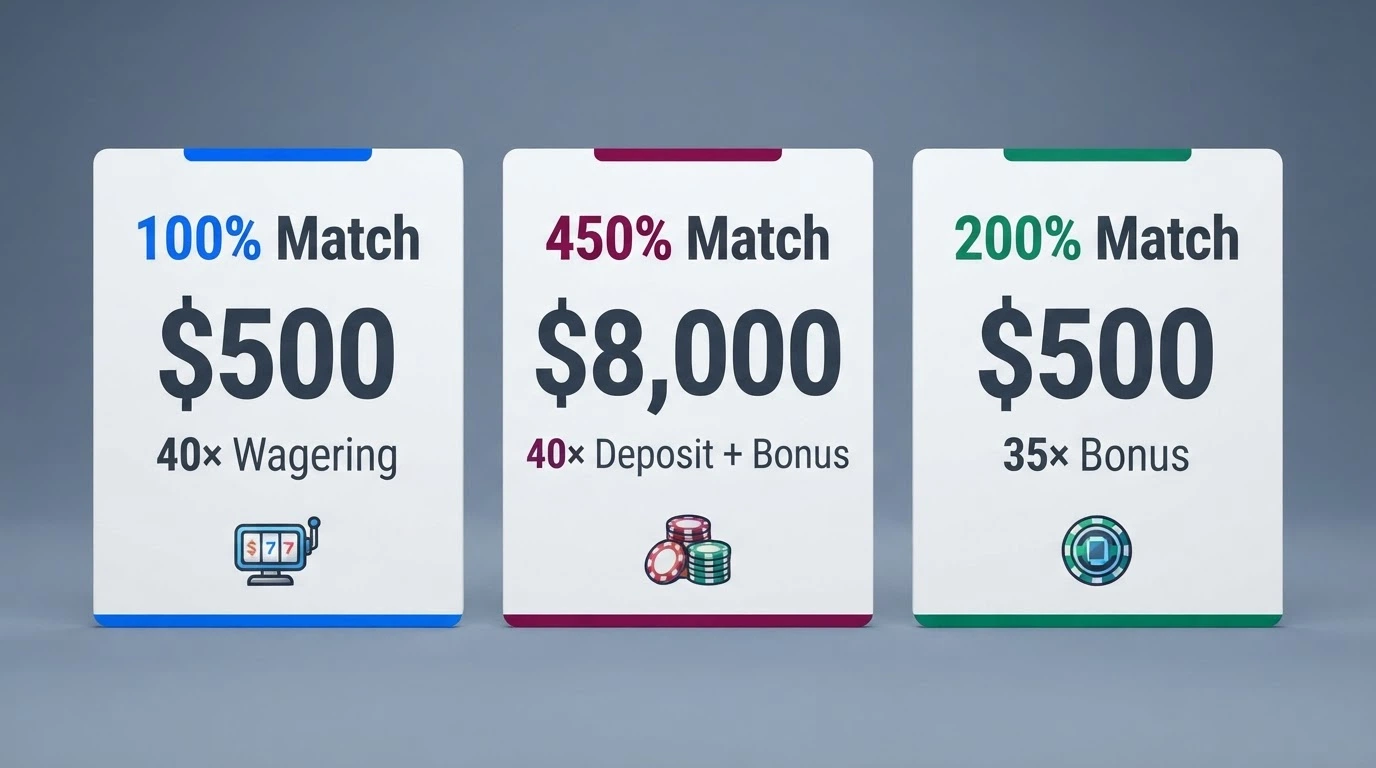
| RocketPlay | Curaçao | 100% to A$500 + 100 FS (1st deposit); 200% to A$500 (2nd deposit) | 40× bonus | 100 |
| SkyCrown | Curaçao | 450% to A$8,000 + 400 FS (4 deposits; fiat only) | 40× deposit + bonus | 400 |
| Royal Reels | Curaçao | 100% to A$500 + A$10 no-deposit | 30–40× | — |
| Stake | Curaçao | Rakeback model (no traditional welcome) | — | — |
| Fair Go | Curaçao | 100% to A$200 × 5 deposits (up to A$1,000) | 30× deposit + bonus | — |
| Rainbet | Curaçao | 100% to A$500 + 50 FS | 35× bonus | 50 |
| WinSpirit | Curaçao | 200% + 25 FS | 40× | 25 |
| Bizzo Casino | Curaçao | Up to A$7,250 + 175 FS (4 deposits) | 40× deposit + bonus | 175 |
| Scream Casino | Not confirmed | Not confirmed | Not confirmed | Not confirmed |
| Rocket Casino | Not confirmed | Not confirmed | Not confirmed | Not confirmed |
The honest read of the table is that the marketing numbers vary wildly — A$500 on one end, A$10,000-equivalent on the other — and the wagering column varies much less. That is the point of the next several sections. A 450% match sounds enormous until you read the wagering multiple, the maximum bet cap and the validity window behind it, and the player who has not done that reading tends to be the one who does not get to keep anything.
What follows is ten short operator write-ups. Each names the licence, walks through the welcome package as it is written, and ends with a verdict on what kind of player the offer suits.
RocketPlay: High Safety Index, Solid Two-Deposit Welcome
RocketPlay is the highest-rated operator in this ranking on Casino.Guru’s Safety Index, which sits at 9.8. The welcome package is split across two deposits: a 100% match up to A$500 plus 100 free spins on the first deposit, and a 200% match up to A$500 on the second. The wagering requirement is 40× on the bonus amount, with a maximum bet of A$7.50 during wagering.
The provider mix is the strongest signal beyond the safety rating. RocketPlay runs thirty or more studios, including Pragmatic Play, Evolution Gaming, Yggdrasil and Hacksaw Gaming — the same supplier list the player will recognise from any other major offshore operator. The catalogue covers pokies, live casino, table games and the kind of crash and instant-win titles that come up a lot on crypto-native sites.
The two-deposit structure means the player is committing more than the headline number suggests. A$500 on the first deposit plus A$250 to clear the second means the welcome package realistically costs A$750 before the bonus clears, even with a 100% and a 200% match layered on. That is not unusual for the market, but it is worth seeing on the way in.
RocketPlay is an excellent choice for a player prioritising a balanced welcome package and high independent safety marks.
SkyCrown: Massive Match, But Crypto Depositors Miss Out
SkyCrown runs the biggest headline bonus number in this ranking: a 450% deposit match up to A$8,000 plus 400 free spins across four deposits, with 40× wagering on deposit plus bonus, an A$7.50 maximum bet during wagering, and a 14-day bonus validity window. The catalogue behind it is large — over 7,200 games from Hollycorn N.V., with fifteen or more active promotions on the operator’s promotions page and a referral program paying up to A$75 per invited friend at 10× wagering.
The catch is the one that undoes the offer for anyone reading this guide. The welcome package is not available to crypto depositors. The operator’s terms page treats crypto deposits as outside the welcome promotion’s eligibility, which means the headline A$8,000 match is paid out in fiat rail terms only. An Australian crypto player walking into SkyCrown gets the games, gets later promotions where available, but does not get the welcome.
While SkyCrown is a quality destination for Australian crypto gamblers, the headline bonus is strictly for fiat depositors. If you are funding with USDT, keep in mind that the site remains a strong gaming choice, but the welcome offer itself does not apply.
Royal Reels: Modest Match, Low-Barrier Entry
Royal Reels sits at a smaller scale than the operators above it, with a 100% match up to A$500 and an A$30 minimum deposit, plus an A$10 no-deposit bonus for new sign-ups. Wagering on the deposit bonus is in the 30–40× range, and the catalogue runs over 2,000 games from thirty or more providers — the same names that appear in the larger operators’ lobbies, including Pragmatic Play, Evolution and Hacksaw Gaming.
The no-deposit sweetener is the reason a player would pick Royal Reels over a bigger headline. It costs the operator A$10 and it lets a player open an account and try the site without committing bankroll. The wagering on that no-deposit bonus is in the same 30–40× range as the welcome, which is on the lighter end of the offshore spectrum.
Royal Reels focuses on small-stakes accessibility, featuring a modest match and a genuine no-deposit bonus. It is a solid entry point for those wanting to test the waters without a significant upfront commitment.
Stake: The Speed Leader with a Rakeback Model
Stake is the fastest crypto withdrawal operator tested in this ranking — one hour fifty minutes average across four test cycles, against four hours eighteen at BitStarz and four hours forty-seven at Wild Fortune. The licence is Curaçao, and the operator runs on a rakeback and cashback model rather than a traditional welcome bonus.
That structure means there is no headline number to compare against the rest of this ranking. The player funds an account, plays, and receives a percentage of the house edge or net loss back as rakeback, depending on the VIP tier. For a player whose priority is withdrawal speed, Stake is the obvious pick in this set; for a player whose priority is a fat deposit match, there is nothing to claim.
The rakeback model is worth understanding before depositing. Research does not carry a specific rakeback percentage in this run, so the player should check Stake’s terms directly for the tier structure and the contribution rate. For a high-volume player who would clear a welcome package anyway, the rakeback structure often pays more than a one-time match. For a casual player who treats the welcome as the main event, the model is harder to evaluate against the rest of the field.
Fair Go: RTG-Only Nostalgia with a Patient Welcome
Fair Go is the most specialised operator in this ranking. The welcome package is a 100% match up to A$200 redeemable five times — up to A$1,000 in total — with 30× wagering on deposit plus bonus combined and an A$20 minimum deposit. There is no maximum cashout on deposit-bonus winnings, which is the rarity in this market. The catalogue runs on RTG (RealTime Gaming) only, and Fair Go accepts Bitcoin, Ethereum and Litecoin.
The RTG-only setup is what makes or breaks this operator for a player. RTG is an older studio, and the games have a recognisable aesthetic — the player who last played at a Las Vegas-flavoured online casino a decade ago will recognise the catalogue instantly. The player who wants the latest mechanics from Hacksaw or the live-dealer production values of Evolution will not find them here.
The A$15 no-deposit chip comes with 60× wagering and a maximum cashout cap commonly near A$180, which is the kind of string that turns a “free” A$15 into roughly an A$180 chance at a real withdrawal. The deposit bonus is more player-friendly by comparison — 30× on the combined amount and no cap on winnings is a fairer structure than most of the rest of this ranking offers.
For a patient player who likes the RTG catalogue and accepts the narrower range, Fair Go is the best-styled offer in this set.
Rainbet: The RTP Gatekeeper
Rainbet’s welcome package is a 100% match up to A$500 plus 50 free spins at A$0.25 per spin, with 35× wagering on the bonus amount and an A$30 minimum deposit. The licence is Curaçao.
The distinctive feature is the RTP ceiling. Games with a return-to-player percentage above 97.4% are restricted while a bonus is active. The player’s instinct is that this should not matter much — most pokies sit in the 94–96.5% range — but the rule is designed to lock the player out of the small set of high-RTP titles where the house edge is thinnest, which is also where bonus clearing is mathematically easiest. The bonus looks clean on paper and the 97.4% line is the catch.
Rainbet’s 35× wagering structure is more accessible than the 40× market standard, provided you navigate the RTP restrictions carefully. Always review the game limitations before you start your session to avoid any surprises.
WinSpirit: Tournaments, Cashback and a 200% Match
WinSpirit runs a 200% welcome bonus plus 25 free spins with 40× wagering on promotions, regular slot tournaments, ongoing cashback offers and a loyalty program. The licence is Curaçao.
The 200% match is a high percentage against the rest of the set — most operators in this ranking sit at 100% on the first deposit — and the retention tools are the distinguishing feature. Tournaments, cashback and a tiered loyalty program give the player ongoing reasons to keep playing past the welcome package, which is where most offshore operators go quiet.
The wagering multiple sits at the market-capped end. 40× is on the heavier side of what is offered in this ranking, and the player who picks WinSpirit is paying for the high percentage match with a steeper clearing requirement. For a player who plans to play through a tournament calendar and use the cashback structure, the match is part of a wider value proposition. For a player who only wants the welcome and is out the door, the higher wagering makes the package less competitive than the headline suggests.
Bizzo Casino: The Volume Play — 8,000+ Games and PayID
Bizzo is the largest catalogue in this ranking — over 8,000 games from seventy or more studios, including Pragmatic Play, Evolution, Yggdrasil, Hacksaw Gaming and most of the other names a player will recognise from any other offshore site. The welcome package runs up to A$7,250 plus 175 free spins across four deposits, with 40× wagering on deposit plus bonus, an A$8 maximum bet during wagering, and an A$250 minimum deposit to unlock the 125% first-deposit tier. The licence is Curaçao, the operator is TechSolutions Group N.V., and the Casino.Guru Safety Index sits at 8.4.
The 175 free spins are the meaningful sweetener. They drip across the four deposits rather than landing all at once on the first, which is the more sustainable way to deliver them, and the catalogue they apply to is the broadest in this set. There is also a 10 no-deposit free spins offer for installing the PWA app — 40× wagering with a A$75 win cap, which is a smaller commitment than the welcome but still a real way to try the site.
The PayID support is the practical differentiator for an Australian player. PayID works for both deposits and withdrawals at Bizzo, which means the Australian-facing payment rail that has been the bet-by-bet norm at licensed wagering operators is also available here. PayID is an Australian instant bank transfer system that settles in seconds rather than the multi-day cycle of the older BPAY-style rails, and the casino supporting it cuts a step out of the player journey.
Bizzo stands out as the premier destination for players prioritising a vast library and local payment methods like PayID.
Scream Casino: A Listed Operator with Thin Public Data
Scream Casino appears in the market-share data the research carries, at roughly 0.99% of the Australian-facing offshore crypto market — a small slice, but enough to register on the ranking. The licence, the welcome package, the wagering terms, and the free spins structure were not independently verifiable in the research carried for this page. The player considering Scream should treat the absence as the relevant fact.
What that means in practice is the verification work the rest of this page has done has not been done for Scream. The Curaçao licence register can be checked, the operator’s terms page can be read directly, and the Casino.Guru complaints history can be reviewed before any deposit is made. None of those checks happened here, which means none of those checks should be skipped.
For a player who has been considering Scream because of the marketing or an affiliate ranking, the right move is to run the same checks this guide runs for the other operators. A market-share presence is not a verification. For a player who prefers to start with an operator whose offer has been independently reviewed, every other operator on this ranking qualifies.
Rocket Casino: Another Thin-Data Entry — Verify Before You Deposit
Rocket Casino carries roughly 0.57% of the Australian-facing offshore crypto market by the same source. As with Scream Casino, the licence, the welcome bonus, the wagering terms, and the free spins structure were not independently verifiable in the research carried for this page.
The same protocol applies. The Curaçao register, the operator’s own terms page, the Casino.Guru complaints history — these are the checks a player runs before depositing at any offshore operator, and they are especially worth running for one where the verification work has not been done independently. A 0.57% market-share slice is small but real, and the player should not assume the slice reflects either quality or risk.
For a player who wants to deposit at Rocket Casino specifically because it appeared on a ranking, the message is the same as for Scream: the table above is what this guide can verify, and a player deciding on a thinner-data entry should verify directly. For a player who wants an offer this guide has reviewed, the other nine operators on this ranking are the comparison set.
Why Every Crypto Casino an Australian Plays At Is Offshore — and What That Costs You
Online casino games, online pokies and in-play sports betting are prohibited to provide to a person in Australia under the Interactive Gambling Act 2001, strengthened by the Interactive Gambling Amendment Act 2017. There is no licence for online casino anywhere in the country — not federally, not in any state or territory. The prohibition targets the provider, not the player; an Australian who plays at an offshore crypto casino is not personally prosecuted, but the operator is operating illegally, and the player is on the wrong side of a regulatory wall.

The crypto payment ban has hardened that wall since 11 June 2024. The Interactive Gambling Amendment (Credit and Other Measures) Act 2023 made credit cards, credit-related products and digital currency — including cryptocurrency — banned as payment for online wagering in Australia, with penalties of up to A$247,500 for non-compliance. The effect on the market has been direct: any licensed Australian wagering operator that accepted crypto as a deposit route is now non-compliant, and the operators that ask for crypto are by definition offshore.
The Australian Communications and Media Authority (ACMA) is the federal enforcer. It has had 1,564 illegal gambling and affiliate websites blocked by Australian ISPs since its first blocking request in November 2019, and more than 225 illegal services have withdrawn from the Australian market since enforcement was strengthened in 2017. The blocking power means an offshore casino can disappear with a player balance still on it — there is no guarantee the player’s funds survive a site being added to the ACMA block list.
What the player leaves behind, going around that wall, is not a single thing. It is the entire scaffolding of the Australian consumer protection environment: BetStop, the National Consumer Protection Framework, the ten measures that framework puts in place, the state-based complaints bodies, the AUSTRAC oversight on the licensed payment rails. None of that reaches the offshore casino. The player’s only protections are the ones the offshore operator chooses to extend.
No-KYC Crypto Casinos: What “Anonymous” Actually Means
“No KYC” is one of the most common marketing terms in the offshore crypto casino space. The promise is appealing: open an account with an email and a password, deposit in crypto, withdraw in crypto, never share a passport or a driver’s licence. Some operators, like Lucky Block, do run on exactly that model — email plus password only, no identity verification at signup.
The promise runs into two hard limits. The first is at the exchange, not the casino. AUSTRAC requires every Australian cryptocurrency exchange to verify customer identity as a condition of its Digital Currency Exchange registration, and the amended AML/CTF Rules from 29 September 2024 require applicable customer identification procedures before any designated service is provided. The player has been identified by the time they have funded an exchange account with fiat AUD. The anonymity sits between the exchange and the casino, not at the start of the chain.
The second limit is the “soft KYC” trigger inside the casino. Most offshore operators will process withdrawals automatically up to a cumulative threshold — typically in the A$2,000 to A$5,000 range — and require identity verification above that line. The threshold is not always published, and the operator reserves the right to ask earlier if anything in the account looks unusual. The AUSTRAC Travel Rule kicks in at A$10,000 for crypto transactions, which is the upper boundary at which an Australian transaction is automatically reportable regardless of operator practice.
The practical ceiling on anonymity is lower than the marketing suggests. A player using an Australian exchange to fund a no-KYC casino has been identified once and will be identified again at the first withdrawal above the operator’s soft threshold. The exception is a player who sources their crypto through a non-Australian exchange and never crosses the operator’s KYC line — a real category, but a narrow one, and one that the marketing tends to obscure.
What Protections Australian Players Leave Behind
The licensed Australian wagering environment is built around ten consumer protection measures under the National Consumer Protection Framework, plus the BetStop national self-exclusion register, plus the state-based complaints bodies with real enforcement power. The offshore crypto casino environment has none of these as a matter of course — they are features the operator chooses to extend, not features the regulatory framework requires.
The table below compares what a player gets at a licensed Australian wagering account versus what they get at an offshore crypto casino. The left-hand column is a feature of the Australian regulatory environment; the middle and right columns are what each environment actually delivers.
| Protection | Licensed AU Wagering | Offshore Crypto Casino |
|---|---|---|
| BetStop self-exclusion coverage | Binds every Australian-licensed online and phone wagering service in one step | Not covered |
| National Consumer Protection Framework (10 measures) | In force | Not applicable |
| Strong age and identity verification at signup | Required | Variable; often email-only |
| Restricted sign-up inducements | Required | None; the headline bonus is the inducement |
| Customer-set deposit limits | Available | Not enforced by the operator |
| Monthly activity statements | Mandatory | Variable; usually not provided |
| Easy account closing | Required | Variable; some operators bury the option |
| AU complaints body with enforcement | State regulator + ACMA | None |
| Site can be blocked mid-session | Rare | ACMA has blocked 1,564 sites since 2019 |
| Recourse if operator refuses withdrawal | AU consumer law applies | No recourse |
| Tax clarity on winnings | Generally not assessable income unless businesslike | Same ATO treatment, but no AU documentation infrastructure |
The two columns are not symmetric, and they do not pretend to be. The offshore column is a description of what the player gets in practice at the operators this guide covers, not a critique of any specific operator. Most of the operators on this ranking do most of the things on the right-hand column reasonably well. None of them are required to do any of them at all.
The BetStop number is the one to weigh most carefully. The National Self-Exclusion Register has 59,830 registrations by 31 March 2026, with 37,247 active exclusions. 78% of registrants were under 40, and 38% chose lifetime exclusion. 77% of people who registered for self-exclusion from online and phone wagering services reported a better overall quality of life. None of those benefits reach a player at an offshore crypto casino. The self-excluded player who turns to crypto to keep playing will find the site accepts them without question, and the harm-reduction scaffolding they relied on at a licensed operator does not exist.
The 2026 Reform Wave: What Changes on 1 January 2027
The Interactive Gambling Amendment (Gambling Reform) Bill 2026 passed Parliament on 19 August 2026, and its measures commence on 1 January 2027. The headline change for offshore crypto gambling is straightforward: from that date, banks and payment providers gain express authority to block transactions to illegal gambling operators. The chain an Australian player currently uses — bank to exchange to casino — runs through a licensed bank at one end, and the bank is gaining the power to refuse the leg from the exchange to the casino.
The reform package is broader than the transaction-blocking measure. Wagering advertising is capped at three ads per hour between 6:00 am and 8:30 pm, with a live-sport blackout during events, radio ad restrictions during school times, broadcasting odds banned, online ads only to logged-in confirmed 18+ users with opt-out, no ads in sports venues or on uniforms, and athletes, celebrities and influencers barred from promoting wagering. Direct marketing of inducements is prohibited for 14 days after signup, three months after BetStop deregistration, and indefinitely for at-risk customers.
The transaction-blocking power is the one that changes the offshore market most directly. An Australian bank that currently flags or refuses an outbound transfer to a known crypto exchange will, from 1 January 2027, have the express authority to refuse a transfer to a known illegal gambling operator. The exchanges themselves are not the target — the casino leg is. The practical effect is that the AUD-fiat side of the funding chain becomes a chokepoint the player cannot route around without leaving the Australian banking system entirely.
What the reform does not do is legalise online casino in Australia. The Interactive Gambling Act 2001 prohibition stands. The reform adds an enforcement layer on top of the existing prohibition — a layer that makes it harder for Australians to fund offshore operators, but does not change the status of the operators themselves.
Why Your 2026 Crypto Casino Bonus Is Smaller Than It Looks
The headline bonus number on an offshore casino’s welcome page is the operator’s strongest marketing tool. The number is engineered to be the largest thing on the page, in the largest type, in the colour that draws the eye first. The wagering requirement, the maximum bet during wagering, the validity window and the game restrictions are all smaller, quieter, and structured to make the headline number feel more generous than it is.
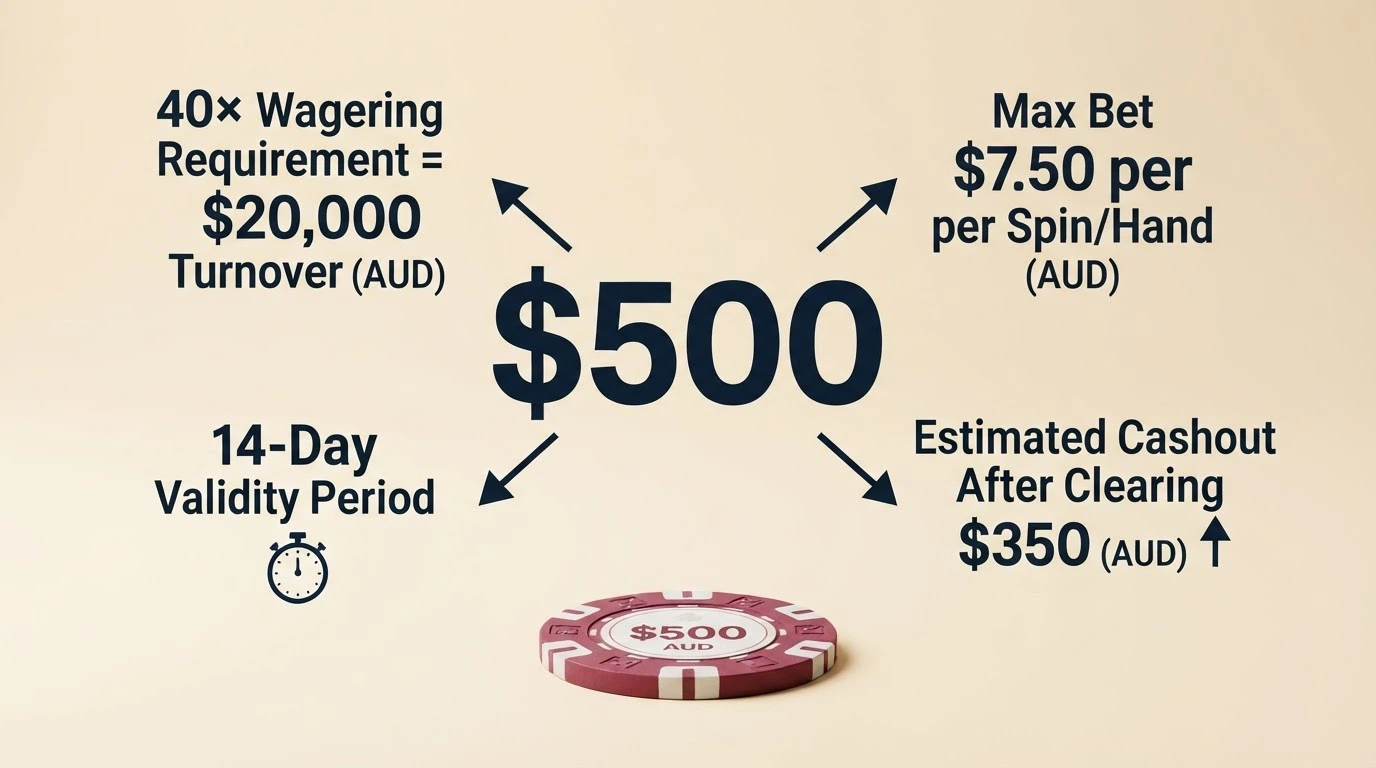
Take a concrete example. RocketPlay’s first-deposit bonus is 100% up to A$500 plus 100 free spins, with 40× wagering on the bonus amount and an A$7.50 maximum bet during wagering. The player who deposits A$500 receives a A$500 bonus and has to wager A$20,000 — forty times the bonus amount — before the bonus balance becomes withdrawable cash. At A$1 per spin, that is 20,000 spins. At five seconds per spin, that is 100,000 seconds of play — about 27.8 hours of continuous spinning, with the A$7.50 cap meaning the player who speeds it up by raising the bet size loses the bonus and the winnings derived from it.
That is the real cost of one of the cleaner welcome packages in this ranking. The 450% match at SkyCrown is bigger, but the wagering runs on deposit plus bonus rather than bonus alone, and the validity window is 14 days — meaning the A$8,000 headline bonus has to be cleared in a fortnight. The 200% match at WinSpirit is bigger again, and the 40× wagering sits at the heavier end of what this ranking offers. The headline number and the wagering requirement move in opposite directions, more or less by design.
The mechanics behind the headline are the same at every operator on this list. A bonus is not free money. It is a commitment to play a specified amount, at a specified maximum bet, within a specified time, on games the operator has approved, with the operator reserving the right to void the bonus and any winnings derived from it if any of those conditions are breached. The player who treats the bonus as a gift is the player the bonus is designed to capture.
Welcome Bonuses Compared: What Each Operator Actually Gives You
The welcome packages in this ranking fall into a few structural shapes, and the player who knows which shape is theirs will read the table at the top of this page more clearly.
Single-deposit clean matches — RocketPlay and Royal Reels, with 100% matches at A$500 and similar terms — are the easiest to value because the calculation is straightforward: deposit, claim, clear. The wagering is 30–40×, the maximum bet is A$7.50 or close to it, and the player who reads the terms once will not be surprised.
Multi-deposit packages — SkyCrown’s 450% across four deposits, Bizzo’s A$7,250 plus 175 free spins across four deposits, Fair Go’s 100% match redeemable five times — carry the biggest headline numbers and require the most commitment from the player. SkyCrown’s headline is A$8,000, but the player has to fund four deposits to claim it, and the terms apply to all four.
Stake runs a rakeback alternative without a traditional welcome, paying a percentage of the house edge back over time. For a high-volume player who would clear a welcome package anyway, the rakeback structure often pays more than a one-time match. For a casual player, the model is harder to evaluate against the rest of the field.
No-deposit sweeteners — Royal Reels’ A$10 for new sign-ups, Fair Go’s A$15 no-deposit chip, Bizzo’s 10 free spins for the PWA install — let a player open an account and try the site without committing bankroll, with the wagering and cashout caps calibrated against meaningful withdrawals.
No-Deposit Bonuses: Free Play with Strings Attached
The no-deposit offer exists at three of the ten featured operators in this ranking, and the rest of the field largely skips the format. Royal Reels runs an A$10 no-deposit bonus for new sign-ups at the standard 30–40× wagering. Fair Go runs an A$15 no-deposit chip at 60× wagering with a maximum cashout cap commonly near A$180. Bizzo runs 10 no-deposit free spins for installing the PWA app, with 40× wagering on the free-spin winnings and a A$75 win cap.
The strings are the point. A no-deposit bonus costs the operator almost nothing — it is the marketing cost of an account signup — and the wagering multiples and cashout caps are calibrated to ensure that the player rarely walks away with real money. Fair Go’s A$15 chip at 60× wagering means A$900 of turnover before any withdrawal is possible, and the A$180 max-cashout cap means that even if the player clears the wagering, the maximum withdrawal is A$180. The expected value of the offer depends on the games the player uses to clear the wagering and the RTP of those games; the structural ceiling is the A$180 cap.
For a player, the right read on a no-deposit bonus is that it is a way to evaluate the casino rather than a way to make money. The player who clears the wagering, hits the cashout cap and withdraws the maximum has won the structural offer — and the structural offer is rarely more than a hundred or two. The player who tries to grind a no-deposit chip into a meaningful bankroll will find the wagering, the cap and the game restrictions have all been designed against that outcome.
Free Spins: Which Operators Give Them and What They Are Worth
Free spins are the most common sweetener in the welcome packages on this ranking. RocketPlay runs 100 with the first deposit. SkyCrown runs 400 across four deposits, tied to Wolf Treasure, Coin Volcano, 15 Dragon Pearls and Mighty Wild: Panther. Rainbet runs 50 at A$0.25 per spin. WinSpirit runs 25 with the welcome. Bizzo runs 175 across four deposits. Fair Go does not run free spins as part of its standard welcome.
The per-spin value varies, and that variation matters more than the headline count. A free spin at A$0.10 is worth less than a free spin at A$0.25, and 100 spins at A$0.10 is worth less than 50 spins at A$0.25 even though the count is higher. Rainbet’s 50 at A$0.25 per spin is more transparent than most operators in this ranking — the per-spin value is named, and the player can do the multiplication.
The structural terms are where free-spin offers tend to be misunderstood. Most operators run separate wagering on free-spin winnings — typically 40× — and most operators lock the spins to specific titles. The 400 free spins at SkyCrown are tied to four named pokies, and the player who wants to use them on a different game cannot. The drip-feed is the other common feature: some operators release free spins at a rate of 10 per day rather than dropping all 100 at once, which means the offer has to be active for ten days to be fully claimed.
The honest read on free spins is that they are worth what the per-spin value, the wagering and the game restriction make them worth, and the count is the least informative of the three numbers. A player who compares operators by free-spin count is reading the smallest number on the offer.
Wagering Requirements: The Number That Decides Whether You Keep Anything
The wagering requirement is the single most important term in any bonus, and it is the term the marketing spends the least effort on. A 40× wagering multiple on a A$500 bonus means A$20,000 of turnover before the bonus becomes withdrawable. A 40× wagering multiple on a deposit-plus-bonus A$500 deposit with a A$500 bonus means A$40,000 of turnover — twice the cost for the same headline number.
The three structures in this ranking are bonus-only, deposit-plus-bonus, and combined. RocketPlay runs 40× on the bonus amount. SkyCrown runs 40× on deposit plus bonus. Fair Go runs 30× on deposit plus bonus combined. Bizzo runs 40× on deposit plus bonus. Rainbet runs 35× on the bonus amount. The range is 30× to 40× across the featured set, and the structural difference matters as much as the multiple.
The maximum bet cap interacts with the wagering multiple. RocketPlay and SkyCrown both run at A$7.50 max bet during wagering. Bizzo runs at A$8. The cap prevents the player from clearing the wagering requirement quickly by raising the bet size — a player who could otherwise wager through A$20,000 in an hour at higher stakes has to spin at A$7.50 or below, which slows the clearance and lengthens the time the player is exposed to the house edge. The cap is the operator’s defence against a player who would otherwise treat the bonus as a one-hour arbitrage.
The practical time cost is the number a player should care about most. A player clearing A$20,000 of turnover at A$1 per spin and five seconds per spin is looking at 27.8 hours of continuous play, by the calculation earlier in this section. The player who has not done that arithmetic tends to be the player who runs out of time inside the validity window — and most operators in this ranking set the validity window at 14 days or shorter.
How Fast Crypto Casino Withdrawals Actually Reach Your Wallet
Crypto’s speed promise is the most legitimate part of the marketing. Withdrawals at the operators in this ranking settle in under five hours on average, and the fastest — Stake at one hour fifty minutes across four test cycles — is materially faster than what an Australian gets withdrawing fiat from most licensed operators. The “instant withdrawal” claim that appears in casino marketing is not literally true, but it is closer to accurate here than at any other corner of the gambling market.
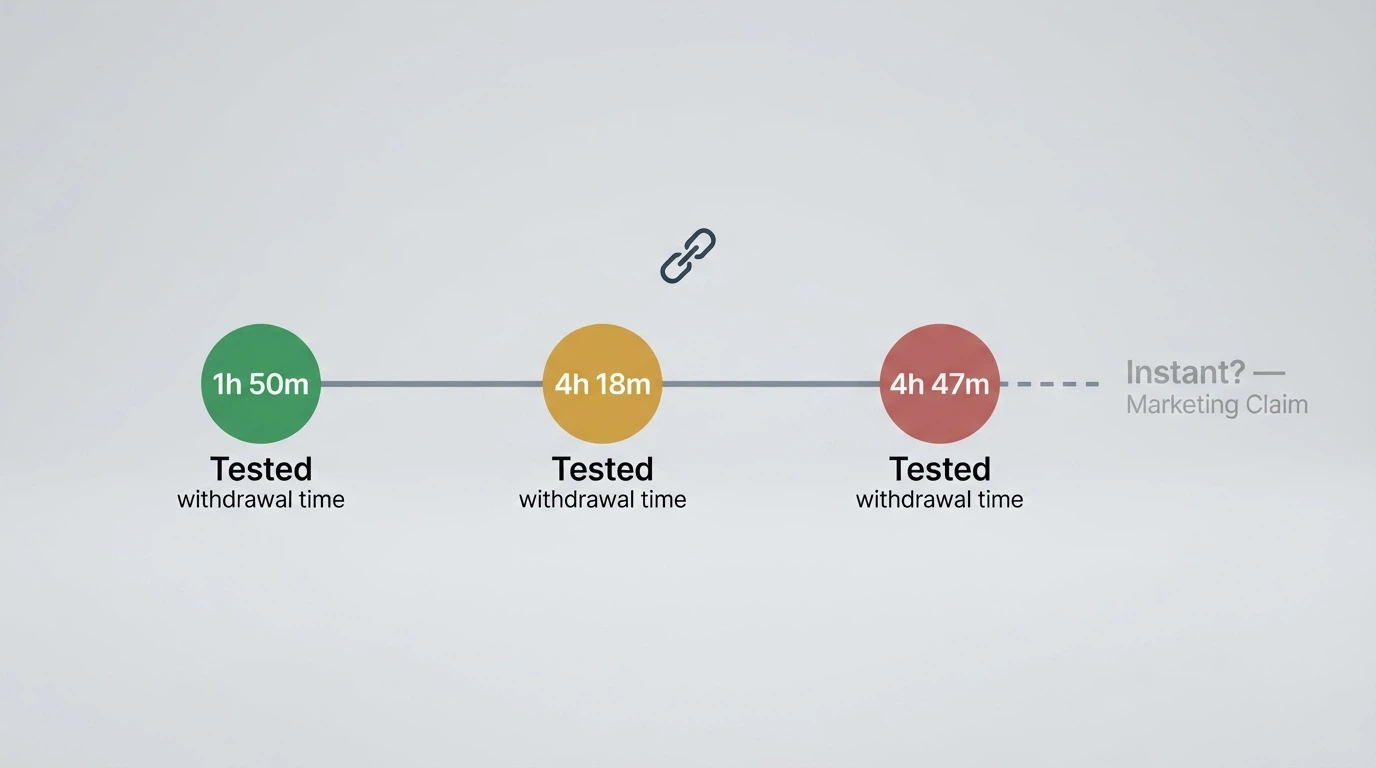
The gap between marketing and reality is worth understanding. “Instant” in the marketing means the casino has released the funds from the player balance the moment the withdrawal is requested — which is the operator-side step, and it does happen in seconds. The remaining time is the blockchain confirmation, which is the part the operator does not control. USDT on TRC20 confirms in roughly sixty seconds. Bitcoin confirms in roughly ten minutes for the first confirmation, with subsequent confirmations following over the next hour. Ethereum sits in between. The two-to-five-hour tested averages include the queueing time inside the casino’s payments team, the soft-KYC check, and the blockchain confirmation. The fastest tested cycle is the operator clearing the withdrawal immediately and the blockchain confirming on the first block; the slowest is a queueing delay before the operator-side release.
The soft-KYC trigger is the variable that can freeze a fast withdrawal. Most offshore operators will process withdrawals automatically up to a cumulative threshold — typically in the A$2,000 to A$5,000 range — and require identity verification above that line. A player who hits the threshold for the first time on a withdrawal that the casino would otherwise release in minutes can find the withdrawal held for the identity check, which adds hours or days to the timeline. The threshold is not always published; the player should treat any withdrawal as potentially the one that triggers it.
How to Deposit Crypto from Australia: The Step-by-Step Route
The Australian path from fiat to offshore casino has been stable for several years. The first hop is funding an Australian cryptocurrency exchange account from a bank account — the bank friction varies, with CommBank and Westpac restricting large outbound transfers to known crypto exchanges, ANZ and NAB flagging without fully blocking, and ING and Macquarie generally permissive. The second hop is exchanging AUD for USDT on the TRC20 network at CoinSpot or Independent Reserve, the two exchanges Australians use most often. The third hop is withdrawing USDT TRC20 from the exchange to the casino’s deposit address. The fourth is the casino crediting the player balance, which usually takes one blockchain confirmation and arrives in minutes.
The AUSTRAC exchange verification sits inside the first hop. From 29 September 2024, all online gambling service providers must complete applicable customer identification procedures before creating an account or commencing to provide any designated service, and the exchange has already verified the player’s identity by the time the AUD is converted. The Travel Rule threshold at A$10,000 is the upper boundary at which a crypto transaction becomes automatically reportable to AUSTRAC. A player who has funded the exchange through normal banking channels has been identified at the exchange level, regardless of whether the casino itself ever asks.
Crypto Pokies in 2026: What Australian Players Are Actually Spinning
Pokies is the term an Australian player uses for what the rest of the world calls slot machines, and pokies dominate the catalogue at every crypto casino on this ranking. The game count at Bizzo is over 8,000; at SkyCrown it is over 7,200; at Royal Reels it is over 2,000; at Fair Go it is whatever RealTime Gaming has released in the last fifteen years, which is a recognisably old-school set. The pokies the player spins at an offshore crypto casino are mostly the same titles the player would find at a licensed venue with an online casino product — if such a thing existed in Australia.

The provider ecosystem is what defines the catalogue. Pragmatic Play is the most visible studio in the offshore crypto space, and the names that come up most often — Gates of Olympus, Sugar Rush, The Dog House, Sweet Bonanza — are Pragmatic Play titles. Evolution Gaming runs the live casino product across most of the operators in this ranking, with the live-dealer game shows (Crazy Time, Monopoly Live, Lightning Roulette) anchoring the live tab. Yggdrasil, Hacksaw Gaming, Nolimit City and Play’n GO round out the modern end of the catalogue. RealTime Gaming is what Fair Go runs exclusively.
The pokies themselves work the same way regardless of the payment rail. The reels, the paylines, the bonus rounds, the volatility — none of that changes because the player deposited in USDT instead of AUD. The return-to-player percentage is set by the game studio and audited by the testing labs the studio works with, and the casino has no ability to alter the RTP of an individual title without the studio’s involvement. The provably-fair mechanic is a separate category that exists at some crypto-native operators, mostly for in-house games like dice, crash and plinko rather than for the major-studio pokies.
The Providers Behind the Reels: Who Makes Australian Crypto Pokies
The provider mix is the signal of catalogue quality. An operator that lists thirty or more providers has done the integration work and is paying its suppliers on time, which is a weak but real proxy for being in business next month. An operator that lists one provider has either made a strategic choice (Fair Go’s RTG-only bet) or has not done the integration work, and the player should read it accordingly.
RocketPlay runs thirty or more providers, including Pragmatic Play, Evolution Gaming, Yggdrasil and Hacksaw Gaming. Bizzo runs seventy-plus studios and over 8,000 games, which is the breadth benchmark in this ranking. Royal Reels runs thirty or more. SkyCrown’s 7,200+ games imply a comparable provider breadth, though the operator does not name the full list publicly. Fair Go runs RTG only, which is the narrowest catalogue in this ranking and the most stylistically distinctive.
The player who values breadth picks Bizzo or SkyCrown. The player who values a curated set picks Fair Go. The player who values a specific studio’s catalogue — most often Pragmatic Play’s Gates of Olympus series or Hacksaw’s Wanted-style games — should check the operator’s game library directly rather than trust the headline count. An 8,000-game catalogue is no guarantee that any specific title is in it.
New Crypto Casinos in 2026: What Is Worth a Look
The newest entrants to the offshore crypto casino market change every few months, and a guide written at any moment is partially out of date by the time it is published. What does not change is the evaluation framework. A new casino is only as good as its licence, its wagering terms, its provider mix and its independent safety rating — and a player applying the same checklist to a new entrant that this guide applies to the established operators will land in roughly the same place.
The track record is the thing a new casino cannot have. Bizzo launched in 2021 under TechSolutions Group N.V. and now carries an 8.4 Safety Index, over 8,000 games, and a four-deposit welcome package the operator has refined over five years. None of that was true on day one. A player evaluating a new casino is evaluating the operator’s claims with no independent track record to weigh them against, and the Casino.Guru Safety Index is the closest proxy — but the index is built partly from complaint history, which takes time to accumulate.
The practical advice is to apply the same checklist this guide applies elsewhere. Curaçao licence — yes or no. Welcome package wagering — bonus only or deposit plus bonus, and what multiple. Free spin count and per-spin value. Provider list and game count. Independent safety rating if available. Soft-KYC threshold and policy. Withdrawal speed if tested. The player who has run this checklist on the established operators can run it on a new entrant in fifteen minutes, and the answer is usually that the new casino is either a thinner version of an established operator or a copy of one with worse terms.
Staying in Control: Responsible Gambling Tools That Actually Work
The scale of gambling harm in Australia is large enough that the responsible gambling section of any guide has to lead with the numbers rather than the tools. In the twelve months to March 2026, Australians lost A$36.0 billion to gambling — an increase of A$1.3 billion from the A$34.3 billion lost in the twelve months to March 2025. As of March 2026, 15.1% of the Australian adult population — an estimated 3.32 million people — are experiencing some level of harm from their own gambling behaviours or those close to them, with 13.0% (2.857 million) experiencing harm from their own gambling. Approximately 3.29 million Australians aged five and over are affected annually by gambling harm, with an estimated 1.97 million adults classified as having at-risk or problem gambling and over 400,000 Years Lived with Disability annually. About 2.1% of Australian adults — roughly 430,000 people — experience problem gambling, with high-risk gambling at 1.8%, per the Australian Institute of Health and Welfare in 2022.
The tools that work are the ones that bind the licensed market. BetStop — the National Self-Exclusion Register — launched on 21 August 2023 and has 59,830 registrations by 31 March 2026, with 37,247 active exclusions. 78% of registrants were under 40, and 38% chose lifetime exclusion. 77% of people who registered for self-exclusion from online and phone wagering services reported a better overall quality of life. The National Consumer Protection Framework for Online Wagering includes ten measures: no line of credit for gamblers, strong identity and age verification, restricted incentives and account sign-up offers, easy account closing, the offer of deposit limits, monthly activity statements, and consistent responsible gambling messaging.
The hard limit is that none of these tools reach an offshore crypto casino. BetStop binds Australian-licensed wagering services; an offshore casino is not licensed in Australia, is not connected to the register, and will continue accepting a self-excluded person’s money. The player who has registered with BetStop and then turns to crypto gambling to keep playing has found a hole in the wall — and the wall was built for them. The ACMA’s blocking power means an offshore casino can be made harder to reach, but the same operator can reappear at a new domain, and the player who is determined to fund the account will find a route.
Where to Get Help: Australian Gambling Support Services
The help infrastructure is free, confidential, and available around the clock regardless of where a person gambles. The National Gambling Helpline is 1800 858 858 — free, confidential, staffed 24 hours a day, 7 days a week — with online chat and counselling available through Gambling Help Online. BetStop is the National Self-Exclusion Register, covering every Australian-licensed online and phone wagering service in a single registration. The Gambling Harm Scales, developed by Central Queensland University, are a self-assessment tool used in the Roy Morgan Gambling Harm Index — ten key questions that capture the financial, emotional and social impacts of gambling. State-based services — Gambler’s Help in Victoria, Gambling Help in New South Wales, Queensland, South Australia and Western Australia, and Relationships Australia — provide face-to-face and telephone counselling. The Australian Government is expanding specialised financial counselling services for people experiencing gambling harm as part of the 2026 reform package.
The number to call is the same from anywhere in Australia. The 1800 858 858 line routes to the state-appropriate service, and the call is free from any phone. The online chat at Gambling Help Online is the equivalent for people who would rather type than talk, and the self-assessment tools at the same service help frame whether the level of gambling someone is doing has crossed a line. None of these tools require the caller to be gambling with a licensed operator. They are for anyone.
How We Selected and Ranked These Crypto Casinos
The ranking on this page is built on four sources. The primary sort is the market-share data carried by the operator-skill research, which ranks operators by Australian-facing traffic and revenue. The second is the Casino.Guru Safety Index, a composite score built from complaint history, terms fairness, payment reliability and licensing. The third is independent withdrawal-speed testing, which has measured crypto withdrawal times across multiple cycles at Stake, BitStarz and Wild Fortune. The fourth is a cross-check against the ACMA register of blocked illegal gambling services and the Australian Communications and Media Authority’s enforcement data.
The ranking criteria are, in order: market share, bonus terms, game breadth, independent safety rating, withdrawal speed where tested. Every operator in the table at the top of this page was checked against the ACMA register, and none holds an Australian licence. The ranking does not weight licence type beyond the absence of an Australian one — every Curaçao licence is treated as equivalent to every other Curaçao licence, which is not strictly true but is the honest simplification given the data available.
What this ranking is not: it is not an endorsement, it is not a safety guarantee, and it is not a recommendation to deposit at any specific operator. Every operator listed is offshore and unlicensed in Australia. The ranking is an ordering by market share and the independent signals the research could verify, and a player who picks the top-ranked operator is picking the operator with the largest Australian-facing presence and the best verifiable record — not the operator where they will have a problem-free experience.
The Bottom Line: What Australian Players Should Actually Do About Crypto Casinos
Three things this page has laid out, each worth weighing separately.

Every crypto casino an Australian plays at is offshore, with no Australian consumer protection. The Interactive Gambling Act 2001 prohibits the product, the crypto payment ban that took effect on 11 June 2024 has hardened that prohibition against the licensed side, and the offshore operator is by definition outside the BetStop register, the National Consumer Protection Framework, the state-based complaints bodies, and every other consumer safeguard the licensed market provides. The Curaçao licence most operators carry grants existence and a regulator to answer to in some form; it does not grant an Australian player recourse.
The bonus headline number is never the real value. A 100% match up to A$500 with 40× wagering on the bonus means A$20,000 of turnover before any withdrawal — about 27.8 hours of play at A$1 per spin and five seconds per spin. A 450% match up to A$8,000 with 40× on deposit plus bonus and a 14-day validity is a bigger commitment for a tighter window. The bonus is a marketing tool, and the marketing is built to make the bonus feel like free money.
The help tools exist but only for licensed services. BetStop has nearly 60,000 registrations and a 77% self-reported improvement in quality of life. The National Gambling Helpline at 1800 858 858 is free, confidential and available 24/7. None of this reaches the offshore casino. The player who has registered with BetStop and then deposited at an offshore crypto casino has found a hole the regulatory environment was not designed to close.
The choice that follows is the player’s. If the player is going to play, the responsible reading of this guide is to check the licence, read the wagering terms before depositing, know the soft-KYC trigger at roughly A$2,000 to A$5,000 cumulative withdrawals, and set a personal limit the site will not enforce for them. The alternative is licensed Australian wagering — sports and race betting only, no online casino — which comes with BetStop coverage, monthly activity statements, deposit limits, and a real complaints body. The convenience and bonus value of the offshore casino is real; the protections the player leaves behind are also real. This page equips the comparison. It does not direct the choice.
Frequently Asked Questions
Are crypto casino winnings taxable in Australia?
Player gambling winnings are generally not assessable income in Australia under section 6-5 of the ITAA 1997, unless the activity amounts to carrying on a business of gambling. Losses are not deductible under section 8-1. The offshore casino does not change the Australian tax treatment, though no Australian documentation infrastructure exists to support the player.
What happens if an offshore crypto casino refuses to pay out — can I get my money back?
No. There is no Australian complaints body with enforcement power over an offshore crypto casino. The Curaçao regulator can investigate if the casino holds a Curaçao licence, but the processes are slower than the Australian equivalents. The practical answer is no recourse if the operator refuses a withdrawal or voids winnings.
What cryptocurrencies do Australian-facing crypto casinos actually accept?
Bitcoin, Ethereum, Litecoin and Tether on the TRC20 network are the standard. USDT TRC20 is the workhorse because the fees are negligible and the confirmation times are short. Some operators accept Bitcoin Cash, Dogecoin and Ripple. The AUSTRAC Travel Rule applies at A$10,000 for any crypto transaction.
Why do Australian banks sometimes block transfers to crypto casinos?
Australian banks have been restricting outbound transfers to known crypto exchanges since at least 2023, with CommBank and Westpac the most restrictive and ING and Macquarie the most permissive. The reason is AML/CTF compliance — the bank is a reporting entity under AUSTRAC’s framework. From 1 January 2027, banks gain express authority to block transactions to illegal gambling operators.
Does BetStop cover offshore crypto casinos?
No. BetStop binds every Australian-licensed online and phone wagering service in a single registration, and an offshore casino is not licensed in Australia. The self-excluded player who turns to crypto gambling to keep playing will find the site accepts them without question. None of BetStop’s benefits reach the offshore casino.
Can I use PayID at a crypto casino from Australia?
Some operators — Bizzo is the clearest example in this ranking — support PayID for both deposits and withdrawals. Most do not, instead routing the AUD leg through a crypto exchange. PayID is an Australian instant bank transfer system that settles in seconds. PayID does not change the offshore status of the casino using it.
Provably Fair vs Traditional RNG: Does It Matter for Australian Players?
Provably fair is the trust mechanism that distinguishes crypto-native operators from the rest of the market. The mechanic works by hashing the server seed before the bet, revealing the hash to the player, and using the server seed combined with the client seed and a nonce to determine the outcome — the player can verify after the fact that the server seed used was the one hashed before the bet. The verification is cryptographic, not regulatory, which is the appeal.
Provably fair applies mostly to in-house games — dice, crash, plinko, the simple multiplier games that crypto-native operators invented. It does not apply to the major-studio pokies that dominate the catalogue. Pragmatic Play slots use a traditional random number generator audited by independent testing labs (GLI, eCOGRA, iTech Labs) and certified by the studio’s licences. The audit trail is regulatory, not cryptographic, and the player who wants to verify a Pragmatic Play game’s fairness checks the testing lab’s certification rather than running a hash check.
For an Australian player, the practical conclusion is that the pokies catalogue at an offshore crypto casino is governed by the same kind of testing infrastructure as the pokies catalogue at a licensed venue — independent labs, certification, and the studio’s reputation on the line. Provably fair is a real and useful mechanism for the games it covers, and a non-factor for the pokies an Australian player will actually spend most of their time on.
Written by the editors at Pokies Melbourne.