
Casino bonus codes in Australia — and what the small print really costs
A bonus code looks like free money. In Australia it is rarely even legal. The codes floating around Australian-facing search results unlock offers at offshore casinos — sites with no Australian licence, no BetStop coverage, and no Australian consumer protection when a balance disappears overnight. What the codes actually give a player is a small credit or a batch of free spins wrapped in three constraints that decide what walks out the other end: wagering requirements, max cashout caps, and an expiry clock. Read this page to understand what each code is, what it costs, and why the offer underneath is the same shape at every operator.
Checked against the ACMA register of licensed interactive gambling providers as at 17 October 2026; operator and harm figures drawn from ACMA, Roy Morgan Research and AIHW publications.
Table of Contents
- What a Casino Bonus Code Is — and Why the “Free” Label Lies
- Every Casino Bonus Code Type You’ll Meet — and What Each One Costs You
- Offshore Casinos With Bonus Codes: What Australian Players Actually Get in 2026
- Why Every Casino Bonus Code in Australia Sits Outside the Law
- The Gambling-Harm Numbers Australia’s Bonus-Code Pages Don’t Show You
- How We Selected and Compared the Operators on This Page
- What Australian Players Should Actually Do About Casino Bonus Codes
- Frequently Asked Questions
What a Casino Bonus Code Is — and Why the “Free” Label Lies
A casino bonus code is an alphanumeric string a player enters at registration, deposit, or in a cashier field that unlocks a promotional offer the site would not otherwise credit. The string is the marketing layer; what sits behind it is a defined package with a dollar value, a wagering multiple, a max cashout ceiling, and an expiry window. That package is the offer. The code is just the key. Without it the offer would not appear on the player’s account; with it the offer appears under those four constraints.
Australian players will not find a licensed source for these codes. No Australian regulator publishes a list of working bonus codes, because online casino is not a licensable product anywhere in the country. The Interactive Gambling Act 2001 prohibits providing online casino games, online pokies, and in-play betting to people physically in Australia, and there is no state or territory that issues a casino licence to an offshore operator. Every code on every list a player encounters is for an offshore site. The individual player is not prosecuted, but the prohibition shapes the market from the supply side: codes float through affiliate pages, aggregator sites, and casino on-site promo pages, not through any Australian register.
The tension the marketing builds around the word “free” is the single biggest gap between the offer and what the player actually walks away with. A “free” A$10 chip is not A$10 of withdrawable cash. It is A$10 of credit that must be wagered many times over before any balance converts, with a ceiling on what can be withdrawn, and a clock running the moment the bonus is credited. The structural reason the casino can hand out “free” credit at all is that the four constraints converge to make the expected value of the bonus lower than its face value for almost every player who claims it. The house still has its edge. The bonus only changes which player pays it, and how quickly.
What a casino bonus code actually is
At its simplest, a bonus code is the difference between a generic welcome offer and a tailored one. Most offshore casinos run automatic welcome bonuses on the first deposit — the player does nothing, and a match percentage credits to the account. A code-gated offer does the same thing, but only when the player types the right string into a field. The three things a code typically unlocks are a batch of free spins on a named pokie, a free chip (a small notional balance the player can wager), or a deposit-match bonus (the casino matches a percentage of the player’s deposit up to a stated cap). Free spins and free chips are the formats most often attached to no-deposit codes; deposit-match codes are typically automatic and rarely require a string at all, but a few affiliates still publish match codes for operators that way.
The values a code unlocks in the AU offshore market fall into well-defined bands. No-deposit chips typically run from AU$5 to AU$20, with some larger offers going to AU$50 or above; no-deposit free spin bundles typically run from 20 to 100 spins, with the per-spin stake fixed at a low denomination the casino chooses. Deposit-match offers scale with the deposit and run on percentage multipliers. The code is the gate; the offer it gates is what the player actually receives, and the offer is structured to make the player’s expected outcome close to the house edge the casino already runs.
How a bonus code works from entry to play
Every code follows the same four steps whether the offer is no-deposit or deposit-match: register, verify, enter the code, play. What changes between offers is whether the first step asks for money. A no-deposit code skips the deposit and asks for registration, then asks for verification — usually email confirmation and a mobile phone number, with some operators gating the bonus behind a phone-verification step the player cannot skip. A deposit-match code asks the player to deposit first, then enters the code at the cashier or in the bonus field before the deposit is finalised.

The verification step is where most players lose time. Offshore casinos that offer a no-deposit spin bundle often require the same Know Your Customer checks a deposit player would face — name, address, date of birth, mobile number — before the bonus credits. Skycrown’s 100 no-deposit free spins are gated behind mobile phone verification, which is the standard rather than the exception. The verification is the casino’s defence against multi-accounting, and the player’s last chance to walk away before any wagering starts.
Once the bonus is credited, the wagering clock begins. Every spin or chip-wager the player makes on an eligible game counts toward the requirement; games contribute at different rates. The bonus remains in the account as a separate balance until the wagering is complete, the max cashout is hit, or the expiry window closes. The first of those three outcomes converts the bonus balance to real money; the other two return the bonus to the casino and keep any small real-money residue. The structure is the same at every offshore site. Only the numbers change.
Where Australians find working bonus codes in 2026
Three places. First, affiliate aggregator pages — the long listicles on Pokiesaustralia.com, BestOnlinePokies, VegasPokie, NewCasino.ai, Laneway Finance, Gambling Insider, and TV1 News that dominate the search results for this topic. These pages rank a handful of operators, copy the latest code strings, and post the wagering and cashout figures the casino has on its own terms page. They are the primary source, and they exist because no Australian regulator publishes the list and no operator with an AU licence exists to publish it either. Second, the casino’s own promo page, where the code sits under a banner and a countdown timer. Third, the casino’s email and SMS list, where personalised codes are sent to players who have already registered and verified.
Codes decay fast. A code live on an aggregator page in June is often dead in July, either because the affiliate string has been replaced or because the operator has rotated the offer. The aggregator pages refresh on a weekly cadence at best; the casino’s own terms change on the same cycle. A player who treats a posted code as permanent is treating marketing material like a contract, and the disappointment is often the only real outcome.
The real cost behind the “free” claim
Three constraints govern every bonus code, and they always appear together. Wagering is the multiplier the bonus balance must pass through before it converts to withdrawable cash — a 60x wagering requirement on a A$10 chip means A$600 of total bets before any withdrawal is possible. Max cashout is the ceiling on what a player can walk away with from bonus-derived winnings — typical no-deposit caps sit between AU$50 and AU$200. Expiry is the clock: 24 to 72 hours to claim the offer once the code is entered, and typically seven days to clear the wagering once the bonus is credited.
The fourth constraint is the one that voids the bonus if it is breached. Most offshore casinos cap the maximum bet at A$5 per spin while wagering is active; exceed it, and the casino reserves the right to void the bonus and any winnings from it. The cap is the casino’s defence against a player staking the entire bonus on a single high-variance spin and walking away with a large balance that the casino would have to honour under the cashout cap. A player who respects the cap spends most of their session below it; a player who tests it once has forfeited their bonus. The rule is buried in the terms page. Most players meet it only after they have lost the bonus.
The structural reason a casino can afford to give A$10 of “free” credit is that the wagering and cashout constraints converge on a negative expected value for almost every player. The chip is small, the wagering is heavy, the cashout is capped, and the expiry is short. Each constraint on its own would not be enough to flip the offer against the player. Stacked, they produce a credit whose expected return sits below its face value, with the difference accruing to the house. “Free” is the marketing word. The small print is the price.
Every Casino Bonus Code Type You’ll Meet — and What Each One Costs You
Five bonus-code categories dominate what an Australian player encounters in the offshore market, and they sort on one question: whether the offer requires a deposit. No-deposit codes, free-bonus codes, and register-with-code offers sit on the no-deposit side; deposit-match codes sit on the deposit side; mobile-only codes are a narrow third category that gates offers by device. The common thread is that every one of them carries wagering. The single biggest variable between them is whether the player has already paid for the privilege of entering the code.
The wagering attached to each type is the structural reason the offers are not interchangeable. No-deposit offers carry the highest multipliers — typically 40x to 60x on the bonus amount — because the casino has handed out credit without taking a deposit in return. Deposit-match offers carry lower multipliers because the casino has the player’s deposit as collateral; the typical band runs from 30x on the bonus-only to 50x or above on deposit-plus-bonus. The difference between those two figures on the same offer can double the turnover the player has to run. The next section works that arithmetic with a real example.
No-deposit bonus codes
A no-deposit code asks for zero money and unlocks either a small chip or a batch of free spins. The typical chip value in the AU offshore market sits between AU$5 and AU$20, with larger chips occasionally going to AU$50 or above; the typical spin bundle runs from 20 to 100 spins, with winnings capped at AU$50 to AU$100. The wagering attached to these offers is the steepest on the site — 40x to 60x on the bonus amount is common, well above the 30x to 35x that sits at the fairer end of the deposit-match market. The cashout ceiling finishes the squeeze: even when a player runs the wagering and wins, the max cashout caps what walks out at AU$50 to AU$200.

The structure is intentional. The casino has handed out credit without collecting a deposit, so it must charge a higher multiple to bring the expected value of the offer back to its favour. A player who claims a A$10 chip at 60x wagering must generate A$600 of total bets before the bonus balance converts to real money, and the entire A$600 sits under a ceiling of A$150 to A$180. The expected return on those bets — at a typical pokie RTP in the mid-90s — is materially below A$600. The difference is what the bonus costs the player who claims it.
Deposit-match bonus codes
A deposit-match code unlocks the offer the casino would otherwise credit automatically: a percentage match on the player’s deposit, up to a stated cap. The standard market structure in the AU offshore segment is a 100% match up to a few hundred dollars, with the casino matching dollar for dollar on the first deposit and sometimes stretching the offer across the first two, three, or four deposits. The critical variable is what the wagering multiplier applies to. A 30x wagering requirement on the bonus only is materially different from a 30x requirement on the deposit plus the bonus.
A worked example makes the difference concrete. A 100% match up to A$500 at 30x on the bonus only means the player deposits A$500, the casino matches with A$500 of bonus, and the player must wager A$500 × 30 = A$15,000 of total bets before the bonus converts. The same A$500 match at 30x on deposit plus bonus means the player must wager A$1,000 × 30 = A$30,000 of total bets — twice the turnover for the same headline offer. The headline is identical. The turnover is not. Operators that publish their wagering as “bonus only” are offering materially better terms than operators that publish it as “deposit + bonus” — and many listicles bury that distinction in the small print.
The fairer end of the AU offshore market in 2026 sits at 35x bonus-only wagering, with most reputable operators clustering around 30x on bonus only. The hostile end sits at 50x or above on deposit plus bonus — the kind of structure that turns a A$500 deposit into A$25,000 of turnover before any withdrawal is possible. Two examples anchor the spread. King Billy runs a multi-tier welcome up to A$2,500 plus 250 free spins across the first four deposits at 30x bonus only, one of the more generous structures currently visible in the AU offshore segment. Boomerang offers a 100% match up to A$750 plus 200 free spins at 30x bonus only, with the first bonus alone requiring up to A$22,500 in turnover. Both are deposit-gated; both carry a real cost; both are cheaper than the no-deposit tier sitting above them in any aggregator list.
Free-bonus and free-chip codes
A free-bonus code and a free-chip code are functionally the same thing: a small notional balance the casino credits without a deposit, playable on a defined set of games, with a fixed stake per spin if the bonus is delivered as free spins rather than a chip. The typical spin count is 20 to 100, with winnings capped at AU$50 to AU$100; the typical stake per spin is fixed at A$0.10, A$0.20, or A$1.00, depending on the operator. The withdrawal ceiling on free-bonus winnings is the constraint that makes the offer feel smaller than its headline: a player who hits a five-figure spin on a 50-spin bundle at A$0.20 per spin still walks away with whatever the cashout cap allows, not the screen value.
A worked example, using Fair Go’s A$10 no-deposit chip at 60x wagering, makes the cost legible. The required turnover is A$10 × 60 = A$600. At a typical A$0.20 spin — the midpoint of the fixed-stake band most offshore casinos use — that is A$600 ÷ A$0.20 = 3,000 spins. At roughly five seconds per spin, that is 3,000 × 5 = 15,000 seconds, or about four hours and ten minutes of continuous play. None of it is guaranteed to clear the bonus. At a typical pokie RTP in the mid-90s, the expected return on A$600 of bets is materially below the A$600 staked; the difference between stake and expected return is what the chip costs the player. And the cashout ceiling — A$150 to A$180 on a chip of this size — means a player who converts the bonus to real money still walks away with less than twenty times the face value of the credit they were given.
Register-with-code offers
A register-with-code offer is the bonus that activates the moment a player signs up — no deposit, just a code at registration. The format is most often a no-deposit spin bundle or a no-deposit chip, identical in structure to the offers covered above, with the difference being the moment the code is entered. The verification step is the real gate. Offshore casinos that offer register-with-code no-deposit bonuses typically require the same KYC checks a deposit player would face — and the verification is the casino’s defence against multi-accounting, which is the easiest way to claim a no-deposit offer twice.
The bonus types a register-with-code offer most often unlocks are free spins and free chips, with deposit-match offers less common at the registration step. The wagering and cashout structure matches the no-deposit tier above — 40x to 60x on the bonus, AU$50 to AU$200 max cashout — because the offer is the same shape, just delivered at a different moment. A player who registers at an offshore casino, enters the code, and skips verification does not receive the bonus; a player who completes verification and meets the wagering has the same chance of converting it as a player who claimed a no-deposit code at the cashier. The structure does not change because the timing does.
Mobile-only bonus codes
A mobile-only code is a narrow category that gates an offer to a player claiming through a mobile browser or a casino app. The category exists because some offshore casinos reserve promotional strings for players who install their app or who load the cashier from a phone rather than a desktop, partly as a way to drive app installs and partly as a way to segment the bonus pool. The state of the category in 2026 is thin in the AU-facing offshore market. Most aggregator pages treat mobile as a delivery channel rather than a separate offer, and the codes that do carry a mobile-only modifier are short-lived — usually tied to a launch promotion for an app or a campaign the operator runs over a few weeks.
A player who sees a mobile-only code should check two things. First, whether the code is locked to the casino’s app or whether it works in a mobile browser; some operators exclude the browser entirely. Second, whether the wagering and cashout on the mobile offer differ from the desktop equivalent; the same operator can run materially different terms across the two channels, and a player who reads only the desktop terms will be reading the wrong ones. In practice, mobile-only codes in the current AU-facing offshore market are a small subset of the codes in circulation, and a player who cannot find a code that suits them on mobile can usually find the desktop equivalent at the same operator without losing much.
The fine print: wagering, cashout caps, expiry and game contributions
| Bonus Type | Typical Wagering | Typical Max Cashout | Typical Expiry | Pokies Contribution Rate |
|---|---|---|---|---|
| No-deposit chip | 40x–60x on bonus | AU$50–AU$180 | 24–72h to claim; 7 days wagering | 100% |
| No-deposit free spins | 40x–60x on winnings | AU$50–AU$100 | 24–72h to claim; 7 days wagering | 100% |
| Deposit-match (bonus only) | 30x–35x on bonus | Often uncapped | 7–30 days wagering | 100% |
| Deposit-match (deposit + bonus) | 30x–50x on combined | Often uncapped | 7–30 days wagering | 100% |
Pokies from Pragmatic Play, NetEnt, Hacksaw Gaming, and NoLimit City usually contribute 100% of each bet to wagering. Table games typically contribute 0% to 10%, depending on the operator; live dealer games through Evolution often contribute nothing at all. A player who runs a A$600 turnover on a no-deposit chip while playing blackjack at 10% contribution must generate A$6,000 of bets to clear the same wagering — a figure that turns the bonus from a four-hour grind into a multi-day one. Game selection is the lever the small print gives the player to either finish the bonus or fail it.
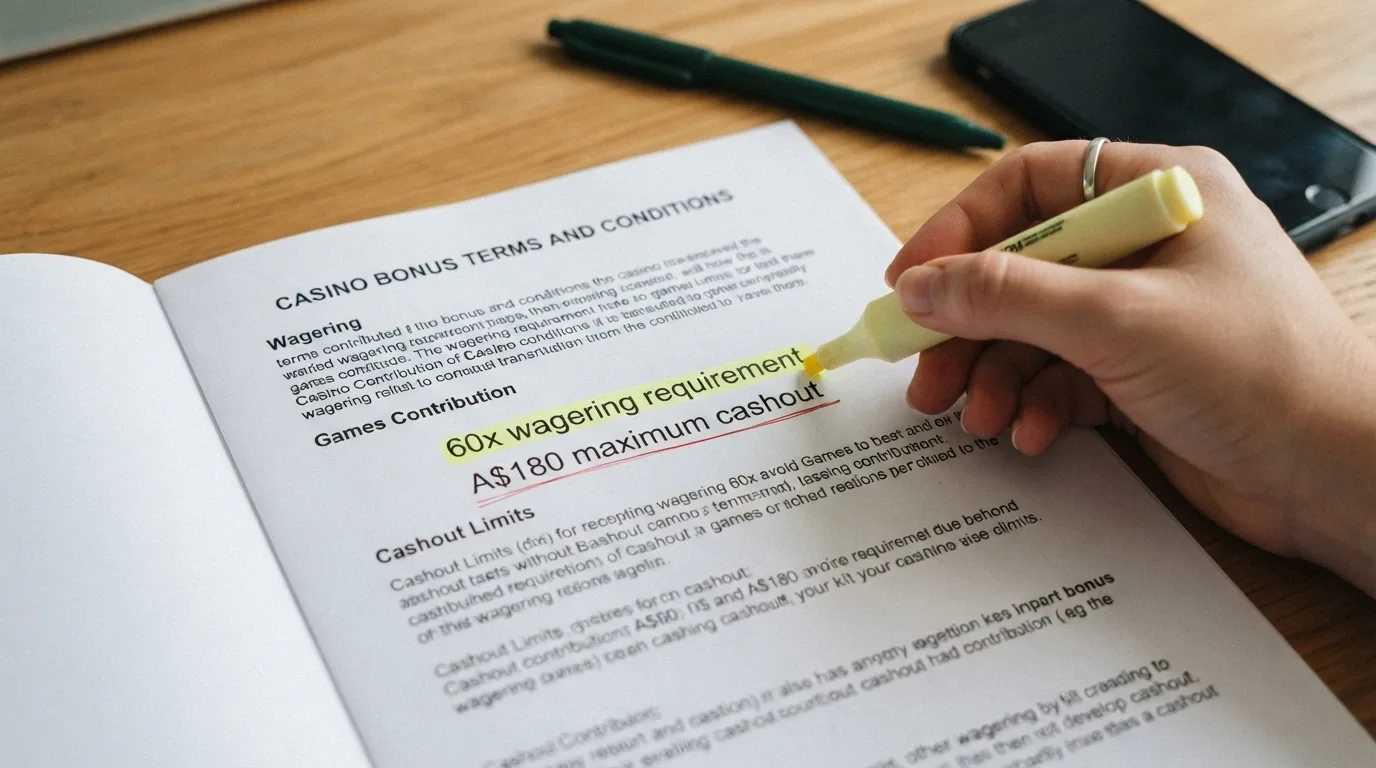
The activation and wagering windows sit on top of the contribution rate. Most no-deposit bonuses expire within 24 to 72 hours if not claimed, and the wagering must typically be met within seven days of the bonus crediting. A deposit-match offer usually gives a longer wagering window — seven to thirty days, depending on the operator — but the wagering requirement itself is heavier. The two windows combined mean the player has a narrow band of time in which to convert the bonus, and missing the window returns the balance to the casino. The expiry is not a footnote; it is part of the cost.
Offshore Casinos With Bonus Codes: What Australian Players Actually Get in 2026
The ten operators ranked below all serve the AU market from offshore. None holds an Australian casino licence; none can, because no such licence exists. The Australian market share figures are drawn from operator-skill data for the AU-facing segment and are best read as a measure of how much AU traffic the operator carries, not as a measure of how good its bonus codes are. The no-deposit bonus column is populated where the operator’s offer is confirmed in search results for this topic; the gaps are gaps in what was confirmed this run, not gaps in the market. A player who sees an empty cell should verify the details on the operator’s website.
| Casino | Licence Status | No-Deposit Bonus | AU Market Share |
|---|---|---|---|
| Skycrown | Offshore; Curaçao eGaming (not verified this run); no AU casino licence | 100 free spins (mobile verification required) | 8.55% |
| Rocket Play | Offshore; Curaçao eGaming (not verified this run); no AU casino licence | — | 9.4% |
| Fair Go | Offshore; Curaçao eGaming (not verified this run); no AU casino licence | A$10 free chip (60x wagering; max cashout A$180) | 0.8% |
| NeoSpin | Offshore; no AU casino licence | 20 free spins | — |
| Royal Reels | Offshore; no AU casino licence | — | 2.51% |
| Stake | Offshore; Curaçao eGaming (not verified this run); no AU casino licence | Not offered (rakeback/cashback model) | 1.28% |
| Rainbet | Offshore; no AU casino licence | — | 1.28% |
| Scream Casino | Offshore; no AU casino licence | — | 0.99% |
| Bizzo Casino | Offshore; no AU casino licence | — | 0.57% |
| WinSpirit | Offshore; no AU casino licence | — | 1.55% |
The numbers in the share column are best understood as traffic, not quality. Rocket Play sits at the top with 9.4% AU market share and the largest revenue of the operators on this page, but its no-deposit bonus was not confirmed in search results this run — a player who wants a code from Rocket Play should go to the operator’s own promo page rather than rely on what an aggregator post has copied across. Skycrown at 8.55% carries the most generous confirmed no-deposit offer in the set. Fair Go at 0.8% runs the heaviest confirmed wagering. The remaining six operators carry no confirmed no-deposit offer for this run, which is a statement about what search results surfaced, not about what the operators do or do not publish on their own sites.
Skycrown
Skycrown is the operator with the highest confirmed no-deposit spin count on this page — 100 free spins credited after registration and mobile phone verification, on a curated pokie from a provider mix that includes Pragmatic Play, NetEnt, Hacksaw Gaming, and NoLimit City. The AU market share sits at 8.55% with revenue around A$436 million, putting Skycrown in the upper half of the featured set on traffic. The typical wagering band on the AU offshore market is 30x to 50x on the bonus; the typical max cashout on no-deposit offers sits between AU$50 and AU$200. The licence is Curaçao eGaming — not verified this run — and Skycrown holds no Australian casino licence, because none exists.
The 100-spin offer is the headline; the verification is the gate. A player who registers without a verified mobile number does not see the bonus in their account, and Skycrown is one of several operators that treats the phone-verification step as a non-skip part of the claim flow. For a player who has a phone they are willing to verify and a pokie from the provider mix they want to test, the offer is competitive. For a player who does not, the same offer is invisible. The mobile gate is the difference between Skycrown showing up in their account and not.
A player who treats Skycrown as a trial of its lobby — one session, one bonus, no further deposit — gets the most value out of the 100-spin offer. A player who registers, claims the bonus, plays through the wagering, and deposits because the lobby looks interesting is the player Skycrown is built for. The bonus is the door. The deposit match is the room.
Rocket Play
Rocket Play sits at the top of the featured set on AU market share — 9.4% — and at the top on revenue, around A$632 million. The no-deposit bonus column is empty for a reason: Rocket Play’s no-deposit offer was not surfaced in the search results this run, and what is not confirmed cannot be reported as fact. The licence is Curaçao eGaming — not verified this run — and Rocket Play holds no Australian casino licence. The provider mix was not confirmed at the level of named studios this run, though the operator carries major pokies providers in the typical offshore configuration.
A player who has heard Rocket Play named on an aggregator page and wants to check what is actually on offer should go to the operator’s own promo page. The aggregator post is a snapshot. The promo page is the live offer. Treating the aggregator as the source of truth is the predictable way for a player to claim a code that has rotated and lose the bonus before they have spun a single reel.
For a player who already plays at Rocket Play, the 9.4% AU share means the operator is large enough that a no-deposit code will appear on the promo page at some point; it just was not visible in the data this page is built on. For a player who has never registered, the size of the share provides a reason to check the operator’s own site, but confirm details before signing up.
Fair Go
Fair Go is the operator that anchors the steepest end of the wagering spectrum on this page. The A$10 no-deposit free chip carries 60x wagering — well above the ~35x benchmark that sits at the fairer end of the AU offshore market — and a max cashout ceiling of A$150 to A$180, depending on the coupon. The provider mix is narrower than most of the featured set: Fair Go runs RealTime Gaming pokies (RTG), which is a single studio’s catalogue rather than the multi-studio mix Skycrown and Stake carry. The AU market share sits at 0.8%, which is the smallest confirmed share in the set and a signal that Fair Go is a niche operator rather than a mass-market one.
The 60x wagering is the cost. A A$10 chip at 60x means A$600 of turnover before the bonus balance converts; at A$0.20 per spin, that is 3,000 spins and roughly four hours of continuous play. The A$180 max cashout means a player who converts the bonus walks away with at most A$180 — eighteen times the face value of the chip they were given, and below the A$600 the player has staked along the way. The expected return on those A$600 of bets, at a typical RTG pokie RTP, is materially below A$600; the difference is what the offer costs. Fair Go is the operator whose terms a player should read before claiming, not after.
For a player who specifically wants to test the RTG catalogue and accepts the heavy wagering, Fair Go is one of the few operators offering it. If you prefer fairer terms, consider exploring the broader market first.
NeoSpin
NeoSpin is the operator with the most modest confirmed no-deposit offer on this page — 20 free spins credited on registration. The 20-spin figure was confirmed in search results; the wagering and cashout specifics were not, and the typical offshore band of 30x to 60x on the bonus and AU$50 to AU$200 max cashout is the context to read the offer against, not a confirmed figure for NeoSpin specifically. The market share sits below the top 20 operators in the AU segment, which puts NeoSpin in the long tail of the AU-facing offshore market rather than the top tier.
The 20-spin offer is concrete, not generous. A player who claims it and clears the wagering walks away with whatever the cashout cap allows, not with a screen-filling win; the ceiling is the same shape as the rest of the no-deposit tier, and the expected value of the bonus at typical pokie RTPs is below the face value of the credit. For a player who has not registered with NeoSpin and wants to test the lobby, 20 spins is enough to learn what the operator’s pokie catalogue feels like without committing a deposit. It is not enough to fund a session.
The headline takeaway: NeoSpin is on this page because it surfaced in the bonus-code search results, not because it offers a standout deal. A player who has found the operator on an aggregator post and wants to confirm the terms should check the operator’s own promo page. The aggregator is a snapshot. The promo page is live.
Royal Reels
Royal Reels holds 2.51% AU market share. Bonus specifics for this operator were not captured in this run. As an offshore site, it lacks any Australian casino licence. We advise verifying current promotions directly on their site before committing.
A player who has seen Royal Reels named on an aggregator list and wants to claim a code should verify the offer on the operator’s own promo page before registering. The 2.51% share is enough to make the operator worth a look, but a posted code that has rotated, expired, or been replaced is the predictable disappointment when a player treats an aggregator post as a contract.
For a player who is choosing between the operators on this page, Royal Reels is best treated as a verify-before-claiming entry. The market share confirms the operator’s presence, though live offers vary by day.
Stake
Stake is the outlier in the featured set. The 1.28% AU market share is modest, but the model is different: Stake is known for rakeback and cashback rather than no-deposit bonus codes. The provider mix includes Pragmatic Play, Evolution, and Hacksaw — a higher-tier selection than most offshore operators carry — and the licence is Curaçao eGaming, not verified this run. Stake holds no Australian casino licence, as none exists.
The absence of a no-deposit bonus is a structural choice, not an omission. Rakeback returns a percentage of the house edge to the player on every bet, regardless of whether the player has claimed a bonus; cashback returns a percentage of net losses over a defined period. Neither requires a code, neither is gated by wagering, and neither carries a max cashout. The trade-off is that the player is paying full house edge on every bet rather than running a bonus at a steep multiple — which is the same arithmetic with a different shape.
For a player who wants a code at all, Stake is not the operator to register with. For a player who prefers a rakeback or cashback model over a one-time bonus, Stake is one of the larger AU-facing operators offering it. The model is different. The offshore status is the same.
Rainbet
Rainbet claims 1.28% AU market share. Details for their bonuses remain unverified for this reporting period. Being offshore, they hold no Australian casino licence. Always check the operator’s promo page for live information.
A player who has seen Rainbet named and wants to check what is on offer should verify the details directly on their official site. The 1.28% share is real, but a posted code that has been replaced is the predictable disappointment when a player treats an aggregator post as a contract. Rainbet is a verify-before-claiming entry, like Royal Reels, and the right next step is the same.
Regarding the options on this page, Rainbet sits in the middle of the long tail. The market share indicates AU traffic, but verification of current offers is essential.
Scream Casino
Scream Casino holds 0.99% AU market share. No current bonus-code information was available for our review. Like others in this list, they operate offshore without an Australian licence. Verify offers on the official site.
A player who has seen Scream Casino named on an aggregator post and wants to claim a code should verify the offer on the operator’s own promo page before registering. The 0.99% share is small but real, and a code that has rotated, expired, or been replaced is the predictable disappointment when an aggregator post is treated as a contract.
For a player choosing between operators on this page, Scream Casino is a verify-before-claiming entry in the bottom half of the long tail. Its market share is modest, and bonus availability remains unconfirmed.
Bizzo Casino
Bizzo Casino accounts for 0.57% AU market share. While we found no active bonus code data, the operator remains active offshore. It lacks an Australian casino licence; confirm current offers directly via the casino.
A player who has seen Bizzo Casino named and wants to check what is on offer should treat the operator’s own promo page as the source of truth. The 0.57% share is the smallest in the set, but a small operator can still run a generous bonus; the absence of a confirmed figure is a gap in this page’s research, not a statement about the operator. The right next step is the same as for Royal Reels, Rainbet, and Scream Casino: verify before claiming.
For a player choosing between operators on this page, Bizzo Casino is a long-tail entry best treated as a verify-before-claiming option. Its market share is limited, and players should check the site directly for active promotions.
WinSpirit
WinSpirit holds 1.55% AU market share. We have no confirmed bonus code details for this operator at present. Remember, this is an offshore site with no Australian casino licence. Official promo pages are the best source for current deals.
A player who has seen WinSpirit named and wants to check what is on offer should treat the operator’s own promo page as the source of truth. The 1.55% share is real, but a posted code that has been replaced is the predictable disappointment when a player treats an aggregator post as a contract. WinSpirit is a verify-before-claiming entry, and the right next step is the same.
For a player choosing between operators on this page, WinSpirit is best read as one of several mid-tail operators with no confirmed bonus data this run. The market share reflects some AU traffic, but no specific bonus was identified.
Why Every Casino Bonus Code in Australia Sits Outside the Law
The Interactive Gambling Act 2001 makes it illegal for gambling providers to offer online casino games, online pokies, and in-play sports betting to people in Australia. There is no licence for any of those products anywhere in the country — not federally, not in any state or territory. The ACMA’s role is to enforce the prohibition, which it does by investigating breaches, issuing formal warnings, referring operators for civil penalty proceedings, and directing ISPs to block illegal sites. The individual player is not prosecuted, but the prohibition shapes the supply side of the market entirely: every bonus code an Australian encounters is for an offshore site, and every offshore site is breaking the prohibition simply by accepting the player.
The prohibition has tightened over time, not loosened. The 2017 amendment closed offshore loopholes and gave the ACMA the blocking and enforcement powers it now uses. The 2023 amendment, in force from 11 June 2024, banned credit cards, credit-related products, and digital currency as payment for online wagering — a payment-method prohibition that doubles as a test of offshore status, since an Australian casino accepting credit cards or crypto is, by definition, not an Australian-licensed operator. The 2026 Gambling Reform Bill, passed on 19 August 2026 and commencing on 1 January 2027, layers additional restrictions: an advertising cap, a live-sport blackout on wagering ads, inducement prohibitions, and — most relevant to this page — express authority for banks and payment providers to block transactions to illegal gambling operators. From January 2027, the deposit a player makes at an offshore casino is not just legally exposed; it is operationally exposed, because the player’s own bank can refuse the transaction.
The Interactive Gambling Act 2001 and what it bans
The Interactive Gambling Act 2001 is the statute that prohibits providing online casino, online pokies, and in-play betting to people in Australia. The 2017 amendment gave the ACMA the enforcement and blocking powers it now uses against offshore operators. The 2023 amendment, effective from 11 June 2024, banned credit cards, credit-related products, and digital currency as payment for any online wagering — a payment-method prohibition that closes the easiest ways an Australian player might have funded an offshore account. The 2026 Gambling Reform Bill, passed on 19 August 2026 and commencing on 1 January 2027, layers advertising restrictions, inducement prohibitions, and — most relevant to offshore operators — express authority for banks and payment providers to block transactions to illegal gambling operators.
The product a “casino bonus code” page describes is not licensable in Australia at all. The deposit, loss, and stake caps that exist in other regulated markets are not relevant here because the product those caps would govern is banned outright. A player who reads about a deposit-limit regime in another jurisdiction and assumes an Australian equivalent is mistaken; the Australian prohibition is structural, not parameter-based. The licensed Australian operators — Sportsbet, bet365, Ladbrokes, and around 150 others on the ACMA’s register of licensed interactive gambling providers — offer wagering on races and pre-event sport, not online casino. They are not on this page because they do not run casino bonus codes, and they could not if they wanted to.
ACMA enforcement: blocks, warnings and the sites that pulled out
The ACMA has blocked 1,788 illegal gambling and affiliate websites since its first blocking request in November 2019. More than 230 illegal services have pulled out of the Australian market since the ACMA started enforcing the post-2017 rules. The Q4 2025 enforcement cycle alone produced 23 investigations into 45 gambling sites, finding 69 breaches of the Interactive Gambling Act, and issued 10 formal warnings to providers — including Dama N.V. for operating Vegas Now, Rooster Bet, and Rocketspin, and NovaForge Ltd for CrownPlay, Spinsy, Cashed, and others. The enforcement pipeline is active, and the operators named in the warnings are the same operators whose bonus codes float through Australian-facing aggregator pages.

The blocking programme is the visible edge of the enforcement regime. A site blocked one week is invisible to Australian ISPs the next; a player who registered at the site and left a balance there has lost access to their own funds. The site is not obliged to refund the balance, because the site is not subject to Australian consumer law and the player is not protected by any Australian dispute resolution body. The withdrawal the player thought they had a right to is no longer enforceable anywhere the player can reach. ACMA blocking is real, and it is the risk a bonus-code player accepts every time they register at an offshore casino.
Offshore means no Australian protection — what you actually forfeit
An offshore casino is, by definition, outside the Australian regulatory perimeter. The protection a player forfeits includes BetStop coverage — the National Self-Exclusion Register does not reach offshore casinos, and a person registered on BetStop can still open an account, deposit, and play at every operator on this page. It includes any Australian complaints body or ombudsman — none of the offshore operators on this page are members of an Australian dispute resolution scheme, because none are licensed in Australia. It includes consumer protection — if the operator voids a bonus, refuses a withdrawal, or closes the account, there is no Australian regulator the player can complain to. And it includes the safety net the payment-method prohibition tries to provide — an offshore casino accepting credit cards or crypto is, by definition, not subject to the 11 June 2024 ban, and a player depositing through one of those routes is funding an illegal transaction.

The payment-method prohibition is also a useful tell. The legal deposit routes for Australian-licensed wagering are debit card, bank transfer, PayID/Osko, and BPAY. A casino accepting credit cards or crypto is not licensed in Australia. A player who sees those methods on the cashier page is looking at an offshore site, and the deposit they are about to make is funding a transaction the ACMA can investigate. From 1 January 2027, the deposit will also be operationally exposed, because the player’s bank will have the express authority to block transactions to illegal gambling operators — and a blocked transaction is one the player cannot make, regardless of how generous the bonus code looks.
The Gambling-Harm Numbers Australia’s Bonus-Code Pages Don’t Show You
The harm numbers sit alongside the market structure for a reason: a bonus-code page that omits them is describing an offer without describing who the offer costs. Three independent data sources converge on a picture of gambling harm in Australia that runs into the millions, and the gap between a marketing word like “free” and the lived experience of problem gambling is large enough that any honest page on this topic carries the numbers on its face.
The numbers themselves are not a moral judgement. They are a baseline. The Australian Institute of Health and Welfare put problem gambling at about 2.1% of adults in 2022 — roughly 430,000 people — with high-risk gambling at 1.8%. Roy Morgan Research, in March 2026, found 13.0% of the Australian population — an estimated 2.86 million people — experiencing some form of gambling harm from their own gambling behaviours, and 15.1% — 3.32 million people — when harm from others’ gambling is included. A model-based study published in the Journal of Gambling Studies in 2026 estimates 3.29 million Australians affected annually by their own or another person’s gambling, with an annual health loss above 400,000 Years Lived with Disability. The figures come from different methodologies and different sample frames, and they all point the same way.
How big Australia’s gambling-harm problem really is
Three sources, three different methodologies, and the same picture. The AIHW figure of 2.1% problem gambling among Australian adults is a clinical prevalence rate — people who meet the diagnostic threshold for gambling disorder. The Roy Morgan figure of 13.0% is a broader harm measure — people experiencing any negative consequence from their own gambling, including financial stress, relationship strain, and time loss — which captures a population the clinical measure misses. The Springer model-based estimate of 3.29 million Australians affected annually folds in harm from others’ gambling, which is the population the AIHW and Roy Morgan figures do not count directly. The 400,000+ YLDs estimate is the health-loss conversion of those prevalence figures into disability-adjusted years, which is how public health researchers compare gambling harm to other disease burdens.
The three figures do not contradict. They measure different things. A page that quotes only the AIHW 2.1% figure is understating the harm; a page that quotes only the Roy Morgan 13.0% is overstating the clinical population but understating the affected-others population. The full picture is the spread. For a player who has registered at an offshore casino and is wondering whether the bonus code is worth the time, the harm data is the reason this page treats the offer as a trial, not a payday. Those who have started chasing losses should prioritise the professional support lines mentioned earlier.
BetStop and self-exclusion — and the offshore gap
BetStop is the National Self-Exclusion Register, launched on 21 August 2023, which lets a person register once and be excluded from every Australian-licensed online and phone wagering service. To the end of Q3 FY 2025–2026 (31 March 2026), 59,830 people had registered, with 37,247 exclusions still active. The exclusion runs for a minimum of three months and up to a lifetime, with no option to request removal in the first three months. The register connects to approximately 150 licensed wagering providers in Australia.
The offshore gap is the load-bearing caveat. BetStop binds only Australian-licensed wagering services — offshore casinos are not connected to the register and will continue accepting a self-excluded person’s money. A player who has registered on BetStop and then opens an account at Skycrown, Rocket Play, or any other operator on this page has not excluded themselves from those operators, and the deposit they make is not blocked by the BetStop registration. The protection BetStop offers is real, but it stops at the Australian regulatory perimeter, and the entire featured set on this page sits outside it. A player who is serious about self-exclusion needs to combine BetStop with a personal commitment not to play at offshore sites, and ideally with the deposit-limit and self-exclusion tools the offshore operators offer on their own platforms.
Practical tools: the helpline, deposit limits and knowing when to stop
- The National Gambling Helpline is 1800 858 858 — free, confidential, and staffed 24/7.
- Gambling Help Online (gamblinghelponline.org.au) offers online chat and counselling, with the same 24/7 coverage and a self-help toolkit for people who are not ready to call.
Most offshore casinos also offer deposit limits and time-out tools inside the player’s account, and the practical step for a player who wants to bound their exposure is to set a deposit limit on the first day of play, not after the first losing session. A limit set in calm conditions is one a player honours under stress; a limit set after a loss is one a player relaxes the moment the next bonus code arrives.
The self-check questions are the ones a player should ask before claiming any offer on this page. Have I deposited more than I planned this month? Am I playing to win back a loss? Has anyone in my life raised my gambling? Am I hiding my play? If any of those answers is yes, the right next step is the helpline, not a bonus code. The bonus is a marketing offer. The harm data is what the offer costs in aggregate. A player who treats themselves as one of the 2.86 million Australians in the Roy Morgan harm figure, rather than as the exception, is a player who reads the small print before claiming.
How We Selected and Compared the Operators on This Page
The ten operators on this page come from the operators-skill market-share table as the offshore casinos with measurable AU traffic and bonus-code visibility in search results. The legal status of every operator was cross-checked against The ACMA register of licensed interactive gambling providers contains 222 entries (as at 10 July 2026). none of the ten operators on this page appears on that register, because no Australian casino licence exists for any of them to appear under. The bonus-code data was drawn from the affiliate pages that dominate Australian-facing search results for this topic — Pokiesaustralia.com, BestOnlinePokies, VegasPokie, NewCasino.ai, Laneway Finance, CrazyVegas, Gambling Insider, and TV1 News — together with the ACMA’s own enforcement publications and the operator-skill market-share dataset.
The operators are ordered by their fit to this page’s topic, not by market share. The primary sort was presence of a bonus code in Australian-facing search results; the secondary sort was market share. Skycrown, Fair Go, NeoSpin, and Rocket Play had the most bonus-code coverage in search results this run, and that is why their entries carry the most confirmed data; the remaining six operators were carried by market share and have qualitative notes where the search results did not surface a specific offer. Operator-sweep budget was exhausted before dedicated per-operator bonus queries could be run, and the gaps in the table reflect that budget, not an absence of offers on the operators’ own sites. A player who sees an empty cell should check the official casino site, as the table is a snapshot of what search results surfaced this run rather than a complete inventory.
What Australian Players Should Actually Do About Casino Bonus Codes
Three rules. Read the wagering before the headline number. A A$10 chip at 60x means A$600 of turnover; a A$500 match at 30x on deposit plus bonus means A$30,000 of turnover. The headline is not the offer. The wagering is.

Assume the cashout cap makes a big win uncollectable. A 50-spin bundle at A$0.20 per spin with a A$100 max cashout means a player who hits a five-figure spin still walks away with A$100, not with the screen value. The cap is the ceiling on what a bonus code is worth, regardless of what the reels show.
Know that offshore means no safety net. No BetStop coverage, no Australian complaints body, no consumer protection. The site can be blocked overnight with a balance still on it. From 1 January 2027, the deposit itself can be blocked by the player’s bank. The protection a player forfeits is not abstract; it is the recourse they would have had if the operator had been licensed.
The scenario where a bonus code makes sense is a low-cost trial of a casino’s lobby and game performance — one session, one bonus, no further deposit. The scenario where it does not is chasing a win through wagering on a code whose terms have not been read. The expected value of every bonus on this page is below its face value at typical pokie RTPs. The arithmetic is the same at every operator. Only the numbers change.
The safest bonus code is the one whose terms the player has read, understood, and run the numbers on before they hit claim. A bonus code is not a gift. It is a credit, with a price the player pays in turnover, in cashout caps, in expiry windows, and in the loss of the consumer protection an Australian licence would have offered. A player who treats the offer that way gets what the offer is worth. Treat the bonus as a cost-benefit calculation rather than free capital.
Frequently Asked Questions
How do I claim a no deposit bonus code in Australia?
Register at an offshore casino, complete the verification step — usually email plus mobile phone — enter the code in the cashier or bonus field, and the bonus credits to a separate balance that begins the wagering clock. The casino is offshore; no Australian casino licence exists, and the bonus is funded by an unlicensed operator. Wagering and cashout caps apply from the moment the bonus credits.
What are wagering requirements on casino bonus codes?
Wagering is the multiplier the bonus balance must pass through before it converts to withdrawable cash — a 60x requirement on a A$10 chip means A$600 of total bets before any withdrawal is possible. No-deposit offers typically run 40x to 60x on the bonus; deposit-match offers typically run 30x to 35x on the bonus only, or 30x to 50x on deposit plus bonus. The same headline offer can carry double the turnover depending on which figure the multiplier applies to.
What is the maximum I can cash out from a no deposit bonus?
No-deposit bonuses in the AU offshore market typically cap withdrawals between AU$50 and AU$200, regardless of how much the player wins during the wagering. A player who converts a A$10 free chip at 60x wagering and hits a big spin still walks away with whatever the cashout ceiling allows, not with the screen value. The cashout cap is the ceiling on what the bonus is worth, not the wagering result.
What games can I play with a casino bonus code?
Pokies from major studios like Pragmatic Play, NetEnt, Hacksaw Gaming, and NoLimit City usually contribute 100% of each bet to wagering. Table games typically contribute 0% to 10%; live dealer games through Evolution often contribute nothing. A player who runs the wagering on a 0%-contribution game will not clear the bonus, regardless of how much they stake, and the bonus will expire with the wagering unmet.
How long do I have to use a casino bonus code before it expires?
Most no-deposit bonuses expire within 24 to 72 hours if not claimed after registration, and the wagering must typically be met within seven days of the bonus crediting. Deposit-match offers usually give a longer wagering window — seven to thirty days — but the wagering requirement is heavier. Missing either window returns the bonus to the casino; the expiry is part of the cost, not a footnote.