
The Mobile Casinos Australians Reach in 2026 — and the Numbers That Decide Which One Is Worth Opening
 Available in AU
Data current as of 18 October 2026; licence claims verified against the Curaçao Gaming Control Board and Anjouan Gaming Management Authority registers.

A mobile casino in Australia is, in practice, a website that opens in Safari or Chrome. There is no app to download from a local store, no “Play Store” listing to tap, and no native binary sitting on your home screen unless you install one yourself. Every operator an Australian player reaches on a phone is, without exception, an offshore company running its product through a mobile browser — and most of them are, technically, illegal to provide inside the country. That is the starting point. Everything else on this page — the welcome packages, the wagering multipliers, the PayID deposit screens — sits on top of it.
This page ranks ten operators Australian players actually use, names their real terms where research confirms them, and explains the legal gap that almost no comparison page acknowledges. The aim is not to steer a reader toward any one brand. It is to make the numbers legible: what each bonus costs to clear, which licence actually sits behind the welcome page, what a 40x wagering requirement does to a A$1,000 headline, and where the offshore product leaves a player without Australian consumer protection.
Table of Contents
- How a Mobile Casino Actually Works on Your Phone
- The 10 Mobile Casinos Australian Players Are Using in 2026
- Why Every ‘Australian’ Casino Site Is Really Registered Overseas
- The Mobile Slots Worth Your Phone Screen in 2026
- Mobile Pokies: Real Money vs Free Play — and Why It Matters
- Why Your 2026 Mobile Casino Bonus Is Smaller Than It Looks
- How Your Money Moves at an Offshore Mobile Casino
- The Legal Reality: Online Casino Is Prohibited in Australia
- Responsible Gambling When the Safety Net Doesn’t Reach Offshore
- How We Selected and Ranked These Mobile Casinos
- What You Should Actually Do With This Information
- Frequently Asked Questions
How a Mobile Casino Actually Works on Your Phone
The “mobile casino” a person searches for and the “mobile casino” a person finds are not quite the same thing. What the search returns is a marketing idea: a polished application, a one-tap login, a small icon on the home screen. What an Australian player actually receives is a URL — sometimes a progressive web app, more often a vanilla HTML5 page — that does everything an app would do, without ever having to clear an app store review.
No App, No Download: The Browser-Only Reality for Australian Players
No AU-facing casino has an App Store or Google Play listing. The Interactive Gambling Act 2001 makes providing online casino games to Australians an offence, and Apple and Google enforce that policy at the platform level: any operator offering real-money casino games to Australian customers will be rejected on submission, and any operator whose product is later reclassified as casino will be delisted. The result is a market in which every brand an Australian player reaches is browser-only.
In practice that means two things. First, the game library runs through HTML5 in a mobile browser — Safari on iPhone, Chrome on Android, any modern browser in between. There is nothing to install in the conventional sense, and no binary that can be revoked mid-session by an operating-system update. Second, the closest thing to a “mobile casino app” Australian players get is a Progressive Web App (PWA) — a website that asks for permission to add an icon to the home screen and behaves, superficially, like a native app. Fair Go Casino is the clearest example of this approach in the featured set: it ships a PWA installation alongside its browser product, with a small free-spin incentive attached to the install itself (10 free spins, 40x wagering, A$75 win cap on anything the spins produce). The install is a marketing nudge, not a technical breakthrough — under the icon, the same browser session runs the same games.
The structural reason for the browser-only landscape is simple. Australian consumer protection is attached to licensed operators, and no online casino licence exists in Australia — none federally, none in any state or territory. The product the browser delivers is, in legal terms, a prohibited interactive gambling service. The browser is the delivery mechanism that lets the operator stay technically reachable while sidestepping the Australian app store gatekeeping that would otherwise keep the product off the phone entirely.
What ‘Mobile-Optimised’ Actually Means When You Sign Up
The gap between “looks fine on a phone” and “actually works on a phone” is the one mobile casino UX claim worth interrogating. The good operators in the featured set — Royal Reels, Skycrown, Bizzo — run the same game providers and payment rails on mobile as on desktop, with a sign-up flow that completes in roughly ninety seconds. Account creation asks for an email, a password and a phone number; document verification (passport, driver’s licence, proof of address) happens in-app, with photos taken through the phone’s camera and uploaded directly. The friction is light compared with a desktop sign-up of the same vintage, and the layout is genuinely built for thumb use rather than retrofitted.
What changes between desktop and mobile is the payment rail. PayID dominates mobile deposits at every featured operator and clears in under 60 seconds — a speed that depends on the bank rather than the casino, but that nonetheless defines the AU mobile experience. The minimum deposit at most AU-facing sites sits between A$20 and A$30, with a minimum withdrawal floor of A$20 to A$100 depending on the method. Players with a small bankroll can therefore test the cashier without committing much, and players with a larger one are not held back by a high entry threshold on the deposit side. What the same floor does not do is make the casino safer, more local, or more accountable to Australian law — a point the rest of this page returns to several times.
The 10 Mobile Casinos Australian Players Are Using in 2026
The table below covers every operator on this page. The featured set is not the entire market — it is the slice Australian mobile players actually reach, based on AU-facing traffic and publicly stated terms. Where a field is blank, research did not confirm a figure this run; the article-language no-data marker (—) is used rather than invented.

| Operator | Welcome Bonus | Free Spins | Wagering | Provider Mix |
|---|---|---|---|---|
| Skycrown | Up to A$8,000 + 400 FS across 4 deposits | 400 (125 + 75 + 50 + 150) | 40x | 7,000+ games; Pragmatic Play |
| RocketPlay | 100% up to A$500 (1st) + 200% up to A$500 (2nd) | 100 (1st deposit) | 40x | — |
| Royal Reels | 100% up to A$500 first deposit | — | 30x | 2,000+ games; Pragmatic Play, Evolution, Yggdrasil, Hacksaw |
| Bizzo Casino | Up to A$7,250 + 175 FS across 4 deposits | 175 (25 daily batches) | 40x | 8,000+ titles; Pragmatic Play |
| Fair Go Casino | 100% up to A$200 × 5 deposits (A$1,000 total) | 10 FS via PWA install | 30x | RTG (RealTime Gaming) |
| WinSpirit | 200% + 25 FS | 25 | 40x | — |
| Rainbet | First-deposit Wager Lock (A$30 min, A$700 max qualifying) | Sweet Bonanza FS | 40x | Slots, live casino, Rainbet Originals |
| Stake | — | — | — | — |
| Scream Casino | — | — | — | — |
| Rocket Casino | — | — | 50x (on deposits >A$100) | — |
Every bonus figure in the table is what the operator advertises, not what a player walks away with. The wagering multiplier and the cashout cap do most of the talking — and the next several sections explain how.
Skycrown: The 7,000-Game Library With A$8,000 on the Table
Skycrown carries the largest welcome package in the featured set: up to A$8,000 plus 400 free spins across four deposits, with 40x wagering on bonus and free spins alike. The first tier takes a minimum deposit of A$30. Each tier caps free-spin winnings at A$300, and the cumulative bonus is hard-limited at A$5,000 per tier and A$20,000 in total — a ceiling most readers will never approach but worth knowing exists.
The library is the genuine upside. Skycrown lists over 7,000 pokies and blackjack games, with Pragmatic Play confirmed among the suppliers. The licence is Curaçao — the operator’s jurisdiction was confirmed this run, though the specific permit date was not. Crypto deposits, which the cashier supports for speed, are excluded from every bonus offer at Skycrown; the support team confirms this directly. A player who wants both the bonus and the fast crypto withdrawal has to choose, not combine.
The honest reading: A$8,000 is what four deposits could clear in headline terms. Required turnover at 40x sits at A$320,000 across the package, which means the offer’s real price — the expected loss embedded in the playthrough — runs into five figures before any withdrawal is attempted. The free-spin cap of A$300 per tier is the second brake. For a player who intends to make all four deposits and chase the headline, Skycrown’s library is the strongest argument. For anyone else, the headline figure is the marketing word, not the offer.
RocketPlay: A Leaner Bonus With a Tighter Deadline
RocketPlay’s two-deposit welcome is shorter and simpler than Skycrown’s four: 100% up to A$500 plus 100 free spins on the first deposit, 200% up to A$500 on the second (minimum A$50). Wagering is 40x on the bonus amount only. The standout detail is the validity window — 14 days from activation. A bonus that is not cleared in a fortnight expires, and at 40x the realistic clearing time is measured in hours of play rather than days.
RocketPlay also runs a no-deposit offer: 20 free spins on Book of Pyramids, 40x wagering, with the maximum win sitting at roughly A$85 once the playthrough is complete. It is a real-money test drive, not a route to a payout, and the cap makes sure it stays one.
The verdict for a player choosing between two bonuses: RocketPlay’s 200% second-deposit match is the better percentage, but the 14-day clock is the catch. Anyone who plays in short, intense sessions will be fine. Anyone who drifts and comes back a week later will find the bonus gone.
Royal Reels: The Only Genuine No-Deposit Bonus in the Field
Royal Reels is the operator where the “no deposit required” claim actually means it. A new account gets A$10 in real-money credit after account creation and phone verification, with 30x wagering and a A$200 maximum cashout — meaning a player can win up to A$200 from the no-deposit bonus and withdraw it, provided the A$300 turnover requirement is met. The headline bonus after that is a conventional 100% match up to A$500 on the first deposit (minimum A$30).
The library runs about 2,000 games from thirty-plus providers, including Pragmatic Play, Evolution Gaming, Yggdrasil and Hacksaw Gaming. The licence is Curaçao, confirmed this run. For a player who wants to test withdrawals without committing their own money, Royal Reels is the cleanest entry in the set — the A$10 no-deposit is genuinely free, and the A$200 cap is honest about what the bonus can return.
The close: this is the operator for a player who wants to see whether the cashier actually pays before they put a dollar in. It is also the operator with the smallest headline welcome in the table. The trade is real-money test access against deposit-bonus size.
Bizzo Casino: 8,000+ Titles and a Bonus Spread Across Four Deposits
Bizzo’s library is the largest in the featured set — more than 8,000 titles, with Pragmatic Play confirmed and Big Bass Bonanza 1000 anchoring the welcome bonus. The package totals up to A$7,250 plus 175 free spins across four deposits, with 40x wagering and free spins released in batches of 25 per day. The first deposit pays the full 125% match only when a player deposits A$250 or more; below that, the match drops.
The wagering math is the obvious brake. Four deposits, each gated by their own threshold, each contributing to a 40x playthrough — most readers will not actually reach the A$7,250 headline. The instant bonus round attached to Big Bass Bonanza 1000 is the detail that matters, because it tells a player which slot the casino expects them to grind through.
For a high-volume Pragmatic Play player, Bizzo’s library is the reason to be here. For anyone depositing modestly and expecting to clear the headline in full, the tiered structure makes that hard.
Fair Go Casino: The RTG Specialist With No Cashout Cap
Fair Go is the only operator in the featured set running exclusively on RealTime Gaming. The welcome is structured differently from the others: 100% up to A$200 per deposit, redeemable across five deposits (up to A$1,000 total), with 30x wagering on deposit and bonus combined. The minimum deposit is A$20 — the lowest floor in the table — and there is no maximum cashout on deposit bonuses. Whatever is won can be withdrawn, in full.
The PWA install — the “app” Australian players get here — comes with a separate small bonus: 10 free spins, 40x wagering, A$75 win cap. It is deposit-free in the strict sense, but requires the install itself.
For a player who wants RealTime Gaming pokies specifically and who dislikes cashout caps, Fair Go is the most generous operator in the set on those two points. The wagering multiplier (30x combined) is also the lowest on real-money terms in the table. The trade is a smaller headline and a narrower provider shelf than the multi-studio brands offer.
WinSpirit: A 200% Match That Looks Bigger Than It Is
WinSpirit’s headline is a 200% match plus 25 free spins with 40x wagering. On a percentage basis that is the highest first-deposit match in the table — but the deposit-amount floor, the bonus validity window, and the maximum cashout are not publicly confirmed this run. A 200% match at 40x wagering produces a higher absolute bonus per dollar deposited than a 100% match at the same multiplier, which sounds like generosity until the clearing cost scales with it.
The honest reading: the percentage is real, the fine print is thin. A player should read the terms page before claiming, because the gap between “200% match” and “200% match with what conditions” is where most bonus disappointments live.
Rainbet: Anjouan-Licensed With Provably Fair Originals
Rainbet is the only operator in the featured set carrying an Anjouan licence — specifically ALSI-152406029-FI2 — which puts it in a different regulatory bracket from the Curaçao brands. The first-deposit promotion is structured as a Wager Lock: minimum A$30 deposit, maximum qualifying A$700, 40x wagering, and a maximum bet capped at 2% of the deposit amount. Sweet Bonanza free spins are attached to the first deposit at the same 40x multiplier.
Rainbet Originals — the in-house titles — are advertised as provably fair, which is a meaningful transparency claim in a market where most pokies rely on the studio’s stated RTP. Hacksaw Gaming and Nolimit City titles are excluded from bonus play, which means a high-volatility specialist may find the bonus library narrower than it looks.
The verdict: Rainbet is the operator for a player who values the provably-fair original games and accepts that the bonus is gated by a hard maximum bet. The 2% bet cap is the detail to internalise before claiming.
Stake: The Crypto-Native Powerhouse With No Welcome Bonus
Stake is the largest crypto casino by global brand recognition and the one operator on this page that offers Australian players no sign-up incentive at all. No confirmed welcome bonus, no confirmed free spins, no confirmed wagering terms — those fields are blank in research because Stake does not run a conventional welcome package. Its AU-facing product is a bare casino with a crypto-native cashier, which is unusual in a market where every competitor dangles a four-figure welcome.
For a player who has decided a welcome bonus is not worth the wagering grind anyway, the absence is the selling point: no playthrough, no max cashout, no fine-print clauses to read. For a player who arrived looking for the biggest bonus in the table, there is nothing here to claim.
Scream Casino: A Newcomer With Almost No Public Data
Scream Casino’s terms are not publicly documented for the Australian market at the time of review. The welcome bonus, free spins, wagering multiplier, and licence jurisdiction are all blank in research — not because they do not exist, but because the operator has not published terms that an Australian reader can verify before signing up. The brand is named in some AU-facing comparison lists, which is why it appears here.
The verdict: an operator with no transparent terms is a structural risk regardless of how the welcome page looks. A player cannot price the offer, cannot price the cashout cap, and cannot confirm the licence. Until those details are public, the safer move is to pick one of the operators that does publish them.
Rocket Casino: The 50x Wagering Wall on Larger Deposits
Rocket Casino’s standout term is the wagering multiplier, which sits at 50x on deposits over A$100 — a step above the market median of 40x. The change is recent: as at September 2026 the figure moved up from a previous 30x with a A$5 minimum bet limit. The minimum deposit is A$20.
A player depositing A$150 and claiming a standard 100% match ends up needing A$7,500 of playthrough (A$150 × 50) before any withdrawal is possible — and that is before the RTP drag is factored in. The full welcome package was not confirmed in research, so the bonus-side detail is partial; what is clear is that the wagering multiplier is the steepest in the featured set.
For a small-stakes player, the 50x multiplier is the central fact. For anyone depositing more than A$100, it is the only one.
Why Every ‘Australian’ Casino Site Is Really Registered Overseas
The word “Australian” in a casino’s marketing is rarely a statement of where it is licensed. It usually means the cashier accepts AUD, the support team works AU-friendly hours, and the bonus page is translated into something that reads like English from Sydney. The licence — if there is one — sits somewhere else. Every featured operator on this page is offshore. None holds an Australian online casino licence, because no such licence exists.
The reason no licence exists is structural. The Interactive Gambling Act 2001 prohibits the provision of online casino games, online pokies and in-play betting to people in Australia. The prohibition targets the provider, not the player — but it does mean there is no regulator in the country that could issue an online casino licence, and no operator that could lawfully receive one. What remains licensable is wagering on races and sport placed before the event, lotteries and keno, all of which sit under state and territory licensing (concentrated at the Northern Territory Racing and Wagering Commission). The offshore brands marketed to Australian players therefore operate under jurisdictions that accept them — Curaçao and Anjouan, almost entirely — and call themselves “Australian casinos” because the cashier speaks AUD.
What a Curaçao or Anjouan Licence Actually Delivers — and What It Doesn’t
A Curaçao licence means the operator has registered with the Curaçao Gaming Control Board and is subject to the regulator’s compliance framework. Skycrown and Royal Reels are the two operators in the featured set whose Curaçao licence status was confirmed this run. An Anjouan licence — Rainbet’s situation under ALSI-152406029-FI2 — means registration with the Anjouan Gaming Management Authority. Both jurisdictions accept online casino operators that Australia does not.
What those licences provide is some baseline of regulatory oversight: dispute mechanisms through the regulator, segregation of player funds in theory, and a register where the licence can be verified. What they do not provide is Australian consumer law coverage. A player with a complaint against a Curaçao-licensed operator cannot take it to the Australian Financial Complaints Authority, the Australian Competition and Consumer Commission, or any state-based tribunal. The dispute goes to the regulator that issued the licence — Curaçao or Anjouan — and the practical recourse depends on that regulator’s cooperation. Offshore casinos are also not connected to BetStop, the Australian National Self-Exclusion Register, which means a self-exclusion registered in Australia has no effect on an offshore account.
The honest comparison: a Curaçao or Anjouan licence is a regulator’s sign-off on a corporate entity, not a player-protection regime Australian readers would recognise. The pages in this article that assume Australian consumer protection are not assuming it for these operators.
‘AUD Support’: What It Means and What It Hides
AUD support is a payment convenience, not a regulatory signal. An operator that lets a player deposit in Australian dollars has wired the cashier to a payment processor that converts to AUD — usually via PayID, sometimes via a debit card or a local bank transfer. The Australian dollar is the customer’s currency. The regulator is not.
The structural tell sits in the payment methods the cashier accepts. Since 11 June 2024, credit cards and crypto have been banned as payment for online wagering under the Interactive Gambling Amendment (Credit and Other Measures) Act 2023 — a rule that applies to licensed wagering and carries penalties of up to A$247,500. An Australian-facing operator that asks for a credit card deposit or a crypto deposit is being served by someone outside the Australian rules. The bonus itself may still be paid in AUD; the rail the money arrived on is the giveaway. Crypto deposits, in particular, are fast — USDT TRC-20 withdrawals clear in 8 to 18 minutes — but they sit entirely outside the Australian payment framework.
For a player comparing two welcome pages, the payment-method list is where the regulatory reality shows through. AUD-denominated balance, PayID deposit, debit-card withdrawal — that combination is consistent with an offshore operator that has built an AUD-friendly cashier. Credit card or crypto at the cashier is the structural tell that the operator is not just offshore, but outside the Australian rules entirely.
The Mobile Slots Worth Your Phone Screen in 2026
The mobile slots section of any AU-facing casino runs into the thousands — most operators carry 2,000 to 8,000+ titles — but only a handful of those games have a publicly verifiable return-to-player and volatility profile. The four below are the ones research confirmed this run. They are also the four that recur across the welcome packages in the featured set.

| Slot Title | RTP | Provider | Volatility | Max Win |
|---|---|---|---|---|
| Big Bass Bonanza | 96.71% | Pragmatic Play / Reel Kingdom | High | 2,100x |
| Sweet Bonanza | ~96.48–96.51% | Pragmatic Play | High | 25,000x |
| Sweet Bonanza 1000 | 96.53% | Pragmatic Play | High | 25,000x |
| Big Bass Bonanza Megaways | 96.70–96.72% | Pragmatic Play / Reel Kingdom | High | 4,000x |
Every title in this table is high volatility, which means long dry stretches punctuated by occasional large payouts. The RTP figures sit in a narrow band around 96.5% to 96.7% — close enough that no title in the table offers a meaningful edge over another on house percentage alone. What separates them is the payout ceiling: Sweet Bonanza and Sweet Bonanza 1000 both top out at 25,000x, while the Big Bass Bonanza family caps at 2,100x for the original and 4,000x for the Megaways variant. A player who wants the largest single-spin payout in the set has only two options.
Pragmatic Play, Reel Kingdom and the Names Behind the Reels
Pragmatic Play is the dominant supplier across the featured set — present at Skycrown, Bizzo and Royal Reels, and the studio behind every title in the table. Reel Kingdom is the development studio that produced the Big Bass Bonanza family in partnership with Pragmatic Play, which is why both names appear in the RTP row. Fair Go is the outlier: it runs exclusively on RealTime Gaming, an older studio whose games predate the HTML5 mobile era by years and which carries its own recognisable catalogue (Asgard, Bubble Bubble, Achilles) rather than the Big Bass series.
The provider matters on an offshore site for a specific reason: the provider’s RTP is the closest thing to an independent fairness check. A Curaçao or Anjouan regulator audits the operator, not every game; the RTP figure on a slot is published by the studio and held constant across licensed deployments. When research names a 96.71% RTP for Big Bass Bonanza, that figure is the studio’s number — and on a regulated market it is verifiable to within a fraction of a percent. On an offshore site it is the same figure, presented without the regulator that would police it. The provider’s reputation is the only audit.
Mobile Pokies: Real Money vs Free Play — and Why It Matters
Every featured operator runs a demo mode. The same games, the same mechanics, the same reels — but with a play-money balance that cannot be withdrawn. Demo mode is genuinely useful for learning a game’s bonus round, its paylines, its betting range. It is not useful as a predictor of real-money play.

Why Free Pokies Don’t Tell You the Whole Story
A demo session and a real-money session use the same random number generator and the same paytable. What they do not share is the surrounding behaviour. Demo mode has no withdrawal friction, no balance anxiety, no wagering requirement attached to the wins, and no cap on how far the balance can run before play stops. A player who hits a feature round three times in twenty demo spins is being shown the long-term hit frequency of the bonus trigger — which can mislead a person into reading it as a near-term expectation. The hot streak is real, and the conditions that produced it will not repeat at the same density in a real-money session with capped stakes.
The RTP is also not necessarily identical between modes in practice. Demo RTP and real-money RTP are both audited at the studio level, but the live deployment at an offshore operator is not policed by an Australian regulator. A player who treats demo play as evidence of how a real-money game will behave is reading a sandbox as a forecast.
The honest use of free pokies is as a rules sandbox: how the bonus round triggers, what the symbols pay, how the gamble feature works. The honest limit is that none of that tells a player what the next A$100 of real money will do.
No-Deposit Pokies: The One Offer That Lets You Play Without a Dollar
Three offers in the featured set let a player spin without depositing. Royal Reels’ A$10 no-deposit is the genuine article: real money in the account after sign-up and phone verification, 30x wagering, A$200 maximum cashout. RocketPlay’s 20 free spins on Book of Pyramids is the second-closest, with 40x wagering and roughly A$85 in maximum winnings. Fair Go’s 10 free spins via the PWA install is the third — deposit-free but conditional on installing the app, with a A$75 win cap.
A no-deposit offer’s value is not the bonus amount; it is the ability to test the cashier without committing. A player who claims Royal Reels’ A$10 and clears the 30x playthrough (A$300 turnover) gets to see whether the operator actually pays a withdrawal. The A$200 cashout cap is what makes the test cheap for the operator — it limits how much the player can win without ever depositing — but the test itself is real. The offer’s worth is the withdrawal, not the bonus.
For a player who has not decided whether to deposit at all, a no-deposit bonus is the lowest-cost way to find out whether the cashier pays.
Why Your 2026 Mobile Casino Bonus Is Smaller Than It Looks
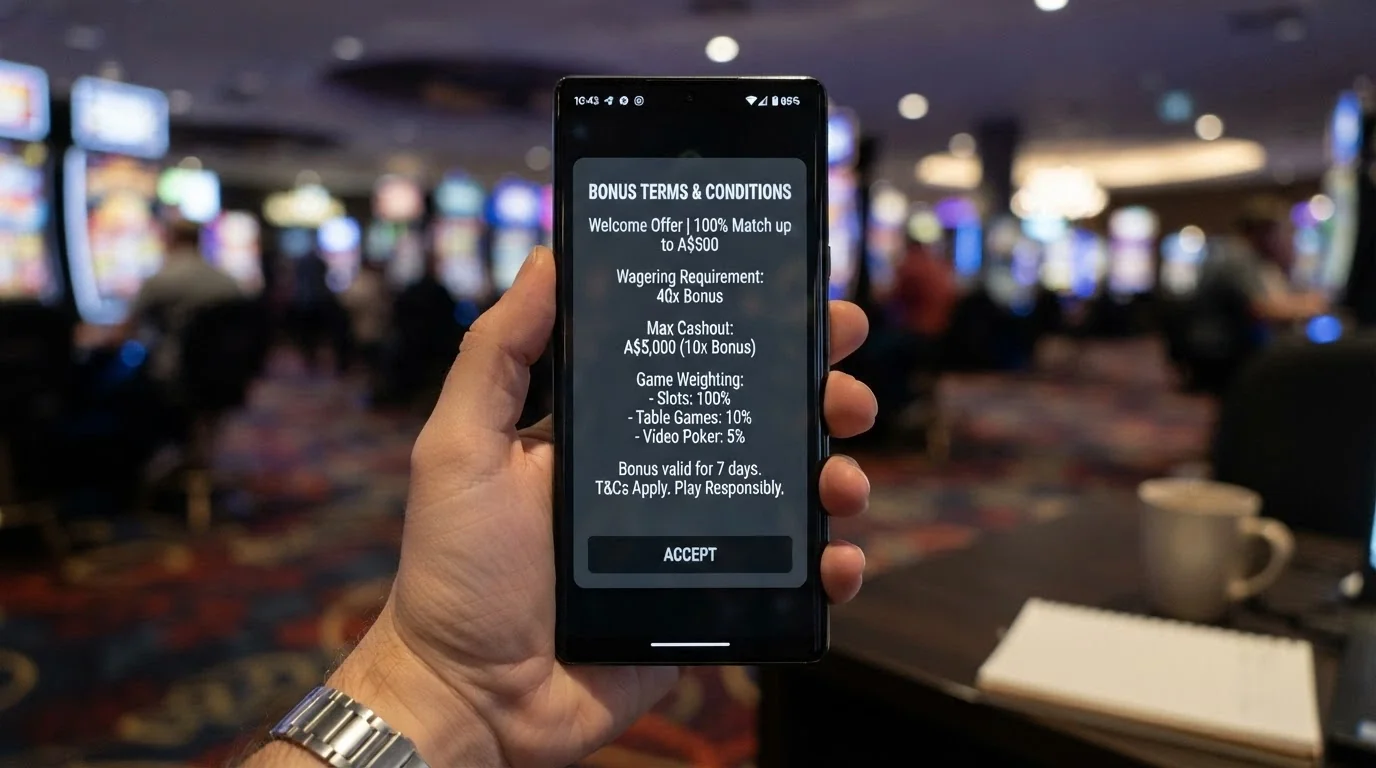
A welcome bonus is a loan with a playthrough attached. The headline figure — A$8,000 at Skycrown, A$7,250 at Bizzo, A$1,000 at Fair Go — is what the bonus could be worth if every cent is claimed, every wagering requirement cleared, and every free-spin tier played in full. Almost no player reaches the headline. The structure is the reason.
How a Welcome Bonus Package Actually Works
The headline bonus is split across multiple deposits at most operators in the set. Skycrown’s four tiers carry minimum deposits rising from A$30 to A$50. Bizzo’s four deposits drop from a 125% match at A$250+ to a 50% match at smaller amounts. Fair Go’s five-deposit structure means a player has to come back five times to claim the full A$1,000. RocketPlay’s two-deposit package is the most concentrated in the table.
The deposit-to-bonus ratio is the number to internalise. A 100% match on a A$100 deposit is a A$100 bonus — and at 40x wagering, the player must run A$4,000 of turnover before any withdrawal. A 200% match at the same A$100 deposit is a A$200 bonus and A$8,000 of required turnover. The percentage match scales the bonus, and the wagering multiplier scales the clearing cost.
The headline number is what four or five deposits could produce. The realistic number for a player who deposits once and clears that bonus alone is much smaller.
No-Deposit Bonuses: What They Really Cost to Claim
A no-deposit bonus is not free in the sense the word suggests. The A$10 at Royal Reels requires A$300 of turnover (30x) before any of the winnings can be withdrawn — and the cashout is then capped at A$200. The player is doing A$300 of real wagering on a A$10 starting balance. The 20 free spins at RocketPlay carry 40x wagering on whatever the spins win, and the cap is roughly A$85. The Fair Go PWA spins carry 40x and a A$75 cap.
The wagering math is the price. A player who claims Royal Reels’ A$10 must run roughly 300 spins at the minimum eligible stake to clear the playthrough — and the expected loss embedded in those 300 spins, at a 96.5% RTP, is around A$10. The bonus is, in expectation, a wash. The value is in the withdrawal test, not the bonus profit.
For a player weighing a no-deposit offer: the question is not whether the bonus is worth claiming — at these terms, it usually is — but what it is actually buying. The honest answer is a withdrawal test, not a payout.
Wagering Requirements: The 40x Multiplier That Shrinks Every Offer
The market median wagering multiplier across AU-facing offshore casinos is 40x. That figure is the multiplier that turns a A$1,000 bonus into A$40,000 of required turnover — and the figure that determines what the offer actually costs in expectation.
The variation matters. Fair Go runs 30x on deposit and bonus combined, which is the lowest real-money wagering figure in the table and the most player-friendly. RocketPlay runs 40x on the bonus amount only, which is the most common structure. Rocket Casino runs 50x on deposits over A$100, the steepest in the set, having moved up from 30x earlier in 2026. The market median is 40x; the outliers sit above and below.
The expected loss embedded in the playthrough is the honest price of the bonus. Using Skycrown’s A$8,000 cumulative package at the median 40x wagering, the required turnover is A$320,000 — and at a representative 96.71% RTP (Big Bass Bonanza), the expected loss is roughly A$10,500. That figure is what the bonus actually costs the player on average, before any withdrawal is attempted. The headline is A$8,000. The price is roughly A$10,500. The “free money” framing collapses the moment the math is run.
For a player clearing a smaller bonus — say A$500 at RocketPlay on a 100% match — the same calculation produces A$20,000 of turnover and an expected loss of around A$660 at the same RTP. The smaller the bonus, the smaller the absolute cost, but the proportional cost stays in the same band. Wagering requirements take a fixed percentage of every bonus dollar in expectation, regardless of the headline.
The conclusion: a 40x wagering requirement is the market’s way of making a bonus expensive to claim. The expected loss is the price, not a worst case. It is a statistical estimate averaged across many spins under the stated assumptions, and it promises no win and no payout. It tells a player what claiming the bonus will cost in expectation — and that figure is large enough to make the headline bonus a smaller offer than it looks.
How Your Money Moves at an Offshore Mobile Casino
The cashier is where an AU mobile casino either feels like a local product or does not. PayID, crypto, bank transfer — each method tells a different story about how the operator is wired into the Australian system, and how fast a withdrawal actually arrives.

PayID: The Fast Track for Australian Dollar Deposits
PayID is the default AUD rail at every featured operator that supports fiat deposits. Deposits clear in under 60 seconds — a speed set by the Australian banking system’s Osko layer rather than by the casino — and withdrawals tested at the fastest AU-facing sites arrive in 28 to 35 minutes. The cashier experience is the closest thing to a “local” payment flow an Australian player finds on an offshore site.
PayID works because it ties the deposit to a bank account and a mobile number or email, which leaves an audit trail the bank holds independently of the casino. That audit trail is part of why PayID sits on the compliant side of the 11 June 2024 payment-method ban: it is a debit-rail transaction, not a credit or crypto one. For an Australian player, PayID is the fastest fiat method available and the one with the clearest regulatory standing.
Crypto and Bitcoin: Faster Payouts, Fewer Questions
Crypto withdrawals — USDT TRC-20 in particular — clear in 8 to 18 minutes at most AU-facing sites. That is the fastest payout on the page, and it is the speed advantage crypto-native operators cite to justify their position. Rainbet is the clearest example in the featured set: Anjouan-licensed, in-house provably fair games, and a cashier built around crypto rails.
The trade is the regulatory one. Since 11 June 2024, crypto has been banned as a payment method for licensed wagering in Australia — a rule that applies to operators licensed under Australian state or territory regimes, with penalties up to A$247,500 for the operator. The operators on this page are not licensed under those regimes. A crypto deposit at Skycrown or Stake or Rainbet is a transaction outside the Australian payment framework, and Skycrown’s bonus terms reflect that reality: crypto deposits are excluded from every Skycrown bonus, a fact the support team confirms directly. The speed is real. The protection is not.
For a player who values speed above regulatory clarity, crypto is the fastest route. For a player who wants to keep the deposit inside the Australian banking system, PayID is the cleaner choice.
How Withdrawal Speed Really Compares Across Methods
The spread runs from eight minutes to five business days. Crypto at the fastest operators clears in 8 to 18 minutes. PayID at the fastest operators arrives in 28 to 35 minutes. Bank transfer is the slow lane — minimum A$100 at Skycrown, multi-day settlement at every operator that supports it.
The minimum withdrawal floor matters at the small-stakes end. Most AU-facing offshore casinos sit between A$20 and A$100, with the floor varying by method rather than by operator. A player withdrawing under the floor cannot withdraw at all, which is the practical reason the floor exists. The fastest payouts at the smallest minimums are the ones that combine the cleanest operator with the fastest rail — and those combinations are not universal.
For a player who has decided to claim a bonus: the wagering requirement has to clear before any withdrawal is possible, and the clearing time depends on how fast the player spins. The withdrawal speed is the second half of the question, not the first.
The Legal Reality: Online Casino Is Prohibited in Australia
Online casino games, online pokies and in-play betting are prohibited under the Interactive Gambling Act 2001. There is no licence for any of those products in Australia — not federally, not in any state or territory. Every operator on this page is providing a prohibited interactive gambling service to Australians, and the IGA makes that provision an offence.
The Interactive Gambling Act 2001 and What It Actually Bans
The IGA, in force since 2001 and strengthened by amendments in 2017, makes it an offence to provide online casino games, online pokies and in-play sports betting to a person in Australia. What remains licensable is wagering on races and sports placed before the event begins, plus lotteries and keno through state and territory licensing. The minimum age for any licensed wagering is 18. The Northern Territory Racing and Wagering Commission is the main issuer of state-level wagering licences, with operators paying a 5% NT wagering tax plus a 0.05% racing levy, and a state point-of-consumption tax of typically 10–15% on top.
The prohibition targets the provider, not the player. A person playing at an offshore casino is not prosecuted under the IGA — but they are also outside the Australian consumer protection framework when they do. There is no ACMA complaint mechanism for an offshore casino withdrawal dispute, no Australian Financial Complaints Authority recourse, no state-based tribunal that can compel a Curaçao-licensed operator to pay a disputed balance. The operator’s regulator — Curaçao Gaming Control Board, Anjouan Gaming Management Authority — is where the dispute would land, if anywhere.
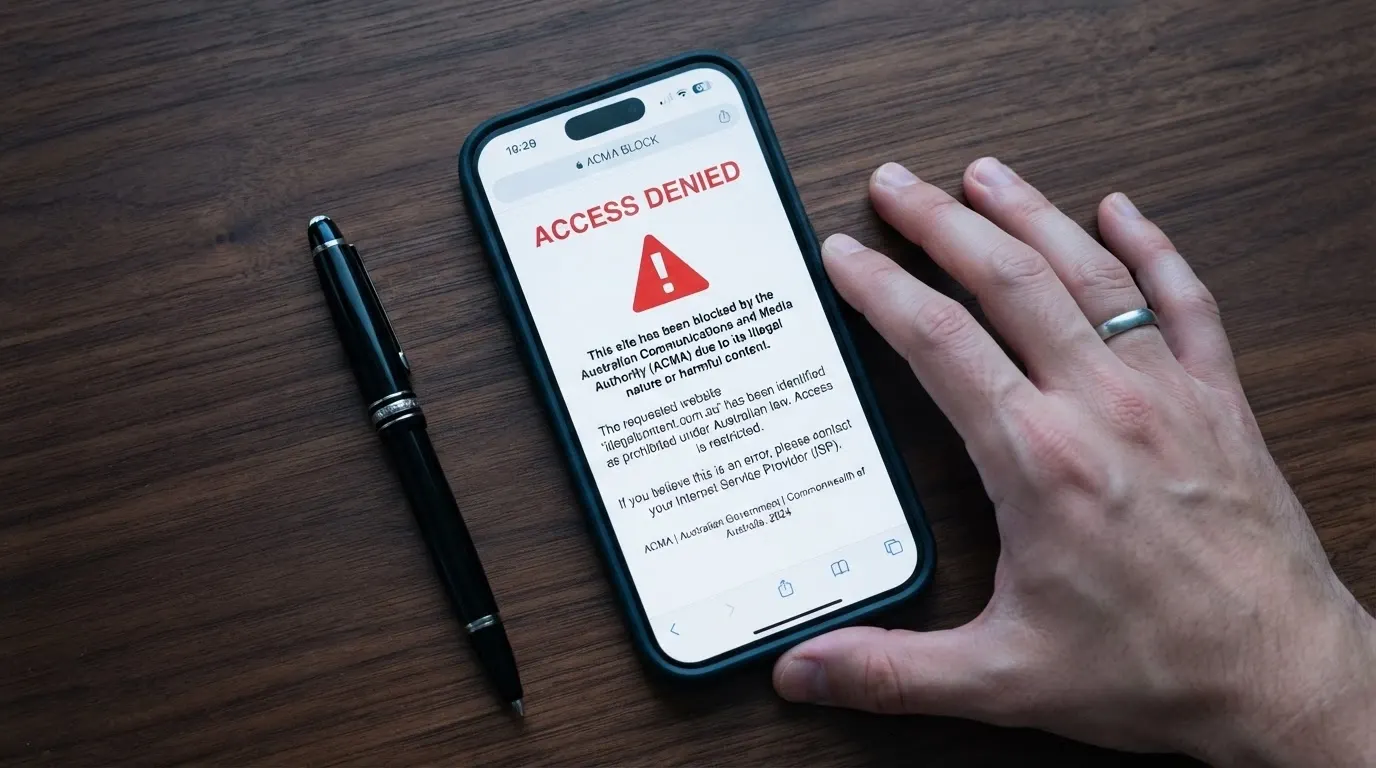
The enforcement picture is also moving. The ACMA has had 1,564 illegal gambling and affiliate websites blocked by Australian ISPs since its first blocking request in November 2019, and more than 225 illegal services have withdrawn from the Australian market since 2017. The block list removes DNS-level resolution at the ISP, which means an Australian player who deposited at a site yesterday may find the site does not resolve tomorrow.
The 2026 Gambling Reform: What Changes on 1 January 2027
The Interactive Gambling Amendment (Gambling Reform) Bill 2026 passed Parliament on 19 August 2026, and its schedules commence on 1 January 2027. The Bill is the most significant shake-up of the Australian online wagering framework in a decade, and several of its changes touch offshore operators directly.
Banks and payment providers gain express authority to block transactions to illegal gambling operators from 1 January 2027. Wagering advertising is capped at three ads per hour between 6:00 am and 8:30 pm, with a live-sport blackout of 15 minutes before to 5 minutes after a live event. Athletes, celebrities and influencers are barred from promoting wagering products. Inducement marketing is banned for 14 days after a customer signs up and for three months after a person deregisters from BetStop. The reform also bans online keno “pocket pokies” and foreign-matched lotteries.
The opt-out register — AdStop, the Wagering Advertising Opt-out Register to be established by ACMA — is not expected to be operational by 1 January 2027, which means the advertising rules commence before the mechanism that would let a consumer enforce them. The asymmetry matters for any reader who wants to opt out of seeing wagering ads.
The bank-blocking authority is the most direct change for offshore operators. A bank that decides to block transactions to a specific illegal operator now has the legal cover to do so, which means an offshore casino’s withdrawal rail can be cut by a bank’s compliance team without notice. The player does not initiate the block; the bank does.
What the Prohibition Means for You as a Player
The player is not breaking the law by using an offshore casino — the IGA targets the provider, not the individual. What the player is also not getting is Australian consumer protection. There is no BetStop coverage for offshore casinos, no withdrawal recourse if an operator refuses to pay, and the site can be blocked at any time with a balance on it. The 1,564 sites blocked since November 2019 are a real risk to an Australian deposit held at an offshore operator.
On the tax side, ordinary punters’ gambling winnings are not assessable income under section 6-5 of the ITAA 1997. A casual player who withdraws from an offshore casino does not declare the withdrawal as income and does not pay tax on it. The rule applies unless the ATO classifies the person as carrying on a business of gambling — a much higher bar, and not relevant to a typical AU mobile casino player.
The black-market scale is the closing fact. The International Masters of Gaming Law has predicted the Australian online gambling black market will reach A$5 billion by 2029. That figure is the size of the gap the IGA has not closed, and it is also the size of the offshore product Australian players are currently reaching through the operators on this page.
Responsible Gambling When the Safety Net Doesn’t Reach Offshore
The Australian responsible-gambling infrastructure is built around licensed wagering. The National Gambling Helpline, Gambling Help Online, BetStop — all of it assumes the operator on the other end of the session holds an Australian licence. For offshore casinos, that assumption does not hold.

The Tools Australian Players Can Actually Use
The National Gambling Helpline — 1800 858 858 — is free, confidential and staffed 24 hours a day, 7 days a week. Gambling Help Online runs chat and counselling at gamblinghelponline.org.au. Both are available to any Australian, regardless of where they play.
Operator-level tools — deposit limits, session timers, take-a-break, activity statements — are available at most featured operators, though the specific configuration is not documented in research for each brand. These tools work at the operator level, which means they apply to one account at one site. A player who sets a deposit limit at Skycrown has not set one at Royal Reels, and an offshore operator’s enforcement of its own limits is not policed by an Australian regulator. BetStop is the national-level equivalent: one registration excludes a player from every Australian-licensed wagering service at once.
BetStop, Offshore Casinos and the Registration Gap
BetStop — the National Self-Exclusion Register — went live in August 2023. As at 31 July 2026, the register had 67,480 registrations, of which 41,290 exclusions were still active. Seventy-eight percent of registrants were under 40; 38% chose lifetime exclusion. The numbers are the registration gap made concrete: tens of thousands of Australians have used the national mechanism to step away from licensed wagering, and the mechanism does not reach the operators on this page.
BetStop binds only Australian-licensed wagering services. An offshore casino is not connected to the register. A player who has registered with BetStop can still deposit at Skycrown, Royal Reels or any other operator in the featured set. The self-exclusion is real where it applies, and silent where the offshore product sits. The 2027 reform closes some of this gap by banning inducement marketing for three months after a BetStop deregistration, which means an offshore operator that markets directly to a former BetStop registrant now faces an Australian rule it could previously ignore. The marketing restraint is not the same as a registration block.
For anyone reading this page who has already registered with BetStop: the exclusion does not extend here. The operator-level tools — deposit limits, session timers, take-a-break — are the lever that does.
How We Selected and Ranked These Mobile Casinos
The ten operators on this page are the brands an Australian mobile player actually reaches. The selection is based on AU-facing traffic and publicly stated bonus terms — the operators that comparison sites in Australia list, the ones that run AUD cashier pages, the ones a PayID deposit can clear. The featured set is not the entire market; it is the slice a reader would encounter while searching.
The evaluation criteria: bonus terms (welcome amount, free spins, wagering multiplier, max cashout), payment methods available to AU players (PayID, crypto, bank transfer), game-library scope, licence jurisdiction, and the transparency of the operator’s terms page. What this page does differently from every other comparison in the market is the legal-disclosure standard it applies — the Interactive Gambling Act context, the ACMA blocking record, the offshore-licence reality, the BetStop gap. No competitor page in the search results names the IGA, the ACMA, or BetStop. None discloses that online casino is prohibited under Australian law. The honesty about the legal position is the page’s differentiator, and it sits beside the bonus comparison rather than in place of it.
What this page does not do: it does not present offshore operators as licensed Australian casinos. It does not recommend one brand over another for a reader to play at. It does not describe any bonus as “free” or “risk-free” — those framings collapse the moment the wagering math is run. It does describe what each bonus costs in turnover and expected loss, because that is the only honest pricing of a welcome package.
What You Should Actually Do With This Information
Three things to check before depositing at any mobile casino an Australian player reaches on a phone.
The licence jurisdiction. A Curaçao or Anjouan licence is what every featured operator carries; no Australian online casino licence exists. The offshore jurisdiction is the regulatory reality, and the operator’s response when asked about it tells a player whether they are dealing with a transparent business or a marketing front.
The wagering terms. The market median is 40x; the outlier in the set is 50x on Rocket Casino deposits over A$100. The expected loss embedded in the playthrough is the bonus’s real price — the headline is what it could be worth, the wagering is what it costs to claim. A player who runs the math before depositing knows what they are buying.
The withdrawal method. PayID is the AUD rail inside the Australian banking system, with deposits clearing in under 60 seconds and withdrawals in roughly 30 minutes at the fastest sites. Crypto is faster on withdrawal but sits outside the Australian payment framework, and credit cards are not an option at any operator that respects the 11 June 2024 ban. An operator that asks for a credit card or a crypto deposit for a “welcome offer” is being served by someone outside the Australian rules.
The structural risk of playing at an unregulated offshore site is real. BetStop does not cover the operators on this page. The ACMA has blocked 1,564 illegal sites since November 2019 and continues to add to the list. From 1 January 2027, banks gain the authority to block transactions to illegal operators directly. A balance held at an offshore site is a balance held outside the Australian protection framework, and that is the position the reader is in if they choose to play.
The National Gambling Helpline is 1800 858 858, free and confidential, 24 hours a day. Gambling Help Online runs chat and counselling at gamblinghelponline.org.au. BetStop is the national self-exclusion register at betstop.gov.au. The numbers are here because the gap between the offshore product and the Australian safety net is the part of this page no other comparison publishes, and it is the part a reader needs most.
Frequently Asked Questions
Is it against the law for a player to use an offshore mobile casino in Australia?
No. The Interactive Gambling Act 2001 targets the provider of online casino games, online pokies and in-play betting, not the individual player. Using an offshore casino is not a criminal offence for the person playing. What the player also does not receive is Australian consumer protection — no ACMA complaint mechanism, no BetStop coverage, and no Australian tribunal recourse if the operator refuses to pay. The legal exposure sits with the operator, the consumer protection gap sits with the player.
Are mobile pokies fair and what RTP should I look for?
A small number of mobile pokies have a publicly verifiable RTP — Big Bass Bonanza at 96.71%, Sweet Bonanza around 96.48–96.51%, Sweet Bonanza 1000 at 96.53%, Big Bass Bonanza Megaways at 96.70–96.72%. Every title on that list is high volatility. The RTP figure is published by the studio (Pragmatic Play, Reel Kingdom) and held constant across licensed deployments. On an offshore site, the studio’s reputation is the only audit — there is no Australian regulator policing the live RTP of each game.
What happens if a mobile casino refuses to pay out in Australia?
The operator’s regulator — typically the Curaçao Gaming Control Board or the Anjouan Gaming Management Authority — is where the dispute lands, not an Australian body. There is no Australian Financial Complaints Authority or state tribunal that can compel an offshore operator to release a balance. The dispute must be raised with the offshore regulator, and the outcome depends on the regulator’s response. ACMA can investigate the offering of illegal services in Australia, but it cannot enforce a withdrawal against an offshore operator on a player’s behalf.
Does BetStop cover offshore mobile casinos?
No. BetStop binds Australian-licensed wagering services only. The register had 67,480 registrations as at 31 July 2026, of which 41,290 were active exclusions, and none of those exclusions reaches the offshore operators on this page. A person registered with BetStop can still deposit at an offshore casino. Operator-level tools — deposit limits, take-a-break, self-exclusion at the casino itself — are the lever that does apply.
Can I use Bitcoin or crypto at a mobile casino in Australia?
Yes at the offshore operators on this page — Rainbet, Stake, Skycrown and others support crypto deposits and withdrawals. USDT TRC-20 withdrawals clear in 8 to 18 minutes at the fastest sites. The Australian regulatory position is different: crypto has been banned as payment for licensed online wagering since 11 June 2024. An Australian-facing operator that asks for a crypto deposit is being served by someone outside the Australian rules — the speed is real, the Australian consumer protection is not.
Published by the Pokies Melbourne team.