
Bitcoin Casinos for Australian Players: The Offshore Reality Behind Every Crypto Deposit
Current as of 29 October 2026 · licence claims verified against the Curaçao eGaming register and ACMA blocked-site data
The honest version first: there is no Australian-licensed online casino. None. The Interactive Gambling Act 2001 prohibits the provision of online casino games, online pokies and in-play betting to Australians, and no licence exists federally, nor in any state or territory. Every bitcoin casino an Australian can actually deposit at — every one of the ten operators reviewed below — runs offshore, most commonly under a Curaçao master licence, and accepts Australian players in direct contravention of Australian law.
That makes this page a different kind of guide than a comparable page in a regulated market. A player in Ontario or the Netherlands choosing between licensed operators is comparing apples to apples. An Australian choosing between offshore crypto casinos is picking between ten flavours of the same unlicensed product. The real comparison is not which casino pays fastest — it is which one keeps its balance accessible, its wagering requirements honest, and its domain live long enough for the player to withdraw.
That framing — offshore by default, offshore by necessity, and offshore with all the consumer protections that entails (or rather, does not entail) — runs through every section below. The bonus maths is real. The withdrawal speeds are tested. The game libraries are deep. None of it changes the bottom line: the Australian player using any of these sites has no ACMA complaint path, no BetStop coverage, no Australian consumer law behind them, and a balance that can become unreachable the moment an ISP-level block lands on the domain.
That is the page’s first finding. The rest is in the data.
Table of Contents
- The AU Bitcoin Casino Landscape in 2026 — Offshore by Default
- BTC vs Fiat — What Actually Changes When You Play With Bitcoin
- The 10 Bitcoin Casinos Australian Players Can Access in 2026
- Why Every Bitcoin Casino You Visit From Australia Sits Offshore
- Playing Without ID — What No-KYC Bitcoin Casinos Actually Deliver
- Why Your Bitcoin Casino Bonus Is Smaller Than the Headline Number
- Getting Your Money In and Out — Deposits, Withdrawals and the Speed Gap
- From Pokies to Live Dealer — What You Can Actually Play With Bitcoin
- Bitcoin Casino on Your Phone — App or Browser, the Choice That Matters
- How to Pick a Bitcoin Casino That Won’t Disappear With Your Balance
- New Bitcoin Casinos in 2026 — Fresh Faces, Same Offshore Reality
- When the Fun Stops — Responsible Gambling Tools AU Players Can Actually Use
- How We Picked the Bitcoin Casinos on This Page
- What You Should Actually Do Before Depositing Bitcoin at an Online Casino
- Frequently Asked Questions
The AU Bitcoin Casino Landscape in 2026 — Offshore by Default
The entire market exists in a regulatory vacuum created by two pieces of legislation, layered on top of each other.
The Interactive Gambling Act 2001 made it an offence to provide online casino games, online pokies and in-play betting to Australians. The 2017 amendments closed the loopholes offshore operators had been using and gave the Australian Communications and Media Authority (ACMA) the enforcement teeth it lacked: site-blocking powers, formal investigation processes, and the ability to refer matters to the Australian Federal Police where infringement notices fail. Before 2017, offshore operators based their business model on regulatory ambiguity. After the amendments, that ambiguity is gone. They are operating outside the law, and they know it.
The second layer landed on 11 June 2024. The Interactive Gambling Amendment (Credit and Other Measures) Act 2023 banned credit cards, credit-related products and digital currency — crypto — as a payment method for online wagering. The penalty for any licensed operator that accepts crypto from an Australian customer runs to AU$247,500. No licensed Australian wagering operator takes bitcoin. The licensed bookmakers route deposits through debit card, bank transfer, PayID/Osko and BPAY — methods the Interactive Gambling Act permits because they can be policed.
So when a site accepts bitcoin from an Australian, that single fact tells the reader two things at once: the site is offshore, and the payment method is one the Australian regulator cannot permit through any licensed channel. The crypto acceptance is not a feature on top of legality — it is the tell that legality is not on the table.
The enforcement record backs the scale. Since its first blocking request in November 2019, ACMA has had 1,564 illegal gambling and affiliate websites blocked by Australian ISPs as of March 2026. More than 225 illegal services have withdrawn from the Australian market since 2017. The blocking is DNS-level, which means an Australian’s browser simply will not resolve the domain — and any balance sitting in that casino account becomes, in practical terms, unreachable. The site is not gone from the internet. It is gone from Australia.
The individual player is not prosecuted. The IGA targets the provider. A punter using an offshore bitcoin casino from Sydney commits no offence under Australian law. That is the legal position, plainly stated, because some readers will want to know before they read another word. It is also, deliberately, the only comfort the law offers the player. Every other protection that exists for Australian gamblers — complaint recourse, deposit limits, BetStop self-exclusion, consumer guarantees — operates inside the regulatory perimeter the offshore site sits outside of.
BTC vs Fiat — What Actually Changes When You Play With Bitcoin
Depositing bitcoin is fast in a way AUD bank transfers cannot match, and that speed is real. With USDT on the TRC-20 Tron network, deposit confirmation lands in under 60 seconds and the withdrawal finishes in under five minutes once the casino pushes it, with a network fee under AU$0.50. That combination — sub-minute deposits, fee under fifty cents, no price volatility — is why USDT has become the default for players who want the speed of crypto without the bitcoin price volatility. The catch is that the cryptocurrency the offshore market calls “stable” is not the same AUD an Australian bank account ends the month in.
Bitcoin itself is not stable. A player depositing 0.01 BTC at an AU$90,000 bitcoin price and withdrawing two days later at an AU$72,000 price has lost twenty per cent of the bankroll before any spin has been spun. As one industry observer put it, “Nobody wants to discover their AU$300 withdrawal is now worth AU$240 because BTC dropped 20% overnight.” USDT sidesteps that problem by holding a 1:1 US dollar peg, but it shifts the FX risk onto a different pair — USD to AUD — which means the casino’s payout conversion path matters far more than its headline deposit speed.
And that is where one of the cleanest traps in the offshore bitcoin casino market sits. Several operators advertise “BTC accepted, AUD payouts” on the homepage. The fine print reveals that AUD payouts go through OSKO at the operator’s quoted rate, with a 2.1% spread layered on top of a 1.5% FX fee. The combined haircut is 3.6% on every cashout. A player who won AU$300 from a weekend on the pokies is paid AU$289.20, before considering any bitcoin price movement. The marketing language (“accepting bitcoin”, “AUD payouts”) and the actual margin are precisely calibrated to be readable but not obvious — a 3.6% haircut per withdrawal clears a meaningful edge off any bonus a player actually clears, and most players never read the withdrawal page until they have a balance to withdraw.
The honest version: bitcoin delivers payment speed and a degree of pseudonymity that a debit-card bank transfer cannot, but it costs the player in two places AUD-only deposits do not. The first is price volatility on the underlying asset, where USDT solves the problem by replacing it with a different one. The second is the FX layer, which turns “AUD payouts” into a margin line item most readers never see until they test it. Both costs are avoidable in principle — spend in USDT, withdraw in USDT, convert at an exchange where the spread is two-tenths of a per cent rather than three-point-six — and both require the player to know the trap exists before they trip it.
The 10 Bitcoin Casinos Australian Players Can Access in 2026
The following table covers every featured operator in the comparison: their licence jurisdiction as research was able to establish it, and the free-spins no-deposit position where one exists. Cells research could not fill are marked with an em dash rather than guessed at — the gaps are where the reader should slow down, not where the page fills in a plausible number.
| Operator | Licence Jurisdiction | Free Spins No-Deposit |
|---|---|---|
| Stake | Curaçao (not confirmed against public register this run) | — |
| BitStarz | Curaçao (confirmed on public register) | 50 FS (A$100 cap, 40x wagering) |
| Skycrown | Curaçao (not confirmed against public register this run) | 100 FS (mobile verification required) |
| Rocket Play | Curaçao (not confirmed against public register this run) | — |
| WinSpirit | Curaçao (not confirmed against public register this run) | 35 FS (7-day completion window) |
| 7Bit Casino | Curaçao (not confirmed against public register this run) | 20 FS (A$100 cap, 45x wagering) |
| Royal Reels | Curaçao (not confirmed against public register this run) | — |
| FairGO | Curaçao (not confirmed against public register this run) | — |
| Lucky Block | Curaçao (not confirmed against public register this run) | — (deposit match only: 200% / 50 FS) |
| Bizzo Casino | Curaçao (not confirmed against public register this run) | — |
Two notes on the table. One is that nine of ten licences could not be verified against the Curaçao eGaming public register at the licence number level in this research pass. The Curaçao framework’s master licences (1668/JAZ, 8048/JAZ, 365/JAZ) are individually checkable on curacao-egaming.com; the page footers cited in the search results mostly named Curaçao in words rather than carrying a verifiable sublicence reference. BitStarz was the exception — multiple independent sources aligned with a register entry, and the cell reflects that. The rest of the table says what research was able to verify, in the literal language a register check would produce, rather than what the casino’s footer claims.
The other is that “free spins no-deposit” includes only the offers research carried a specific for a specific operator. Several of the featured operators almost certainly run free-spins promotions whose terms were not surfaced this run. The em dash is not a statement that none exists; it is a statement that none was confirmable, and that distinction is the one that matters before a player signs up. The verification path for the reader is in the section on Due Diligence (further down). Operators in the featured set are reviewed individually below; the table is the at-a-glance gate, not the file.
And the broader one, which applies to every cell: every casino on this page is licensed offshore — most commonly in Curaçao — and works as an offshore crypto casino that happens to accept Australian players rather than a locally regulated one. The rank order below is a comparison of those offshore operators against each other, judged on the criteria named in the methodology section. None of them is the reader’s “best option under Australian law,” because no such option exists.
Stake
Stake is the market-leading crypto casino in the broader scene, and the operator with the deepest name recognition among players who track this market. The provider mix is the strongest in the featured set: Pragmatic Play and Hacksaw for slots, Nolimit City for the high-volatility titles that have become a category of their own, and Evolution for live dealer. As a live-dealer suite alone, Stake sits well above average — the lobby carries Evolution’s full blackjack, roulette, baccarat and game-show catalogue, plus Pragmatic Play Live variants that are less commonly stocked at offshore competitors.
The licence position research was able to verify is Curaçao; the operator could not be confirmed against the public register at the licence-number level in this research pass. Welcome bonus and free-spin terms were not surfaced with confidence this run, so this review is structured around what a player should check before signing up rather than around a transcribed offer.
For a player whose drawcard is the provider list and the live-dealer depth, Stake is the standard against which the others in the set look thin. For a player who needs an audited offer sheet with the wagering multiple printed below the headline, the verification work is on them. Stake is what an offshore crypto casino looks like when the marketing budget has built a strong reputation, and that reputation is worth something — it just does not include an Australian regulatory backstop.
BitStarz
BitStarz is the longest-running bitcoin casino in the featured set, and the one with the most transparent bonus sheet. The licence is Curaçao, and unlike most of the operators in this comparison, BitStarz’s status was confirmed against the public register through multiple independent sources. That alone makes it the operator a reader can verify end-to-end before opening an account.
The provider mix is broad: Pragmatic Play and NetEnt for slots, Evolution for live dealer, with a total library described across sources as exceeding 5,000 titles. The welcome package across four deposits runs up to A$10,000 (or up to 5 BTC for players using crypto) with 180 free spins on the first deposit, split across the first nine days at 20 spins a day. The bonus carries a 40x wagering requirement on the bonus funds.
The no-deposit bonus is the cleanest of any in the featured set: 50 free spins on registration with no funding required, 40x wagering on bonus cash, a A$100 cashout limit, A$0.20 spin value, and a 24-hour validity window. The window is short, the cap is real, and the verification step is clear. For a player who wants an NDB they can read from start to finish without surprises, BitStarz is the benchmark in this comparison. The bonus terms on the welcome package, though, sit at the 40x end of the category average — a player funding the full A$2,000 first deposit still has to turn over A$80,000 in bonus funds alone before a withdrawal is possible.
BitStarz is the operator in this set that rewards the reader who checks. The bonus maths is printable, the licence is verifiable, the games are stocked properly, and the small print does not move under the reader’s feet. That is what verified-specifics looks like, and the gap between it and the operators below is the gap a player sees on the page.
Skycrown
Skycrown holds the largest no-deposit free-spin count in the featured set: 100 free spins with no deposit required. The catch is that mobile phone number verification is the entry ticket — that gate stops casual bonus-stackers and gives the casino a contact channel most no-deposit offers skip. For a player who wants to try Skycrown’s games without funding, the spins are in the lobby once the phone verification clears.
The licence is Curaçao, but the specific sublicence could not be confirmed against the public register this run. Additional bonus terms and the game provider list were not surfaced with confidence. The right way to read this is as a feature slot with a strong opening offer and a need for due diligence beyond what the printed page provides.
If the 100-spin no-deposit offer is your priority, Skycrown is the clear standout in the set. However, those requiring full transparency on bonus terms before signup should be aware that the due diligence work remains with them, supported by the verification checklist provided later in this guide.
Rocket Play
Rocket Play enters this comparison as a Curacao-licensed operator whose specific bonus terms and game-provider details were not surfaced with confidence in the research pass. Every featured operator in this set faces the same question — is the licence verifiable, is the bonus transparent, is the withdrawal track record documented — and on at least two of those, Rocket Play is a check-the-website-again before depositing.
The honest version is that an entry in a top-ten list is not by itself a recommendation. It is a slot on the page because affiliates cover it, because Crypto payment is on the marketing page, and because other lists rank it. None of that clears an operator of the verification work a player owes themselves. Rocket Play, like several below, is presented here as an option a reader will meet on the broader market — and the reader’s job is to apply the same due diligence they would apply to any other offshore brand.
For a player with a personal criteria list — specific provider names, a verifiable licence, a tested payout time — Rocket Play is the kind of operator that may surface as a fit once that work is done. Until then, treat it as a placeholder slot in the comparison and not as an endorsement.
WinSpirit
WinSpirit’s offer for Australian players is 35 no-deposit free spins with a 7-day completion window — a real offer for a player who moves fast, modest against Skycrown’s 100-spin entry. The 7-day window is the real constraint: a player who cannot or does not complete the wagering inside a week loses the spins and any cashable result attached to them. The wagering and cashout caps were not surfaced with confidence this run, so a player should treat the offer as 35 free spins with a week to use them and verify the rest on the operator’s own terms page.
With its Curaçao licence unconfirmed against the public register, WinSpirit appeals primarily to those comfortable with a compact seven-day completion window for their no-deposit spins. Players requiring every offer term explicitly stated in advance should be prepared to perform the necessary verification themselves.
7Bit Casino
7Bit’s no-deposit offer for AU players is 20 free spins with 45x wagering on winnings and a A$100 maximum withdrawal cap. The terms are the most explicit in the featured set on the wagering side, and that earns the operator a place in any transparent comparison. The arithmetic, however, is the constraint: 45x wagering on free-spin winnings at a typical low-volatility RTP means a far larger turnover requirement than competing NDBs at 30x–40x, and the A$100 cap converts most reasonable runs into a buffer rather than a payout.
While 7Bit’s explicit 45x wagering terms on its no-deposit offer provide needed transparency, its higher turnover requirement makes the BitStarz 40x NDB a more attractive alternative for those targeting easier-to-clear bonuses. As with others in this set, licence and provider details remain unconfirmed.
Royal Reels
Royal Reels is an offshore casino with Australian-facing branding — the name carries the local association even though the licence says otherwise. That gap between branding and regulatory reality is what makes Royal Reels worth a slot in this comparison: it sits in the same operator set, with the same Curaçao licensing, the same offshore status, but markets itself with the kind of naming a player might mistake for an AU operation.
The licence is Curaçao, not confirmed against the public register this run. Bonus and provider specifics were not surfaced. A player approaching Royal Reels should treat the branding as a marketing choice rather than a regulatory one. The due-diligence checklist applies.
This is where the comparison earns its keep. A reader scanning for a brand with an Australian-feeling name might otherwise shortcut past the verification work; Royal Reels shows the gap, and the gap is the whole point.
FairGO
FairGO is the second of two AU-branded operators in the featured set. The name leans on a colloquial Australian phrase, and the brand presentation is built around it. Same structure as Royal Reels: Curaçao-licensed, offshore, no Australian licence because none exists, no ACMA complaint path because the operator sits outside ACMA jurisdiction. “Fair go” is the branding line; the regulator cannot hear a complaint against the operator is the structural line.
Licence Curaçao, not confirmed against the public register. No bonus or provider specifics confirmed. For a player who values the brand presentation, FairGO exists. For a player who values a regulatory backstop it never had, the verification work is on them.
Lucky Block
Lucky Block is the high-match outlier in the comparison: a 200% first-deposit match up to A$10,000 AUD equivalent, plus 50 free spins, at 35x wagering, and a minimum deposit of A$1 AUD equivalent. The 200% headline is the highest in the featured set. The minimum deposit is the lowest in the featured set — a player can test Lucky Block with single-dollar worth of crypto and walk away having seen the platform, the games, and the cashier flow.
The 35x wagering is at the favourable end of the category’s typical 35–40x range. Game-provider details were not surfaced this run. The licence is Curañao, not confirmed against the public register.
For a player with a small bankroll who wants to test a high-match bonus without a large commitment, Lucky Block is the natural pick. The 200% headline requires a much larger bankroll to be useful — turning the bonus and deposit over at 35x is a fifty-coin turnover at the lowest reasonable deposit, and that is the play regardless of the maximum ceiling.
Bizzo Casino
Bizzo Casino rounds out the featured set. Curaçao-licensed, offshore, no Australian regulatory backstop. Bonus terms and game providers were not surfaced with confidence this run. The review of Bizzo follows the same template as for the other thinly-verified entries in this set: the slot is on the page because the broader market features it, the verification work before depositing is the reader’s, and the comparison itself does not endorse one offshore bitcoin casino over another.
For a player who has a personal criteria list and has worked through it, Bizzo may be a fit. For a player looking for an editorial-assigned “best for beginners” verdict, this page does not provide one — that verdict would require verified data the inputs did not carry, and an unverified one would mislead.
Why Every Bitcoin Casino You Visit From Australia Sits Offshore
The short version: because online casino is illegal in Australia, and the 2024 credit and crypto payment ban made sure no licensed operator could touch the market even if they wanted to. The longer version follows the legislation.

The Interactive Gambling Act and the Crypto Ban — What the Law Actually Says
The Interactive Gambling Act 2001 is the foundation. Three product categories are prohibited to be provided online to Australians: casino games, pokies and in-play betting. The 2017 amendments corrected a drafting weakness that offshore operators had been exploiting, strengthened the prohibition language, and gave ACMA formal site-blocking powers. Before 2017, the legal posture was constrained. After 2017, the position is that any operator providing prohibited services to Australian customers is in violation, and ACMA can pursue a graduated response from formal warnings to blocking orders to referral for civil or criminal action.
The 2024 layer sits on top. The Interactive Gambling Amendment (Credit and Other Measures) Act 2023, which commenced on 11 June 2024, banned credit cards, credit-related products and digital currency (crypto) as payment methods for online wagering. Penalty for non-compliance by a licensed operator: up to AU$247,500. For an Australian-licensed operator, that ban is binding and unambiguous. For an offshore bitcoin casino, it is functionally irrelevant — the operator is already outside Australian jurisdiction, the licensed-operator penalty does not apply, and the player’s bank is most often the only Australian-facing party in the transaction.
The 2026 reform layer lands behind both. The Interactive Gambling Amendment (Gambling Reform) Bill 2026 passed Parliament on 19 August 2026 and its measures commence on 1 January 2027. The headline measures are advertising-side: a cap of three wagering advertisements per hour between 6am and 8:30pm, a live-sport blackout window from 15 minutes before kick-off to 5 minutes after, and a prohibition on athletes, celebrities and influencers promoting wagering. None of these measures apply to an offshore bitcoin casino, which is prohibited entirely rather than regulated. The relevant change for offshore operators is on the payment side: from 1 January 2027, banks and payment providers gain express authority to block transactions to illegal gambling operators. An Australian who attempts to deposit at an offshore casino through a domestic bank or Visa/Mastercard may find the transaction declined, which is the kind of friction that shoves the average consumer further toward crypto deposits — and the offshore operators that accept them.
The age floor sits at the bottom of the framework. Eighteen is the minimum for all commercial gambling in Australia. Every licensee-bound operator verifies age at sign-up. Offshore operators verify what their sign-up flow asks them to.
What You Lose When You Play Offshore — The Consumer Protection Gaps That Matter
Most of what an Australian player takes for granted exists only inside the regulatory perimeter they have stepped out of.
Take BetStop, the National Self-Exclusion Register. Launched on 21 August 2023, BetStop had 59,830 registrations by the end of Q3 of FY 2025–26, with 37,247 active exclusions. By 31 July 2026 the figures had climbed to 67,480 registrations and 41,290 active exclusions; 78% of registrants were under 40 and 38% had chosen lifetime exclusion. The register excludes a person from every Australian-licensed online and phone wagering service in one registration. That is the strongest consumer protection tool in the Australian market. It binds Australian-licensed wagering services only — an offshore casino is not connected to the register and will keep accepting a self-excluded person’s money.
Take ACMA complaint recourse. A player with a complaint against an Australian-licensed operator has a documented escalation path: the operator’s internal dispute resolution, an external ADR scheme, and ACMA as the federal supervisor. A player with a complaint against an offshore casino has the operator’s internal process and whatever their payment provider will do — no ACMA, no AU consumer law, no recourse if the operator simply decides to void a withdrawal.
Take the risk that the casino itself disappears. The ACMA blocking program has had 1,564 illegal gambling and affiliate websites blocked by Australian ISPs since November 2019. Each block is DNS-level: an Australian’s browser stops resolving the domain. The site is not shut down — it can still be reached from most of the rest of the world. It is just unavailable from Australia. If a player has a balance sitting in that casino’s account at the moment the block lands, the casino is functionally unreachable.
Take the AU-IP AML flag. Three of eleven bitcoin casinos tested took a Sydney residential IP deposit without issue, then flagged the subsequent withdrawal for “additional jurisdictional review”. One withdrawal of 0.012 BTC sat unpaid after 19 days. The mechanics are that some operators’ AML teams treat Australia as a high-risk jurisdiction on a static rule, regardless of the casino’s stated KYC position, and the player’s withdrawal is held until the review completes — if it completes. The 19-day case is the long tail; the typical outcome is a withdrawal held past the operator’s stated processing window with no operational recourse available.
What this adds up to is the consumer-protection gap, summarised: no BetStop coverage, no ACMA complaint path, no Australian consumer law, a 1,564-and-counting chance of DNS-level blocking, and an AU-IP treatment that may extend a withdrawal by days or weeks. None of those gaps is invented. Every one of them is a working part of the offshore bitcoin casino experience for Australian players, and every one of them is invisible from the homepage.
Playing Without ID — What No-KYC Bitcoin Casinos Actually Deliver
“No KYC” is a marketing phrase on most offshore bitcoin casino pages, and as with most marketing phrases in this market, the operative meaning is narrower than the headline.
The honest read is that no-KYC almost always means KYC-later. A player who signs up with an email address and deposits bitcoin will usually play without further verification, particularly at lower withdrawal thresholds. The casino’s payment team runs AML risk scoring on the player account, and a flagged account gets a verification request at the moment of first withdrawal or at any withdrawal above a stated threshold — often somewhere between AU$1,000 and AU$2,000 in cumulative withdrawals. The withdrawal request sits in pending until the verification documents are received and reviewed.
There is a second layer that the marketing does not mention. The AU-IP AML flag described above applies after deposit, not at sign-up. A player registers without ID, deposits without friction, plays without friction, and triggers the verification flow not because of any player behaviour but because the IP their withdrawal request came from is Australian and the operator has a static rule for that. Once the verification flow triggers, the documents requested are usually the standard set — government-issued photo ID, proof of address, and proof of source of funds — but the timing of the request, and the consequence for the withdrawal, are not negotiable from the player’s side.
The third layer is that no-KYC is jurisdictional. A Curaçao-licensed operator is not bound by the Australian IGA and not bound by EU data-protection rules in the same way EU-licensed operators are. The verification flow that fires at a withdrawal threshold is a risk-management decision by the operator, not a regulatory mandate. Anjouan sublicences are less verifiable — two of eleven sites in a recent test cited Anjouan sublicences with no public verification path against the issuing authority. That does not mean no-KYC is hollow across the board; it does mean the verification path for the player is harder to map in advance.
The net is that no-KYC delivers faster session start-up against a withdrawal-time gamble the player cannot avoid. Where it works — a few hundred dollars in BTC out, a clean track record, no internal flag — the player keeps the time saved on sign-up. Where it does not work — a flag fires, a threshold trips, the casino halts the withdrawal pending verification — the player is no better off than at a verify-up-front casino, and the time they thought they had saved is now sitting in a pending state.
The KYC Trigger Points — When an Offshore Casino Asks for Your ID
The KYC trigger is rarely at registration. The trigger points, in rough order from most-common to least-common, are: first withdrawal, withdrawal above a stated threshold, cumulative withdrawals above a stated threshold, a change in payment method, a flagged IP or country of origin, and an internal AML alert tied to player behaviour. Thresholds vary by operator; commonly they sit somewhere between AU$1,000 and AU$2,000 in cumulative withdrawals, with the first-withdrawal case often pushed up to that same range depending on the casino’s stated policy.
The AU-IP effect is the variable an Australian player faces without their own action. Of the bitcoin casinos in the broader test set, three of eleven triggered additional jurisdictional review on withdrawals, with the longest case at 19 days. Some operators publish a “high-risk country” list internally. None of them make it visible at signup. The verification flow, once triggered, typically requests a photo of a government-issued ID, a proof of address (utility bill or bank statement), and proof of source of funds (deposit origin or exchange statement). The source-of-funds request is the harder one for a player who purchased bitcoin on a non-AUSTRAC-registered platform — the exchange may not be able to produce the kind of statement these checks expect.
Two closing thoughts. First, players who want to avoid the AML review should expect to use stablecoins (USDT/USDC) at deposit, rather than direct BTC, since stablecoins add a layer of FX conversion the AML rules often clear more readily. Second, the KYC trigger is asymmetric in time — even if the verification flow eventually clears, a 19-day pending period burned through the player’s tolerance for friction. The consumer-protection gap is built into the no-KYC model; whether a player experiences it comes down to the trigger they happen to meet.
Why Your Bitcoin Casino Bonus Is Smaller Than the Headline Number
Three numbers shrink every bonus before the player touches it: the wagering requirement, the game contribution weighting, and the cashout cap. The headline is a number, the small print is the contract, and the contract is what determines whether the player keeps anything.

The table below covers the bonus offers across the featured operators where research carried specific terms. The columns are offer, type, wagering, free spins, max cashout and validity. Where research did not carry a figure for a specific cell, the cell carries an em dash rather than a guessed value.
| Offer | Type | Wagering | Free Spins | Max Cashout | Validity |
|---|---|---|---|---|---|
| BitStarz 100% up to A$2,000 first deposit | Deposit match | 40x bonus | 180 FS on first deposit (20/day x 9) | — | — |
| BitStarz 50 FS on registration | No-deposit | 40x winnings | 50 FS | A$100 | 24 hours |
| WinSpirit 35 FS | No-deposit | Not confirmed | 35 FS | Not confirmed | 7 days |
| 7Bit 20 FS | No-deposit | 45x winnings | 20 FS | A$100 | Not confirmed |
| Skycrown 100 FS | No-deposit | Not confirmed | 100 FS | Not confirmed | Not confirmed |
| Lucky Block 200% match up to A$10,000 AUD equiv + 50 FS | Deposit match | 35x bonus | 50 FS | — | Not confirmed |
| Wazamba 100 mBTC + 100 FS + Bonus Crab | Deposit match | 35x D+B / 40x FS winnings | 100 FS | — | — |
| Vave 100% up to 1 BTC | Deposit match | 40x bonus | — | — | — |
| Jack.com | No-deposit | 30x bonus-only | — | — | — |
| Winz.io | All rewards | 0x wagering | — | — | — |
| BC.Game 180% up to 20,000 BCD | Deposit match | 500x | — | — | — |
| Category average | — | 35–40x | — | — | — |
The row worth building a worked example around is the BitStarz first-deposit bonus, because every ingredient of bonus economics is on the page. A$2,000 deposited, 100% match, A$2,000 bonus credited. Wagering requirement of 40x on the bonus means A$2,000 multiplied by 40, which is A$80,000 in turnover required before any part of the bonus is withdrawable. At a typical online pokies stake of A$1 per spin, that is 80,000 spins before cashout eligibility. At five seconds per spin, a player would need about 111 hours of continuous play to clear the requirement — roughly four and a half full days without sleep or bathroom breaks, which is itself the sleight of hand: the wagering requirement is structured so that the player who tries to clear it within a reasonable session length will not, and the casino keeps the original deposit regardless.
The category average wagering is 35–40x, with anything below 30x considered favourable and anything above 60x flagged as exploitative. BC.Game’s 500x is the extreme — research carries it as a specific figure, and the article notes it for the reader precisely because it sits an order of magnitude above the average. Winz.io’s 0x wagering is the opposite extreme, the rare structure where a player can withdraw a bonus without further turnover, with the obvious offset that the bonus amounts tend to be smaller or the terms narrower in other dimensions. Jack.com’s 30x bonus-only wagering is the middle ground: standard multiple, but on the bonus amount alone rather than on the deposit plus bonus.
Game contribution weightings are the second layer most players miss. A typical 40x wagering requirement applies cleanly to pokies and keno, but table games like blackjack and roulette, and live-dealer titles, often contribute at 5–20% of the wager. A AU$100 blackjack hand at 10% contribution counts as AU$10 against the wagering requirement. That detail, almost never printed on the homepage, converts “40x wagering” into something costlier on table games than on pokies. Players who skip pokies entirely and play live dealer should expect to multiply their expected play time by five or ten.
The cashout cap is the third number. It applies most often to no-deposit offers — BitStarz caps at A$100, 7Bit caps at A$100 — and converts what looks like “free spins” into a free trial with a hard ceiling on the upside. A player who hits a 100x line on the BitStarz NDB is paid A$100 regardless, with the rest absorbed by the casino.
Two more structural notes. No-deposit bonuses carry wagering requirements typically higher than deposit bonuses — research puts the range at 30x to 60x, higher because the casino is funding the whole amount with no player skin in the game. The implication is that the player acceptance criterion for “this NDB is worth claiming” is meaningfully tighter than for a deposit match.
And the operators that break the pattern — Winz.io at 0x, Jack.com at 30x bonus-only, BC.Game at 500x — are the ones to read the small print on first, because the deviation from the typical 35–40x is the operator telling the player something about the cost. Winz.io and Jack.com are flagging an offer they can afford to publish transparently. BC.Game is flagging an offer whose turnover requirement is, at industry standard, exploitative. The headline works in both cases; the small print discriminates.
No-Deposit Free Spins — What They’re Actually Worth
Free spins with no deposit sound like free money. They are not. They are a chance to play the casino’s slots without depositing, and the structure around them is designed to ensure that the casino wins the average case.
The four NDBs in the featured set illustrate the pattern. BitStarz’s 50 free spins at A$0.20 spin value with 40x wagering on bonus cash and a A$100 cashout limit, with a 24-hour validity window. WinSpirit’s 35 free spins with a 7-day completion window. 7Bit’s 20 free spins with 45x wagering on winnings and a A$100 cashout cap. Skycrown’s 100 free spins, the largest count in the set, gated behind mobile phone verification.
The shape of the constraint on each is the same one in a different wrapper. BitStarz gives a small bonus with a short window and a high cashout cap ratio; WinSpirit gives a modest bonus with a slightly longer window; 7Bit gives the smallest count with the tightest wagering and a clear cashout cap; Skycrown gives the largest count with the deepest sign-up friction. The 50 spins at BitStarz with A$0.20 spin value is the headline AU$10 of play value, and the 100 spins at Skycrown is the headline AU$20 of play value — but the headline is the offer that lands in the player’s inbox; the small print is the offer the casino will honour.
The point of an NDB, plainly stated, is to give the casino your phone number and your email. The player value is the chance to evaluate the casino’s games and cashier on the casino’s dime. For that purpose, BitStarz’s 50-spin offer is the cleanest in the set; for spinning the largest number of slots with the smallest commitment, Skycrown’s 100 spin count wins on volume. The thing none of them is, despite the marketing, is a path to a payout.
Welcome Packages and the Wagering Multiplier That Eats Them
A welcome package is, at its core, a deposit match with a high wagering requirement, often delivered across multiple deposits. The BitStarz welcome of 100% up to A$2,000 on the first deposit (and up to A$10,000 in total across four deposits) at 40x wagering is the cleanest example. The Lucky Block welcome of 200% up to $10,000 AUD equivalent at 35x wagering is the highest-percentage example in the featured set.
The worked example above covered BitStarz’s bonus clearing at A$2,000. Lucky Block at 200% and 35x changes the math: deposit A$5,000 AUD equivalent in crypto, get A$10,000 AUD equivalent in bonus, wager A$10,000 × 35 = A$350,000 in turnover required, on top of the original A$5,000 which is also part of the turnover on most “deposit+bonus” structures. The headline “200% up to A$10,000” reads like a gift; the wagering requirement underneath it reads like the price of a small house.
Game contribution weightings apply across the board. A player who wants to clear the wagering requirement on live dealer Evolution blackjack should expect to convert their effective wager at 5–20%, which means the A$80,000 turnover becomes A$400,000–A$1,600,000 in actual blackjack hands before the bonus is cleared. A player who sticks to online pokies at standard weight clears the wagering ten times faster, which is exactly why most welcome packages restrict live-dealer contribution — and exactly why a player who reads the table above and does not notice the column fails.
Winz.io at 0x wagering and Jack.com at 30x bonus-only are the outliers a player reading comprehension is built around. The 0x offer has no turnover requirement, so the bonus is withdrawable once the player has played through any minimum play conditions the operator attaches. The 30x bonus-only structure means the wagering applies only to the bonus amount, not to the deposit plus bonus together — a deposit-A$500, bonus-A$500 structure at 30x bonus-only costs the player A$15,000 in turnover rather than A$30,000. The headline tells the reader “high welcome offer”; the small print tells them whether the operator wants their custom enough to make the offer actually attainable.
Getting Your Money In and Out — Deposits, Withdrawals and the Speed Gap
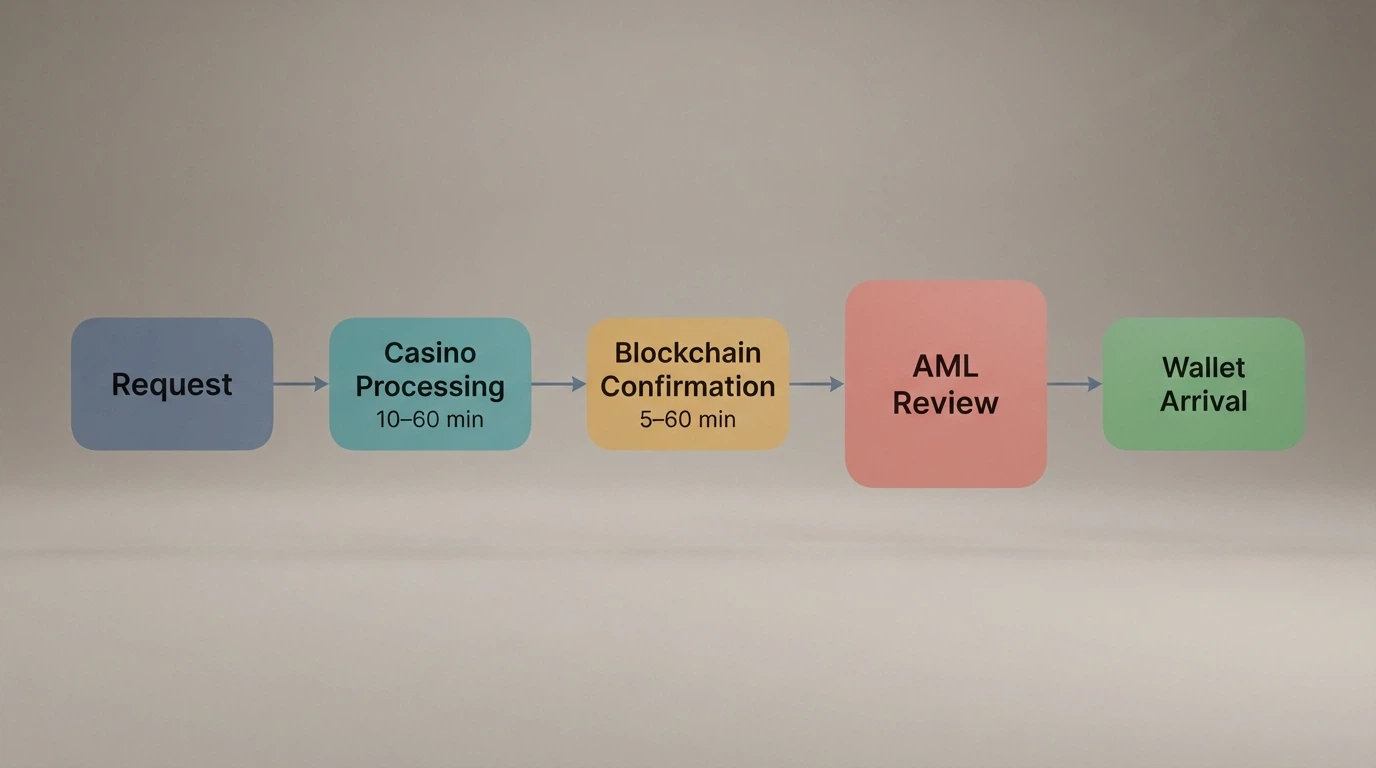
Bitcoin deposits are a fast lane. Bitcoin withdrawals are a fast lane followed by processing, by blockchain confirmation, and by AML — three queues that often run in sequence rather than in parallel.
USDT on the TRC-20 Tron network is the speed benchmark: deposit under 60 seconds, withdrawal under 5 minutes once the casino releases it, network fee under AU$0.50, no price volatility. Those figures are the “instant” the marketing on most casino homepages implies. They are accurate for the network layer — what happens on the Tron blockchain once the casino pushes the transaction.
They are not the full withdrawal story. After the casino pushes the transaction, there is the casino-side processing, which most legitimate operators run within 10–60 minutes, and there is the AML review, which can hold a withdrawal for days if the player account triggers a flag. The Wild Fortune test cycle — five withdrawals timed across February to May 2026 — averaged 5 hours 24 minutes from request to crypto confirmation, with a range of 3 hours 50 minutes to 7 hours 58 minutes. The fastest case in the test was 3h50m; the slowest was 7h58m. None of those involved an AU-IP flag. An AU player can expect, on a clean withdrawal, four to eight hours from request to wallet arrival; on an AML-flagged withdrawal, days to weeks.
There is also a daily cap on most operators. Wild Fortune’s cap sits at US$4,000 equivalent. A player who wins a five-figure balance from a hot weekend on the pokies will not withdraw the lot on Tuesday morning — they will structure withdrawals across consecutive days and wait for the operator’s processing queue to push each one. The cap, like the wagering requirement, is a structural cost rarely visible at sign-up.
Depositing Bitcoin at an Online Casino — The Steps and the Hidden Costs
The deposit flow runs from a player’s bitcoin-holding location to the casino’s deposit wallet. For an Australian player the holding location is most often an Australian-registered exchange — CoinSpot, Swyftx, and a handful of others — or a personal wallet funded through one of those exchanges. The casino’s deposit wallet is an address the casino provides at the cashier screen.
The flow has three cost layers. The first is the exchange spread: the difference between CoinSpot’s or Swyftx’s posted BTC price and the price the exchange actually settles the buy at. For a player buying AU$300 in bitcoin, the spread is the first cost. The second is the network fee: depending on whether the player uses BTC on the Bitcoin network or USDT on TRC-20, the fee can range from a few dollars in BTC to under AU$0.50 in USDT/TRC-20. The third is the FX spread the casino applies if the player deposits bitcoin but plays in a fiat-equivalent currency, or if the player withdraws back to AUD through the casino’s OSKO channel.
The latter cost is the trap. Operators that advertise “BTC accepted, AUD payouts” are usually routing the AUD payout through OSKO at the operator’s quoted rate, with a 2.1% spread and a 1.5% FX fee layered in. The combined haircut is 3.6% on every cashout. A player with a clean strategy — deposit in USDT, withdraw in USDT, convert to AUD on the Australian exchange side at CoinSpot’s normal FX margin — collapses the 3.6% haircut to the exchange’s own spread, which is meaningfully smaller.
The lesson of the deposit flow is that the casino is one party in it and the exchange is the other party in it, and both take a fee. The casino’s fee is in the FX layer of the payout; the exchange’s fee is in the spread on the buy/sell and the network fee on the transfer. The casino’s marketing rarely surfaces its fee. The exchange’s fee is visible on the order screen.
Withdrawal Speed — Why ‘Instant’ Rarely Means Instant
The casino’s homepage claims instant withdrawals as a feature. The reality is a sequence of three stages. The first is the casino’s processing stage: 10–60 minutes for a legitimate operator to receive the request, run any internal checks, and push the transaction. The second is the blockchain confirmation: 5–60 minutes for BTC on a clean network, under five minutes for USDT/TRC-20. The third is the AML review, which sits between the player’s request and the casino’s push for any player whose account triggers a flag — and which can stretch a 30-minute withdrawal into a 19-day unresolved case.
The clean withdrawal sequence runs casino processing plus blockchain confirmation in one to two hours for USDT/TRC-20. The flagged withdrawal sequence adds the AML review on top, and the player has no visibility into which stage the withdrawal is in. Different operators handle flag cases differently; some push the withdrawal regardless and review afterwards, others hold the funds until the review is closed.
The withdrawal cap layers on top. A daily cap of US$4,000 means a five-figure win is split across multiple withdrawal requests, each subject to the three-stage sequence. The total time to clear a AUD$10,000 win at Wild Fortune’s cap would be three consecutive days of US$4,000 withdrawals, with three full processing cycles — roughly twelve to eighteen hours end-to-end.
The player takeaway is that “instant withdrawal” describes the network layer the casino does not control. The casino-controlled layer adds processing time. The operator-controlled layer on top of that adds AML review. The full sequence, from request to wallet arrival, is somewhere between thirty minutes and three weeks, with the typical Australian case running a few hours and the AML-flagged case running days.
From Pokies to Live Dealer — What You Can Actually Play With Bitcoin
Bitcoin deposits unlock the same games fiat deposits do. A bitcoin casino’s lobby is, in the vast majority of cases, an identical copy of a fiat casino’s lobby with a different cashier on top — same Pragmatic Play pokies, same NetEnt titles, same Evolution live dealer, same blackjack variants. The crypto angle is the payment method, not the game.

The volume is real. Jackbit carries more than 6,000 bitcoin casino pokies across its catalogue. BitStarz runs more than 5,000 games in total. Stake’s mix leans toward the high-volatility slot end — Pragmatic Play and Hacksaw for the standard catalogue, Nolimit City for the extreme-volatility releases — plus Evolution for live dealer. Every featured operator stocks table games and live dealer. The volume question is not “is there enough?” — there is more than enough across the whole set. The question is provider quality, which is where the operators spread apart.
A large game library at an offshore operator is not by itself a quality signal. Several offshore casinos stock thousands of titles because they license via aggregator platforms, where a single content deal gives them access to thousands of games from dozens of studios. The aggregator arrangement is fine — it is how the licensed market works too — but it means the headline “5,000+ games” is closer to a count of how many studios the casino pays an aggregator fee for than a measure of curation. Provider quality shows up in specific names: NetEnt for branded slots, Pragmatic Play for live dealer plus broad pokies coverage, Evolution for live dealer production values, Nolimit City for the high-volatility niche.
Bitcoin Pokies — What AU Players Can Spin in 2026
The pokie libraries across the offshore bitcoin casino market are deep enough that a player who only plays one provider’s titles has hundreds of pokies to choose from. Pragmatic Play’s catalogue alone runs into the hundreds across its standard, hold-and-win, and Megaways releases. Hacksaw Gaming’s recent output is smaller but distinguished by mobile-first design and high RTPs. Nolimit City’s xMechanics series (xBomb, xNudge, xWays) is the niche for the high-volatility market — extreme variance, asymmetric pay tables, and feature-buy mechanics that turn a single spin into a significant stake.
Stake and BitStarz are the deepest-sorted featured operators for pokies specifically. Stake’s mix leans into Hacksaw and Nolimit City as provider identities you can recognisably target in the lobby. BitStarz’s broader 5,000+ catalogue includes Pragmatic Play and NetEnt, which gives the player the more familiar branded pokies alongside deeper niche content. The other featured operators almost certainly have reasonable pokie libraries, but the comparator here is not whether they have pokies — they all do — but whether the specific providers a player prefers are stocked, and the data to verify that is not on every featured operator’s homepage.
For an Australian player the relevant fact is that all of these pokies run on offshore servers, beyond ACMA’s reach. A player who loads a Pragmatic Play pokie at Stake is playing the same Pragmatic Play title available at any licensed Australian social-casino site — the slots are not the regulated element; the casino is.
Table Games — Blackjack, Roulette and Where Crypto Fits
Blackjack, roulette and baccarat play identically at a bitcoin casino as they do anywhere else. The card mechanics are not different; the roulette wheel hits the same numbers regardless of which currency is on the stake. Crypto changes nothing about the game rules. What it does change is the table limits and the available variants — the offshore market tends to stock a wider range of side-bet configurations than the standard casino floor, sometimes because the licensing environment permits variants the more conservative regulators would not.
Evolution’s live-dealer catalogue is the most distinctive table-game offering at Stake and BitStarz. The standard blackjack and roulette tables are available 24/7. The game-show formats (Crazy Time, Monopoly Live, Deal or No Deal Live) are categorically different from what a brick-and-mortar or RNG casino offers, with the live-stream studio adding production the RNG games cannot match. Pragmatic Play Live is the second-tier live dealer, with similar variants at slightly lower production values.
The fairness question on RNG table games sits on the game’s published RTP. A standard blackjack variant returns somewhere between 99% and 99.5%; European roulette returns 97.3%; American roulette returns 94.7%. These are mathematically determined by the game’s rules; they do not vary by operator. The licence does not change the math.
Live Dealer vs RNG — The Difference Crypto Doesn’t Change
A live dealer table is a video stream from an Evolution studio somewhere in Europe. A bettor places a chip stack on a digital layout; the dealer deals physical cards from a physical shoe; the win/loss outcome is determined by the cards. The bitcoin angle is the cashier at the side of the screen; the gameplay is identical to a fiat casino running Evolution.
The same Evolution studio serves both. Same blackjack rules, same roulette wheel, same game-show production. What is different is the consumer protection: an Evolution stream licensed by the UK Gambling Commission has UK regulatory recourse and AGCO and other regulators layered on top; an Evolution stream at an offshore Curaçao-licensed casino has none of that. The stream looks the same. The licence sitting around it is not.
The corollary is that provider quality is a poor proxy for regulatory safety. A casino can offer Evolution’s full live dealer catalogue and still provide a thin consumer-protection environment. A casino with a skeletal live dealer offering from a less prestigious provider can carry identical regulatory risk. The player who picks a casino on the live dealer alone is picking on a dimension that does not predict quality on the dimensions that matter for an Australian player.
Bitcoin Casino on Your Phone — App or Browser, the Choice That Matters
Most bitcoin casinos do not have a native iOS or Android app. The few that do are the exception, not the rule. The default is mobile-browser play, with the casino’s site loaded through Chrome or Safari on a phone.
This is not a mark against the offshore market by itself. Mobile-browser play is the norm for the UK Gambling Commission-licensed market as well — operators largely abandoned native apps in response to App Store policy changes around real-money gambling apps. The browser approach is the regulated-market path, and the offshore bitcoin casino industry adopted it for similar reasons.
For an Australian player, mobile-browser play has one specific feature that native-app play does not: it does not require installing a third-party application. A native app from an offshore operator is a sideload for a player who does not have access to the App Store in a way that surfaces the offshore brand; for an Android player using APK installation, the app is from an unverified publisher. Browser play sidesteps all of that. There is nothing to install, nothing to update, and nothing to leave behind when the casino disappears from the ISPs.
The corollary is that an app-store presence is not a trust signal. An app appearing in Apple’s App Store reflects Apple’s policy compliance, not the operator’s regulatory standing. An offshore casino with a published iOS app does not have an Australian licence because none exists; the App Store listing cannot provide one.
Native Apps vs Mobile Browser — What Actually Works for AU Players
For Australian players, mobile-browser play is the default and the recommended path. Bitcoin casino apps from offshore operators introduce a small but real installation risk on Android — APK files outside the Play Store lack the safety scanning the store applies — and an iOS app from an offshore operator is rare in this segment. The browser approach removes both concerns.
A practical workflow: bookmark the casino site in the phone’s browser. Enable two-factor authentication on the casino account. Test on a home Wi-Fi connection first, where any geo-IP behaviour the casino exhibits is clearly visible; switch to mobile data only after a deposit-withdrawal cycle has cleared cleanly. Most offshore bitcoin casinos are optimised for mobile browser play, often with their own or their aggregator’s lightweight HTML interface rather than a desktop site scaled down. The user experience is closer to an app than to a desktop site, without the install.
How to Pick a Bitcoin Casino That Won’t Disappear With Your Balance
Three checks filter out most of the failure modes: the licence register, the withdrawal terms and the player-forum record. None of them is exotic. All of them are work the player can do in an hour.
Provably Fair Gaming — The Promise and the Reality
Provably fair is a cryptographic mechanism that lets a player verify each spin was not manipulated by the casino. The mechanism works like this: the casino commits to a server seed, the player provides a client seed, and a hash of both seeds plus a nonce determines the outcome. After the spin, the player can verify the algorithm produced the result the casino committed to, and reject any spin where the post-spin audit does not match the algorithm.
The promise is that no human, including the casino, can manipulate an individual spin once the seeds are committed. The reality is twofold. First, only a subset of bitcoin casino games use provably fair — typically a casino’s own “original” titles and a handful of slots adapted to the framework, rather than the broader Pragmatic Play and NetEnt catalogues. Second, provably fair confirms the spin was not manipulated; it does not confirm the casino will honour your withdrawal, will not void your bonus, will not block your IP, or will not vanish after a DNS block. Provably fair is a game-fairness mechanism, not a consumer-protection mechanism.
For a player who wants the option, provably fair is worth having. For a player who is choosing between two casinos based on provably fair alone, the comparison is incomplete — game fairness is one variable, and balance safety is another.
Reputation Checks — What to Look For Beyond the Bonus
Four checks before depositing are essential. First, verify the licence on the Curaçao eGaming register. The master licences 1668/JAZ, 8048/JAZ and 365/JAZ are public at curacao-egaming.com. Type the casino name or the licence number into the register search; a non-result is a red flag rather than a confirmation. Be sceptical of Anjouan / Comoros sublicences, where two of eleven sites in a recent test cited sublicences with no public verification path against the issuing authority. A sublicence claim with no underlying register entry is hollow.
Second, read the withdrawal terms before depositing. The three numbers that matter: the daily and monthly withdrawal cap, the stated processing time, and the FX policy on AUD payouts. A cap below US$1,000 a day is narrow; a stated processing time under 10 minutes is faster than the actual; “AUD payouts via OSKO” with a quoted rate is a fee the player cannot inspect until they test it.
Third, search the forums for the operator’s name plus “withdrawal” or “pending”. Player forums (and a few independent-tester sites) carry recent withdrawal-experience reports. A casino with no public withdrawal reputation is a casino whose first payment to a new player is its reputation. The 5h24m Wild Fortune average from a tester who ran five withdrawals over four months is more useful than a casino’s own claims, because it is the figure from someone whose incentive is to publish, not to convert.
Finally, check whether your IP and country are flagged. The AU-IP AML flag affects three of eleven sites in a recent test. The flag is invisible at signup and only surfaces at the first flagged withdrawal. A player who can ask a tester, a forum, or a search engine about this gets the answer cheaper than the player who finds out at withdrawal.
The expected outcome of the four checks is a short list of one to three operators, not an endorsement of every casino a promoter reviews. The offshore market is wide; the verifiable subset of it is narrow.
New Bitcoin Casinos in 2026 — Fresh Faces, Same Offshore Reality
New bitcoin casinos launch every quarter. The rebranding, the new domain, the fresh welcome offer are real; the licence jurisdiction, the wagering requirements, and the offshore status are the same as for any established operator. A 2026 launch date is a marketing line, not a regulatory signal.
For an Australian player, a new operator without a track record is a player who must do the verification work from scratch — licence register check, withdrawal-terms read, forum search — without the offset of a player base whose experience is documented. New casinos tend to grow their bonus offers more aggressively in the launch phase, with the obvious offset that a casino whose reputation is unestablished may not be in business for the long term. The same BetStop gap, the same AU-IP AML risk, and the same ACMA blocking exposure apply. The launch date is not a trust signal; the absence of the launch date, for established operators, is not necessarily a risk signal either.
Launched This Year — What’s New and Whether It Matters
A player looking for new bitcoin casinos in 2026 will find them, in the affiliate review circuit, with launch dates printed in the operator profile. The launch dates are mostly marketing material for affiliate pages seeking fresh content. The operational reality is unchanged from any other operator on this page: Curaçao licensing where verifiable, Anjouan where the verification path is opaque, no Australian regulatory backstop.
The reader’s question for a new casino is the same as for an established one, with one added item: how recent is the licence? An operator with only a year under the same brand has less public record to search against. The verification step for a new operator is the verification step for an established one, applied with the awareness that there is less to verify.
When the Fun Stops — Responsible Gambling Tools AU Players Can Actually Use
The consumer-protection infrastructure for Australian players is real and it is mostly outside the offshore casino. For a player reading this page, the tools listed below apply. For a player depositing at one of the casinos on this page, most do not.
The headline figure is that more than 622,000 Australian adults meet the Problem Gambling Severity Index threshold for problem gambling (Roy Morgan, August 2025). The AIHW 2022 figure is around 430,000 — about 2.1% of Australian adults. About 3.29 million Australians are affected annually by their own or another person’s gambling. 15.1% of the adult population is experiencing some level of gambling harm. Only 8–15% of people experiencing gambling problems seek help.
The tools available to a player are listed in plain terms below.
BetStop and the Offshore Gap — Why Self-Exclusion Doesn’t Cross Borders
BetStop is the National Self-Exclusion Register. One registration excludes a person from every Australian-licensed online and phone wagering service. The figures reflect the take-up: 67,480 registrations by 31 July 2026, with 41,290 active exclusions and 78% of registrants under 40. The most common registered choice is a period exclusion of three months or more, with 38% of registrants opting for lifetime exclusion.
The limitation that matters for a reader of this page is that BetStop binds Australian-licensed wagering services only. An offshore casino is not connected to the register and will keep accepting a self-excluded person’s money. From 1 January 2027, additional restrictions apply — direct marketing of inducements is prohibited for three months after a person deregisters from BetStop, and indefinitely for customers identified as at risk — but these restrictions apply to licensed operators, not to the offshore casinos this page covers.
The upshot for any reader who has self-excluded: BetStop is doing its job on the licensed side of the market and is doing nothing on the offshore side. The remaining channel for a player who has registered exclusion is the casino’s own deposit-block feature, supported by the Gambling Help Online Chat at gamblinghelponline.org.au.
The Numbers — Gambling Harm in Australia and Where to Get Help
The harm-prevalence figures, anchored to their sources:
- Problem gambling affects about 2.1% of Australian adults — roughly 430,000 people — with high-risk gambling at 1.8% (AIHW, 2022).
- Roy Morgan research (August 2025) estimates 2.9% of Australian adults — about 622,000 people — meet the PGSI threshold for problem gambling.
- About 3.29 million Australians aged 5 and over are affected annually by their own or another person’s gambling, including about 1.38 million adult affected others.
- 15.1% of the Australian adult population — an estimated 3.32 million people — are experiencing some level of gambling harm (Roy Morgan, March 2026).
- The annual health loss associated with gambling-related harm is estimated at over 400,000 Years Lived with Disability.
The help infrastructure, with the specific contact details, includes the National Gambling Helpline at 1800 858 858 (free, confidential, 24/7), Gambling Help Online at gamblinghelponline.org.au (free online chat, counselling, information 24/7), the National Self-Exclusion Register BetStop online at betstop.gov.au (which excludes from all AU-licensed online/phone wagering in one step; does not reach offshore casinos), and Gamblers Anonymous Australia for peer support meetings.
Help-seeking works only when the player knows help exists. The figures above are estimates, not forecasts — they describe how common problem gambling is now, in Australia, and the gap between prevalence (hundreds of thousands) and help-seeking rate (8–15%) is the gap this section exists to close.
How We Picked the Bitcoin Casinos on This Page
The featured operators were selected from a wider set of fifteen bitcoin casinos tested against Australian accessibility criteria. The screening criteria used were the operational status as a bitcoin-accepting online casino accessible from Australia in 2026, the Curacao licensing claim on the operator’s own site, with licence number or master licence reference where one was publishable, and a welcome offer or no-deposit free-spins offer with at least one term-figure documented from a verifiable source.
Every operator in the wider fifteen-bracket set sits offshore, with verifiable Curacao master licences (1668/JAZ, 8048/JAZ and 365/JAZ) named explicitly on the public register at curacao-egaming.com. The featured set narrows to ten operators with named welcome or no-deposit offers surfaced in the research pass.
What we could not verify in the research pass is worth stating explicitly. For nine of ten featured operators, the specific sublicence number could not be confirmed against the public register this run — only BitStarz was confirmed at the register level through multiple independent sources. For several operators, the bonus terms and the game-provider lists were either incomplete in the source set or not surfaced at all. The em-dash in the relevant table cells reflects this absence of confirmation, not an inference that no bonus or no provider list exists.
Independence note. The competition insight is that the wider market is sometimes — though rarely — converging. The wider set used competitor reviews, ACMA blocked-site data, BetStop statistics, and the Curacao eGaming register as primary sources; it did not rely on casino-side marketing as a sole source for any featured operator. The Wild Fortune withdrawal test cycle (5h24m average across five test runs, February to May 2026) was used as a methodology example for what tester data reveals that marketing claims cannot. No roulette wheel was weighted, no tournament was won or lost, in our favour or against.
The framing of this page — offshore-by-default, with the consumer-protection gaps stated explicitly — and the comparison table that lists nine of ten licences as “not confirmed against public register this run” represent the same editorial choice from two angles: the comparison is honest because the gaps are visible, and the gaps are visible because the comparison is honest.
What You Should Actually Do Before Depositing Bitcoin at an Online Casino
Six steps, each anchored to a finding on this page.
- Verify the licence number on the Curacao eGaming register. For Curacao-licensed operators, the master licences 1668/JAZ, 8048/JAZ and 365/JAZ are public at curacao-egaming.com. A licence claim with no search result is a claim, not a fact. Be wary of Anjouan / Comoros sublicences, where the verification path against the issuing authority is opaque.
- Read the bonus wagering and cashout terms before you deposit. A typical 35–40x wagering requirement on a A$2,000 match bonus is A$80,000 in turnover before cashout eligibility. The 0x wagering at Winz.io, the 30x bonus-only at Jack.com and the 500x at BC.Game are the boundaries of what the offshore market publishes — anything outside those boundaries is a custom offer the player should read very carefully.
- Test with the minimum deposit and a small withdrawal first. Lucky Block’s A$1 minimum deposit is the structural benchmark; small-withdrawal testing is the practical one. A first withdrawal cycle of less than the daily cap, on a clean AU IP, that completes inside the stated processing window is the cheapest reputation check any operator sells.
- Use USDT on TRC-20 to cap volatility risk. The deposit time is sub-minute, the withdrawal time is sub-five-minute, and the network fee is under AU$0.50. USDT sidesteps BTC’s price volatility without sidestepping the FX layer on AUD payouts — for an Australian player, USDT is the better default at the casino, with AUD conversion happening at the Australian exchange afterwards.
- Keep BetStop on the licensed side and the helpline on the speed-dial. BetStop excludes from Australian-licensed wagering only — an offshore casino is not connected. The National Gambling Helpline at 1800 858 858 is free, confidential and 24/7, with Gambling Help Online at gamblinghelponline.org.au offering online chat. The offshore casino does not connect these resources; the player has to.
- Treat every offshore balance as at-risk. The ACMA has had 1,564 illegal gambling and affiliate sites blocked by Australian ISPs since November 2019. A block is DNS-level. An Australian player whose browser stops resolving the operator’s domain has a balance they cannot reach. The only guaranteed withdrawal is the one already in the player’s wallet.
The offshore bitcoin casino market is what the licensed Australian market is not — open, anonymous, fast-moving, and built around the player rather than around the regulator. The trade-offs are the Australian protections the player steps out of: BetStop coverage, ACMA complaint recourse, Australian consumer law, and the small protection of a regulator who can hear a complaint. The maths of bonuses, the speed of withdrawals, and the breadth of games are competitive with the licensed market on most measures. The player-protection math is the part the casino’s homepage does not show.
Frequently Asked Questions
Is playing at a bitcoin casino allowed under Australian law?
No. The Interactive Gambling Act 2001 prohibits the provision of online casino games, online pokies and in-play betting to Australians, and no Australian licence for online casino exists. Every bitcoin casino accessible to Australian players operates offshore, most commonly under a Curaçao licence, and accepts Australian players in breach of the IGA. The law targets the operator rather than the individual player, who is not personally prosecuted — but the player is also outside every consumer-protection framework the Act builds.
What can I do if an offshore casino blocks my withdrawal?
Very little. There is no ACMA complaint recourse for offshore operators, no Australian consumer law backstop, and no Australian alternative dispute resolution scheme. The practical options are: escalate through the casino’s own support channel (the operator’s stated dispute resolution process), request a chargeback through the card or payment provider used for the deposit (limited utility for crypto payments), and pursue the matter through the Curaçao eGaming regulator if the casino’s licence is register-verifiable. For an Anjouan-sublicensed operator, this last option is rarely available — the verification path is opaque. Prevention is dramatically cheaper than cure, which is why a small-test withdrawal before committing is the strongest defence.
What cryptocurrencies beyond Bitcoin do these casinos accept?
Ethereum (ETH), Litecoin (LTC), Tether (USDT), and increasingly USDC are standard alongside BTC across the offshore bitcoin casino market. Some operators add Dogecoin, Bitcoin Cash, and a handful of others. USDT on the TRC-20 Tron network is the typical recommendation for Australian players because the deposit-and-withdrawal times run sub-minute to sub-five-minute with a network fee under AU$0.50 and no price volatility relative to the US dollar. The casino’s cashier page lists the specific cryptos and networks supported; the broader market standard is the ABC stablecoin-based spread: BTC, ETH, LTC, USDT.
Are bitcoin casino winnings taxable in Australia?
For an ordinary punter, no. Gambling and betting winnings are not assessable income under section 6-5 of the ITAA 1997, and losses are not deductible under section 8-1 — unless the person is carrying on a business of gambling. No Australian case has held the winnings of an ordinary punter assessable. A professional gambler running gambling as a business can be taxed on net winnings, on the ATO’s determination of business status; that is a different scenario from the casual offshore casino player.
How do I know if a bitcoin casino is provably fair?
Provably fair is a cryptographic mechanism using a server seed (committed by the casino before play), a client seed (provided by the player), and a hash function that determines outcomes. After each spin, the casino reveals the server seed; the player can verify the spin’s outcome using both seeds and the game’s algorithm. A provably-fair outcome that does not match is rejectable. The catch is twofold: only a subset of games at any given casino use provably fair — typically the casino’s own titles rather than the broader Pragmatic Play and NetEnt catalogues — and provably fair confirms game fairness only, not balance safety, withdrawal honours, or licence validity.
Where can I find a bitcoin casino no-deposit bonus as an Australian player?
In the featured set, BitStarz offers 50 free spins on registration with a A$100 cashout cap, 40x wagering on bonus cash, A$0.20 spin value and a 24-hour validity window. Skycrown offers 100 free spins on registration, gated behind mobile phone verification. WinSpirit offers 35 free spins with a 7-day completion window. 7Bit offers 20 free spins with 45x wagering on winnings and a A$100 max cashout. All four offers are no-deposit, all four are time- or cap-limited, and none of them is a path to a substantial payout — the structure is a free trial of the casino, not a cashable bonus. Each of the four is detailed in its own section above the table that consolidates them.