2026 $1 Minimum Deposit Pokies in Australia: What a One-Dollar Deposit Actually Buys
 Available in AU
Online pokies are a prohibited service in Australia. No licence for online casino games exists anywhere in the country — not federally, not in any state or territory — and every site advertising “$1 deposit pokies” to Australian players is an offshore operator whose product is illegal to supply here. The Interactive Gambling Act 2001 targets the provider, not the individual punter, which is why these sites keep loading in Australian browsers and why this page exists: to set out what genuinely sits behind the one-dollar headline, which payment rails clear at that level, which bonuses actually trigger, and what an Australian reader gives up by depositing at all.
The short version: a dollar buys roughly ten spins on a ten-cent pokie, lasts a few minutes under any sensible play pattern, and almost never unlocks the welcome bonus the site advertises above the fold. PayID and a handful of crypto networks clear at A$1; Visa and Mastercard rarely do, because card processing eats thirty to fifty cents of every dollar before it arrives. The bonuses that activate at the one-dollar level are small free-spins packs with short expiry windows and tight cashout caps. And the offshore casino sitting on the other end of the transaction sits outside every Australian protection: no BetStop coverage, no ACMA complaints route, no consumer-law recourse, and a non-trivial chance the site is blocked at the DNS level with the player’s balance still on it.
Data current as of 18 October 2026, cross-checked against the ACMA register, the Interactive Gambling Act 2001 and the BetStop Q3 2025–2026 statistics.
Table of Contents
- What a $1 Deposit at an Online Casino Actually Buys You in 2026
- 2026 $1 Deposit Pokies Sites — Offshore Operators Ranked and Compared
- Why Your 2026 $1 Deposit Bonus Is Smaller Than the Headline Number
- Payment Methods That Actually Work for a $1 Deposit in 2026
- $1 Deposit Pokies on Your Phone — What Is and Isn’t Different in 2026
- Australia’s Online Pokies Ban — What It Means for Every $1 Deposit
- Why Crypto Is the Rail That Makes Genuine $1 Deposits Possible
- Playing Within Limits — What Responsible Gambling Looks Like at a Dollar a Time
- How We Evaluated 2026 $1 Deposit Pokies Sites
- Is a $1 Deposit Worth It? Weighing the Real Cost of Micro-Deposit Pokies in 2026
- Frequently Asked Questions
What a $1 Deposit at an Online Casino Actually Buys You in 2026
The dollar headline is a marketing threshold, not a floor most Australian players will reach. Across the offshore casinos that actively court Australian traffic, A$1 is the exception rather than the rule — the realistic minimum that most payment methods will actually clear at is A$10 for standard rails and A$5–A$10 for crypto. Genuine one-dollar deposits show up on a narrow band of rails only: specific card and e-wallet segments at a handful of sites, and a few crypto networks where the per-transaction fee doesn’t eat the deposit entirely.
The reason is straightforward economics. A card transaction at one dollar might cost the casino thirty to fifty cents in processing alone. The operator either sets the minimum at a level that absorbs that cost or quietly shifts the floor higher in practice. The marketing claim and the cashier screen tend to land in different places — and that gap is the first thing an Australian player should look at before typing in a card number.
The deeper issue is what the dollar actually buys once it clears. At a ten-cent minimum stake on the most common pokie, a dollar lasts ten spins. At twenty-five cents on the high-RTP Blood Suckers, it lasts four. The expected session runs minutes, not hours, and the expected loss across those spins is the gap between the deposit and the RTP — roughly four cents per spin on Starburst, roughly two cents per spin on Blood Suckers, the difference between walking away with nothing in your wallet and walking away with nothing in your wallet slightly faster. A dollar is a way to look at the lobby; it is not a way to play a session.
The reality gap — why most “$1 deposit” claims are really $10
The payment rail does most of the work in deciding whether the dollar claim is real. A genuine A$1 deposit through a card is functionally non-existent for the operator: card processing costs A$0.30–A$0.50 per transaction, and nobody runs a business at a loss on every customer. So the minimums on card rails sit at A$10–A$25 across the featured operators — RocketPlay’s card floor is A$25, SkyCrown’s is A$20, Royal Reels is A$10 for most methods. Crypto does better, with realistic floors at A$5–A$10 because the per-transaction cost is lower, but even there the network fee can wipe out a one-dollar deposit before it arrives.
Bitcoin network fees in 2026 typically run A$0.50–A$3 per transaction. USDT on TRC-20 is cheaper at A$0.50–A$1, but on a one-dollar transfer the fee still represents a substantial fraction of the deposit. A dollar sent via Bitcoin can arrive as forty cents; a dollar sent via USDT-TRC-20 arrives slightly closer to a dollar but not by much. PayID is the cleanest Australian rail at this level — it clears under thirty seconds, costs nothing on either side, and works at A$1 — but entry-level AU casinos still set their PayID floor at A$10 and premium platforms at A$30.
None of this is hidden from the player. It is just not on the landing page. The page says “$1 minimum deposit”; the cashier says something different; the bonus terms say something else again. The work of reconciling those three numbers falls on the person clicking deposit.
Best pokies for a $1 bankroll — RTP, volatility and minimum stakes
Seven pokies show up across the AU-facing offshore sites with both real RTP data and a stake small enough that a dollar buys more than one spin. The table below sets them out side by side — return rate, provider, volatility and minimum stake in AUD. Where a particular title at a particular operator ships in a lower-RTP variant, that is flagged in the source data; the figures here are the standard RTP for the title.
| Pokie Title | RTP | Provider | Volatility | Minimum Stake (AUD) |
|---|---|---|---|---|
| Starburst | 96.09% | NetEnt | Low | A$0.10 |
| Book of Dead | 96.21% | Play’n GO | High | A$0.10 |
| Big Bass Bonanza | 96.71% | Pragmatic Play | Low–medium | A$0.10 |
| Sweet Bonanza | 96.51% | Pragmatic Play | High | A$0.20 |
| Blood Suckers | 98.00% | NetEnt | Low | A$0.25 |
| Gates of Olympus | 96.50% | Pragmatic Play | High | Not confirmed |
| Wolf Gold | 96.01% | Pragmatic Play | Medium | A$0.25 |
Blood Suckers is the outlier and the only pokie here with a return rate that genuinely matters at this bankroll. At 98.00% RTP and A$0.25 minimum stake, it is the textbook wagering-clearance pokie — the title bonus-contributing players gravitate to when they want to grind through a turnover requirement with the smallest possible expected loss. Caveat: the title exists in 94% and 92% variants at some operators, so the high RTP is not guaranteed. Starburst, with its 96.09% return and ten-cent minimum, is the most common spin-package game at AU casinos and the pokie that makes a one-dollar deposit feel like a session. Gates of Olympus has no confirmed minimum stake in the source data, and the column carries the no-data marker accordingly.
What $1 actually plays — stakes, spins and expected play time
Translating a dollar into spins is the easy part. At A$0.10 per spin — the minimum stake on Starburst, Book of Dead and Big Bass Bonanza — a dollar buys ten spins. At A$0.25 on Blood Suckers or Wolf Gold, it buys four. At A$0.20 on Sweet Bonanza, five. The harder question is what those spins are worth in expected return.
Using Starburst as the baseline: ten spins at A$0.10, at an RTP of 96.09%, gives an expected return of A$0.96 — meaning the expected loss across the session is A$0.04, or roughly four cents per dollar deposited. The arithmetic for any other pokie on the table follows the same shape: deposit divided by stake gives spins; spins multiplied by stake and by (1 minus RTP) gives expected loss. The formula is plain and the conclusion is uniform — at any sensible RTP, the house edge on a one-dollar deposit is small in absolute terms but large as a fraction of what was put in.
In session length, ten spins at a five-second interval runs about fifty seconds. Even doubling that for menu time and decision pauses, a one-dollar session tops out at a couple of minutes. It is not a way to kill an evening. It is a way to see the lobby, feel the spin, and learn whether the cashier screen on the way out is going to clear the way it cleared on the way in.
2026 $1 Deposit Pokies Sites — Offshore Operators Ranked and Compared
The featured set covers ten offshore operators that surface in the AU-facing $1 deposit conversation. Six have search-result data backing their entries; four do not — those four appear in the operator sweep but their licence jurisdiction, bonus terms and deposit minimums were not confirmed in this round of research, and their fields are marked accordingly. No Australian licence exists for any operator in the table. Every one of them runs on a non-Australian jurisdiction — Curacao for the confirmed six, unspecified for the rest — and the Interactive Gambling Act 2001 makes supplying their product to someone in Australia an offence under Australian law.

| Operator | Licence | Welcome Offer | Wagering Requirement | Accepts AU Players |
|---|---|---|---|---|
| RocketPlay | Curacao | Up to AU$6,000 + 300 FS across 4 deposits | 30x–40x bonus | Yes (offshore — NOT Australian-licensed) |
| SkyCrown | Curacao | A$8,000 + 400 FS across 4 deposits | 40x bonus / 30x FS winnings | Yes (offshore — NOT Australian-licensed) |
| Royal Reels | Curacao | 100% up to A$500 + 50 FS | 30x–35x bonus | Yes (offshore — NOT Australian-licensed) |
| Stake | Curacao (CGA) + 4 LatAm | 200% up to USD 2,000 | 40x deposit + bonus | Restricted in T&C; site still receives AU traffic |
| Fair Go | Curacao (Deckmedia N.V.) | A$1,000 across 5 deposits (100% × A$200) | 30x–40x estimated | Yes (offshore — NOT Australian-licensed) |
| Rainbet | Not specified | 100% up to AU$500 + 100 FS | 30x bonus + deposit | Restricted in T&C; site still receives AU traffic |
| WinSpirit | Not confirmed this run | Not confirmed | Not confirmed | Not confirmed |
| Bizzo Casino | Not confirmed this run | Not confirmed | Not confirmed | Not confirmed |
| Scream Casino | Not confirmed this run | Not confirmed | Not confirmed | Not confirmed |
| Rocket Casino | Not confirmed this run | Not confirmed | Not confirmed | Not confirmed |
Stake and Rainbet both list Australia as a restricted territory in their own terms and conditions, yet continue to receive meaningful AU traffic. That tension is part of the deal, not an exception to it — the operator’s paperwork says one thing and its cashier says another, and the player sits in the gap. The four operators with unconfirmed fields (WinSpirit, Bizzo Casino, Scream Casino, Rocket Casino) appear in the operator sweep but did not surface in this round of research with usable licence, bonus or terms data; readers should treat their entries as placeholder rows until verified elsewhere.
RocketPlay
RocketPlay runs on a Curacao licence and has been operating since 2020, with a 3,000+ game library and a four-deposit welcome package worth up to AU$6,000 plus 300 free spins. Wagering sits at 30x–40x on the bonus, and the deposit floor is A$25 via Visa or Mastercard, A$20 via Neosurf. There is no genuine one-dollar rail on this site — the headline floor is marketing and the cashier starts at A$20–A$25 depending on method.
RocketPlay suits a player who wants a deep game library and is comfortable depositing at the A$20+ level the bonus actually requires. The package is large in headline terms but the 30x–40x wagering multiplies the bonus into a heavy grind before any of it is withdrawable. A punter planning to deposit A$1 will be disappointed by the cashier; a punter planning to clear a multi-thousand-dollar welcome will need to read the bonus terms before clicking.
SkyCrown
SkyCrown is the headline leader of the featured set on welcome value: A$8,000 plus 400 free spins across four deposits, with the first deposit matched 100% up to A$500 plus 100 free spins on Book of Dead. Wagering is 40x on the bonus and 30x on free-spin winnings, with a minimum qualifying deposit of A$20 and a 14-day validity window per tier. The bonus clears fast or not at all — 14 days against a 40x wagering requirement is a tight window for a multi-thousand-dollar package.
The book on SkyCrown: large package, tight clock. A player who deposits the full A$20 minimum on each tier and clears the bonus inside two weeks is taking a heavy playthrough inside a short window; a player who misses the 14-day validity loses the bonus and any winnings tied to it. The 30x on free-spin winnings is lighter than the 40x on cash bonus, but neither is light. SkyCrown is a headline offer for a player with bankroll and patience; for a casual punter, the offer is out of reach.
Royal Reels
Royal Reels has the lowest deposit floor in the featured set at A$10 for most methods and A$20 for crypto, with a 5,400+ pokie library drawn from more than 40 providers. The site also offers a A$10 no-deposit bonus after phone verification, a 100% up to A$500 plus 50 free spins welcome, 30x–35x wagering on the bonus, and a minimum withdrawal of A$50. PayID and crypto payouts clear in three to four hours on the withdrawal side.
The Royal Reels profile is the closest the featured set comes to the one-dollar conversation: the A$10 no-deposit bonus is a real entry point for a player who wants to look around without funding an account, and the A$10 deposit floor is closer to A$1 than anything else on the table. The phone-verification step on the no-deposit bonus is friction, not a blocker. Ultimately, Royal Reels stands as the most dollar-friendly option among the confirmed six.
Stake
Stake holds a Curacao CGA licence and four Latin American licences, with UKGC surrendered in March 2025. It runs a fiat and crypto hybrid across 35 deposit methods and 14 withdrawal methods, with a 200% welcome match up to USD 2,000, 40x wagering on deposit plus bonus, and a 30-day window. A 15-level VIP programme with progressive rakeback sits on top.
The complication is the T&C: Australia is listed as a restricted territory, and the site is not officially available to Australian residents — yet it continues to receive meaningful AU traffic in practice. That gap between the paperwork and the cashier is the deal on Stake. The bonus is competitive; the licence footprint is broad; the AU terms are not. A punter who deposits anyway is outside the operator’s stated terms, and any dispute lives or dies on the operator’s discretion rather than on a regulator’s complaint process.
Fair Go
Fair Go runs on a Curacao licence via Deckmedia N.V., with a Realtime Gaming portfolio of around 280 titles — a much smaller library than the multi-thousand-game sites, but a stable RTG roster that appeals to players who want the older pokies catalogue. The welcome package runs A$1,000 across five deposits at 100% up to A$200 each, with wagering estimated at 30x–40x but not publicly confirmed in the operator’s published terms. AUD is supported.
The Fair Go read: an RTG-focused site with a steady but unspectacular welcome package and terms that aren’t fully published. The smaller library is the trade for the older RTG titles. For a punter who likes the catalogue and accepts that the wagering figure is an estimate rather than a published number, Fair Go is a known quantity; for a punter who wants every term on the page, the unconfirmed wagering is a gap.
Rainbet
Rainbet offers a 100% match up to AU$500 plus 100 free spins as the headline welcome, with 30x wagering on bonus plus deposit and an AU$200 maximum cashout from the bonus. An alternative welcome runs 250% up to A$2,100 plus 60 free spins across three deposits at 40x wagering. The licence is not specified in search results — a gap that compounds with the T&C.
The T&C lists Australia as fully restricted. The site is not officially available to Australian residents, but it continues to receive AU traffic. For a player who values the larger alternative welcome, the maths is attractive; for a player who reads the terms page, the AU restriction is the end of the conversation. The AU$200 max cashout from the headline bonus is also worth noticing — it caps the upside before wagering even finishes.
WinSpirit
WinSpirit appears in the operator sweep but its licence jurisdiction, bonus offer, wagering requirements and deposit minimums did not surface in this round of research. The site’s public-facing pages are reachable but the terms that would let a player compare it to the confirmed six did not return in the queries used here. WinSpirit is marked unconfirmed across the table and readers should treat its entry as a placeholder until verified against the operator’s own terms or a regulator.
Bizzo Casino
Bizzo Casino appears in the sweep without confirmed licence, bonus, wagering or minimum deposit data. Like WinSpirit, the public-facing pages exist but the comparison data did not return. The row is a placeholder.
Scream Casino
Scream Casino appears in the sweep without confirmed licence, bonus, wagering or minimum deposit data. The row is a placeholder pending verification.
Rocket Casino
Rocket Casino appears in the sweep without confirmed licence, bonus, wagering or minimum deposit data, and is a separate entity from RocketPlay above — the names are close enough to confuse. The row is a placeholder pending verification, and players should not assume the two share a licence or operator behind them.
Why Your 2026 $1 Deposit Bonus Is Smaller Than the Headline Number
The bonus advertised at the top of the page is rarely the bonus that triggers at the bottom of the cashier. Across the AU-facing offshore market in 2026, headline welcome packages range from A$500 to A$7,500 and free-spin packs from 25 to 300 spins — but the fine print almost always sets the bonus-trigger minimum at A$10, A$20 or A$30, with wagering of 20x to 45x and a max bet during wagering of A$5 to A$10. Free-spin expiry runs 24 hours to 10 days. No-deposit cashout caps sit at A$50 to A$100.
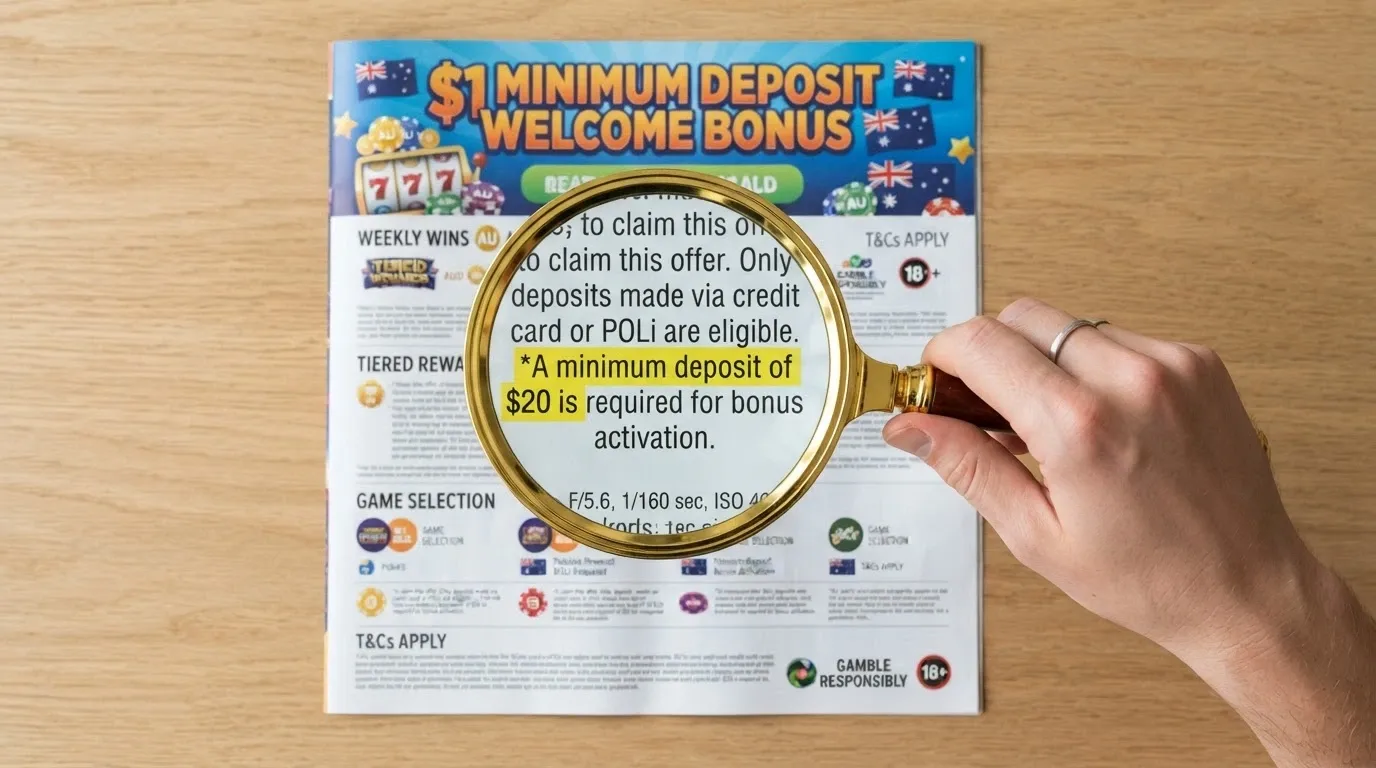
What that means for a one-dollar deposit is simple: the A$1 rarely unlocks the headline. The bonus that does fire at that level is usually a small free-spins pack — 20 to 100 spins — or a match bonus with a low cap. The headline welcome sits one tier up the minimum-deposit ladder, and a player who deposits A$1 is depositing under the trigger threshold.
First-deposit offers — what a $1 actually triggers
At the A$1 deposit level, the most common bonus a player actually receives is a small free-spins pack of 20 to 100 spins, sometimes a match bonus with a low cap. The multi-deposit welcome packages that headline at A$3,000 or more across four deposits — SkyCrown’s A$8,000 package, RocketPlay’s AU$6,000, Fair Go’s A$1,000 across five deposits — sit above the A$1 line and require the first-tier minimum to trigger.
A punter who deposits A$1 is, in most cases, accepting the small-FS tier (if any) and stepping outside the headline welcome entirely. That is a fine trade if the player only wanted to look around, and a poor trade if the player wanted the advertised package.
New-player eligibility and the deposit-minimum fine print
The two-step reality of the A$1 deposit looks like this: deposit A$1, then check whether the welcome bonus has triggered. On most sites, it has not — the bonus sits behind an A$10–A$30 minimum, with a validity window of 14 days (SkyCrown), 30 days (Stake), or 24 hours to 10 days for free spins. The bonus win caps at $1-deposit casinos are typically A$50–A$100, and minimum withdrawals run A$10–A$20 regardless of deposit size.
The eligibility logic is worth understanding. A player who deposits A$1 and triggers only a small free-spin pack has not wasted a deposit — the spins still play, the winnings still count. But the player who thought they were activating the headline welcome has read the offer wrong, and the gap between what they thought they were getting and what they got is the page’s most common source of frustration.
Free spins at the $1 level — what 20 to 100 spins actually deliver
A 20-spin pack at A$0.10 per spin runs the bonus stake at A$2 — a small bonus in absolute terms, but enough to test the cashier and the game library. A 100-spin pack at the same stake runs A$10. At a 96% RTP, the expected return across a 20-spin pack is A$1.92; across a 100-spin pack, A$9.60. The expected loss is small in cash and small as a fraction of the bonus.
The constraint is the cashout cap and the wagering on winnings. SkyCrown applies 30x on free-spin winnings — meaning a A$1.92 expected return from a 20-spin pack must be wagered 30 times before any of it is withdrawable. The arithmetic runs the other way too: no-deposit and low-deposit cashout caps of A$50–A$100 cap the upside regardless of how the spins land. The Blood Suckers play is the one route through the wagering that costs the player least — at 98% RTP and A$0.25 stake, the expected loss across the bonus-clearance grind is roughly 2% of every dollar turned over.
Payment Methods That Actually Work for a $1 Deposit in 2026
Three payment rails clear at the A$1 level with usable economics: PayID, a small set of crypto networks, and Neosurf/paysafecard as a one-way voucher. Card rails (Visa, Mastercard) rarely do, because processing fees consume the deposit before it reaches the operator. POLi, the previous Australian low-deposit rail, was shut down at the end of September 2023; PayID and Osko functionally replaced it.
PayID — the only Australian rail that works cleanly at $1
PayID is the cleanest A$1 deposit rail available to an Australian player. Deposits clear in under thirty seconds, no casino-side fee applies, and Australian banks generally do not charge for outgoing PayID transfers. The same rail works for withdrawals, with a median payout of 15 to 40 minutes for verified accounts on small balances — a turnaround that the card networks do not match.
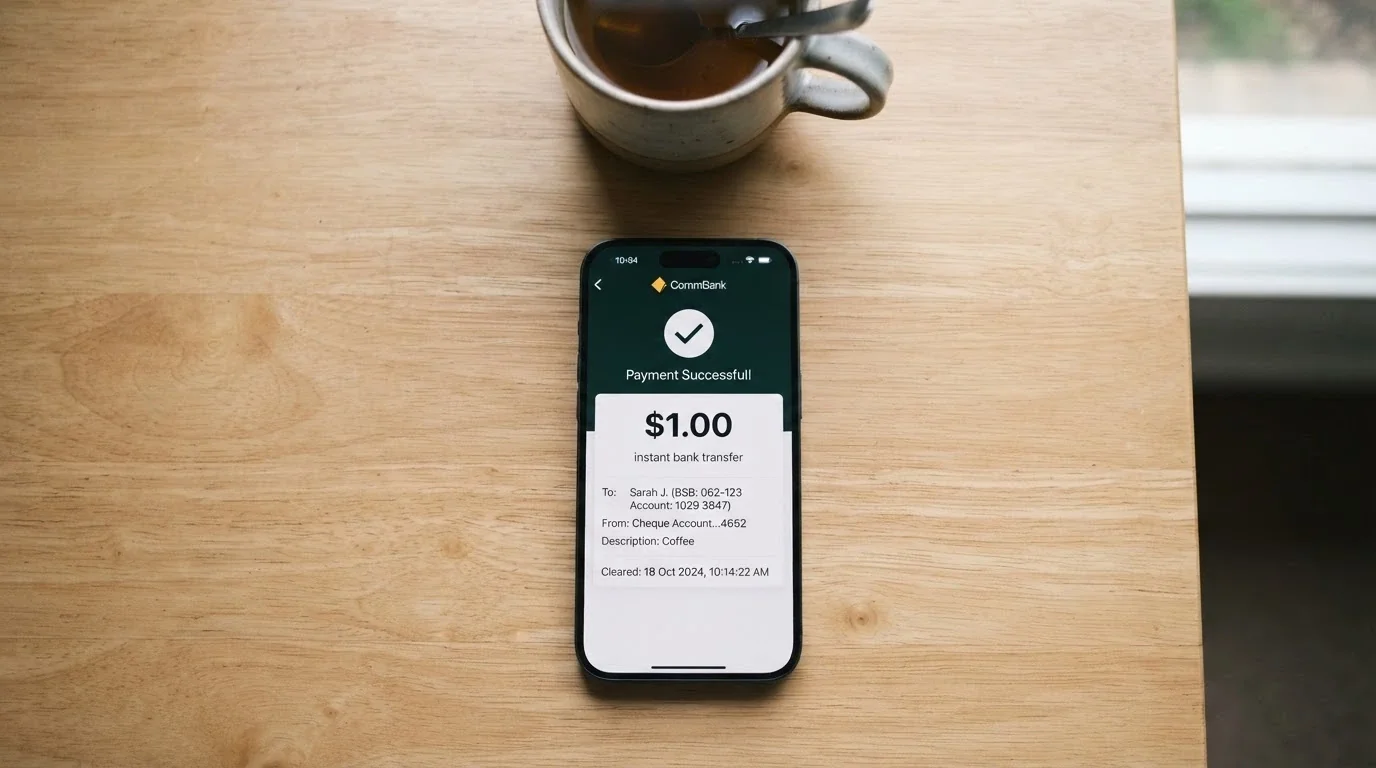
The constraint is on the casino side. PayID deposit ranges at AU casinos sit at A$10 at entry-level sites and A$30 at premium platforms, even though the rail itself clears at A$1. The minimum is set by the operator’s cashier, not by the payment network, and the floor varies by site. POLi shut down at the end of September 2023, leaving PayID and Osko as the Australian instant-deposit rail for online gambling.
For a punter who wants the cleanest A$1 experience, PayID is the answer. For a punter who has chosen an offshore site whose PayID minimum is A$30, the rail is correct but the cashier is the limit.
Card deposits — why $1 via Visa or Mastercard barely exists
Card processing costs the operator A$0.30–A$0.50 per transaction. On a A$1 deposit, that processing fee consumes between thirty and fifty per cent of the deposit before it arrives at the casino. The economics do not work for most operators, and the cashier minimum on card rails reflects it: RocketPlay’s card floor is A$25, SkyCrown’s is A$20, and most sites sit between A$10 and A$25.
There is also the regulatory layer. Credit cards, credit-related products and digital currency are banned as payment for online wagering since 11 June 2024, under the Interactive Gambling Amendment (Credit and Other Measures) Act 2023, with penalties of up to A$247,500 for non-compliance. That ban applies to licensed Australian wagering operators; offshore casinos accepting cards from Australian debit accounts sit outside the enforcement perimeter of the ban, which is one reason the card rails still load at offshore sites even though they are illegal at home.
The net effect is that an Australian player depositing A$1 via Visa or Mastercard to an offshore casino is running against the economics the operator has already priced into a higher minimum. The cashier will refuse it.
Neosurf and prepaid — one-way vouchers at the low end
Neosurf and paysafecard work as deposit rails at the low end: a player buys a voucher at a retail outlet for A$10, A$20 or larger, and redeems the code at the casino cashier. The rail works at the A$1 deposit level on sites that allow it.
The catch is the direction of travel. Neosurf and paysafecard are one-way — they cannot receive a withdrawal. A player depositing via Neosurf must cash out to a bank account, card, or crypto wallet, with the inconvenience of a separate withdrawal rail and the operator’s minimum withdrawal (typically A$10–A$50) sitting between the voucher and the bank. For a punter with a dollar and a plan, the deposit is easy and the withdrawal is the friction.
$1 Deposit Pokies on Your Phone — What Is and Isn’t Different in 2026
The mobile experience of an offshore $1 pokies site is mostly the desktop experience with a smaller screen. Game libraries load in mobile browsers; deposit flows through PayID or a crypto wallet on the phone work the same way as on desktop, with PayID clearing in under thirty seconds. Offshore casinos do not appear in Australian app stores, which means the entry point is the mobile browser rather than a native app.
The Betzoid test data is the most concrete read on mobile behaviour: across 14 Australian-facing casinos tested over three months, nine offered full game libraries immediately on mobile and five restricted live dealer access until a player deposited A$10 or more. For a punter depositing A$1, the slots lobby generally opens; the live dealer tables sit behind the higher tier. Game providers are the same on mobile as on desktop — Royal Reels’ 5,400+ pokies from 40+ providers, RocketPlay’s 3,000+ games, Stake’s 3,000+ titles — with the same RTPs and the same minimum stakes.
PayID works the same on mobile as on desktop. Crypto deposits work the same on mobile as on desktop. The friction point is the operator’s cashier minimum, which does not move based on screen size.
Australia’s Online Pokies Ban — What It Means for Every $1 Deposit
The Interactive Gambling Act 2001 makes it an offence to provide online casino games, online pokies and in-play betting to a person physically in Australia. No licence for online casino exists anywhere in the country — not federally, not in any state or territory. The Australian Communications and Media Authority (ACMA) is the federal enforcer: it investigates complaints, issues formal warnings and civil penalty proceedings, refers operators for enforcement, and directs ISPs to block illegal sites.
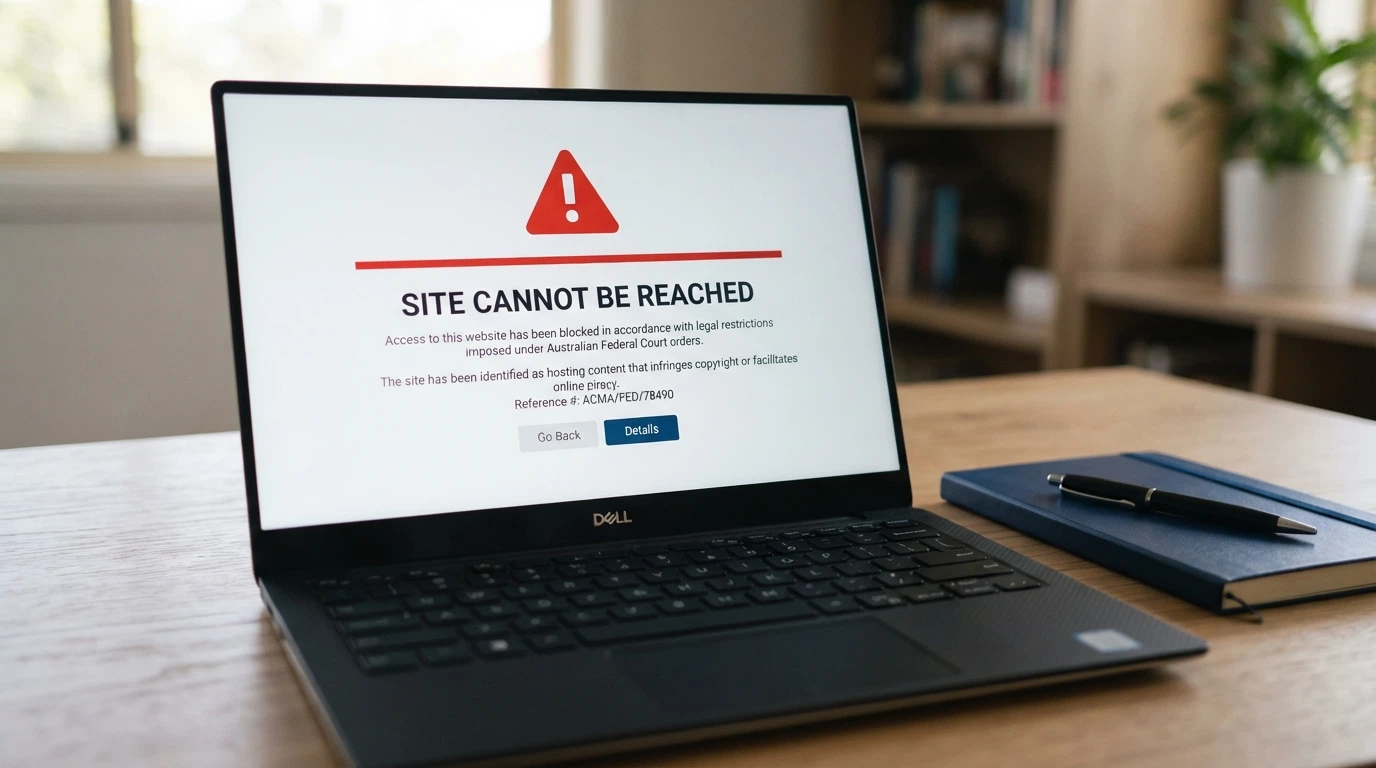
The Act targets the provider, not the player. Individual Australians are not prosecuted for depositing at an offshore casino. The 1,564 illegal gambling and affiliate websites blocked since November 2019 and the 225+ illegal services that have withdrawn from the Australian market since 2017 are the enforcement record, and that record is what the offshore $1 deposit sites sit against.
The IGA 2001 — why no online casino is licensed in Australia
The Interactive Gambling Act 2001 prohibits online casino games, online pokies and in-play betting on sporting events. What is licensable is narrower: wagering on races and sport placed before the event begins, lotteries, and keno, through operators licensed by a state or territory (in practice concentrated through the Northern Territory Racing and Wagering Commission, administered via Licensing NT). Online casino and online pokies are not on that list.
The ACMA is the federal enforcer. Its consumer guidance explicitly includes online slots and pokies among illegal online gambling services when supplied by prohibited operators. Civil penalties apply to providers; formal warnings precede proceedings; ISP blocking is the bluntest instrument. The individual player is not prosecuted — the Act targets the provider.
The upshot for an Australian punter considering a $1 deposit is that the product they are buying is illegal to supply in this country, the operator supplying it is unlicensed in this country, and the enforcement record against that supply is the largest in the ACMA’s history.
The 2026 gambling reform — what changes on 1 January 2027
The Interactive Gambling Amendment (Gambling Reform) Bill 2026 passed Parliament on 19 August 2026; its measures commence on 1 January 2027. The bill is passed but not yet in force, and the difference matters — the measures below are the law from 1 January 2027, not the law today.
- From 1 January 2027, no more than three wagering ads per hour between 6:00 am and 8:30 pm on television, with a complete live-sport blackout from fifteen minutes before to five minutes after a broadcast
- Athletes, celebrities and influencers are barred from promoting wagering products
- Wagering advertising in sports venues and on uniforms is prohibited; broadcasting of sporting odds is banned outright
- Online, wagering ads reach only logged-in, age-verified users with an opt-out
- Direct marketing of inducements is prohibited for fourteen days after sign-up, three months after BetStop deregistration, and indefinitely for at-risk customers
- Banks and payment providers gain express authority to block transactions to illegal gambling operators
- Foreign matched lotteries and online keno (described in the reform as “pocket pokies”) are prohibited
For a punter using an offshore $1 deposit site, the most direct change is the bank-and-payment-provider authority to block transactions. From 1 January 2027, an Australian bank or payment provider can decline a transaction to an illegal operator without further notice. That is the moment the offshore route loses its current ease.
What the offshore route costs an Australian player
The licensed Australian market has a layered protection stack: BetStop for self-exclusion, the ACMA for complaints, Australian Consumer Law for dispute resolution, and the operator’s licence as the lever that makes any of those protections stick. The offshore route sits outside every one of those layers.
- No ACMA complaints body for offshore operators — the ACMA enforces Australian-licensed operators and blocks illegal sites; it does not adjudicate a punter’s dispute with an offshore casino
- No BetStop coverage — BetStop binds Australian-licensed wagering services only; an offshore casino is not connected to the register and will keep taking a self-excluded person’s money
- No withdrawal guarantee — there is no Australian regulator an Australian punter can complain to about an offshore operator refusing to pay out
- No Australian consumer-law recourse — the Australian Consumer Law applies to goods and services supplied in Australia; an offshore operator’s supply sits outside it
- No deposit insurance — if the operator is hacked, becomes insolvent, or disappears, the player’s balance is at the operator’s discretion
- DNS-level blocking with the balance still on it — the ACMA can direct ISPs to block an offshore casino’s domain with no notice to players, and a player with funds in the account at the moment of blocking has no Australian recourse
The 1,564 illegal gambling and affiliate websites blocked since November 2019 and the 225+ illegal services withdrawn since 2017 are not a hypothetical risk — they are the operating environment. Any offshore $1 deposit site an Australian punter uses can be on the next blocking list.
Why Crypto Is the Rail That Makes Genuine $1 Deposits Possible
Crypto is the only rail where the per-transaction cost to the operator is low enough that a one-dollar deposit is economically viable. Card rails charge A$0.30–A$0.50 per transaction regardless of deposit size; crypto networks charge a variable fee based on network conditions. The catch is that the fee is borne by the sender, and on a one-dollar transfer the fee can be a substantial fraction of the deposit.
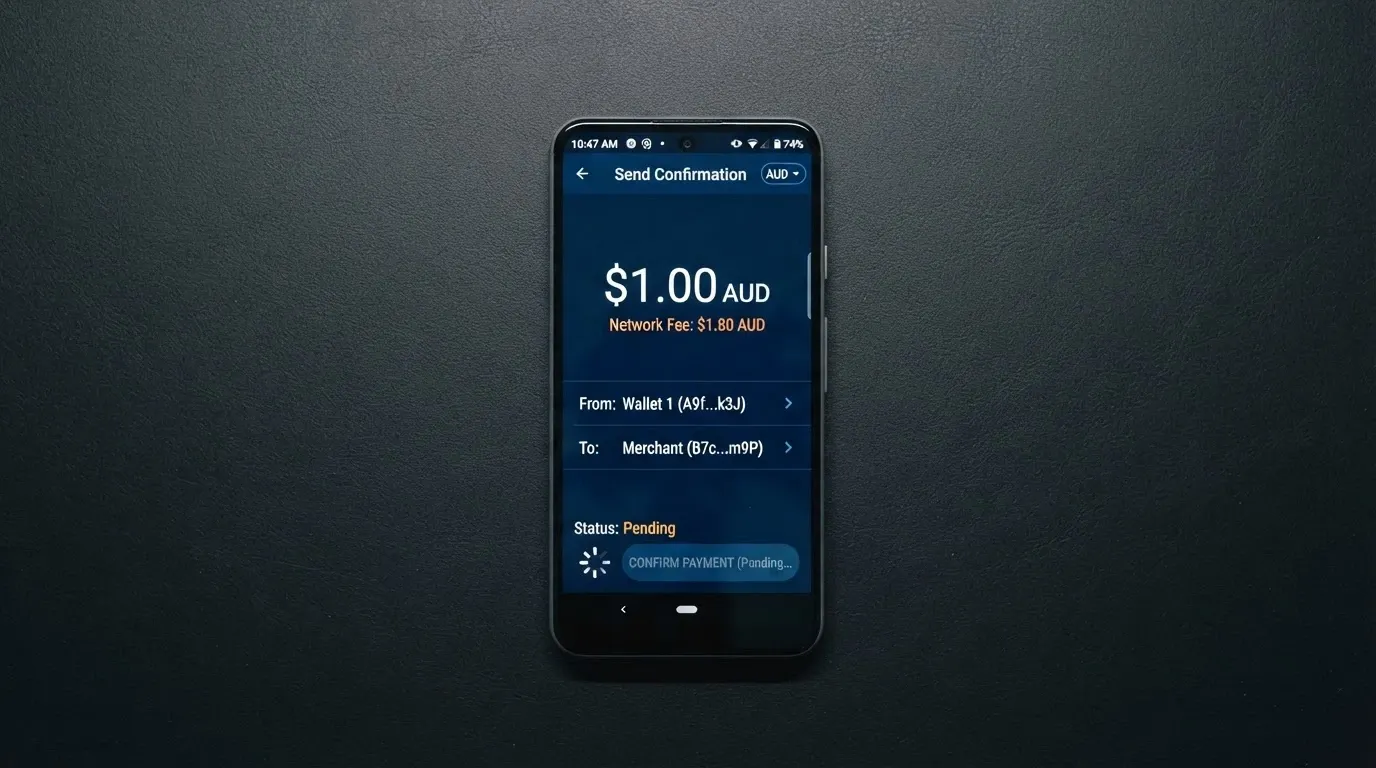
Bitcoin network fees in 2026 typically run A$0.50–A$3 per transaction. USDT on TRC-20 is cheaper, at A$0.50–A$1, because the Tron network carries lower per-transaction fees than Bitcoin’s mainnet. A dollar sent via Bitcoin can arrive as forty cents after the network fee; a dollar sent via USDT-TRC-20 arrives closer to a dollar but not by a wide margin.
The irony sits at the regulatory layer. Australia banned digital currency (crypto) as a payment method for licensed online wagering on 11 June 2024, alongside the credit-card ban. Crypto is legal for offshore casinos and illegal at home; crypto is the rail that makes offshore one-dollar deposits viable and the rail that licensed Australian wagering cannot use. The contradiction is structural, not a bug.
Most AU-facing offshore casinos set their crypto deposit floor at A$5–A$10, even though the rail itself clears at lower amounts. The floor is set by the operator, not by the network.
Playing Within Limits — What Responsible Gambling Looks Like at a Dollar a Time
The one-dollar deposit is the smallest possible entry point into real-money pokies in Australia, and the smallest entry point sits at the intersection of every protection gap the offshore route opens. A punter who chooses to deposit at an offshore $1 deposit site is, by definition, outside the Australian self-exclusion register, outside the Australian complaints body, and outside the Australian consumer-law framework. The dollar is small; the absence of every layer above it is not.
The harm data behind this conversation is real. Roy Morgan Research (March 2026) estimates that 15.1% of Australian adults — about 3.32 million people — are experiencing some level of gambling harm from their own gambling or from someone else’s. The Australian Institute of Health and Welfare put problem gambling at roughly 2.1% of adults (about 430,000 people) and high-risk gambling at 1.8% in 2022. A model in the Journal of Gambling Studies estimates around 1,970,000 Australian adults are at-risk or problem-gambling, with an annual health loss above 400,000 Years Lived with Disability. These figures predate the offshore-vs-licensed split; they describe the population a $1 deposit conversation reaches.
The self-exclusion blind spot — offshore casinos and Australian player protections
BetStop — the National Self-Exclusion Register — launched on 21 August 2023. As of 31 March 2026, 59,830 people had registered and 37,247 exclusions were active. Seventy-eight per cent of registrants are under forty; thirty-eight per cent chose lifetime exclusion. The Statutory Review of BetStop was published on 25 February 2026.
BetStop covers Australian-licensed wagering services only. An offshore casino is not licensed in Australia, is not connected to the register, and will keep taking a self-excluded person’s money. The single registration that excludes a punter from every Australian-licensed online and phone wagering service does not touch the offshore sites an Australian player can reach with a one-dollar PayID transfer.
The National Gambling Helpline — 1800 858 858 — is free, confidential and staffed 24 hours a day, with online chat and counselling through Gambling Help Online. Neither the helpline nor Gambling Help Online can reverse a loss or recover funds from an offshore casino; what they offer is a place to start when a player decides the $1 deposit conversation has gone further than it should have.
How many Australians are affected — the numbers behind the harm
The prevalence figures set the scale. About 15.1% of Australian adults — 3.32 million people — are experiencing some level of gambling harm; 13.0% (about 2,857,000) from their own gambling, and 5.4% (about 1,177,000) from someone else’s gambling. Roughly 2.1% of adults (about 430,000) experience problem gambling. The at-risk or problem-gambling population is estimated at 1,970,000 adults, with an annual health loss above 400,000 Years Lived with Disability.
For a reader considering a $1 deposit, the figures mean that the harm the offshore route can deliver is not abstract. It is the size of a small Australian city.
How We Evaluated 2026 $1 Deposit Pokies Sites
The operator ranking draws on a sweep of AU-facing offshore casinos that surface for the $1 minimum deposit topic, cross-checked against the ACMA register and the published licence footprints of each operator. The ACMA register is a blocklist, not a whitelist — it confirms the absence of an Australian licence, which is the relevant fact for a prohibited-service market. The IGA 2001’s prohibition on online casino means every operator in the featured set is offshore by legal necessity.
Four operators — WinSpirit, Bizzo Casino, Scream Casino, Rocket Casino — did not surface with usable licence, bonus or terms data in this round of research, and their fields are marked unconfirmed rather than guessed. The six operators with confirmed data — RocketPlay, SkyCrown, Royal Reels, Stake, Fair Go, Rainbet — carry the figures their own terms pages or affiliate reviews surfaced, with the qualifier that those figures are as-published and may have changed. The ranking reflects four qualitative criteria: licence transparency (a verifiable licence jurisdiction beats an unspecified one), welcome offer value (size, package structure and free-spin count), wagering fairness (lower multiples and longer validity windows score better), and AU-player acceptance (operators whose T&C explicitly bar Australia score lower than those whose T&C do not). The criteria are descriptive, not weighted — no operator scores a percentage and no scoring system has been hidden behind the prose.
Stake and Rainbet both list Australia as restricted in their T&C, yet both receive meaningful AU traffic. The page does not treat that tension as resolved; it sits in the operator write-ups as a known feature of the deal. The ACMA’s enforcement record — 1,564 sites blocked, 225+ services withdrawn — is the operating environment every operator in the table sits inside.
Is a $1 Deposit Worth It? Weighing the Real Cost of Micro-Deposit Pokies in 2026
The arithmetic of a one-dollar pokies session is small in cash and large in what it does not include. At A$0.10 per spin on Starburst, a dollar buys ten spins; the expected loss is about four cents. At A$0.25 on Blood Suckers, a dollar buys four spins; the expected loss is about two cents. The session runs minutes, not hours, and the outcome is overwhelmingly likely to be a smaller balance at the end of it.
What the dollar costs the player is not the spin. It is the protections that evaporate on the way to the cashier. BetStop does not cover the offshore site. The ACMA does not adjudicate disputes with it. Australian Consumer Law does not apply to it. The site can be DNS-blocked with the player’s balance still on it, and the player has no Australian recourse. From 1 January 2027, the player’s bank can decline the transaction in the first place.
The one-dollar threshold is a marketing line, not a safety rating. A site accepting one dollar has not automatically proved its withdrawals are reliable, that its licence protects an Australian customer, that its terms are reasonable, or that it is legally authorised to provide online pokies to someone physically in Australia. The dollar is small; the absence of every Australian protection sitting above it is not.
For a punter who wants to look around a lobby, PayID is the cleanest rail and Royal Reels’ A$10 no-deposit bonus (after phone verification) is the most dollar-friendly entry point in the featured set. For a punter who wants to clear a headline welcome, the bonus-trigger minimums sit at A$10–A$30 and the wagering at 20x–45x. For a punter who wants to play a real session, the dollar is not enough and the offshore site is the wrong place to add to it. The honest version of the choice: a one-dollar deposit at an offshore casino in 2026 is a way to see what the cashier looks like, paid for in the protections that licensed Australian wagering would otherwise provide.
Frequently Asked Questions
Can I really deposit just one dollar and play pokies for real money in Australia?
A genuine A$1 deposit is possible at a small number of offshore casinos via PayID or specific crypto networks, but most AU-facing sites set their real cashier minimum at A$10 for standard methods and A$5–A$10 for crypto. Card rails rarely clear at A$1 because processing costs consume the deposit. The dollar that does clear buys roughly ten spins at the A$0.10 minimum stake and the session runs minutes.
Which payment methods actually support a $1 deposit at Australian-facing casinos?
PayID is the cleanest Australian rail at the A$1 level, with deposits clearing in under thirty seconds and no casino-side fees. USDT on TRC-20 is the cheapest crypto option at A$0.50–A$1 in network fees. Visa and Mastercard rarely clear at A$1 because processing fees of A$0.30–A$0.50 eat the deposit. Neosurf and paysafecard work as one-way deposits but cannot receive withdrawals.
Do $1 deposits unlock welcome bonuses or free spins, or is the bonus minimum higher?
The A$1 deposit rarely unlocks the headline welcome bonus. Most AU-facing offshore casinos set the bonus-trigger minimum at A$10, A$20 or A$30, with the headline welcome sitting above that floor. What the A$1 typically triggers is a small free-spins pack of 20 to 100 spins, sometimes a low-capped match bonus. The fine print is the part that says so.
What are the best pokies to play with a $1 bankroll — and what can I expect from 10 spins?
At A$0.10 per spin, ten spins run on Starburst, Book of Dead or Big Bass Bonanza. At A$0.25, four spins run on Blood Suckers or Wolf Gold. At a 96% RTP, the expected return across ten spins is A$0.96 and the expected loss is A$0.04. Blood Suckers at 98% RTP is the highest-return title in the researched set, but it ships in lower-RTP variants at some operators.
Is it legal for an Australian resident to play real-money pokies on an offshore site?
Online casino games and online pokies are prohibited services in Australia under the Interactive Gambling Act 2001. No licence for online casino exists anywhere in the country. The Act targets the provider, not the individual player, which is why Australian players are not prosecuted for depositing offshore. The product is illegal to supply here; the offshore operator sits outside Australian jurisdiction; the player sits in the gap.
What protections do I lose by using an offshore casino instead of a licensed wagering operator?
An offshore casino is not connected to BetStop, so a self-exclusion registered in Australia does not stop an offshore casino from taking the player’s money. The ACMA does not adjudicate disputes with offshore operators; Australian Consumer Law does not apply; there is no withdrawal guarantee. The ACMA can direct ISPs to block the offshore site with no notice to players, and any balance in the account at that moment has no Australian recourse.
How do PayID, crypto and card deposits compare for $1 micro-deposits — in speed, fees and withdrawal support?
PayID clears in under thirty seconds, costs nothing on either side, and works for withdrawals at 15 to 40 minutes for verified accounts on small balances. USDT on TRC-20 carries A$0.50–A$1 in network fees and varies by network conditions; Bitcoin carries A$0.50–A$3 and is the most expensive rail at this level. Card rails carry A$0.30–A$0.50 in processing fees and rarely clear at A$1; withdrawals to card are slower and less reliable than PayID.
What is BetStop, and does it cover the offshore casinos accepting $1 deposits?
BetStop is Australia’s National Self-Exclusion Register, launched on 21 August 2023 with 59,830 registrations and 37,247 active exclusions as of 31 March 2026. A single registration excludes a person from every Australian-licensed online and phone wagering service. BetStop does not cover offshore casinos; an offshore site is not connected to the register and will keep taking a self-excluded person’s money.
Published by the Pokies Melbourne team.