$10 PayID Casino No-Deposit Bonus Australia in 2026: What the Marketing Words Actually Mean
 Available in AU
Verified as of 18 October 2026 — operator terms cross-checked against the Curaçao Gaming Authority register and the ACMA blocked-sites list.
A “$10 casino bonus” means two very different things in Australia, and almost every search result for the term blurs them into one. One is a free A$10 chip the casino credits to your account on sign-up, with no deposit required at any point. The other is a regular welcome offer at a casino that accepts a A$10 minimum deposit through PayID — your own A$10, not theirs. The marketing language treats them as the same product. They are not. The free chip costs you nothing to claim and a great deal to clear. The deposit version is yours to begin with, and the bonus sits on top.
This page is a working guide to both, written for an Australian player who wants to know what each offer actually costs in time, in wagering and in cash that can be withdrawn. Ten AU-facing casinos sit in the comparison. Every one of them is licensed offshore, and the article names that openly. None holds an Australian casino licence, because no such licence exists. The Interactive Gambling Act 2001 prohibits the product.
Table of Contents
- What a $10 No-Deposit Casino Bonus Actually Means for Australian Players
- Why Your 2026 $10 Bonus Is Worth Less Than You Think
- The 10 $10-Bonus Casinos Australians Actually Play at in 2026
- PayID at the $10 Level — What AU Casino Deposits Actually Look Like
- Which Pokies Give Your $10 Bonus the Best Shot — RTP and Volatility in 2026
- The Legal Reality — Are $10 Casino Bonuses Legal for Australian Players?
- Staying in Control When the House Is Offshore — Responsible Gambling for AU Players
- How We Picked and Ranked These $10 Bonus Casinos
- Is a $10 No-Deposit Casino Bonus Worth Your Time in 2026?
- Frequently Asked Questions
What a $10 No-Deposit Casino Bonus Actually Means for Australian Players
The phrase sits across two distinct products and two distinct player intents. A punter searching for a “$10 no-deposit bonus” wants free money to play with, ideally with the chance of withdrawing it. A punter searching for a “PayID casino $10 deposit” wants to fund a small bankroll through the Australian instant-banking rail without a credit card. The two intents collide in the search results, and they collide inside the marketing pages of casinos that offer both — a free chip on sign-up plus a deposit match once you put money in.
The distinction matters because the cashout path looks nothing like the deposit path. The free chip carries wagering requirements (turnover multiplied by the bonus amount before any withdrawal is permitted), and almost always a hard ceiling on what can be taken out. The deposit version is your own cash from the moment the deposit clears, with bonus funds layered on top under their own wagering rules. Each path produces a different experience of the same casino.
The Two Different $10 Offers — No-Deposit Bonus vs Minimum-Deposit Casino
A no-deposit bonus is exactly what it sounds like. The casino credits A$10 to a bonus wallet when you register and verify your mobile number, and you use that A$10 on selected pokies. You do not pay in. You do not link a card. The bonus is the casino’s money, and the casino’s terms govern how and when any winnings can be withdrawn. The full path typically runs: register, verify, claim the chip, wager the bonus through the required turnover, then withdraw what is left after the cashout cap. None of those steps cost the player anything in cash. They cost time, and they cost the player a non-trivial chance of walking away with nothing.
A $10 minimum-deposit casino is the same casino after the player has decided to spend. You transfer A$10 from an Australian bank account via PayID (or another accepted route), the casino credits your account with your own A$10 plus, usually, a deposit-match bonus — a percentage of your deposit credited as bonus funds — that can extend well beyond the A$10. The bonus funds carry their own wagering. Your real-money balance does not, but it is also not protected from the wagering clock. If you do not complete the required turnover before the bonus expires, both the bonus and any winnings attributed to it can be removed.
The reason the search results confuse the two is that the marketing works on a single word — “bonus”. The free chip and the deposit match are both called “a $10 bonus”. The free chip does not require a PayID transfer; PayID is irrelevant until the player chooses to deposit. The deposit version does not give A$10 for nothing; it gives the player’s own A$10 plus whatever the casino is willing to layer on top. A player looking for the first will be annoyed to find a deposit page. A player looking for the second will be annoyed to be told they need to fund an account first.
How a $10 Free Chip Works at AU-Facing Online Casinos
The lifecycle of a no-deposit chip is the same shape at almost every operator in the comparison. You open an account. The casino sends a one-time code to your mobile number, you enter it, and the bonus wallet is credited. The chip sits there. You open a pokie, set a stake that fits the maximum-bet rule while wagering (the casino’s cap on the size of a single bet during the bonus period — most often A$5 or lower), and start spinning. Winnings land in the bonus wallet alongside the original chip, and the wagering requirement tallies up against the bonus amount as you go.
Once the turnover is reached, the casino converts whatever is in the bonus wallet into withdrawable cash, capped at the published maximum cashout. Everything above the cap is voided. If the bonus expires before turnover is met, the bonus wallet — chip, winnings, all of it — is removed, and the player is back at a zero balance with no cashout to attempt.
Know-your-customer verification sits on top of this lifecycle. AU-facing operators do not always run it before the bonus is credited, but every one of them runs it before the first withdrawal. The casino will ask for a government ID, a proof of address and sometimes a selfie holding the ID. Offshore operators, by their own published practice, may request the same documents again if a withdrawal looks unusual to them — a large win, a change of payment method, a flagged IP. This is friction that does not exist at an Australian-licensed wagering operator, where verification follows the same rule but is enforced once and enforced by an Australian-facing complaint body.
Why Your 2026 $10 Bonus Is Worth Less Than You Think
Three numbers turn A$10 into something the player needs to think about carefully: the wagering multiplier, the maximum cashout cap and the eligible-games list. Each one shrinks the offer. Together they shrink it dramatically.
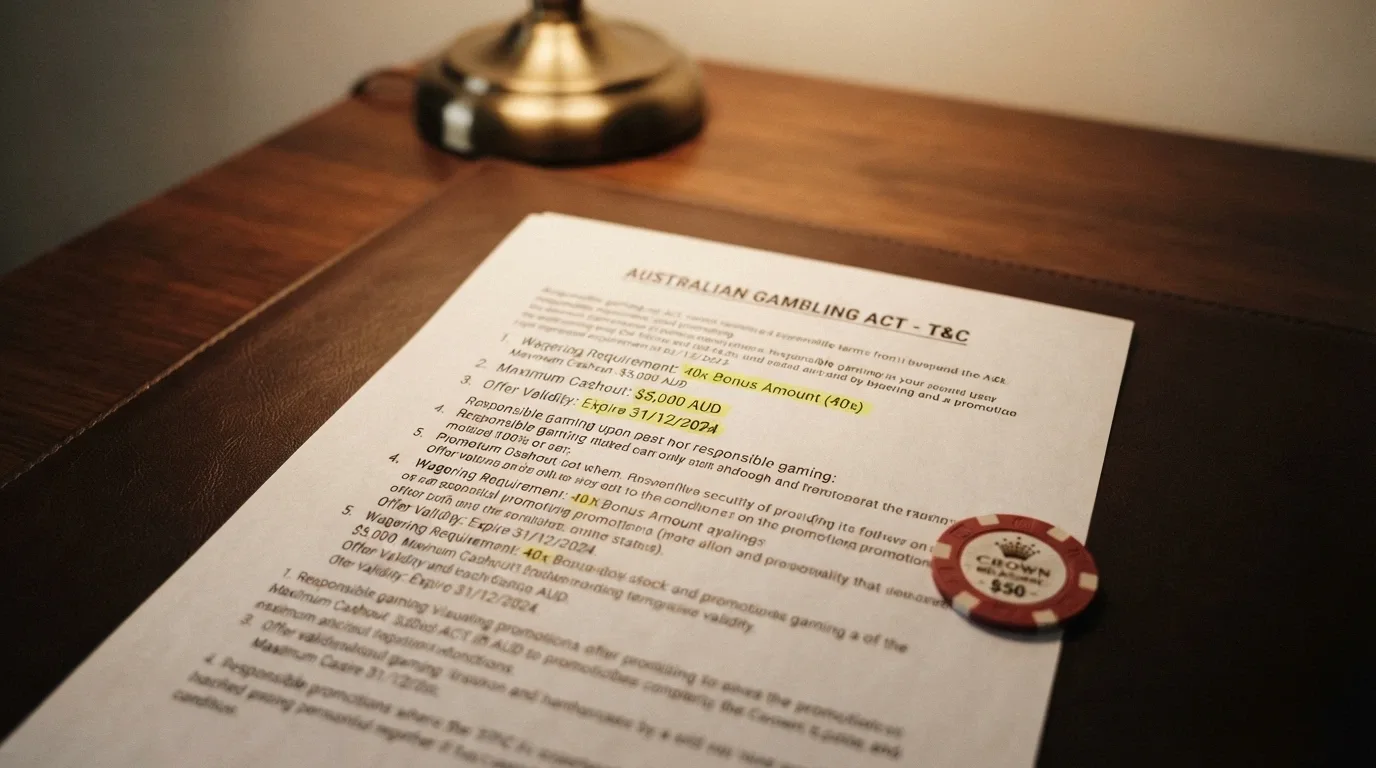
Wagering multiplies the bonus. A A$10 chip at 60x wagering, which is the high end of what AU-facing casinos ask for, requires A$600 in total bets before any winnings can be withdrawn. A A$10 chip at 30x requires A$300. The lower the multiplier, the smaller the hurdle — but the smallest wagering in this set is 30x, which still means thirty times the bonus value has to run through the pokies before the cashier opens. At an A$1 stake per spin, 60x is six hundred spins. At A$0.20, three thousand. Either is a long way from “free”.
The cashout cap limits the upside. A$50 is the lowest cashout cap in the set. A$200 is the highest. Even at A$200, the player has converted A$10 into at most A$200 of withdrawable cash — a twenty-times multiple of the original chip, conditional on clearing the wagering in full. Most sessions do not clear in full. Many sessions never reach the cap at all, because the bonus expires first.
The eligible-games list steers the player toward high-RTP pokies that minimise the house edge. “RTP” — return to player — is the percentage of total wagered money a slot is designed to pay back over the long run; the rest is the house edge. A pokie with a 96.21% RTP, Book of Dead from Play’n GO, keeps a 3.79% house edge. Over A$600 of turnover, the expected loss on that pokie is about A$22.74 — a statistical estimate across many spins under the stated assumptions, not a guaranteed outcome for any single session. The offer asks the player to risk roughly a fifth of the bonus’s nominal value in the wagering process alone, before any cap is reached and before any time has been spent.
The house always has an edge. The chip doesn’t change that. It just front-loads the risk and back-loads the cashout.
$10 No-Deposit Sign-Up Bonuses — Real Cash on Registration
Six of the ten featured operators credit a A$10 chip on registration without a deposit. The terms vary more than the headline. Royal Reels auto-credits a A$10 free chip on SMS verification with 40x wagering and a A$200 max cashout — the highest cashout ceiling in the set. PlayCroco’s chip is also A$10, but the wagering is 60x and the cap is A$180. Ozwin matches PlayCroco on the wagering but cuts the cap to A$50, the lowest in the comparison. Pokie Spins lands in the middle: a $10 chip, 50x wagering, $100 cashout.
Fairgo is the outlier on terms rather than amount. The chip is A$10, the wagering is 30x, and the operator does not publish a maximum-bet rule while wagering — a small but real advantage, because most other operators cap the player at A$5 a spin during the bonus. Fairgo’s looser terms make the chip cheaper to grind through, which is exactly why the operator rotates them rather than offering them on every sign-up.
The remaining four featured operators — SkyCrown, Rocket Play, Stake and WinSpirit — focus their welcome strategies elsewhere. SkyCrown, Rocket Play and WinSpirit run deposit-match welcome offers, while Bizzo provides ten free spins via its progressive web app. Stake’s no-deposit offering was not confirmed for this review. These operators do not offer a standard A$10 chip, making them less suitable for a player specifically targeting that product.
Dinkum33, which sits outside this featured set, runs a comparable A$10 chip with 60x wagering, a $50 cashout cap and a 14-day expiry — a tighter version of what PlayCroco and Ozwin offer, useful as a benchmark rather than a recommendation.
Welcome and First-Deposit Match Bonuses at the $10 Level
A A$10 first deposit typically unlocks more total bonus than the free chip, and it does so under a different set of terms. Royal Reels runs a 100% match up to A$500 — deposit A$10, receive A$10 in bonus funds, the cap still A$500 away. Wagering on the match sits at 35x, lower than the 40x attached to the no-deposit chip at the same operator. The math favours the deposit path for any player willing to fund the account.
SkyCrown runs a multi-deposit welcome package at 40x wagering. The minimum deposit is A$10 via PayID, Neosurf or crypto. Bizzo runs a deposit match plus free spins at 40x, with PayID accepted on both deposit and withdrawal — a structural advantage for a player who plans to clear the bonus and cash out. Rocket Play’s welcome package sits at 35x–50x across sources. The spread is a tell that the package’s terms have changed across the welcome’s components, which is common for multi-stage offers.
The wagering on a deposit match is usually lower than the wagering on the no-deposit chip. The cashout cap, where one applies, is usually higher. The reason is structural. A no-deposit chip costs the casino real money on every claim, with no guarantee the player will fund the account. A deposit match is funded by the player’s own deposit; the casino’s risk is the bonus, not the matched cash. The casino can afford a more generous cap because the player’s deposit underwrites it.
For a player with A$10 to spend, the deposit-match path usually wins on paper. The bonus is larger, the wagering is lighter, the cashout cap (where there is one) is higher. The trade-off is that A$10 is now in the casino’s hands rather than the player’s, and the bonus clock is running.
Free Spins Dressed as a $10 Bonus — What One Spin Is Really Worth
Fifty free spins at A$0.20 each is a A$10 theoretical stake value, and several operators market the package as a “$10 bonus” without quite saying so. The math on entry looks like the chip’s math. The math on exit does not.

Free-spin packages typically arrive with their own wagering rule applied to spin winnings, separate from any chip wagering. A typical package — fifty spins at A$0.20 — runs 40x on what the spins produce, with a max cashout between A$50 and A$100. Bonza7’s package of seventy-five spins carries a $15 play value (fifty cents more than the A$10 headline), 50x wagering on winnings and a $100 cashout cap, with a 7-day expiry. Bizzo runs ten free spins via its PWA app — a smaller count, lower per-spin value — with an A$75 max cashout and 40x wagering.
The player should read the spin package the same way they read the chip: the headline value is the entry price, not the exit value. The A$10 of “free play” arrives with a wagering multiplier that turns a small win into a long grind and a max cashout that prevents the package from becoming a payout. A player who would not claim a A$10 chip at 60x with a A$180 cap should think twice before claiming the spin equivalent at 50x with a A$100 cap.
Bonus Codes — When a Casino Asks for One and When It Does Not
Some bonuses arrive automatically. Royal Reels credits the A$10 chip on SMS verification — no input from the player beyond the verification itself. Other bonuses require a code. PlayCroco’s chip is code-based: the player enters a coupon at the cashier before the bonus attaches. Pokie Spins also runs a code-based claim. Codes document the offer’s source — affiliate, segment, seasonal promotion — and let the casino attribute the player accurately across marketing channels. Codes also let the casino expire an offer quietly, by retiring the coupon rather than rewriting the welcome page.
The risk for the player is not the code itself but the code’s lifecycle. An expired code at an AU-facing casino produces an error message at the cashier, not a credit. The player assumes they have been given a bonus, registers, verifies, and finds the bonus wallet empty. The casino’s help desk usually requires a fresh code from a current affiliate page. The friction is small, but it is friction the auto-credited version does not have.
The 10 $10-Bonus Casinos Australians Actually Play at in 2026
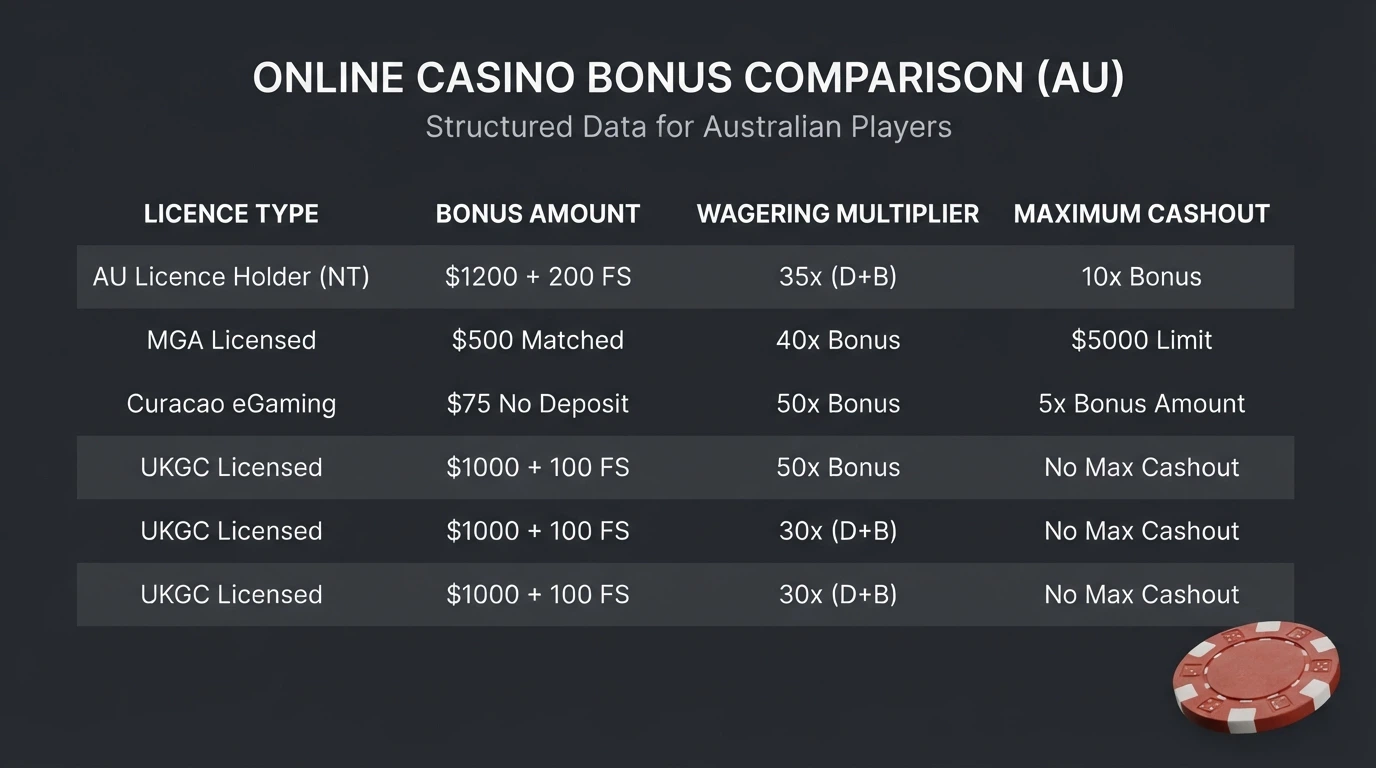
The ten operators in the comparison below are the AU-facing casinos with the clearest A$10-level bonus activity. Every one of them is licensed in Curaçao. None holds an Australian casino licence, because the product the licence would cover is prohibited under the Interactive Gambling Act 2001. Two of the ten (Bizzo, SkyCrown) accept PayID on both deposits and withdrawals. Three more (Royal Reels, PlayCroco, Fairgo) accept PayID on deposits only. The remainder have not confirmed PayID support at this level. The table covers the columns where the research produced a solid figure across most of the set.
| Casino | Licence | No-Deposit Bonus | Wagering (ND) | Max Cashout |
|---|---|---|---|---|
| Royal Reels | Curaçao (CGA) | A$10 chip | 40x | A$200 |
| PlayCroco | Curaçao | A$10 chip | 60x | A$180 |
| Ozwin Casino | Curaçao | A$10 chip | 60x | A$50 |
| SkyCrown | Curaçao (Hollycorn N.V.) | — | — | — |
| Bizzo Casino | Curaçao (TechSolutions Group N.V.) | 10 free spins (PWA) | 40x | A$75 |
| Fairgo Casino | Curaçao | A$10 (periodic) | 30x | — |
| Rocket Play | Curaçao | — | — | — |
| Stake | Curaçao | — | — | — |
| WinSpirit | Curaçao | — | — | — |
| Pokie Spins | Curaçao | $10 chip | 50x | $100 |
Four cells in the table are blank as those operators do not offer a no-deposit chip at this level, focusing instead on deposit-match or free-spin packages. The profile sections below detail their respective offers.
Royal Reels
Royal Reels runs the most generous no-deposit package of the featured set on the headline terms. A$10 chip on SMS verification. 40x wagering. A$200 max cashout. The chip is auto-credited — no code to enter, no cashier click. Royal Reels also runs a 100% first-deposit match up to A$500 at 35x wagering on the match, which is the lighter hurdle of the two offers.
The operator is licensed in Curaçao under the Curaçao Gaming Authority. Royal Reels accepts PayID for deposits, alongside Visa, Mastercard, Neosurf, Skrill, Neteller, bank transfer and a small set of cryptocurrencies. PayID withdrawals are reserved for VIP players, where payouts can land in one to two hours. The default withdrawal ceiling is approximately A$9,000 per day, and processing begins within twenty-four hours of approval for everyone else.
The T&Cs publish a maximum bet while wagering of A$5 per spin or game round. That is the operator’s biggest single brake on a player’s wagering speed. A player who bets more than A$5 while the bonus is active risks having the bonus and any winnings attributed to it removed.
ACMA blocked Royal Reels during the October–December 2025 quarter. The operator continues to serve Australian players through other domains, which is the standard pattern for AU-facing offshore casinos caught in the ACMA blocking cycle. A player who lands on a blocked domain mid-session loses their route in but does not lose their account; the operator’s support points them to the current working address.
Royal Reels provides the most rounded A$10 bonus experience, combining accessible wagering conditions with a reasonable cashout ceiling.
PlayCroco
PlayCroco’s A$10 chip is the most wagering-heavy of the confirmed no-deposit offers in the set. 60x wagering. A$180 max cashout. 7-day validity. Code-based claim, which adds one step the player has to take at the cashier. The library is Real Time Gaming and SpinLogic — a smaller provider footprint than the Pragmatic Play and NetEnt heavy hitters elsewhere in the comparison, but the same kind of high-volatility pokies in RTG’s catalogue.
The Curaçao licence is offshore. The bonus terms are tighter than Royal Reels on the wagering side (60x versus 40x) and lighter on the cashout side (A$180 versus A$200). A player clearing PlayCroco’s wagering faster than Royal Reels’s would need a steady run of mid-sized wins on the eligible pokies.
ACMA has blocked multiple PlayCroco domains during the October–December 2025 quarter. The operator continues to operate through alternate addresses. For a player who already knows the platform and is comfortable with the RTG catalogue, the offer is competitive. For a first-timer, the higher wagering is a reason to look at Royal Reels or Fairgo first.
Ozwin Casino
Ozwin’s A$10 chip is the lowest-cashout no-deposit offer in the featured set. 60x wagering. A$50 max cashout. 7-day validity. RTG/SpinLogic library, Curaçao licence.
Given the 60x turnover on a A$50 cap, Ozwin’s chip is a proposition that rarely delivers a significant payout, best suited for those strictly interested in testing the RTG library without real-money expectations.
SkyCrown
SkyCrown focuses its welcome strategy on a deposit-match package rather than a no-deposit chip. Its welcome offer is a multi-deposit package at 40x wagering with a A$10 minimum deposit accepted via PayID, Neosurf and crypto. The pokies library is the largest in the comparison — over 7,000 titles from 70+ studios, with Pragmatic Play, Betsoft, Hacksaw and Evolution among them.
SkyCrown’s Trustpilot score sits at 1.5 out of 5 from around 350 reviews, with recurring complaints about withdrawal delays and repeated verification requests in 2026. That is the single worst player-feedback score in the featured set and the reason SkyCrown sits below the deposit-match operators that have cleaner recent records. The Curaçao licence is held by Hollycorn N.V., an operator that runs a stable of similarly positioned AU-facing brands.
SkyCrown represents a high-volume pokies destination for A$10 depositors, though the mixed player feedback on withdrawal times suggests it should be approached with more caution than the Bizzo alternative.
Bizzo Casino
Bizzo’s standing no-deposit offer is ten free spins via its progressive web app, not a chip. A$75 max cashout on the spin package. 40x wagering on spin winnings. The library is the largest in the comparison — over 8,000 games from more than 70 studios, including Pragmatic Play, Play’n GO, BGaming, Hacksaw and Evolution.
The structural advantage over SkyCrown is the withdrawal side. Bizzo accepts PayID on both deposits and withdrawals. A player funding through PayID and cashing out through PayID keeps the deposit rail both ways. The Curaçao licence is held by TechSolutions Group N.V., and Bizzo is not on ACMA’s current blocked-sites list — the only operator in the featured set other than SkyCrown with that status.
For a player who wants the spin-package entry point and the broadest provider mix, Bizzo is the cleaner choice of the two largest libraries in the comparison. The free-spin path is smaller than a chip and easier to clear. The 40x wagering is the standard for the segment.
Fairgo Casino
Fairgo runs the most player-friendly wagering terms of the featured set on the chip path. A$10 no-deposit chip, available periodically rather than on every sign-up. 30x wagering — half of what PlayCroco and Ozwin ask for. No maximum-bet rule while wagering, which removes the A$5 brake that Royal Reels and several others apply.
The library is RTG/SpinLogic. The Curaçao licence is offshore. The operator does not accept PayID, which removes it from the PayID deposit path comparison entirely. A player funding their account after the chip has been cleared is back to the standard offshore banking options — Visa, Mastercard, Neosurf, crypto, where supported.
ACMA has blocked Fairgo during the October–December 2025 quarter. Like the other blocked operators in the set, Fairgo continues to operate through alternate addresses. The 30x wagering is the right number. The missing PayID support is the cost of getting it.
Fairgo is the optimal choice for players prioritising low-wagering bonuses, provided they are content with traditional banking methods.
Rocket Play
Rocket Play does not publish a standing A$10 no-deposit bonus at this level. The welcome offer is a deposit match with wagering reported between 35x and 50x across sources — the spread itself is a sign of the package’s mixed components. The Curaçao licence is offshore. The provider mix is multiple studios.
ACMA has blocked three Rocket Play domains during the October–December 2025 quarter. Three blocked domains in a single quarter is the largest count of any single operator in the featured set and a flag worth taking seriously. A player who lands on a Rocket Play address that gets blocked mid-play has the same continuity problem as the rest of the comparison, scaled up.
For a player set on a deposit match and willing to fund the account, Rocket Play is a smaller library and a higher-risk address than SkyCrown or Bizzo for the same A$10 deposit. The deposit-match sub-ranking within the comparison places Rocket Play below both.
Stake
Stake’s no-deposit offering was not confirmed for this review. The platform is the crypto-native operator of the comparison — Curaçao licence, proprietary and major-studio games, and a player base that skews toward the cryptocurrency side rather than the AUD-banking side. PayID support for AUD deposits was not confirmed.
ACMA’s blocking history for the Stake ecosystem is limited to adjacent domains — rain.gg is the only address in the same operator’s footprint that has appeared on ACMA’s list. The Stake status was not confirmed for this review.
Stake operates as a niche, crypto-focused venue that departs from the traditional no-deposit chip model, making it a distinct alternative for players who do not require standard AUD-banking features.
WinSpirit
WinSpirit does not publish a standing A$10 no-deposit bonus at this level. The welcome offer is a deposit match plus free spins package. The Curaçao licence is offshore. The provider mix is multiple studios.
ACMA has blocked four WinSpirit domains in July 2025 alone. Four blocked domains at a single operator is the highest enforcement count in the featured set, ahead of Rocket Play’s three. A blocked domain mid-session is the same continuity problem every operator in the comparison carries, but the depth of the blocking cycle at WinSpirit is a signal that the operator has had trouble keeping addresses open.
For a player set on a deposit match and willing to fund the account, WinSpirit is the highest-risk address in the comparison on the enforcement metric. The deposit-match sub-ranking places WinSpirit at the bottom of the address list inside the sub-rank.
Pokie Spins
Pokie Spins runs a $10 chip with 50x wagering and a $100 max cashout — middle of the pack on the chip sub-ranking. 7-day validity. Multiple studios in the library. Curaçao licence offshore. ACMA has blocked Pokie Spins and multiple alternates.
For a player who would not claim PlayCroco’s 60x with the A$180 ceiling but would not bother with Ozwin’s A$50 ceiling either, Pokie Spins is the in-between option. The chip is not the cheapest to clear, and it is not the most generous on cashout. It is the version of the offer a player picks when the alternatives feel like too much or too little.
What We Compared — Wagering, Cashout Caps and the Offshore Picture
Four columns made the comparison table. The licence column is filled for every operator because every operator is Curaçao-licensed — a uniform datum that the table turns into a single line. The no-deposit bonus column is filled for six of ten operators. The wagering-on-no-deposit column is filled for the same six. The max-cashout column is filled for five of the six with a chip offer; Fairgo’s cap was not published at the time of research.
PayID support was the column that did not survive. Four operators confirmed PayID on deposits — Royal Reels, SkyCrown, Bizzo, Fairgo confirmed partial support. The PayID presence varies between deposit-only and deposit-and-withdrawal, which is a difference the table could not show in a single column without losing the variant. The column was routed into the operator write-ups, where the deposit/withdrawal split has room to breathe.
Bonus validity was dropped for the opposite reason. The research covered 7-day windows for most operators and 14 days for Dinkum33 (outside the featured set), with several operators reporting validity “varies by offer”. A validity column with five empty rows and four 7-day rows carries no information. The validity period sits in the operator profiles that have it, where it matters most.
The offshore picture is the same across the table. Every operator in the featured set is licensed in Curaçao. None is licensed in Australia. The Interactive Gambling Act 2001 prohibits the product an Australian licence would cover, and there is no path to one.
PayID at the $10 Level — What AU Casino Deposits Actually Look Like
PayID is the Australian instant-banking rail built into the New Payments Platform. The player registers a mobile number or email address as a PayID against their Australian bank account, and any other PayID user can send money to that identifier through their own banking app, with the funds clearing through Osko within seconds. It works for utility bills, for splitting a restaurant bill and for moving money into a casino cashier. The transfer is initiated in the player’s bank app and lands in the casino’s nominated account within the same minute.
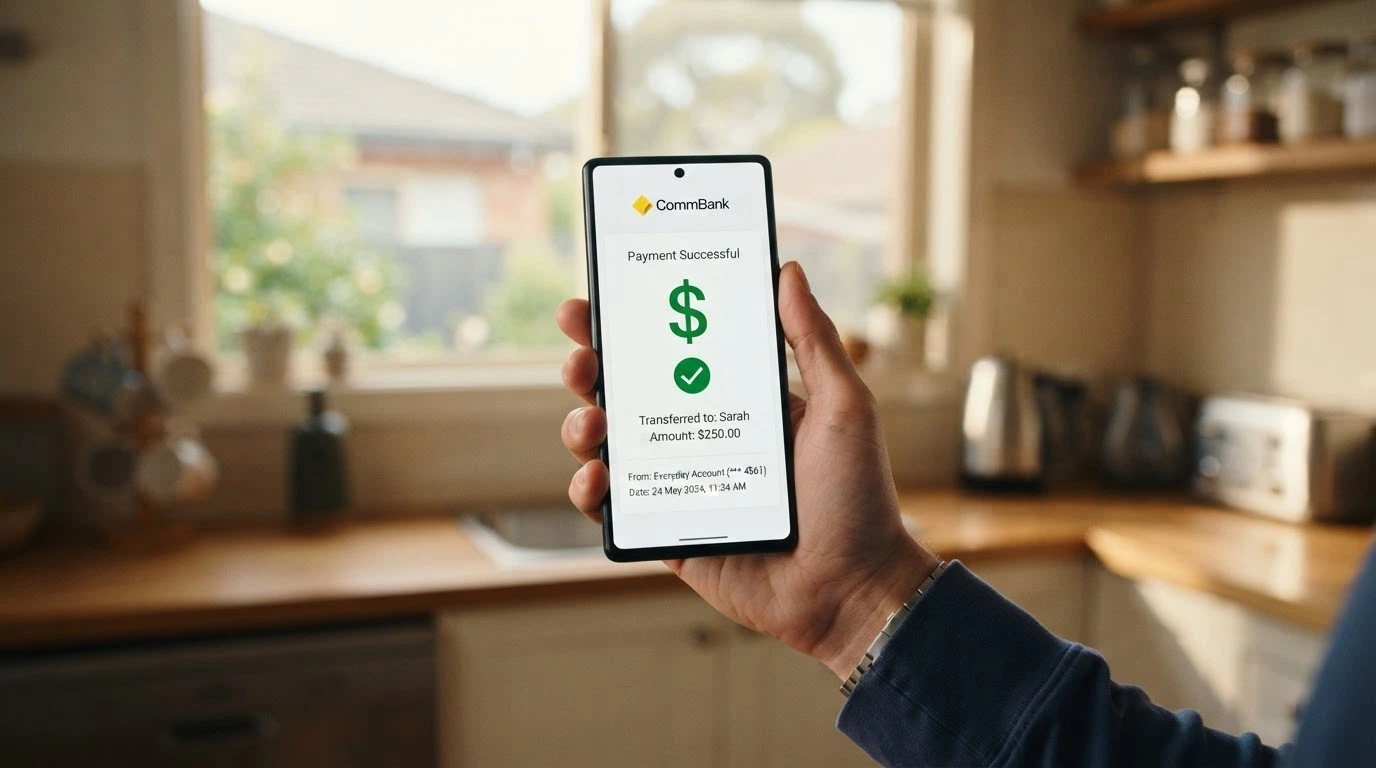
PayID is irrelevant for a no-deposit bonus. There is no deposit to make. The free chip lands on the bonus wallet with no banking rail attached to it. PayID becomes relevant the moment the player decides to fund the account — to claim a deposit-match bonus, to keep playing once the chip has cleared or been spent, or to play at an operator that does not run a chip programme at all. At that point PayID is the cleanest of the legal deposit routes for an Australian player, alongside debit card, direct bank transfer and BPAY. Credit cards and cryptocurrency are banned as payment for online wagering in Australia, which removes them from the licensed side and is the cleanest single tell that a casino asking for them is operating outside Australian rules.
The casino side of the transfer sits outside Australian rules no matter how clean the banking rail is. PayID clears the deposit. The casino is still Curaçao-licensed. The deposit is still at an offshore operator. The speed of the rail does not change the legal status of the recipient.
How PayID Works as a Casino Banking Method in Australia
The cashier at a PayID-accepting casino generates a PayID destination — usually a mobile number or email address, sometimes a unique ABN-style identifier. The player opens their bank app, enters the PayID and the A$10 amount, and confirms the transfer. The funds land in the casino account in seconds. The minimum PayID deposit at an AU-facing casino is in the A$10 to A$30 range, which places the rail squarely at the entry-level deposit tier for many AU-facing casinos.
The deposit rail is one-way for most operators. Royal Reels accepts PayID for deposits; PayID withdrawals are reserved for VIP players on a one-to-two-hour payout. Bizzo accepts PayID on both deposits and withdrawals. SkyCrown accepts PayID on deposits. Fairgo does not accept PayID at all. The other operators in the featured set have not confirmed PayID support at this level for the AUD-funded account path. A player set on a PayID round-trip — deposit and withdrawal on the same rail — has a short list to choose from.
PayID’s speed is the headline advantage. There is no card processing delay, no chargeback risk for the casino (which is partly why offshore operators adopt it) and no third-party processor in the middle. The casino knows the deposit will arrive and will not be reversed. For the player, the trade-off is that PayID deposits cannot be charged back through the bank the way a credit card deposit can — which is part of why the AU-side rules ban credit cards for online wagering.
From a $10 PayID Deposit to a Pokies Spin — The Real Funding Path
The A$10 lands. The casino credits the player’s account with the A$10 in real-money balance plus, where the welcome offer applies, the matched bonus funds. Royal Reels credits A$10 real plus A$10 bonus at the 100% match up to A$500. The bonus funds enter the wagering requirement, which is calculated against the bonus amount — A$10 at 35x is A$350 of required turnover before the bonus wallet converts to cash.
The wagering lock applies to both the bonus funds and, in most operators’ T&Cs, the real-money balance the deposit created — the player cannot withdraw the deposit until the bonus has cleared or been forfeited. The clock starts at deposit. A$5 max bet per spin while wagering is the standard cap. The bonus validity is the standard window — 7 days at most operators in the comparison, with the time running from the deposit date.
Withdrawal comes after the wagering clears. Royal Reels processes withdrawals within twenty-four hours of approval and pays approximately A$9,000 per day at the upper end. PayID payouts for VIP players can land within one to two hours. The same operators that take PayID on deposits do not all take PayID on withdrawals. A player who deposits A$10 via PayID and clears the bonus can still be paid through bank transfer, Visa, Skrill, Neteller or crypto — depending on the operator and the verification status.
Which Pokies Give Your $10 Bonus the Best Shot — RTP and Volatility in 2026
The eligible-games list matters as much as the wagering multiplier. A chip wagered through a high-house-edge pokie loses more of its expected value before the cashout threshold is reached. A chip wagered through a high-RTP pokie holds more of it. The list of pokies on the bonus is operator-specific, but the major studios in the featured set — Pragmatic Play, Play’n GO, NetEnt, BGaming, Hacksaw — carry enough overlap that a small set of titles covers most of the comparison.

Five pokies have verified RTPs from the research. Each one is a high-volatility title with the exception of Starburst. The table ranks them by RTP, the standard measure of how much of the wagered money a slot returns to players over the long run.
| Slot Title | Provider | RTP | Volatility | Max Win |
|---|---|---|---|---|
| Sweet Bonanza 1000 | Pragmatic Play | 96.53% | High | 25,000x |
| Sugar Rush 1000 | Pragmatic Play | 96.53% | High | 25,000x |
| Gates of Olympus 1000 | Pragmatic Play | 96.50% | High | 15,000x |
| Book of Dead | Play’n GO | 96.21% | High | 5,000x |
| Starburst | NetEnt | 96.09% | Low | ~500x |
The two highest-RTP titles in the table — Sweet Bonanza 1000 and Sugar Rush 1000 — share the same provider (Pragmatic Play), the same RTP to two decimal places and the same max win. Sugar Rush 1000 carries a slightly higher top-configuration RTP of 97.5% and a hit frequency of about 34.48%. Gates of Olympus 1000 sits one notch below them at 96.50%. Book of Dead is the standard Play’n GO high-volatility reference at 96.21% — note that lower RTP variants at 94% and 92% may exist in some configurations.
Starburst is the outlier on volatility. Low volatility means smaller wins, more often. For a A$10 chip on a 30x-to-60x wagering run, a low-volatility pokie is the safer grind — the bankroll survives longer, the wagering requirement is more likely to be cleared and the cashout threshold is more likely to be reached. The trade-off is the max win: ~500x the stake is the ceiling, where the high-volatility titles reach 5,000x or 25,000x. A small bonus bankroll trades upside for survival on Starburst, and most sessions on a A$10 chip end up better off taking that trade.
High-RTP Slots Worth Your Bonus Spins in 2026
The five titles in the table cover most of the eligible-games lists at the featured operators. Sweet Bonanza 1000, Sugar Rush 1000 and Gates of Olympus 1000 are Pragmatic Play’s 2026 flagship high-RTP cluster, all sitting at 96.50% or higher with high volatility and max wins between 15,000x and 25,000x. Book of Dead is the Play’n GO classic — older than the Pragmatic cluster by a decade, lower max win (5,000x), but a stable high-RTP option that has been on eligible-games lists since its 2016 release. Starburst is NetEnt’s 2012 low-volatility benchmark, the pokie a player picks when the wagering matters more than the upside.
For a A$10 chip with 30x to 60x wagering, the practical question is which pokie clears the requirement fastest. The high-volatility titles produce bigger wins when they hit but dry up faster on cold runs. A A$10 bankroll on Gates of Olympus 1000 will outlast a A$10 bankroll on Sugar Rush 1000 only if the variance cooperates. Starburst outlasts both, because the smaller, more frequent wins preserve the bankroll through the wagering grind.
For a player optimising for clearing the bonus, Starburst is the safer pick. For a player optimising for the cashout cap on the rare high-multiplier round, the Pragmatic cluster is the right address. The eligible-games list at the operator is the constraint; the operator’s T&Cs decide which of these five the player can actually play.
Pokies at New AU-Facing Casino Sites — What Changes
New casinos carry much the same provider catalogue as the established ones. Pragmatic Play and NetEnt’s libraries are licensed widely enough that almost every AU-facing operator offers them. Hacksaw and BGaming appear at the newer sites — Bizzo’s 8,000+ library includes both. A player moving from Royal Reels to Bizzo to SkyCrown is unlikely to find a new high-RTP pokie; they will find the same titles under a different roof.
What does change is the bonus structure. New casinos tend to run higher wagering requirements on their welcome offers, because the operator’s acquisition cost is the bonus and the operator has not yet built the player base to spread that cost across. Established operators can run lower wagering because the volume subsidises it. A player who picks a newer site for the catalogue is paying for the catalogue in the bonus terms.
What also changes is the ACMA-blocking cycle. New domains appear as old ones are blocked. The single largest blocking quarter on record — October to December 2025 — saw 133 websites blocked in three months, with the legal-reality section carrying the cumulative counts. New casinos appear at roughly the same rate old ones disappear. A player at a brand-new site in 2026 is playing on a domain whose address lifetime is uncertain, and the player takes that uncertainty on at the bonus-clearing stage of the cycle.
The Legal Reality — Are $10 Casino Bonuses Legal for Australian Players?
The short answer: providing them is illegal. Claiming them is not prosecuted. The longer answer is what the rest of this section covers.

The Interactive Gambling Act 2001 prohibits the provision of online casino games, online pokies and in-play sports betting to people in Australia. The prohibition sits on the operator, not the player. No Australian player has been prosecuted for claiming a $10 no-deposit bonus or playing at an offshore casino. ACMA’s enforcement work targets the operator side — the blocking requests, the civil penalty proceedings, the formal warnings to affiliate sites that market to Australian players.
What an Australian player forfeits by playing offshore is the set of consumer protections an Australian-licensed product would carry. BetStop’s coverage stops at licensed wagering — offshore casinos are not on the register, and an Australian self-excluded through BetStop can still deposit and play at any of the ten operators in this comparison. There is no AU-side complaint body to escalate a disputed withdrawal to. There is no AU-side deposit or loss ceiling. There is no AU-side enforcement of the bonus terms. The terms are whatever the operator published, and the only recourse is the operator’s own help desk. (The section on responsible gambling tools covers what BetStop’s gap means in practice.)
The 2026 reform is the layer that comes next. The Interactive Gambling Amendment (Gambling Reform) Bill 2026 passed Parliament on 19 August 2026; its measures commence 1 January 2027. Banks and payment providers gain express authority to block transactions to illegal gambling operators. Wagering advertising is restricted to three ads per hour between 6:00 am and 8:30 pm. Direct marketing of inducements is prohibited for 14 days after a customer signs up, for three months after a person deregisters from BetStop, and indefinitely for customers identified as at risk of gambling-related harm. The reform does not legalise online casino. It tightens the perimeter around the licensed side.
What the Interactive Gambling Act Actually Prohibits
The IGA’s section 15(2A) is the line. It prohibits providing an online casino, online pokies or in-play sports betting to a person in Australia. The prohibition is on the provision. The player side is governed by separate state and territory rules that do not, in practice, criminalise the player.
The carve-out that confuses the picture is licensed wagering. Races, pre-event sports betting, lotteries and keno are legal in Australia and licensed by the state and territory regulators. The Northern Territory Racing and Wagering Commission (NTRWC) acts as the de facto national online-wagering licensor; most of the licensed Australian bookmakers — the major TABs and corporate bookies — operate under NT-issued wagering licences. The product the licence covers is wagering, not casino. There is no Australian casino licence to hold, because the IGA prohibits the product the licence would cover.
Minimum age is 18 across all forms of commercial gambling in Australia. The IGA does not set a federal deposit or loss ceiling — there is no Australian federal rule that caps how much a player can deposit at an online casino, because there is no Australian online casino to cap. The licensed-wagering side carries its own customer-set deposit limits and activity-statement requirements under state and territory conditions. None of it extends to offshore casino.
Offshore Operators, ACMA Site Blocks and What They Mean for Your Money
ACMA has been issuing blocking requests against offshore casino and affiliate sites since November 2019. The mechanism is an ISP-level DNS block: the domain fails to resolve through Australian internet providers, and the player sees a “site cannot be reached” message rather than the casino’s homepage. The block does not take the casino down globally — it removes the address from Australian internet routing. The operator’s servers keep running. The operator’s other domains keep working.
By March 2026, ACMA had 1,564 illegal gambling and affiliate websites blocked. By June 2026, the running total had reached 1,751. The October–December 2025 quarter alone saw 133 sites blocked in three months — the largest single quarter on record. Over 225 services have voluntarily withdrawn from the Australian market since 2017, in advance of a blocking request. WinSpirit alone has lost four domains to ACMA in a single July 2025 sweep (the WinSpirit operator profile names the addresses).
What a blocked domain does to a player’s balance: nothing immediately. The account still exists. The balance still sits in the casino’s ledger. The player just cannot reach the casino through the blocked address. The operator’s support is supposed to point the player to a working domain. In practice the operator’s incentive is to keep the player funded, which usually means the working address is communicated promptly. The enforcement effect is on the player’s discovery path — a new player cannot find the casino through Australian search results, and a current player cannot reach it through the previously working address. It is not a takedown. It is an address.
Staying in Control When the House Is Offshore — Responsible Gambling for AU Players
The tools that exist for Australian players were designed for the licensed wagering side of the market. Offshore casino removes most of them.

The National Gambling Helpline (1800 858 858) is the universal resource — free, confidential, staffed 24 hours a day, seven days a week. Gambling Help Online carries online chat and counselling. Both are run for Australian residents regardless of where the player has been gambling. They are the place to start.
BetStop — the National Self-Exclusion Register — covers roughly 150 Australian-licensed online and phone wagering services. As at 31 July 2026, 67,480 people had registered, with 41,290 exclusions still active. 78% of registrants were under 40; 38% chose lifetime exclusion. BetStop does not extend to offshore casinos. A self-excluded player at an Australian-licensed bookmaker is also self-excluded at every other Australian-licensed bookmaker. The same player at an offshore casino has the same BetStop record but a normal account at every operator in this comparison.
Deposit limits at an offshore casino are an honour system with no regulatory backstop. The casino may publish a daily, weekly or monthly limit. The player may set a personal limit through the cashier. The casino is not required to enforce it. If the operator’s system does not trigger, the deposit goes through. There is no AU-side regulator to escalate to.
How Big the Problem Is — Gambling Harm Numbers in Australia
About 2.1% of Australian adults — roughly 430,000 people — experience problem gambling. The Australian Institute of Health and Welfare put high-risk gambling at 1.8% in its 2022 survey. Both numbers describe the licensed and unlicensed sides together; the breakdown is not separately reported, because the unlicensed side does not report.
78% of BetStop registrants are under 40. 38% chose lifetime exclusion. The skew toward younger adults is consistent across Australian gambling-harm data; the cohort most likely to use offshore casino products is also the cohort most likely to experience harm from them. The 2026 reform’s cooling-off periods — 14 days after sign-up, three months after BetStop deregistration, indefinitely for at-risk customers — are written for the same population.
The reform does not address offshore casino directly. The 14-day cooling-off on inducements applies to licensed Australian wagering operators; offshore operators are not bound by it. The reform’s payment-blocking authority — banks and payment providers gaining the power to block transactions to illegal gambling operators — is the indirect tool. A bank that sees a pattern of transfers to an offshore casino can decline them. The pattern is detectable through the bank’s own transaction monitoring. The mechanism exists; the deployment starts 1 January 2027.
BetStop, Helplines and the Tools That Actually Work
BetStop launched on 21 August 2023. The register excludes a person from every Australian-licensed online and phone wagering service simultaneously, through a single registration. Roughly 150 services are connected. As at 31 July 2026, 67,480 people had registered, with 41,290 exclusions active. Offshore casinos are not connected.
For a player who wants to self-exclude from offshore casino, the only available tool is the casino’s own self-exclusion feature. Most Curaçao-licensed operators offer some version of it. The feature does not propagate across operators. A player self-excluded at Royal Reels can still deposit at PlayCroco, at Ozwin, at Fairgo, at Stake. The only multi-operator tool that catches offshore casino is the player setting deposit limits at every operator they fund — an honour-system approach with the same enforcement gap.
The tools that work regardless of where the gambling happens are the helpline and the counselling service. 1800 858 858 is free and 24/7. Gambling Help Online runs online chat. Both are independent of any operator. Both are the right first call for a player who has realised the spend has gone past what they planned.
How We Picked and Ranked These $10 Bonus Casinos
Ten operators sit in the comparison, ranked by what an Australian player looking for a $10 bonus needs to know. The selection came from AU-facing casino affiliate pages (CasinosHub, Betzoid, MatesWin, PokiesAustralia, Slotozilla) cross-checked against the operators’ own terms pages. The ranking criteria were bonus availability at the A$10 level, wagering fairness (lower is better), max-cashout generosity, PayID support where it confirmed, ACMA enforcement history as a risk flag, and the depth of the provider catalogue.
The ranking is editorial. It is based on the published terms, the recent enforcement record, and the verification status of each claim against the Curaçao Gaming Authority register and the ACMA blocked-sites list. It does not include a hands-on test of any operator. The ranking is what the publicly available record supports, and the article states what the public record supports — including the cells it cannot fill.
SkyCrown’s Trustpilot score (1.5/5 from approximately 350 reviews) is the worst player-feedback score in the comparison and a published risk factor that the ranking reflects. WinSpirit’s four-domain blocking history (July 2025) is the deepest enforcement record in the comparison and a published risk factor. Fairgo’s 30x wagering is the most player-friendly chip terms in the comparison and a published benefit. Royal Reels’ A$200 max cashout on the A$10 chip is the highest in the comparison and a published benefit. Every cell that the table fills is what the research found. Every cell that the table leaves blank is what the research could not find at the level required to fill it.
The full featured set of ten is ranked regardless of whether a standing no-deposit bonus was confirmed. The article states what each operator actually offers. A player who arrives looking for a $10 chip will not find one at SkyCrown, Rocket Play, Stake or WinSpirit. The page tells them so and explains why the operator still earns a place in the comparison.
Is a $10 No-Deposit Casino Bonus Worth Your Time in 2026?
The honest verdict is that a $10 no-deposit bonus is a zero-cost way to test an AU-facing casino’s platform, pokies and cashier. It is not a reliable path to real cash. Treat it as a trial, not a bankroll strategy.
The best-case outcome is a clean wagering run on a low-volatility pokie, with the bonus wallet converting to A$50 to A$200 of withdrawable cash at the cashout threshold. That outcome requires the player to grind through A$300 to A$600 of turnover, survive the variance of high-RTP pokies, complete KYC verification on first withdrawal and have the operator honour the cap. Every step of that chain has a non-trivial failure rate.
The realistic outcome is the bonus funds exhausted by the wagering grind before the cashout threshold is reached. A $10 chip with 60x wagering requires A$600 in total bets. On a high-volatility pokie, A$600 of turnover burns through the bonus balance faster than the cashout cap suggests. The bonus expires in 7 to 14 days at most operators, and the clock runs whether or not the player is at the casino. Most chips expire before they convert.
The offshore risk is the layer underneath. Every operator in this comparison is Curaçao-licensed. None is AU-licensed. A blocked domain mid-session is a real possibility. A delayed or disputed withdrawal has no AU-side escalation path. A verification re-request that takes two weeks to clear has no AU-side complaint body to chase. The deposit rail — PayID or otherwise — is the cleanest part of the transaction. The casino at the other end of it sits outside Australian rules.
For a player with A$10 to spend and an hour to spend it, the no-deposit chip is worth claiming at the cheapest wagering in the set (Fairgo’s 30x). For a player with A$10 to spend and an afternoon to clear a bonus, the deposit-match path at Royal Reels (35x on the match, A$500 ceiling) is the cleaner value. For a player who would rather not deal with offshore friction at all, the licensed wagering side of the Australian market is the address — different product, different rules, no bonus chip in the welcome. Punter winnings from gambling are not assessable income under Australian tax law, but that is a small benefit next to the consumer-protection gap.
No operator in this comparison is picked as the recommendation. The page describes ten options. The decision is the reader’s.
Frequently Asked Questions
How much do I need to wager before I can withdraw winnings from a $10 free chip?
The wagering requirement at the featured operators runs from 30x to 60x the bonus. At 30x a $10 chip requires $300 in total bets; at 60x, $600. Only turnover on the bonus wallet counts. Wagering must clear before the bonus converts to cash, and most operators cap single bets at $5 while a bonus is active.
What is the most I can actually cash out from a $10 no-deposit casino bonus?
The maximum cashout at the featured operators runs from A$50 (Ozwin) to A$200 (Royal Reels). PlayCroco sits at A$180, Pokie Spins at $100, Bizzo’s spin package at A$75. Anything above the cap is voided on conversion. The cap covers bonus winnings only — your own deposit can be withdrawn separately once KYC clears.
Does BetStop protect me if I sign up to a casino with a $10 no-deposit bonus?
No. BetStop covers Australian-licensed online and phone wagering services only, and none of the ten casinos in this comparison is Australian-licensed. To self-exclude at an offshore casino you must use that operator’s own self-exclusion feature, which applies at that casino only and does not propagate across operators.
If I win big on a $10 free chip, can the casino refuse to hand over the money?
A casino can refuse payment that exceeds the published maximum cashout — that is the cap working as designed. Beyond the cap, the operator’s own terms govern. Disputes over bonus interpretation are handled by the operator’s support, with no AU-side complaint body. Treat the dispute path as the operator’s terms and nothing else.
Why do some $10 casino bonuses need a code typed in and others appear automatically?
Auto-credited bonuses (Royal Reels) trigger on a verifiable event like SMS verification and need no cashier input. Code-based bonuses (PlayCroco, Pokie Spins) need a coupon from an affiliate channel or the operator’s promotion page. Codes help the casino track and retire offers. Use a current code — an expired one produces an error at the cashier.
Are there restrictions on which games I can use a $10 no-deposit chip on?
Yes. Every operator publishes an eligible-games list, typically covering a subset of pokies while excluding table games, live casino and sometimes jackpot titles. Wagering on ineligible games usually does not count toward turnover and can void the bonus entirely. Read the T&Cs before claiming — especially for high-volatility titles, which operators may exclude.
Published by the Pokies Melbourne team.