
Best Casino in Canberra: What the ACT’s Only Casino Actually Offers
 Available in AU
“Best casino in Canberra” reads like a comparison question. It is not. Casino Canberra is the only casino in the Australian Capital Territory and has held the ACT’s sole casino licence since 23 December 2014. There is no second venue, no rival operator, and no expansion licence pending. A reader weighing the question is therefore choosing between one casino and the rest of what an ACT resident can actually gamble on — pokies in suburban pubs and clubs, the licensed wagering apps that reach Canberra punters, and the offshore casino sites whose ads keep showing up in the same search results despite being illegal to provide to Australians in the first place. This page works through Casino Canberra on its own terms: what the gaming floor actually offers, how the licence and the regulator work, what the building’s redevelopment history looks like, where the responsible-gambling help sits for a Canberra player, and why the offshore operators in the same search results carry no Australian protection at all.
Verified as of 18 October 2026 against the ACT Gambling and Racing Commission licence register.
Table of Contents
- Casino Canberra at a Glance: The Capital’s Only Casino
- Casino Canberra Reviewed: What the Capital’s Only Casino Gets Right
- Can You Play Casino Canberra Online? Why Online Casino Is Off the Table in Australia
- Is Casino Canberra Legal? How the ACT’s Casino Licence Works
- Staying Safe: Responsible Gambling Tools That Actually Work at Casino Canberra
- How We Reviewed Casino Canberra
- Should You Visit Casino Canberra? Our Verdict
- Frequently Asked Questions
Casino Canberra at a Glance: The Capital’s Only Casino
Canberra is unusual among Australian capital cities in having a single licensed casino rather than a flagship resort complex. Sydney has The Star, Melbourne has Crown, the Gold Coast has The Star, and Perth has Crown Burswood. Canberra has one venue, on one site, in the Civic precinct — and that is the entire licensed casino footprint of the ACT. What follows is a section-by-section walk through what the venue actually delivers: where it sits, what hours it keeps, who gets in, what is on the floor, what the on-site food and drink looks like, who owns the building, and where its own press releases have placed the word “potential” rather than “delivered”.
Location, Parking & Nearby Accommodation
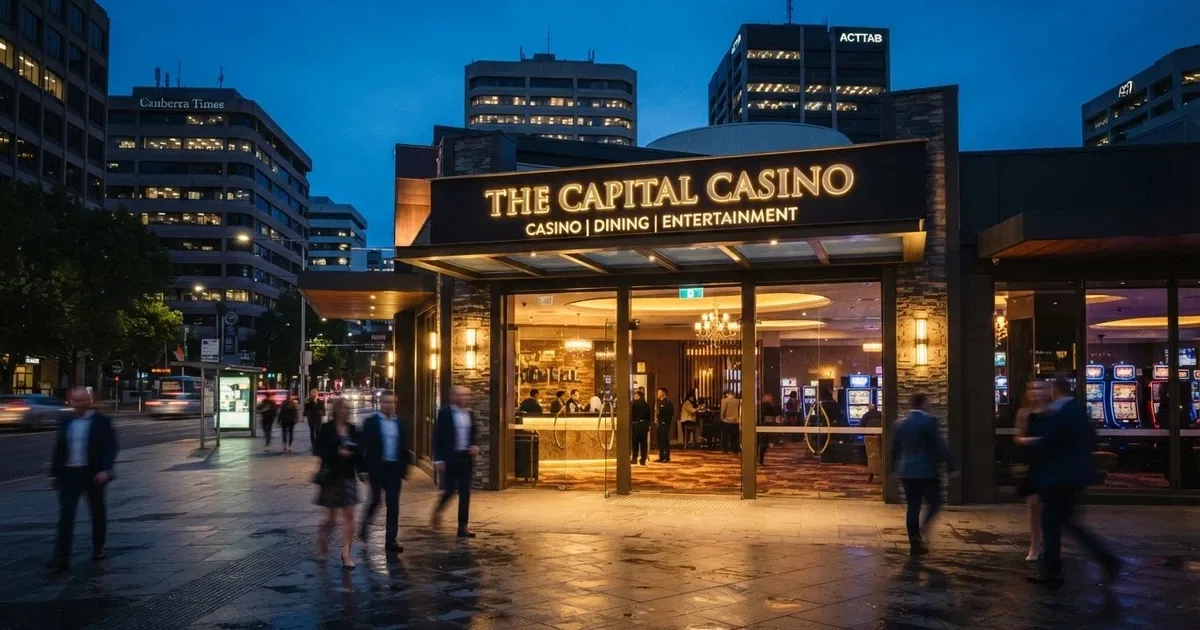
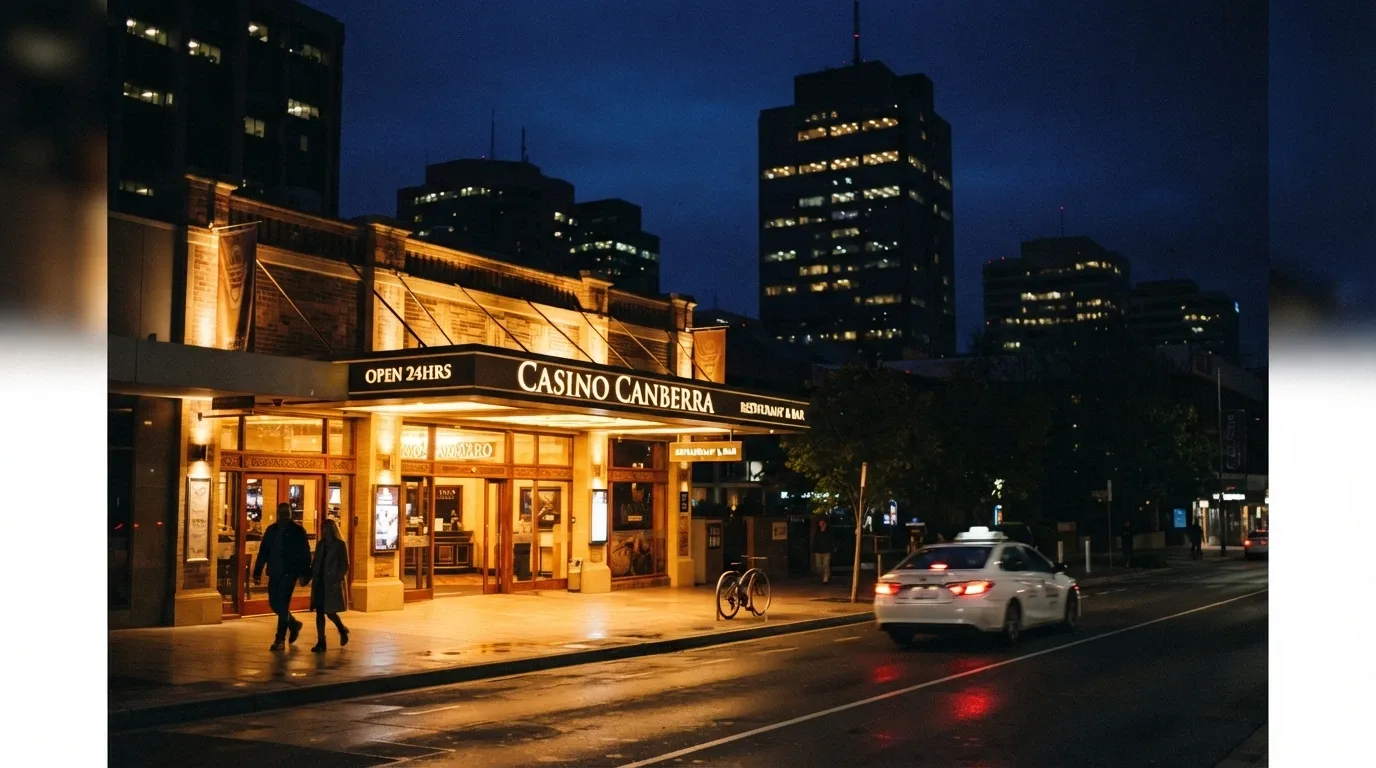
Casino Canberra sits at 21 Binara Street, Canberra ACT 2601 — in the Civic commercial centre, the same precinct as most of Canberra’s CBD office towers, the Canberra Centre shopping mall and the main bus interchanges. Civic is the part of the capital where after-work foot traffic already exists; the venue is not a tourist-belt destination reached by a dedicated shuttle, it is a working city centre that happens to contain a casino.
For visitors choosing where to stay, the closest hotel is the Crowne Plaza Canberra, located 50 metres from the venue according to booking listings. The Sebel Canberra Civic sits roughly 300 metres away, and the Novotel Canberra sits within easy walking distance. Anyone planning a night around a gaming session can effectively stay on the same block.

Parking in Civic is the usual Australian CBD mix: street meters, several commercial car parks within a short walk, and the Canberra Centre car park a few blocks south. The casino’s own site does not publish a validated or free parking scheme as a headline offer, and the on-site detail should be checked directly with the venue before driving in. Public transport is straightforward — Civic is the hub of Canberra’s bus network and is also walkable from anywhere in the CBD.
Entry Requirements: Photo ID, Age & What to Bring
The entry gate is a robust regulatory checkpoint worth understanding before walking up to it. Every guest must be at least 18 years of age, must present a valid form of photographic ID, and that ID will be scanned and verified against the ACTGED database — the ACT Government Exclusion Database, which carries the names of people who have self-excluded or been excluded from gambling venues in the territory. The scan is not a formality; it is a real-time check.
Acceptable forms of photo ID, as the venue publishes them, are: a current Australian Driver’s Licence or Learner Driver’s Permit with photograph; a current passport; or a Proof of Age card or equivalent issued by an Australian State or Territory. Digital IDs and screenshots of licences do not satisfy the requirement — the ID must be the physical document, current and unexpired, with a photograph that can be scanned.
A name that matches an ACTGED entry means the gate does not open, regardless of how a person feels about their own exclusion that day. The same rule catches people subject to third-party exclusion orders. For tourists and visitors, the scan works the same way: bring the passport, present it, and the check runs against the ACT’s database regardless of where the ID was issued.
Dress code is not heavily published. Casino Canberra, like most Australian casinos outside the resort tier, operates on a smart-casual baseline — neat, covered, closed shoes. The venue does not enforce a strict jacket-and-tie floor, but it does not welcome thongs, workwear, or singlets. Confirming the current standard on the day is sensible for any reader planning a first visit.
The Gaming Floor: Every Table Game at Casino Canberra
The main gaming floor hosts over 30 of the world’s most popular table games, with the list explicitly drawn from the venue’s own positioning: Blackjack, Baccarat, Roulette, Poker, Pai Gow, Money Wheel, Pontoon, Canberra Poker and a suite of electronic table games. Thirty tables in one venue is a real spread — large enough to keep multiple games running at peak, small enough that a visitor can walk the floor and read the room rather than getting lost in a resort maze.
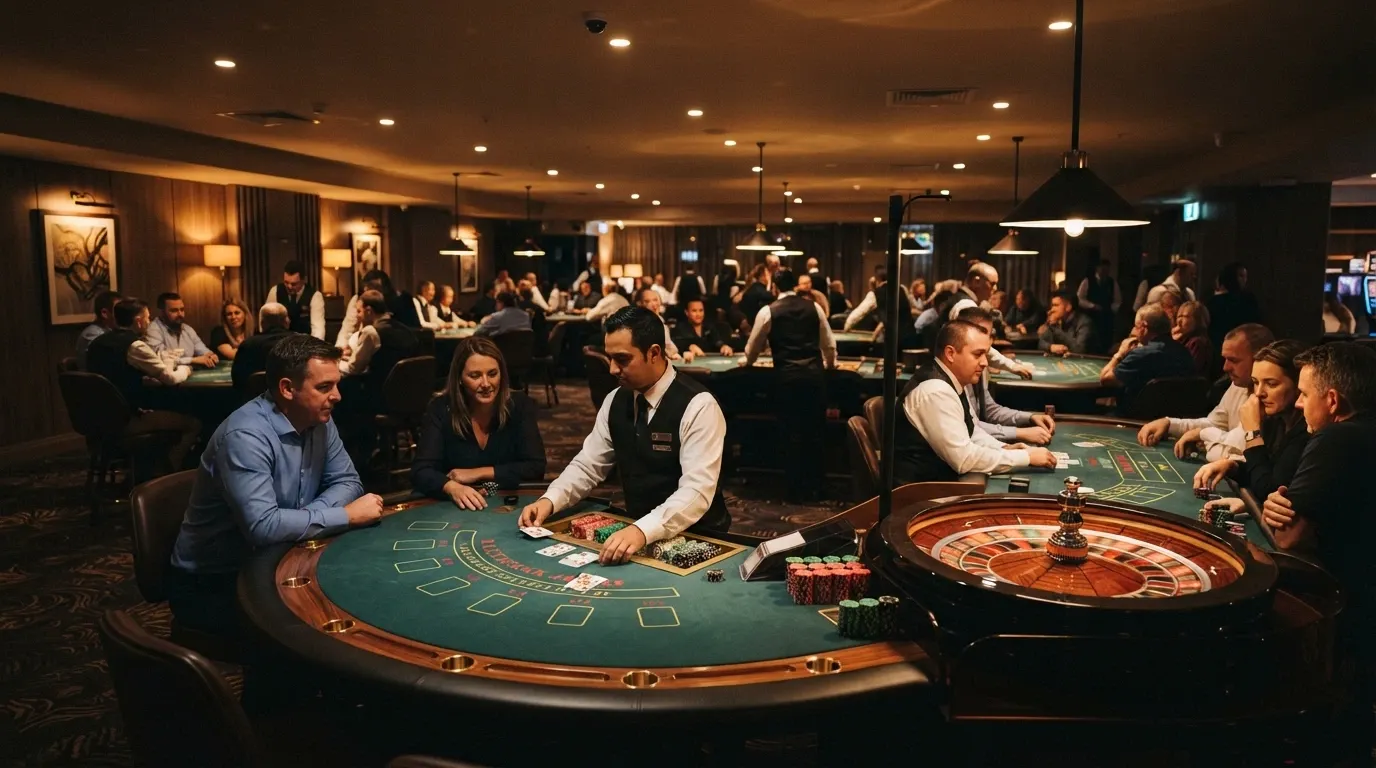
For first-time visitors, the practical reality is that table limits at Casino Canberra span the range an Australian player would expect — from low-stakes Blackjack and Roulette tables that suit a casual session through to higher-limit Baccarat and Pai Gow pits. The venue does not publish its minimum bets on a public-facing page; the actual floor minimums vary by game, by time of night, and by demand. Asking at the desk on arrival is the reliable move for anyone planning a session around a specific bankroll.
Dealers at Casino Canberra run under the ACT’s casino employee licensing regime (covered in detail later in the page), which means every dealer and every supervisor on the floor holds a current licence issued by the ACT Gambling and Racing Commission. That is a higher floor of accountability than a hotel poker night or a charity casino can offer, and it shows up in the quality of the dealing standard.
Canberra Poker: The Capital’s Own Game Variant
Casino Canberra features a branded poker variant, “Canberra Poker”, listed alongside Blackjack, Roulette and Baccarat on the main gaming floor. The venue has positioned it as a drawcard for visitors who want to play something the bigger Sydney and Melbourne floors do not run. The game’s full rules are not published in detail on the venue’s public site — what is published is the name and its place on the floor — so any player wanting to know how Canberra Poker differs from Texas Hold’em or from casino-stud variants should ask the floor staff on the day for the house rule card.
What a player can reasonably expect is a poker-style card game, dealer-led, played for table stakes, with rules structured to suit the house. Casino-branded variants almost always tweak hand rankings, side-bet structures, or qualifying rules to differentiate the game from the standard variants that players already know — that is the point of putting the venue’s name on the table. The “Canberra Poker” branding also gives the venue a marketing story for visitors who already play in Melbourne or Sydney: this is a game you cannot play at home.
Pokies & the Digital Gaming Stadium
Casino Canberra’s pokie footprint is smaller than the headline number suggests, and that is worth being precise about. When Aquis Entertainment took over the venue in 2014, it asked the ACT Government for approval to install 500 pokie machines on the floor. It was approved for 200 of the 500 — the smaller footprint is the regulatory outcome, not the operator’s ambition. Two hundred approved machines is a modest machine bank by Australian capital-city standards; a typical suburban pub or club can run more than that.
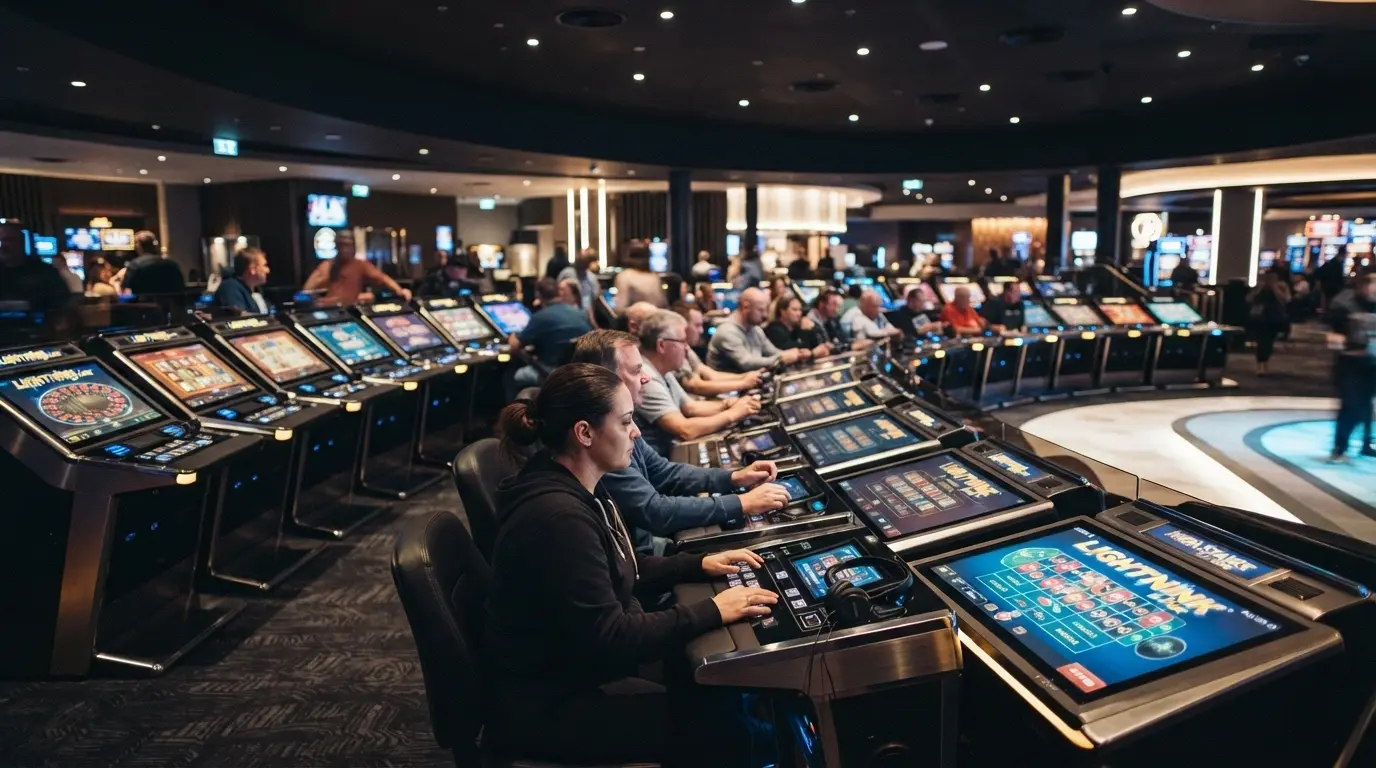
Alongside the physical pokies, the venue installed a 50-seat digital Multi Terminal gaming stadium — the centrepiece of the A$14 million remodel that followed the 2014 licensing. The stadium mixes electronic table games with screen-based pokie terminals, all of it run from a 50-seat bank rather than a wall of stand-alone machines. For players who prefer electronic play to dealer-led tables, the stadium is the venue’s answer.
The ACT regulates the return-to-player floor on its gaming machines, and any pokies operating under the ACT licence must meet the published standard. Casino Canberra does not publish per-title RTP figures on its site — that is normal for Australian venues — so a player picking a machine is choosing on theme and bet size rather than on disclosed mathematics. Anyone who wants to know what they are actually playing against needs to treat the venue’s machine selection as a black box.
Dining at Natural 9
Natural 9 is Casino Canberra’s signature on-site restaurant. The venue’s own positioning frames it as the dining anchor of the casino floor — the place that justifies a non-gambler coming along for a meal rather than a session. What the venue publishes about Natural 9’s offering is limited: the name, its position inside the building, and the general sense that it is the restaurant of the casino rather than one restaurant among several. Specific menu detail, pricing tier and dish-by-dish coverage are not on the public site, which means a reader planning a meal around a gaming session should book ahead and confirm the menu on the day.

Crucially, Natural 9 is open to non-gamblers. That matters because a number of Australian casino venues run their signature restaurants on a “patrons only” basis, with a separate entrance and a separate sign-in. Casino Canberra’s positioning on dining is that the restaurant is a destination in its own right. Visitors who want to eat there without intending to gamble should still bring photo ID, because the entry gate operates regardless of whether a guest’s purpose is food or gaming.
Bars & Nightlife: Chandelier Bar, Onyx Lounge & The Lotus Room
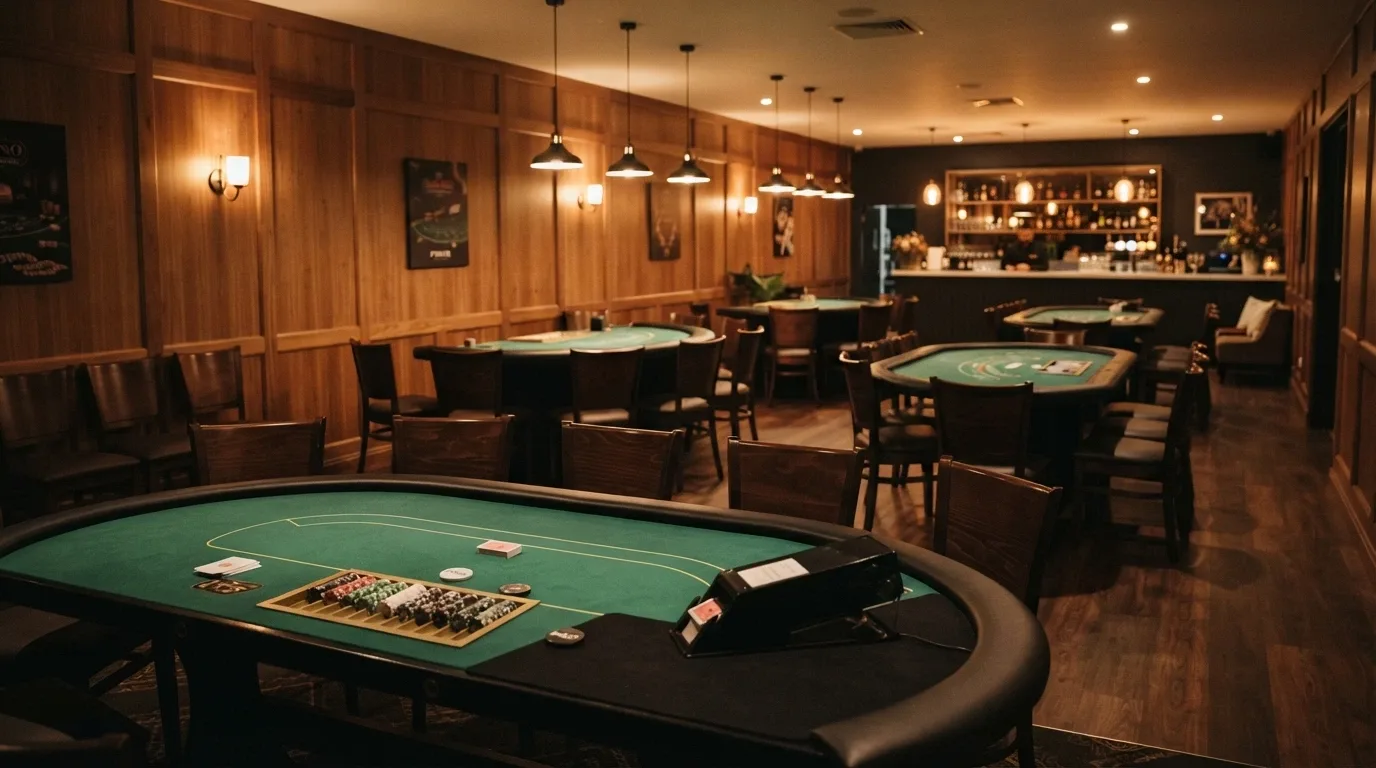
Three distinct drinking spaces anchor the venue’s after-dark offering, each positioned for a different kind of night. The Chandelier Bar takes the headline slot — its name comes from the chandelier that sits over the bar counter, and it functions as the casino’s main lounge bar, the place most visitors encounter first when they walk off the floor. The Onyx Lounge is positioned as the more intimate of the three, a darker, lower-volume space for a quieter drink or a meeting point before moving on to the floor. The Lotus Room doubles as the venue’s dedicated poker parlour and sports bar — it is where televised sport plays and where the poker crowd gathers, so it carries a noticeably different energy from the Chandelier Bar.

Drink prices, cocktail menus and per-bar opening hours are not broken out on the public site. Treat the three bars as a tiered nightlife offering: the Chandelier Bar for atmosphere, the Onyx Lounge for a quieter drink, the Lotus Room for sport and poker. None of the three is restricted to gamblers on a member-only basis.
Infinity Rewards: The Loyalty Program
Casino Canberra runs a loyalty program called Infinity Rewards. The venue publishes the program’s name on its site and runs it through a membership-and-promotions structure common to Australian casinos — sign up, accumulate points on rated play, redeem those points for venue benefits. Beyond the program’s name, the venue’s own published detail on tier structure, earn rates and specific rewards is thin. Members sign up through the venue, and the program’s terms — including the point-earning rate on table games versus pokies, the tier thresholds, and the rewards on offer — sit in the program’s own T&Cs rather than on the public marketing pages.
For a regular visitor, the practical value of Infinity Rewards depends on rated play volume: a player who visits a few times a year for a casual session will accumulate points slowly, while a player who plays rated tables regularly will move through the tier structure faster. Anyone considering signing up should read the program’s published T&Cs for the earn rates and the redemption terms, because those terms are the actual deal — not the marketing framing.
Private Functions, Events & The Lotus Room
The Lotus Room is also a bookable private-gaming venue: the venue’s own positioning describes it as a space for private gaming functions tailored to fit any event or party. That covers corporate end-of-year gatherings, birthday and celebration nights, and bespoke poker tournaments that the casino runs as private events rather than on the public floor. Booking goes through the venue’s functions team, and the floor configurations — gaming tables, seating, AV, food and drink — are set up for the specific event rather than off a fixed package.
The venue also runs an entertainment calendar — live acts, themed nights, sporting-event broadcasts — but specific event listings for 2026 are not published as a standing feature of the public site. Anyone planning around a specific show should check the venue’s events page directly for the current calendar.
Who Owns Casino Canberra? From Aquis to Iris Capital
The ownership trail is the part of the venue’s history that does the most work to explain why Casino Canberra looks the way it does. On 23 December 2014, Aquis Canberra Pty Ltd was issued the ACT’s casino licence under section 22 of the Casino Control Act 2006 — a fresh licence issued to a fresh operator, replacing the previous licensee. Aquis Entertainment, the parent group, then invested A$14 million to completely remodel the venue inside and out, including the 50-seat digital Multi Terminal gaming stadium, brand-new gaming tables, and the refreshed Chandelier Bar and Onyx Lounge.
Then came the redevelopment proposal. Aquis lodged a A$307 million redevelopment request with the ACT Government that promised 100 five-star hotel rooms, 12 six-star luxury villa-style accommodation, luxury retail, world-class food and beverage, and 200 full-time jobs once operational. The proposal’s own press language placed the word “potential” in front of the venue having “a space worthy of the nation’s capital”. A separate quote from the same period talked of “revitalising the southern part of Civic and creating that vibrancy that is lacking here”. The proposal is still a proposal — the venue remains a single-floor operation, and no hotel or villa component has been delivered on the Binara Street site. The promised 200 full-time jobs did not eventuate on the redevelopment timeline because the redevelopment did not proceed.
Aquis’s ownership of the licence later transferred to Iris Capital, and Casino Canberra now operates as part of the Iris Capital group. The A$14 million remodel is the visible legacy of the Aquis years; the A$307 million redevelopment is the legacy’s missing piece. For a reader trying to read the venue’s ambitions, the gap between the two numbers — A$14 million delivered against A$307 million proposed — is the story.
Casino Canberra Reviewed: What the Capital’s Only Casino Gets Right
A review of a single venue reads differently from a review of ten. There is no “compared with Operator B” row in the comparison table because there is no Operator B. What a review can do is hold Casino Canberra against what an Australian player reasonably expects from a capital-city casino licence — and against the bigger resort venues a Canberra visitor might have already played at in Sydney or Melbourne. That is the frame for the rest of this section.
Casino Canberra at a Glance
The key facts in one row:
| Field | Detail |
|---|---|
| Licence | ACT casino licence issued 23 December 2014 to Aquis Canberra Pty Ltd under section 22 of the Casino Control Act 2006 |
| Current owner | Iris Capital |
| Address | 21 Binara Street, Canberra ACT 2601 |
| Hours | 12 pm – 4 am daily |
| Entry | 18+, valid photo ID scanned against the ACTGED database |
| Table games | 30+ — Blackjack, Baccarat, Roulette, Poker, Pai Gow, Money Wheel, Pontoon, Canberra Poker, electronic table games |
| Pokies | 200 approved (of 500 requested) |
| Digital gaming | 50-seat digital Multi Terminal gaming stadium |
| Restaurant | Natural 9 |
| Bars | Chandelier Bar, Onyx Lounge, The Lotus Room |
| Loyalty program | Infinity Rewards |
| Self-exclusion | ACT self-exclusion program, 6 months – 3 years |
| Aquis-era remodel | A$14 million |
The Gaming Experience: Atmosphere, Service & What Players Say
The single-floor footprint shapes the experience in a way the table count alone does not capture. A venue running 30-plus tables across Blackjack, Baccarat, Roulette, Poker, Pai Gow, Money Wheel, Pontoon and the Canberra Poker variant does not need a corridor map. The floor is one room. A visitor can be at the Roulette wheel and the bar in roughly the same number of steps as it takes to walk off an escalator at a resort venue.
VisitCanberra’s tourism listing aggregates 61 visitor reviews of the venue, and the consistent tone of those reviews is what an Australian CBD casino delivers: accessible, professional dealing, walkable from the surrounding hotels, and not the “resort experience” the bigger capitals sell. That is a fair summary of the floor. Where the reviews are softer is on the venue’s scale — the comments do not pretend Casino Canberra is a Crown or a Star, and they are right not to.
Service quality on the floor is shaped by the licensing regime every dealer and supervisor works under. Section 41 of the Casino Control Act 2006 requires every employee on the gaming floor to hold a current licence issued by the ACT Gambling and Racing Commission, and that licence carries a maximum validity of six months with no renewal — meaning every employee on the floor has been re-vetted inside the past half-year. That is a tighter cycle than most hospitality workforces run under, and it shows up in how the floor is staffed.
The honest criticism that recurs across the venue’s positioning and its visitor reviews is the trade-off a single-floor operation makes. There is no hotel tower, no concert arena, no day spa, and no resort pool. A reader who wants those things should be looking at Crown Melbourne or The Star Sydney, not at Casino Canberra. A reader who wants a working capital-city casino with the full suite of table games, a usable pokies floor and a central location will get exactly what they came for.
How Casino Canberra Compares to Australia’s Casino Capitals
Crown Melbourne runs roughly 2,500 gaming machines and around 540 table games across a complex that includes three hotels, a concert arena, dozens of restaurants and a resort pool. The Star Sydney runs around 1,500 machines and around 200 table games inside a Pyrmont complex that includes two hotels, a spa and multiple signature restaurants. Crown Perth runs on a comparable scale in Burswood. Casino Canberra runs 200 approved pokie machines and 30-plus tables inside a single-floor Civic building with one restaurant and three bars.
The scale gap is not subtle. A Canberra player who has spent an evening at Crown or The Star will walk into Casino Canberra and feel the difference on the first turn of the floor. The Star’s gaming floor alone covers more square metres than Casino Canberra’s entire footprint, and Crown Melbourne’s complex is several times that again.
What Canberra does that those venues do not is proximity to a working CBD and to the federal government. A public servant finishing work in Civic can be at the gaming floor inside a few minutes’ walk. A Sydney or Melbourne visitor who wants a casino session has to plan around a venue that sits apart from where they actually live and work. The Capital’s single casino being in the commercial centre of the city rather than on its fringe is a structural advantage the bigger venues cannot replicate.
The other thing Casino Canberra does not have to compete on is the hotel-and-entertainment bundle. Resort casinos sell a complete night out as a package. Casino Canberra sells a gaming session, plus a meal, plus a few bars. The trade-off is honest: a visitor to Casino Canberra gets a focused gaming experience without paying for an entertainment tower they were not going to use.
Can You Play Casino Canberra Online? Why Online Casino Is Off the Table in Australia
Online casino games, online pokies and in-play sports betting are prohibited in Australia under the Interactive Gambling Act 2001. There is no federal licence for an online casino anywhere in the country, no ACT licence for one, and no Casino Canberra-branded online gaming product of any kind. The casino is, and has always been, a land-based venue. The “online” in the same search results as Casino Canberra is the offshore product — and it is illegal for the offshore operator to offer it to a person in Australia, even though the same operator will take an Australian deposit and run an Australian player’s bets without asking where they sit.
The Australian Communications and Media Authority, ACMA, enforces the federal prohibition. It investigates complaints, issues formal warnings, runs civil penalty proceedings, and can direct Australian internet service providers to block illegal sites. Since November 2019, ACMA has had 1,564 illegal gambling and affiliate websites blocked by Australian ISPs. More than 225 illegal services have withdrawn from the Australian market since 2017. That is what “enforcement” has looked like, and the next round of enforcement starts on 1 January 2027.
The Reality of Online Gambling in Australia: What the IGA Actually Prohibits
The Interactive Gambling Act 2001, strengthened by the Interactive Gambling Amendment Act 2017, makes it an offence to provide online casino games, online pokies (slots) or in-play sports betting to a person physically in Australia. The law targets the provider, not the player — Australian individuals are not prosecuted for placing a bet with an offshore site. What the law does do is give ACMA the authority to investigate, fine and block those providers.
What the IGA does not prohibit is wagering on a race or sporting event placed before the event begins. Pre-event wagering through a licensed Australian operator — SportsBet, TAB, Bet365, Ladbrokes, TABtouch, Neds, PointsBet and others — is legal, and those operators reach ACT residents through their apps. Lotteries and keno are also legal and are run by licensed state and territory operators.
The penalty structure for a provider caught breaching the prohibition is civil rather than criminal, but the numbers are not small. An operator that fails to enforce the credit-and-crypto payment ban faces penalties of up to A$247,500 per breach. ACMA can also seek broader injunctions, refer operators for criminal investigation, and direct ISPs to block the offending service.
What all of that means for a Canberra player is straightforward: a casino website offering pokies or table games to Australian customers is operating illegally. The fact that the site accepts an Australian credit card and pays out in Australian dollars does not change that. The IGA’s prohibition is on the supply of the product, and that prohibition is enforced.
Offshore Casino Sites: What Canberra Players Risk When They Sign Up
Rocket Play, Skycrown, Royal Reels and Stake are four of the offshore casino brands that hold significant Australian traffic despite offering a product that is illegal to provide here. Rocket Play’s AU traffic share is around 9.4%, Skycrown’s around 8.55%, Royal Reels around 2.51% and Stake around 1.28%. Those numbers are not endorsement — they are the fact of an illegal market operating in plain sight of the search results.
None of these brands holds an Australian licence of any kind. They are not on the ACT Gambling and Racing Commission’s register, they are not registered with the Northern Territory Racing and Wasting Commission, and they are not bound by Australian consumer law. The single biggest practical consequence is what they cannot offer: no BetStop coverage, no ACMA complaint pathway, no Australian-licensed complaints body, no enforceable withdrawal guarantee, and no guarantee the site will exist in six months. ACMA can direct ISPs to block the site, and the site’s balance goes with it. A blocked site does not return a player’s money.
The second consequence is the payment pathway. From 11 June 2024, credit cards, credit-related products and digital currency are banned as payment for online wagering in Australia under the Interactive Gambling Amendment (Credit and Other Measures) Act 2023. That ban applies to licensed operators. An offshore site that accepts a credit card or crypto from an Australian customer is doing so in violation of the same law the licensed operators are bound by, and the penalty for non-compliance — A$247,500 per breach — is the operator’s risk, not the player’s protection. From 1 January 2027, banks and payment providers gain express statutory authority to block transactions to illegal gambling operators, which will tighten the payment pipeline further.
A player who wants to chase a casino game from home in Canberra has three honest options: drive to Casino Canberra, play the licensed wagering apps that cover sports and racing, or stop gambling. The fourth option — opening an account with an offshore casino — is the option that costs the player every protection the licensed market provides.
The 2026 Gambling Reform: What Changes in January 2026
The Interactive Gambling Amendment (Gambling Reform) Bill 2026 passed Parliament on 19 August 2026, and its measures commence on 1 January 2027. The bill layers new rules onto the existing IGA framework, and the changes are large enough to reshape how wagering advertising and payments work in Australia.
The advertising rules are the most visible change. From 1 January 2027, no more than three wagering ads per hour may run between 6:00 am and 8:30 pm across television, radio and online. A live-sport blackout runs from 15 minutes before a live sporting event begins until 5 minutes after it ends, so the live broadcast window does not carry wagering ads. Radio wagering advertising is barred during school hours. Broadcasting odds is banned. Online wagering ads may only be shown to logged-in users who have verified they are over 18. Wagering advertising is prohibited in venues and on uniforms, and athletes, celebrities and influencers are barred from promoting wagering brands.
The inducement rules sit alongside the advertising caps. Wagering operators are prohibited from offering inducement marketing for 14 days after a customer signs up, for three months after a customer deregisters from BetStop, and indefinitely for any customer the operator has identified as at risk. A “Bet Bonus” or a “Deposit Match” sent within the first fortnight of a new account is now a prohibited inducement, not a marketing tool.
The payment rules are the most consequential change for offshore operators specifically. From 1 January 2027, banks and payment providers gain express statutory authority to block transactions to illegal gambling operators. Combined with the existing ban on credit and crypto payments that has been in force since June 2024, the practical effect is that the legal payment pipeline to offshore casinos — already narrow — narrows further. The licensed wagering market continues to take debit cards, PayID, BPAY and bank transfer, and the credit/crypto ban stops there too.
For Casino Canberra specifically, the reform changes nothing about the land-based operation: the venue is licensed, regulated and offline. What it does is reshape the surrounding market — the wagering ads a Canberra resident sees on their phone, the inducements that try to pull a punter back to a wagering app after a self-exclusion, and the offshore operators trying to run an Australian deposit through a credit card or crypto wallet.
Is Casino Canberra Legal? How the ACT’s Casino Licence Works
Casino Canberra is fully licensed under the Casino Control Act 2006 and regulated by the ACT Gambling and Racing Commission. The licence was issued to Aquis Canberra Pty Ltd on 23 December 2014 pursuant to section 22 of the Act, and the licence remains in force under the current ownership structure. The Act, the regulator and the licensing rules together form the legal scaffolding the venue operates under, and they are the reason every dealer on the floor, every guest at the gate, and every machine on the floor is covered by enforceable ACT standards.

The Casino Control Act 2006: The Law Behind the Licence
| Regulatory Fact | Detail |
|---|---|
| Statute | Casino Control Act 2006 |
| Licence issued | 23 December 2014 |
| Licensee | Aquis Canberra Pty Ltd |
| Regulator | ACT Gambling and Racing Commission |
| Employee licence | Section 41 (6-month validity) |
The Casino Control Act 2006 is the ACT statute that governs every aspect of Casino Canberra’s operation — the licence-issuance process, the probity checks on the licensee and its key people, the operational standards the venue must meet, the harm-minimisation obligations the venue carries, and the employee-licensing regime that runs through the venue’s workforce. The Act is the legal reason a Casino Canberra dealer is not the same as a hospitality worker in any other setting in Canberra; the Act is the reason the gaming floor is auditable; and the Act is the reason the regulator can discipline the venue if it falls short.
Section 22 of the Act is the provision under which the licence was issued on 23 December 2014. Section 41 is the provision that requires every employee working at the casino to hold a current licence. Other sections of the Act cover responsible-gambling obligations, advertising restrictions, the handling of loyalty programs and inducements, the segregation of player funds, and the regulator’s investigative and disciplinary powers. The full text of the Act is published on the ACT Legislation Register, and it is worth reading for any reader who wants to understand what the licence actually obligates the operator to do.
Compared with other state casino statutes — the Casino Control Act 1991 in Victoria, the Casino Control Act 1992 in New South Wales — the ACT Act is shorter, newer and scoped to a single-venue jurisdiction. It does the same job: it sets probity, operational and harm-minimisation standards, and it backs those standards with enforceable regulator powers.
The ACT Gambling and Racing Commission: Who Regulates Casino Canberra
The ACT Gambling and Racing Commission is the ACT Government body that issued Casino Canberra’s licence, monitors the venue’s compliance with the Casino Control Act 2006, and disciplines the operator if it falls short. The Commission is the land-based casino regulator; ACMA, covered earlier, is the federal online-gambling regulator. The two do different jobs and enforce different statutes, and the boundary between them is straightforward: ACMA enforces the Interactive Gambling Act 2001 against offshore and illegal operators; the Commission enforces the Casino Control Act 2006 against Casino Canberra.
The Commission’s published remit covers compliance monitoring, complaints handling, licence-condition enforcement and probity oversight of the licensee. A player who has a complaint about Casino Canberra’s conduct — a refused withdrawal, a dispute over a loyalty-program term, an issue at the entry gate — has an Australian regulator to escalate the complaint to. That is not the same complaint pathway a player at an offshore casino has, because an offshore casino is not on the Commission’s register and not subject to the Act.
The Commission also publishes the casino licence register publicly, and the register confirms that Aquis Canberra Pty Ltd is the named licensee. Anyone can check the register directly to confirm that the venue they are walking into is the venue the Commission regulates.
Entry Rules: Age, ID & Who Gets Turned Away
The entry gate is the most regulator-visible part of the venue, and the rules are detailed earlier on this page in the entry requirements section. In summary: every guest must be 18 or older; every guest must present a valid form of photographic ID (Australian Driver’s Licence or Learner Permit with photograph, current passport, or Proof of Age card issued by an Australian State or Territory); that ID is scanned and verified against the ACTGED database — the ACT Government Exclusion Database — and a name that matches an exclusion means the gate does not open.
The ACTGED covers both self-excluded persons and persons subject to third-party exclusion orders. A self-exclusion registered under the ACT program (covered in detail in the responsible-gambling section that follows) is the most common reason a name appears in the database. A third-party exclusion order is rarer and is typically issued in circumstances involving harm to others. Either way, the entry gate is where the database check lands.
The entry gate does not waive the ID requirement for any class of guest. Members of the Infinity Rewards loyalty program still present ID on entry — membership is not a substitute for the ACTGED check. The ID requirement applies regardless of how often a guest has visited, and the venue’s staff do not have discretion to waive the scan on a case-by-case basis.
Casino Employee Licensing: Who Can Work the Floor
Section 41 of the Casino Control Act 2006 requires every person working at Casino Canberra — dealers, supervisors, surveillance officers, management, count-room staff — to hold a current licence issued by the ACT Gambling and Racing Commission. The licence carries a maximum validity of six months and may not be renewed; at the end of each six-month cycle the employee must apply for a fresh licence. Applicants must be at least 18 years of age to be eligible.
The six-month cycle is the part of the regime that distinguishes it from a hospitality working-with-children check or a standard police check. A Casino Canberra dealer working the Blackjack pit tonight was re-vetted by the regulator within the past half-year, and the regulator can refuse to reissue the licence if the employee’s probity has changed. That is the structural reason a casino floor under section 41 is not the same working environment as a pub or a club gaming room — the floor is licensed, the cycle is short, and the regulator has direct visibility into who is working.
For a player, the practical consequence is the floor’s professionalism. The dealer dealing your hand has passed a regulator-issued probity check inside the past six months, has been trained on the venue’s house rules, and is operating under the venue’s licence conditions. That is not a guarantee of any individual outcome, but it is the floor’s actual standard.
Staying Safe: Responsible Gambling Tools That Actually Work at Casino Canberra
Casino Canberra sits inside the ACT’s harm-minimisation framework, and the framework is layered: the venue carries its own self-exclusion program, the national BetStop register covers online and phone wagering (not land-based casinos), and the ACT Government publishes the help services that take calls 24 hours a day. The harm-minimisation story a reader needs to understand is that each tool does a different job, none of them does all of them, and a player who wants a complete safety net needs to know which tool covers what.
Self-Exclusion at Casino Canberra: How It Works
The ACT self-exclusion program allows a person to exclude themselves from Casino Canberra for a defined period ranging from six months to three years. The exclusion is registered with the ACT Government, the registrant’s name is added to the ACTGED database, and the entry gate’s ACTGED scan reads that database on every visit — meaning a self-excluded person cannot walk in even if they want to. The registration also cuts off venue marketing: the venue will not send promotional material to a self-excluded person’s address or email during the exclusion period.
The registration process itself goes through the ACT Government’s responsible-gambling channels. A person who wants to self-exclude does not need to declare it at the casino; the process happens outside the venue, the database is updated, and the venue’s gate does the rest. The minimum exclusion period is six months — there is no “24-hour cooling-off” option — and the maximum is three years. After the exclusion period expires, the person’s name is removed from the ACTGED and the venue is no longer obliged to refuse entry.
What self-exclusion does not do is cover every other form of gambling a Canberra resident might use. It covers Casino Canberra only. It does not cover the licensed wagering apps — those are covered by BetStop, covered in the next section. It does not cover the pokies in suburban pubs and clubs — those venues run their own self-exclusion arrangements. It does not cover offshore online casinos — those are not bound by the ACT program at all. A player who wants a comprehensive exclusion needs to register with each layer separately.
BetStop: The National Self-Exclusion Register — and What It Does Not Cover
BetStop is the National Self-Exclusion Register, run federally by ACMA, and it launched on 21 August 2023. One registration with BetStop excludes a person from every Australian-licensed online and phone wagering service in a single step — no need to contact SportsBet, TAB, Bet365, Ladbrokes, TABtouch, Neds and PointsBet individually. As of 31 July 2026, BetStop had 67,480 total registrations and 41,290 active exclusions. Seventy-eight per cent of registrants are aged under 40; thirty-eight per cent chose a lifetime exclusion.
The earlier reference point sits at the end of March 2026, when 37,247 people held active exclusions — meaning the register grew by roughly 4,000 active exclusions in a single quarter. That growth tells its own story about the demand for a single, federal self-exclusion tool, and it tells it before the marketing reforms scheduled for January 2027 add the three-month post-deregistration inducement ban.
The critical limitation is the one a Canberra player needs to know before relying on BetStop alone. BetStop binds Australian-licensed wagering services only. It does not bind Casino Canberra, because Casino Canberra is a land-based venue and is licensed under the ACT’s Casino Control Act, not under the federal wagering framework. It does not bind offshore online casinos, because those casinos hold no Australian licence of any kind. A BetStop registration excludes a player from the licensed wagering apps — that is real and useful protection — but it does not stop the same player from walking into Casino Canberra or from placing a bet with an offshore casino that has never heard of BetStop. Comprehensive exclusion means registering at every layer.
Gambling Harm in Australia: The Numbers Behind the Problem
The Australian gambling-harm figures for the 12 months to March 2026 give a player a sense of what the safeguards are working against. Australians lost A$36.0 billion to gambling in that 12-month window, up by close to A$1.7 billion on the A$34.3 billion lost in the 12 months to March 2025. Roy Morgan’s research puts 13.0% of the Australian population — an estimated 2,857,000 people — as experiencing some form of gambling harm from their own gambling behaviours. Another 5.4% — around 1,177,000 people — are experiencing harm from other people’s gambling. Combined, the affected-other-and-own figure sits at roughly 3.29 million Australians aged five and over, including approximately 1.38 million adult affected others.
The narrower clinical category is smaller but more acute. About 2.1% of Australian adults — roughly 430,000 people — experience problem gambling. The Australian Institute of Health and Welfare put high-risk gambling at 1.8% in 2022, which is consistent with the same population of adults carrying the heaviest burden. The health impact is measured in Years Lived with Disability, and the model puts the annual health loss associated with gambling-related harm in Australian adults at over 400,000 YLDs.
Those figures matter for two reasons. They tell a player who is starting to worry about their own gambling that the affected population is not small — 2.1% of adults is one in fifty, not one in a million. They also tell the same player that the help services listed in the next section are built for the scale of the problem, not as a token gesture.
Where to Get Help: Helplines, Counselling & Online Support
The single number every Australian player should have on their phone is the National Gambling Helpline on 1800 858 858. It is free, confidential and staffed 24 hours a day, seven days a week. The same service runs the online chat and counselling channel through Gambling Help Online at gamblinghelponline.org.au. The ACT-specific service is the ACT Gambling Counselling and Support Service, accessible through the same 1800 858 858 number, and that service routes face-to-face counselling in the territory.
For a player who wants to act today, the practical steps are: call 1800 858 858 or open gamblinghelponline.org.au for a confidential conversation, register with the ACT self-exclusion program if Casino Canberra is the venue of concern, and register with BetStop if the licensed wagering apps are the venues of concern. Offshore casinos are not on either register, so the offshore layer requires a separate decision — typically to stop using the offshore sites, because there is no Australian-registered self-exclusion tool that will.
How We Reviewed Casino Canberra
This page is built from a defined set of sources, and naming them is part of how a reader can check the work. The primary venue-level source is Casino Canberra’s own site, which publishes the gaming-floor list, the bars and restaurant names, the Infinity Rewards program name, and the entry-gate requirements. The ACT regulatory source is the ACT Gambling and Racing Commission’s published licence register and Casino Control Act 2006, which together confirm the licence issuance to Aquis Canberra Pty Ltd on 23 December 2014 and the section 22 statutory basis. The ACT Government’s own self-exclusion page confirms the 6-month-to-3-year exclusion range and the ACTGED scan at the entry gate.
For visitor-level context, the VisitCanberra tourism listing carries a 61-review aggregate of the venue’s positioning and atmosphere. Industry coverage from G3 Newswire carries the Aquis A$14 million remodel, the 50-seat digital Multi Terminal stadium, the Chandelier Bar and Onyx Lounge branding, the Natural 9 restaurant, the Lotus Room poker-parlour and sports-bar framing, the A$307 million redevelopment proposal, and the 200-of-500 pokie approval. The World Casino News piece carries the Aquis-to-Iris Capital ownership transfer and the regulatory cash set aside for the change.
For the regulatory framework around Casino Canberra, the federal sources are ACMA’s own published material on the Interactive Gambling Act 2001, the National Gambling Helpline and BetStop, the Roy Morgan gambling-harm research for the population-level figures, and the Australia Institute’s P2037 report for the A$36.0 billion annual-loss figure. Where research has a published statistic, that statistic is sourced; where research has no specific figure, the page states the point qualitatively rather than fabricating a number.
What this page does not do is more important than what it does. It does not include unverified player testimonials — no quoted individuals who may or may not exist. It does not include a hidden-visit report — the venue’s own positioning is the positioning the page reports. It does not weight criteria on percentage bases research does not support, and it does not name a “best” casino to send a reader to, because the page’s subject is a single venue and there is no second venue to rank against.
Should You Visit Casino Canberra? Our Verdict
The honest summary is that Casino Canberra delivers what a capital-city casino licence promises and stops there. Thirty-plus tables across the main games, a 200-machine pokies floor, a 50-seat digital stadium, a single restaurant, three distinct bars, a loyalty program, a licensed workforce and a regulator who actually regulates it. That is the ACT’s licensed casino offer, and it is the only licensed casino offer available in the territory. A reader planning a night out at the venue will get what the venue’s own site describes, and the description is accurate.
Who Casino Canberra suits: locals after a gaming session without driving to Sydney or the Gold Coast; visitors curious about the ACT’s sole casino and happy with a focused gaming experience rather than a resort package; table-game players who prefer a smaller, more readable floor over a complex one; and anyone who values the regulator-visible accountability that comes from the ACT licence. The Infinity Rewards program rewards regular play for anyone returning often enough to make a tier meaningful.
Who Casino Canberra does not suit: anyone looking for a 24-hour venue (the floor closes at 4 am); anyone whose casino visit is built around a hotel, a day spa, a pool or a concert arena; anyone whose primary interest is high-volume pokie play (200 machines is the regulatory outcome, not a venue built around pokies); and anyone who arrives expecting the scale of Crown Melbourne or The Star Sydney. Those readers should be in different cities, or should be planning their night around a different venue entirely.
One final point worth making explicit. The “online casino” advertisements that appear in the same search results as Casino Canberra are not Casino Canberra, are not licensed in Australia, and are illegal to provide to a person in Australia under the Interactive Gambling Act 2001. The brand names in those ads are offshore operators holding no Australian licence, no BetStop binding, no ACMA complaint pathway, and no enforceable withdrawal guarantee. From January 2027, the payment pipeline to those operators narrows further as banks gain express authority to block transactions. Casino Canberra is none of those things: it is the ACT’s licensed, regulated, land-based casino on 21 Binara Street, and the only casino in the territory it will be until someone is issued a second ACT casino licence under section 22 of the Casino Control Act 2006. No such licence is currently in train.
For a reader planning a visit: bring photo ID, check the venue’s current hours on the day, decide which of the three bars you want to start at, and book Natural 9 if a meal matters. For a reader who is worried about their own gambling or someone else’s, the number is 1800 858 858, free, confidential, 24/7.
Frequently Asked Questions
Are drinks free while playing at Casino Canberra?
Casino loyalty programs in Australia typically offer complimentary drinks to members who are actively gaming, and Casino Canberra runs the Infinity Rewards program on a membership basis. The venue does not publish its specific complimentary-drink policy on the public site, so the reliable way to confirm what is on offer for a given visit is to ask the floor staff or check the Infinity Rewards terms at sign-up. Treat any drink policy as venue-specific rather than as an industry-wide guarantee.
Is there a hotel at Casino Canberra?
No. Casino Canberra does not have an on-site hotel. The venue’s most recent redevelopment proposal — the A$307 million plan lodged by Aquis Entertainment with the ACT Government — included 100 five-star hotel rooms and 12 luxury villas, but that proposal has not proceeded and the venue remains a single-floor operation. The closest accommodation is the Crowne Plaza Canberra, 50 metres from the venue, with the Sebel Canberra Civic roughly 300 metres away and the Novotel Canberra within easy walking distance.
Do I need to be a member to enter Casino Canberra?
No. Membership is not an entry requirement. What every guest does need is to be 18 or older and to present a valid form of photographic ID — an Australian Driver’s Licence or Learner Permit with photograph, a current passport, or a Proof of Age card issued by an Australian State or Territory. The ID is scanned against the ACTGED exclusion database at the gate. Membership in the Infinity Rewards loyalty program is optional and runs alongside the entry requirements rather than replacing them.
Can tourists enter Casino Canberra?
Yes. Tourists and interstate or international visitors can enter Casino Canberra on the same basis as ACT residents, provided they are 18 or older and present acceptable photo ID. A current passport is the typical ID for international visitors and is on the venue’s published list of acceptable documents. The ACTGED scan runs regardless of where the ID was issued, so an exclusion registered against a visitor’s name will be caught at the gate. International visitors should also note that online casino play is illegal to provide to a person in Australia, and any offshore casino site accepting their deposit is operating outside Australian law.
What is the cheapest table game at Casino Canberra?
Casino Canberra does not publish per-table minimum bets on its public site. The 30-plus tables on the main floor span Blackjack, Baccarat, Roulette, Poker, Pai Gow, Money Wheel, Pontoon, Canberra Poker and electronic table games, and the floor typically runs a mix of low-stakes and mid-stakes tables depending on demand and time of night. The reliable way to confirm the minimum bet for a specific game on a specific night is to ask the floor staff or the desk on arrival. Plan a session around the bankroll a player is comfortable with rather than around a published minimum.
Does the national self-exclusion register cover Casino Canberra?
No. BetStop — the National Self-Exclusion Register — binds Australian-licensed online and phone wagering services, not land-based casinos. A BetStop registration excludes a person from licensed wagering operators such as SportsBet, TAB, Bet365, Ladbrokes, TABtouch, Neds and PointsBet, but it does not stop the same person from walking into Casino Canberra. To exclude from Casino Canberra specifically, a player needs to register with the ACT self-exclusion program, which runs for a defined period of six months to three years and registers the person’s name with the ACTGED database that the entry gate scans.
Opening Hours: When Is Casino Canberra Open?
Casino Canberra is open from 12 pm to 4 am daily. Sixteen hours a day, every day of the year. For a capital-city venue in Australia, that is a tight trading window compared with the bigger resort casinos — Crown Melbourne and Crown Perth run continuously, The Star Sydney runs essentially around the clock — but it is consistent with a single-floor operation that does not have a 24-hour hotel attached. A reader planning a session needs to factor the closing time: the gaming floor stops at 4 am, and last-call for tables and machines falls inside that window.
The venue does not publish a separate public-holiday schedule as a standing feature of its site. Major public holidays in the ACT — Australia Day, Canberra Day, Easter, Anzac Day, the King’s birthday — fall under the standard 12 pm to 4 am trading pattern unless the venue itself announces otherwise. Confirming the trading hours on the day is worth doing for any visit that lands on a public holiday, because the venue reserves the right to adjust its open and close times for specific dates.
There is no separate “last entry” rule published on top of the trading hours: the venue closes at 4 am, and the floor stops accepting play inside that window. For anyone planning to walk in late, treat 4 am as the hard cut-off and budget getting there well before it.
Created by the ”Pokies Melbourne” editorial team.