
Easy Withdrawal Casinos Australia: An Honest Guide to Getting Paid in 2026
The “easy withdrawal” promise only matters because there is no Australian regulator to recover your money if the operator disappears. Online casino games, online pokies and in-play sports betting are prohibited under the Interactive Gambling Act 2001; no licence for the product exists anywhere in the country — not federally, not in any state or territory. Every operator an Australian player can actually reach sits outside Australian law. The pace of a payout, the size of a withdrawal cap, and the friction in a KYC check are the only protections the player has. That is why this page exists.
Current as of 22 November 2026 · Licence claims verified against the ACMA register of blocked services and Curaçao eGaming
Table of Contents
- What “Easy Withdrawal” Actually Means When Every Casino Is Offshore
- The Best Easy-Withdrawal Casinos Australian Players Can Access in 2026
- Online Casino Is Prohibited in Australia — Here’s What That Means for Your Withdrawal
- Withdrawal Methods Ranked by Speed: What Clears Fastest from an Offshore Casino
- Why Your 2026 Welcome Bonus Is Harder to Withdraw Than It Looks
- Which Pokies Pay Out Fastest — and Why the RTP Number Alone Isn’t Enough
- Responsible Gambling and the Offshore Self-Exclusion Gap
- How We Selected and Ranked These Casinos
- Your Withdrawal Checklist: What to Do Before You Deposit at Any Australian-Facing Casino
- Frequently Asked Questions
What “Easy Withdrawal” Actually Means When Every Casino Is Offshore
Easy withdrawal is the marketing phrase every offshore casino uses to describe how quickly you can pull cash out. It is also the only safety net Australian players have. Wagering operators licensed in the Northern Territory — Sportsbet, bet365, Ladbrokes and around fifty other bookmakers — are governed by Australian consumer law and answerable to state regulators. The casino sites reviewed here answer to no one in Australia. If a withdrawal is refused, there is no complaints body to write to and no regulator that can compel a payout. Withdrawal ease is not a luxury at these sites; it is the difference between a balance in your hand and a balance on a blocked domain.
That framing drives everything on this page. Speed matters because a fast operator reduces the window in which a site can be blocked, an account closed, or terms quietly changed. Limits matter because a small daily cap turns a five-figure win into a month of withdrawals. KYC matters because, as the operator-side data shows, incomplete verification is the single most common cause of withdrawal delay at offshore casinos. None of these is theoretical. They are the friction points every Australian player eventually meets.
The Offshore Withdrawal Reality: No ACMA, No Guarantee
Since November 2019 the ACMA has had 1,564 illegal gambling and affiliate websites blocked by Australian ISPs, and more than 225 illegal services have withdrawn from the Australian market since enforcement strengthened in 2017. That is the scale of the offshore market the regulator is pushing against — and the scale of the market Australian players are still reaching. A blocked site is a site that can no longer be reached through an Australian ISP, but it is also a site that may still be reachable through a VPN, a mirror domain or a redirect. The point is not that Australians never reach these sites; the point is that the only reason the regulator has not recovered a player’s money from them is that it cannot. ACMA enforcement is about stopping supply, not compensating demand.
The pending-period versus transfer-time distinction is the first thing a sharp-eyed reader will notice. An offshore casino will often quote “instant withdrawals” — and that is true of the transfer step, the moment the cashier presses approve and the funds leave the casino wallet. What the marketing does not count is the pending period (the 24 to 48 hours the casino holds the request while it reviews it) and the KYC verification queue that sits behind every first withdrawal. A site that processes crypto in ten minutes still takes 48 hours to approve a request from a brand-new account that has not uploaded documents. The promised speed applies to the last mile, not the first.
KYC is the real bottleneck. Incomplete KYC is the number-one cause of withdrawal delays at offshore casinos serving Australian players. The reason is structural: the casino has no regulator forcing it to pay, so it uses document review as a discretionary pause button. A player who uploaded a driver’s licence but used a deposit method under a spouse’s name can be asked to re-verify the source of funds. A player who deposited from a residential IP and is now withdrawing to a different country can be asked for new proof of address. None of this is illegal; it is the operator exercising the discretion an Australian regulator would constrain.
What “Easy Withdrawal” Actually Means: Speed, Limits and No Surprises
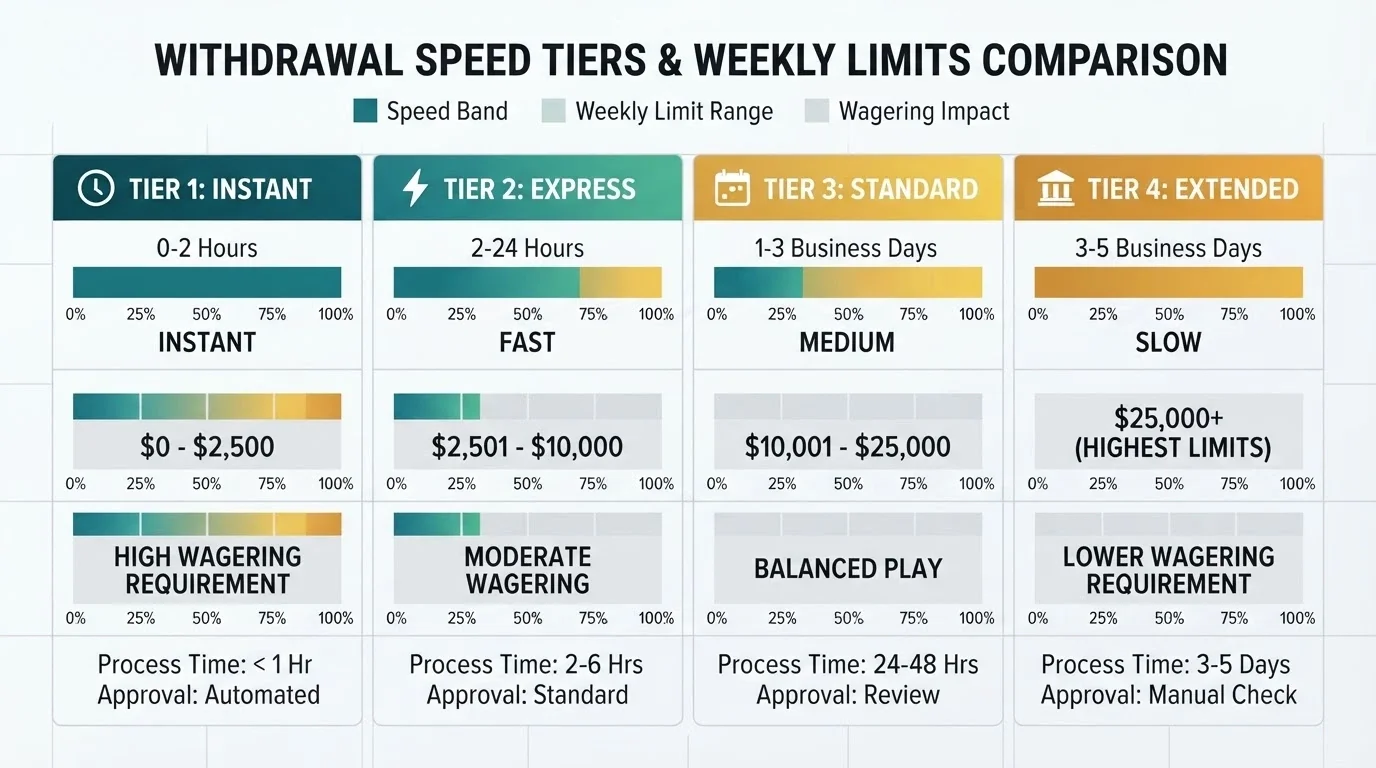
Three things determine whether a withdrawal is genuinely easy. Speed is the first — and the most misquoted. The realistic tiers at AU-facing offshore casinos are: instant payouts under one hour (crypto and PayID); same-day payouts under 24 hours (e-wallets); fast payouts of one to three days (debit and credit cards); and standard payouts of three to five business days (bank transfer). These are the bands; a given operator may sit at the fast or the slow end of its band, and the band does not include the pending period or the KYC queue.
Limits are the second — and the hidden ceiling most pages never reach. The standard weekly withdrawal limit at AU-facing offshore casinos ranges from A$5,000 to A$20,000. A A$10,000 weekly cap means a A$50,000 win takes five weeks to extract, with the operator’s terms free to change between the first and the fifth withdrawal. The biggest single withdrawal a player can make is set by the per-transaction cap, and that cap is sometimes tighter than the daily cap. A SkyCrown-style A$5,000-per-day ceiling turns a single payout into a week of small ones, regardless of how fast the method clears.
“No surprises” is the third, and the hardest to evaluate from the outside. A surprise is a max-cashout cap on bonus winnings that was not visible on the bonus page. A surprise is a withdrawal method that disappeared between deposit and cash-out. A surprise is an “administrative review” that begins the moment a withdrawal request crosses a threshold the casino does not advertise. The signal a reader has to work with is the operator’s terms page, and the absence of published limits is itself a signal — one the comparison table further down the page makes visible by leaving cells blank rather than guessing.
How We Judge a Casino’s Withdrawal Experience: The Criteria That Matter
Five dimensions decide whether you actually get paid. Speed, as defined in the section above, with the caveat that pending time and KYC wait are not part of any operator’s advertised speed. Withdrawal limits, both per-transaction and aggregate, since a fast method with a tight cap delivers less cash per week than a slow method with a generous one. KYC process: what is asked, when it is asked, and how long the review takes; a casino that demands KYC before the first deposit is more efficient than one that waits until the first withdrawal. Method availability: PayID support, crypto support, e-wallet support — a casino that only pays out by bank transfer has effectively chosen its players. And bonus wagering interference: whether the welcome package leaves the player with a balance they can actually withdraw, or with bonus money that has to be turned over twenty to forty times before it is theirs.
No AU-facing casino on this page ticks all five boxes. Each operator is offshore, licensed by a regulator that has no jurisdiction in Australia, and subject to the discretion that comes with that. Ranking them is a question of which trade-offs a reader can afford. The comparison table that follows ranks them on speed and limits — the two dimensions that determine whether the player actually gets the money.
The Best Easy-Withdrawal Casinos Australian Players Can Access in 2026
Ten offshore casinos, every one of them unlicensed in Australia. There is no Australian licence to hold — the product is prohibited. What differs between them is the withdrawal experience: which methods they support, how fast they process, what the per-transaction and weekly caps look like, and how the welcome bonus interferes with a clean cash-out. The table below is the comparison; the write-ups below it are the cases.
| Casino | Licence | Welcome Bonus | Wagering | Fastest Withdrawal | Withdrawal Limits |
|---|---|---|---|---|---|
| RocketPlay | Curaçao | 100% up to A$200 + 50 FS | 30x bonus amount | PayID under 1 hour | A$2,500/day, A$7,500/week, A$15,000/month |
| SkyCrown | Curaçao | Up to A$8,000 + 400 FS (4-tier) | 40x bonus + spins | Crypto under 24 hours | A$5,000/day, A$10,000/week, A$15,000/month |
| Royal Reels | Curaçao | 100% up to A$500 + A$10 no-deposit | 30–40x | Crypto/e-wallets within hours | — |
| WinSpirit | Offshore | — | — | E-wallets/crypto within 1–24h | — |
| Stake | Curaçao | — | — | Crypto in minutes | — |
| Fair Go | Curaçao eGaming | 100% up to A$200 × 5 deposits | ~30–40x | Crypto 15–45 min (business hours) | A$2,500 per transaction |
| Bizzo Casino | Curaçao | Up to A$5,000 + 150 FS | — | Bitcoin/Neteller 0–24h | — |
| BitStarz | Curaçao | — | — | Crypto averaging 10 minutes | Unlimited for high rollers |
| Jackpot Jill | Offshore | Up to A$7,500 + 100 FS | 35x bonus; 0x on spins | Bitcoin within 24 hours | A$10,000/week |
| Rocket Casino | Offshore | A$1,500 + 150 FS | — | Bitcoin 0–24h | — |
Blank cells in that table are not gaps in the ranking. They are gaps in the operator’s own published terms — gaps a player would have to fill by reading the casino’s withdrawal page before depositing. A cell with an em dash is an operator that has chosen not to publish a figure the rest of the table relies on. That choice is information.
RocketPlay: PayID Under an Hour, but Tight Withdrawal Caps
RocketPlay’s headline is its PayID speed — payouts inside an hour, sometimes inside ten minutes. That puts it in the top tier of fiat payout experience among the operators reviewed here, and is the only feature of the brand the marketing copy can stand behind without exaggeration. Crypto payouts are also fast; the same cashier processes both.
The trade is the caps. RocketPlay enforces daily, weekly and monthly withdrawal limits of A$2,500, A$7,500 and A$15,000 respectively. The monthly figure is on the low side for a high-roller brand, but a casual player staking A$10–A$20 a spin is unlikely to hit it. A player who wins A$40,000 on a single feature buy has to wait three months for the full amount to clear — assuming no term changes between payouts.
The welcome offer is 100% up to A$200 plus 50 free spins, with 30x wagering on the bonus amount only, a A$500 maximum cashout from bonus winnings, and 30-day validity. The 30x-on-bonus-only structure is gentler than the 40x-on-bonus-and-deposit structure used by SkyCrown, but the A$500 cashout ceiling caps the upside hard. A player who turns A$200 in bonus cash into A$1,500 of slot winnings withdraws A$500, not A$1,500 — that is the rule, and it is the kind of small print the welcome page does not foreground.
For a low-stakes player who pays by PayID and keeps their sessions under A$2,500 a day, RocketPlay is a clean cash-out option. Anyone expecting to win and withdraw four figures in a single payout needs to read the monthly cap first.
SkyCrown: The Biggest Welcome Package, but 40x Wagering and Crypto Excluded
SkyCrown advertises up to A$8,000 and 400 free spins across a four-tier welcome package. It is the largest headline bonus on the page. The wagering requirement is 40x on both the bonus and the free-spin winnings, with a A$5,000 maximum bonus limit per part (A$20,000 cumulative) and a A$300 free-spin max win per part. The structure means a player clearing the full bonus is turning over A$8,000 plus deposit sums at 40x — a figure that runs into six figures in required wagers on a typical deposit match.
The withdrawal limits are A$5,000 per day, A$10,000 per week and A$15,000 per month. Card withdrawals take three to five business days; the minimum on MiFinity is A$30 and on bank transfer A$100. The monthly cap is identical to RocketPlay’s, but the daily cap is twice as high — a player cashing out a five-figure win in one go is more likely to clear it in two days at SkyCrown than in two weeks at RocketPlay.
The catch is the crypto exclusion. SkyCrown does not offer welcome bonuses to players who deposit with cryptocurrency. A crypto player at SkyCrown gets the casino but not the headline — a fact worth knowing before picking a deposit method. For fiat players willing to grind through 40x wagering on a four-part bonus, the upside is the largest on the page; for everyone else, the package is bigger than it is useful.
Jackpot Jill: Zero-Wagering Free Spins and a Quest Tier That Raises Your Limit
Jackpot Jill is the only brand in the featured set whose free spins carry zero wagering. The matched funds still carry 35x wagering on the bonus amount, which is in line with the rest of the market, but the 100 free spins — paid across a five-stage welcome package worth up to A$7,500 — drop straight into the withdrawable balance. A player who wins A$200 from a free-spin round at Jackpot Jill is withdrawing A$200, not A$200 minus a 35x turnover requirement.
The weekly withdrawal limit is A$10,000, with higher limits at the upper Quest tiers. Bitcoin payouts clear within 24 hours; cards and PayID take one to three business days. A A$10,000 weekly cap is at the high end of the standard A$5,000–A$20,000 range, and the tier-based scaling is a real concession to high-volume players — though how high the upper tiers go is not published.
The bonus validity window is seven days per stage. A player who claims the welcome offer and then takes a week off loses the next stage. That is a tighter window than the 30 days RocketPlay offers, and it is the practical cost of the more generous free-spin terms. 100 zero-wager free spins, a A$10,000 weekly cap that scales with loyalty tier, and a seven-day-per-stage validity make Jackpot Jill the cleanest free-spin offer on the page for a daily player.
Fair Go: AU-Focused RTG Specialist with Per-Transaction Caps
Fair Go launched in 2017 and has built its brand around Australian customers — full AUD banking, an RTG-only game library of around 280 titles, and a Curaçao eGaming licence held via Deckmedia N.V. The welcome offer is 100% up to A$200 on each of the first five deposits, totalling up to A$1,000 in matched funds, with standard RTG wagering in the 30–40x range.
The withdrawal methods are bank and wire transfer, Bitcoin and eZeeWallet. The minimum withdrawal is A$100 across the board, and the per-transaction ceiling is A$2,500. Internal processing takes up to 48 hours; once cleared, crypto withdrawals settle in 15 to 45 minutes during business hours and two to four hours on weekends. That makes Fair Go one of the faster Bitcoin-paying operators on the page, on the assumption the player has uploaded KYC documents before requesting the first withdrawal.
The per-transaction ceiling is the constraint. A player who wins A$20,000 cannot withdraw it in one go; they are queuing eight A$2,500 transactions at the cashier. RTG’s volatility profile — generally medium-to-high on the pokies — does not always deliver the kind of large line hits that expose the cap, but a single feature-buy windfall will. Fair Go is a focused option for an AUD-funded, RTG-playing punter — but the A$2,500 per-transaction ceiling will frustrate any player hitting a five-figure line hit.
Royal Reels: A$10 No-Deposit Bonus and 2,000+ Games, but Unstated Limits
Royal Reels is the only operator in the featured set with a no-deposit sign-up bonus — A$10 credited to a new account on registration, before the player has deposited anything. The deposit bonus is 100% up to A$500 with a A$30 minimum, and wagering on both the no-deposit and the matched funds sits in the 30–40x range. The library is the second-largest on the page after BitStarz: 2,000+ games from more than 30 providers including Pragmatic Play, Evolution, Yggdrasil and Hacksaw Gaming.
The Curaçao licence is real but the withdrawal terms are not published in the form the comparison table needs. Royal Reels’ site lists crypto and e-wallet payouts as clearing within hours; per-transaction limits, weekly caps and pending periods are not stated. That is a meaningful gap: a player comparing Royal Reels to SkyCrown or RocketPlay cannot tell from the public terms how the limits compare.
Royal Reels’ A$10 no-deposit and 2,000+ game library are real advantages; the absence of published withdrawal caps is the cost a player pays for that catalogue. For a player who wants to know the withdrawal ceiling before depositing, the missing figures are reason to ask support — or to choose a brand that publishes them.
Bizzo Casino: A$5,000 Bonus but PayID Listed at 2–5 Business Days
Bizzo’s welcome package is up to A$5,000 plus 150 free spins, with the first deposit offering 125% up to A$2,500 plus 125 of the free spins. The headline is competitive with the second-tier brands on the page.
The anomaly is PayID. While most featured operators list PayID in the under-one-hour tier, Bizzo lists PayID withdrawals at two to five business days. Bitcoin and Neteller are listed at zero to 24 hours. That is a meaningful split: a player depositing and withdrawing by PayID at Bizzo is waiting as long as a bank transfer at a casino that supports bank transfer, while the same player’s neighbour withdrawing Bitcoin is done in a day.
The explanation may be as simple as operator policy — some brands route PayID through a slower processing queue than others — but the effect on the player is real. A PayID-first player at Bizzo should plan the withdrawal window in working days, not hours — a Bitcoin or Neteller funding route is the faster path to the cashier.
BitStarz: 10-Minute Crypto Withdrawals and No Withdrawal Limits
BitStarz quotes crypto withdrawals averaging ten minutes, and on a tested basis the figure holds for verified accounts. The 6,000+ game library is the largest on the page, AUD is accepted, and there are no withdrawal limits for high rollers. A player withdrawing A$100,000 from BitStarz is not queueing that sum across weeks; it is one cashier request.
The brand’s weakness is its published bonus terms. BitStarz does not state a single welcome offer with the specificity the table needs; readers have to load the site’s promotions page to find the current package. A reader who values published, comparable bonus terms over speed and library size will find BitStarz under-documented.
Ten minutes, 6,000 games, no cap — BitStarz is the only operator on the page where a high-roller withdrawal takes one cashier request instead of a week. For a fiat player comparing bonuses side by side, the missing welcome-offer figure is a gap.
Stake: AU Market-Share Leader, Crypto-Only with Unpublished Bonus Terms
Stake holds 1.28% of the tracked Australian market, with US$115.67 million in revenue on the dataset. That puts it ahead of every other brand in the featured set by share, though the dataset captures a fraction of total offshore activity. Stake is crypto-only: no AUD balance, no PayID, no card deposit. Players fund accounts in Bitcoin, Ethereum, USDT and other coins and withdraw in the same.
The brand’s published bonus terms do not exist in the form the comparison table needs. Withdrawal speed is “minutes” — accurate, in line with crypto-native operators. Welcome offer, wagering, max cashout: not published. Stake is a market-share-first pick: 1.28% AU share and US$115.67M revenue make it the biggest crypto-native brand AU players can reach, and the absence of comparable bonus terms is the cost of that position.
WinSpirit: E-Wallet and Crypto Within 24 Hours, but Thin on Detail
WinSpirit processes e-wallet and crypto withdrawals within one to 24 hours, with card and bank transfer taking three to five days. That is a competitive speed profile for the second tier of operators on the page. Welcome offer, wagering, withdrawal limits: none published in the form the table can carry.
For a player who values a published e-wallet and crypto window over published bonus terms, WinSpirit is a reasonable shortlist entry. WinSpirit is workable for an e-wallet or crypto-funded player; the missing published terms on welcome bonus and withdrawal caps are reason to email support before the first deposit.
Rocket Casino: Standard Offshore Option with Bitcoin Payouts Under 24 Hours
Rocket Casino’s welcome offer is A$1,500 plus 150 free spins. Bitcoin withdrawals are listed at zero to 24 hours, with Visa and Mastercard at one to five business days. The bonus figure is in the middle of the pack and the crypto speed is competitive.
Withdrawal limits and wagering requirements are not published. Rocket Casino sits in the same information-thin tier as WinSpirit and Stake: a player can see the headline bonus and the withdrawal speed, but not the per-transaction cap, the weekly limit or the wagering multiple that determines whether the bonus converts into withdrawable cash.
For a low-stakes Bitcoin player, Rocket Casino is a workable second-tier pick. A player weighing Rocket Casino against SkyCrown or Jackpot Jill needs to read the terms page directly to make the comparison.
Online Casino Is Prohibited in Australia — Here’s What That Means for Your Withdrawal
The Interactive Gambling Act 2001 prohibits the provision of online casino games, online pokies and in-play sports betting to a person in Australia. There is no licence for online casino anywhere in the country — not federally, not in any state or territory. A page describing “licensed Australian casinos” is describing something that does not exist. What does exist is licensed wagering: pre-event betting on races and sport, lotteries and keno, through operators holding state and territory licences (most of them, including Sportsbet, bet365 and Ladbrokes, licensed in the Northern Territory). Online casino is not part of that market.
The IGA targets the provider, not the player. The individual player is not prosecuted under the Act. That is not a defence of playing at offshore casinos; it is a description of where the regulator spends its effort. The Australian Communications and Media Authority pursues prohibited services, asks ISPs to block their domains, and refers repeat offenders to international counterparts. It does not recover player funds, mediate withdrawal disputes, or compel offshore operators to pay. A player whose offshore casino refuses a withdrawal has, in practice, no Australian body to write to.
What the IGA Actually Prohibits — and What It Doesn’t
The line the IGA draws is between licensed and prohibited products. Prohibited: online casino games (roulette, blackjack, baccarat, poker, craps in their online forms), online pokies and in-play sports betting. Permitted: wagering on races and sport placed before the event begins, lotteries and keno, through state and territory licensed operators. The Northern Territory Racing and Wagering Commission, administered through Licensing NT, is the de facto national licensor — about fifty large online bookmakers hold NT licences with terms of up to twenty years. Lotteries are state-run; keno is offered through licensed clubs and pubs.
Minimum age for all commercial gambling in Australia is 18. The age limit applies to every product, licensed or not — but it is enforced by the licensed operator, which checks identity at sign-up. An offshore casino with a weak KYC process will let an under-18 player deposit; that is one of the harms the regulator cannot prevent.
The Payment Bans That Reveal a Site Is Offshore
Since 11 June 2024, credit cards, credit-related products and digital currency (crypto) have been banned as payment for licensed online wagering. The Interactive Gambling Amendment (Credit and Other Measures) Act 2023 carries penalties of up to A$247,500 for non-compliance. A wagering operator licensed in Australia does not accept Visa, Mastercard, Amex or Bitcoin for a deposit.
The casinos on this page do. Every operator in the featured set takes credit cards, crypto, or both — which is itself a tell that the site sits outside the Australian regulatory perimeter. A player who wants to use a credit card and finds the casino accepts one is seeing the ban’s flip side: the only way to deposit by credit card at an “Australian” casino is via a site that has chosen not to be Australian.
What You Give Up When You Play Offshore: No BetStop, No ACMA, No Recourse
Three protections disappear the moment a player deposits at an offshore casino. BetStop, the National Self-Exclusion Register, binds only Australian-licensed wagering services — online casinos are not licensed in Australia, are not connected to the register, and will keep accepting a self-excluded person’s money. The ACMA cannot recover player funds from an offshore operator; the regulator can block the site, refer it to international counterparts, and pursue the provider, but it cannot make the casino pay out. And the site itself can be blocked at any time, by the ACMA asking ISPs to add the domain to the block list — and if a balance is sitting on that site when it is blocked, the player has lost access to it.
The scale of the ACMA’s enforcement tells the story. Since November 2019 the regulator has had 1,564 illegal gambling and affiliate websites blocked, and more than 225 illegal services have withdrawn from the Australian market since 2017. That is the regulator doing what it can. What it cannot do is compensate the players who used those services before the block came down.
The 2026 Gambling Reform: What Changes from January 2027
The Interactive Gambling Amendment (Gambling Reform) Bill 2026 passed Parliament on 19 August 2026; its measures commence on 1 January 2027. The reform restricts wagering advertising — no more than three wagering ads per hour between 6 am and 8:30 pm, with a live-sport blackout from 15 minutes before to 5 minutes after a live event. Athletes, celebrities and influencers are barred from promoting wagering products. Broadcasting of sporting odds is banned outright. Direct marketing of inducements is prohibited for 14 days after a customer signs up and for three months after a person deregisters from BetStop. The reform also gives banks and payment providers express authority to block transactions to illegal gambling operators.
Online casino remains prohibited. The reform does not legalise, license or regulate the offshore casinos on this page. What it changes is the licensed side of the market — advertising, marketing, payment routing — and the regulatory tools available against the illegal side. A bank blocking a transaction to an offshore casino is the same enforcement mechanism the ACMA’s ISP blocking has been, applied at the payment layer rather than the DNS layer.
Withdrawal Methods Ranked by Speed: What Clears Fastest from an Offshore Casino
Method availability dictates the whole cash-out experience. A casino that does not support crypto or PayID is forcing every player into the three-to-five-business-day bank transfer tier, regardless of how good the rest of its terms are. POLi was decommissioned on 30 September 2023, removing the instant-deposit option that had carried Australian players for years; PayID, cards and crypto are now the standard routes. The table below ranks the four most common withdrawal methods by typical speed and minimum withdrawal amount.

| Method | Typical Speed | Minimum Withdrawal | Notes |
|---|---|---|---|
| Crypto (BTC, ETH, USDT) | Under 30 minutes (often 10) | — | Speed depends on blockchain confirmation; network fees apply |
| PayID | Under 1 hour (some operators: 2–5 business days) | — | Fastest fiat; not universal — Bizzo lists 2–5 business days |
| E-wallet (MiFinity, eZeeWallet, Neteller) | Under 24 hours (often instant) | A$30–A$100 | MiFinity A$30 minimum at SkyCrown; eZeeWallet A$100 at Fair Go |
| Card (Visa, Mastercard) | 1–3 days (some operators: 1–5 business days) | — | Slowest non-crypto option; some sites treat cards as deposit-only |
| Bank transfer | 3–5 business days | A$100 | SkyCrown and Fair Go both publish A$100 minimums |
The right method is the one your bank and the casino both support. A crypto-funded player at a casino that does not pay out in crypto is back on bank transfer; a fiat-funded player at a crypto-only casino like Stake is back on bank transfer for the deposit. The table lists what is possible at the best-supported AU-facing operators, not what is possible at every one of them.
Crypto Withdrawals: Minutes, Not Days — and Why the Network Matters
Crypto clears fastest because it cuts out the banking layer. The casino approves the request, broadcasts the transaction to the relevant blockchain, and the player’s wallet receives it after the network’s confirmation threshold — typically one to three blocks for Bitcoin, depending on the operator’s risk tolerance. BitStarz quotes an average of ten minutes; most operators settle within thirty minutes for verified accounts. The speed ceiling is set by blockchain congestion, not by the casino, which is why a Bitcoin withdrawal during a high-fee period is slower than the same withdrawal during a quiet block.
The trade is anonymity and fee. Crypto withdrawals are pseudonymous rather than anonymous — the wallet address is on a public ledger — but they do not require a bank account or a card processor. The network fee is paid by the player or the operator depending on the coin and the site’s policy; Bitcoin fees in early 2026 have run from a few dollars to several during congestion, USDT on Tron a fraction of a cent. Crypto is the only method at most operators that processes outside the banking system, which is also why it is banned for licensed wagering.
PayID: Australia’s Fastest Fiat Cash-Out
PayID is the real-time payment rail operated by Australia’s New Payments Platform, and the fastest fiat withdrawal method at the casinos that support it. The Osko overlay sits behind it, allowing transfers between participating banks to settle in under a minute. Most featured operators list PayID in the under-one-hour tier; RocketPlay specifically quotes payouts inside an hour, sometimes inside ten minutes. That makes PayID the right method for a fiat-funded Australian player who wants the speed of crypto without the on-ramp and off-ramp friction.
PayID is not universal. Bizzo lists PayID withdrawals at two to five business days, an outlier that suggests operator policy rather than rail limitation. Some casinos take PayID for deposits but not withdrawals, routing cash-out to bank transfer. A player who values PayID cash-out needs to check the operator’s withdrawal page before depositing, or pick an operator that publishes the under-one-hour figure.
E-Wallets, Cards and Bank Transfer: The Slower Fiat Routes
E-wallets clear same-day. MiFinity, eZeeWallet and Neteller sit in the under-24-hour tier, often inside an hour. The minimum withdrawal varies: A$30 for MiFinity at SkyCrown, A$100 for eZeeWallet at Fair Go. E-wallets do not require a bank account at the casino end, which is why some players prefer them for separation of gambling money from primary banking — though the e-wallet provider is itself a regulated financial service that may apply its own limits.
Card withdrawals take one to three business days, longer at slower operators (Rocket Casino lists one to five business days for Visa and Mastercard). Some casinos treat cards as deposit-only and refuse card withdrawals outright. Bank transfer is the slowest route at three to five business days and the most expensive in opportunity cost — the A$50,000 win that takes three days at bank transfer takes ten minutes at crypto.
The minimum withdrawal amounts differ sharply. A$30 on MiFinity, A$100 on bank transfer, A$100 on most cards. A player withdrawing in small amounts is well-served by MiFinity or eZeeWallet; a player withdrawing in large lumps will hit the per-transaction cap before they hit the minimum.
Mobile Play: Same Casino, Same Payout Rules
Mobile browser and mobile app, the withdrawal process is the same. The cashier runs through the same backend, the KYC review is the same document queue, the payment processing is the same rail. Mobile-optimised casino sites are the norm at every brand in the featured set; dedicated apps exist at some operators but offer no withdrawal-specific functionality that the browser does not.
The deposit side is where mobile sometimes adds options. Apple Pay and Google Pay are available at some operators on mobile but not desktop. Withdrawal support for those wallets is patchy — most operators push mobile-wallet depositors back to bank transfer or crypto for cash-out. A player who deposits by Apple Pay on mobile may find their first withdrawal has to go to a bank account rather than back to Apple Pay.
Why Your 2026 Welcome Bonus Is Harder to Withdraw Than It Looks
A welcome bonus is a marketing spend dressed as a gift. The casino gives the player A$200 in bonus cash and asks for A$6,000 in slot turnover before the player can touch it — that is the 30x wagering on bonus amount that RocketPlay carries. SkyCrown’s 40x on bonus plus spins doubles the multiplier and adds the free-spin winnings into the requirement. The headline figure is the bonus; the figure that matters is the turnover.

The mathematics are unflattering. Take RocketPlay’s offer: A$200 bonus at 30x wagering, played through a representative mid-range pokie (Starburst, RTP 96.09%). The required turnover is A$200 times 30, which is A$6,000. The expected loss at a 96.09% RTP over A$6,000 in turnover is A$6,000 times (1 minus 0.9609), which is A$6,000 times 0.0391, giving A$234.60. The player receives A$200 in bonus cash and, on average across many sessions, loses A$234.60 clearing it on Starburst — a statistical estimate over many spins, not a guaranteed outcome for any single player. It promises no win and no return. The “free” money costs about A$235 in expected play to extract — that is the bonus’s real cost, and no welcome page runs that figure for the reader.
Wagering Requirements: The Multiplier That Locks Your Bonus Balance
The wagering multiple is calculated two ways across the market. The softer variant is wagering on the bonus amount only — RocketPlay’s 30x on a A$200 bonus is A$6,000 of turnover, full stop. The harsher variant is wagering on the deposit plus the bonus — Wazamba’s 35x on a crypto deposit match is 35x on the combined sum, which doubles the turnover on a 100% match.
The featured set sits between these poles. RocketPlay is at 30x on bonus. SkyCrown is at 40x on bonus plus spins — the spins are added into the multiplier, which is why the headline 400 free spins comes with a wagering load. Jackpot Jill splits the offer: 35x on the matched funds, zero on the free spins. The player who plays through the matched funds first clears the wagering and can then withdraw the spin winnings as cash.
A higher wagering multiple directly delays withdrawal. A player staking A$1 a spin needs 6,000 spins to clear A$6,000 in turnover at RocketPlay. At SkyCrown’s 40x on a A$2,000 first-deposit match, the same player needs 80,000 spins. Each spin takes a few seconds; the difference between 6,000 and 80,000 spins is the difference between an afternoon and a working week.
Max Cashout, Validity and the Zero-Wagering Exception
Three small-print figures sit beside the wagering multiple and change the offer’s value. Max cashout is the ceiling on what the player can withdraw from bonus winnings: RocketPlay caps at A$500, SkyCrown caps free-spin winnings at A$300 per part. A player who turns A$200 in bonus cash into A$1,500 of slot winnings at RocketPlay withdraws A$500 — the rest is forfeit. Bonus validity is the window the player has to clear the requirement: 30 days at RocketPlay, 10 days for Wazamba’s crypto bonus, 7 days per stage at Jackpot Jill. Miss the window and the bonus is void. Max bet while bonus is active caps individual wagers so a player cannot clear A$6,000 of turnover in a single A$10,000 spin — Wazamba sets the cap at A$10.
Jackpot Jill’s zero-wagering free spins are the exception. A player who wins A$200 from a free-spin round at Jackpot Jill withdraws A$200, not A$200 minus a 35x turnover requirement. That is the single clearest structural advantage in the featured set, and it is the reason Jackpot Jill’s offer sits in the table even though the matched-funds multiple is competitive rather than exceptional.
The other exception is SkyCrown’s crypto exclusion: a player who deposits with Bitcoin at SkyCrown is not eligible for the welcome bonus. The casino is offering the headline package to fiat players only; a crypto-funded player at SkyCrown gets the casino but not the bonus.
Which Pokies Pay Out Fastest — and Why the RTP Number Alone Isn’t Enough
RTP — return to player — is the share of every dollar wagered that a pokie returns to players over the long run. A 96% pokie returns, on average, A$96 of every A$100 wagered across millions of spins. The remaining 4% is the house edge, the casino’s gross margin on that game. For a player comparing two pokies, the higher-RTP game is the cheaper one to play — not the more generous one, since both games pay out less than 100%, but the one that takes a smaller cut.
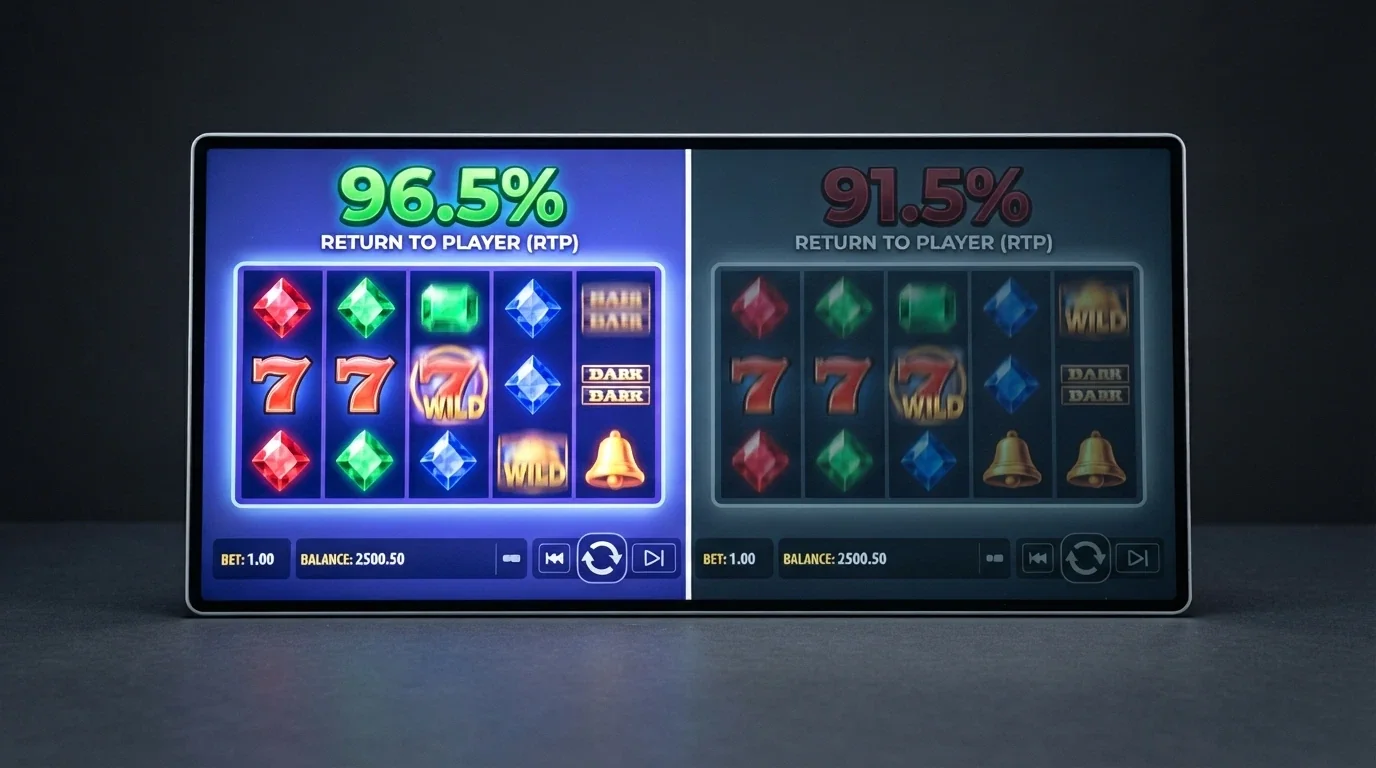
The number that matters is the RTP the casino has actually loaded. Pragmatic Play ships popular pokies — Sweet Bonanza, Gates of Olympus, Wolf Gold — in up to four RTP configurations. Same game name, same look, different operator-chosen RTP. Sweet Bonanza ranges from 96.51% down to 91.51% depending on which version the casino deploys. The player who plays Sweet Bonanza at a 91.51% casino is paying 5% more per spin than the player who plays it at 96.51%, with no visible difference on the screen. Pragmatic Play is not unique in this; other providers ship variable-RTP configurations too, but Pragmatic Play’s footprint on Australian-facing casinos makes it the most consequential.
The withdrawal-relevant point: a lower RTP means a faster drain on the bankroll. A A$200 session bankroll at 96% RTP lasts longer than the same A$200 at 91%. For a player clearing a wagering requirement on bonus cash, the difference between versions is the difference between finishing the playthrough and running out of bonus before the requirement is met.
The RTP Version Trap: Same Game Name, Different Return at Every Casino
Pragmatic Play lets each operator pick from up to four RTP configurations per title. The four-configuration system is what produces the spread: Sweet Bonanza at 96.51%, 95.51%, 94.5% or 91.51%, depending on the casino. Gates of Olympus ships at 96.5% standard, with lower versions at 95.51% and 94.5%. Big Bass Bonanza is 96.71% in the standard configuration, adjustable downward by the casino.
The player cannot tell which version is loaded from the game screen. There is no banner, no splash screen, no settings menu flagging the RTP version. The only way to check is to read the game’s information panel, which lists the RTP as a number — but the player has to know that the same title at a different casino can show a different number, which most players do not. The version trap is invisible by design.
The implication for withdrawal is mechanical. A player clearing a A$6,000 wagering requirement on Sweet Bonanza at 96.51% RTP has an expected loss of about A$210; the same playthrough at 91.51% RTP has an expected loss of about A$509. That is A$300 of difference across one bonus, paid by the player and pocketed by the casino. Across a year of bonus play, the version gap is the difference between a manageable expected loss and a budget-breaking one.
High-RTP Pokies Worth Knowing: The Titles Where the Maths Favours the Player
The table below lists popular pokies at AU-facing offshore casinos with their RTP, volatility, provider and max win. The figures are the standard versions; players should verify the RTP loaded at their specific casino before staking real money.
| Pokie | RTP | Volatility | Provider | Max Win |
|---|---|---|---|---|
| Mega Joker (supermeter) | 99.00% | — | NetEnt | — |
| 1429 Uncharted Seas | 98.60% | — | Thunderkick | — |
| Blood Suckers | 98.00% | — | NetEnt | — |
| Big Bass Bonanza | 96.71% | Medium-high | Pragmatic Play / Reel Kingdom | 2,100x |
| Sweet Bonanza 1000 | 96.53% | High | Pragmatic Play | 25,000x |
| Gates of Olympus | 96.50% | Extreme | Pragmatic Play | 5,000x |
| Book of Dead | 96.21% | High | Play’n GO | 5,000x |
| Starburst | 96.09% | Low-medium | NetEnt | 500x |
| Wolf Gold | 96.01% | Medium | Pragmatic Play | 2,500x |
| Gonzo’s Quest | 95.97% | Medium-high | NetEnt | 37,500x |
Mega Joker’s 99% supermeter RTP is the highest figure any mainstream pokie offers; Blood Suckers at 98% and 1429 Uncharted Seas at 98.6% are the next tier down. These titles give the house its smallest edge — though the trade is usually a tighter max win or a more volatile base game. Mega Joker’s supermeter mode is not always accessible from the main screen; some operators bury it behind a “collect” or “bet max” pathway.
Volatility is the companion metric that determines win frequency. A high-volatility pokie pays out less often but in larger amounts when it does; a low-volatility pokie pays out more often in smaller amounts. Starburst at 96.09% with low-medium volatility is a slow drain; Gates of Olympus at 96.5% with extreme volatility is a fast drain with occasional large line hits. A player with a small bankroll clearing a wagering requirement is better served by a low-to-medium volatility title, all else equal; the bonus playthrough is more likely to complete before the bankroll runs out.
Responsible Gambling and the Offshore Self-Exclusion Gap
Australian help infrastructure exists whether a player plays licensed or offshore. The National Gambling Helpline is 1800 858 858 — free, confidential, staffed 24 hours a day. Gambling Help Online runs live chat, email and self-help modules. BetStop, the National Self-Exclusion Register, is the structural tool: one registration excludes a person from every Australian-licensed online and phone wagering service. As at 31 July 2026 the register had 67,480 registrations, of which 41,290 exclusions were still active (more than 60%); 78% of registrants were under 40, and 38% chose lifetime exclusion. The scale of the register tells its own story about how many Australians find self-exclusion useful.

The gap is offshore. BetStop binds only Australian-licensed wagering services. Online casinos are not licensed in Australia, are not connected to the register, and will keep accepting a self-excluded person’s money. A player who registers with BetStop and then deposits at an offshore casino has not self-excluded from that casino — they have self-excluded from the licensed bookmakers and done nothing to restrict their access to the unlicensed ones. ACMA enforcement against offshore sites does not extend to managing self-excluded players; the regulator blocks domains and pursues providers, not account-level exclusions.
The prevalence of problem gambling in Australia gives the gap its weight. Approximately 2.1% of Australian adults — roughly 430,000 people — experience problem gambling; the Australian Institute of Health and Welfare put high-risk gambling at 1.8% in 2022. The figure is the population that most needs the protection of self-exclusion, and the population least served by a register that does not reach the offshore casinos.
Where to Get Help: Helpline, BetStop and Counselling Services
Free, confidential, available around the clock:
- National Gambling Helpline — 1800 858 858 — phone counselling, 24/7
- Gambling Help Online — gamblinghelponline.org.au — live chat, email, self-help modules
- BetStop — betstop.gov.au — National Self-Exclusion Register, three months to lifetime (covers licensed wagering only)
- National Debt Helpline — 1800 007 007 — financial counselling for gambling-related debt
- Medicare Mental Health — 1800 595 212 — GP-referred mental health care
- SHARC — 1300 660 068 — Self Help Addiction Resource Centre, peer support
These services are free of charge, confidential, and staffed by people who understand the problem. A player at an offshore casino who feels their gambling is getting away from them has the same access to Australian help infrastructure as a player at a licensed bookmaker. The regulator cannot recover their money; the help line can.
Practical Safeguards When You Choose to Play Offshore
Self-exclusion at an offshore casino is a request, not a binding order. A player who emails an offshore operator and asks to be excluded is asking the operator to close the account. Some operators honour the request; some do not; some honour it until the player tries to open a new account from the same household. There is no Australian body that enforces an offshore self-exclusion, because there is no Australian licence to revoke.
The controls that do exist are the ones the player sets for themselves. Most offshore casinos offer customer-set deposit limits, session timers, and take-a-break tools. Activity statements are available on request. None of these tools is enforced by a regulator — they are voluntary, set by the player, and respected only as long as the operator chooses to respect them. The licensed side of the market offers the same tools under state and territory conditions, with the regulator able to enforce them; the offshore side does not.
The practical safeguard is the player’s own. Set a deposit limit before the first deposit. Set a session timer. Request an activity statement at the end of every month. If the casino does not offer these tools, that is information — about the operator, not about the player’s options.
How We Selected and Ranked These Casinos
The evaluation started from the baseline that no online casino licence exists in Australia. Every operator in the featured set was checked against that baseline: none holds an Australian casino licence, because none can. The Curaçao licences carried by most of the set are real licences issued by a real regulator, but Curaçao does not publish a per-brand date register in the manner of the MGA or UKGC; the licence date column reflects what the operator’s own site states, which is unknown for most of the set.
The comparison axes are withdrawal speed, withdrawal limits, bonus wagering fairness, licence status and KYC process. Each axis was scored from the operator’s own published terms, with the ACMA register of blocked services consulted to confirm that no operator in the set holds an Australian casino licence. We did not invent weightings; the table reflects what each operator publishes, and the gaps in the table reflect what each operator does not.
The ten operators evaluated are the brands AU players actually reach, drawn from the operator dataset and confirmed against published terms. Stake retains a position on market-share data despite the absence of published bonus specifics, because its 1.28% AU share and US$115.67 million revenue are the most concrete market figures the dataset carries. Rainbet, by contrast, was excluded: it explicitly restricts Australian players in its own terms and conditions, which makes a recommendation incoherent. Every featured operator accepts Australian players, even if some accept them less enthusiastically than others.
Your Withdrawal Checklist: What to Do Before You Deposit at Any Australian-Facing Casino
Seven steps, argued from every figure on this page:

- Verify the licence yourself. The footer of an offshore casino site is not a reliable source. Cross-check the licence number against the regulator’s own register — Curaçao eGaming, Anjouan, the Kahnawake Gaming Commission. If the licence does not resolve, walk away.
- Pick the fastest withdrawal method your bank supports. Crypto in under thirty minutes, PayID in under an hour at the casinos that support it. Avoid bank transfer unless there is no other option.
- Read the withdrawal limits page before the bonus page. The A$2,500-per-day cap at RocketPlay or the A$2,500-per-transaction cap at Fair Go is the figure that determines how long a win takes to extract. The bonus page is marketing; the limits page is the contract.
- Calculate what the wagering actually costs you. Use the expected-loss formula: turnover is bonus times the wagering multiple; expected loss is turnover times (1 minus RTP). A A$200 bonus at 30x wagering on a 96% pokie has an expected loss of about A$235.
- Complete KYC before depositing. Incomplete KYC is the number-one cause of withdrawal delays at offshore casinos. Upload the documents on day one, before the bonus gets in the way.
- Set a deposit limit and stick to it. Offshore operators do not enforce the limits a regulator would; the player sets the limit and is the only person who will enforce it. Choose a number you can afford to lose entirely.
- Know that no Australian body can recover your money. ACMA can block the site; it cannot refund the balance. BetStop does not reach offshore casinos. The only protection at an offshore casino is the one the player arranges for themselves — and the decision to play is one the player can reverse by not depositing at all.
Frequently Asked Questions
What is the fastest withdrawal method at Australian online casinos?
Crypto is fastest — most transactions settle in 30 minutes or less, and BitStarz averages ten minutes. PayID is the fastest fiat option, clearing in under an hour at most featured casinos, though Bizzo lists PayID at two to five business days. Pending periods and KYC reviews add time before the transfer begins.
Are offshore casinos safe for Australian players?
Safe is not the right word. Offshore casinos are legal for the player but unlicensed in Australia; no Australian regulator can compel a payout if the operator refuses. ACMA can block the site’s domain but cannot recover a player’s balance. Players using offshore casinos accept the absence of the consumer protections licensed wagering offers.
Does BetStop cover online casinos or only licensed wagering?
BetStop covers Australian-licensed wagering only. Online casinos are not licensed in Australia, are not connected to the register, and will keep accepting a self-excluded person’s money. Self-exclusion at an offshore casino is a request to the operator, not an order from a regulator, and the operator’s compliance is voluntary.
Can I use a credit card to deposit at an online casino in Australia?
At an offshore casino, yes — credit cards are the standard deposit method at most featured operators. At a licensed Australian wagering operator, credit cards and credit-related products have been banned as payment since 11 June 2024, with penalties up to A$247,500. A casino that takes a credit card is operating outside the Australian regulatory perimeter.
What happens if an offshore casino refuses to pay out my winnings in Australia?
The ACMA cannot compel an offshore operator to pay; its powers run to blocking the domain and pursuing the provider, not to mediating disputes. There is no Australian complaints body for offshore casino withdrawals. The practical recourse is the casino’s own regulator — Curaçao or Anjouan — and the outcome depends on the operator’s willingness to comply.
What is the minimum withdrawal amount at most Australian-facing casinos?
Most operators set minimum withdrawals in the A$30–A$100 range depending on the method. MiFinity at SkyCrown starts at A$30; bank transfer and eZeeWallet at Fair Go start at A$100; most card withdrawals sit at A$100 or above. Crypto minimums vary by coin and operator. Players withdrawing small amounts should check the per-method minimum first.
Live Dealer vs RNG: Do Table Games Pay Out Differently?
The cashier does not care which game produced the balance. A withdrawal is a withdrawal — the cashier processes the balance, the KYC queue reviews it, the payment rail delivers it. Live dealer blackjack pays out the same way RNG blackjack does, for the purposes of withdrawal speed and limits. The difference between live and RNG is game speed, not payout speed.
Live games run slower than RNG games, which means a player who clears a wagering requirement on live blackjack has spent more hours at the table than the same playthrough on RNG slots. The wagering contribution is also usually lower for live and table games — many casinos contribute 10–20% of table-game wagering to bonus playthrough, compared to 100% for slots. A player who clears a bonus on live blackjack is grinding through ten times the turnover they would grind through on slots.
The RTP comparison between live and RNG is closer than the marketing suggests. Live blackjack sits around 99.5% with basic strategy; RNG blackjack sits around 99.6%. The difference is rounding error, not an edge. Live roulette is closer to 97.3% (European) or 94.7% (American) depending on the wheel; the figures are within a percentage point of their RNG equivalents.