
The highest payout online casino in Australia is offshore — and that fact decides everything else on this page
Three different things get called “highest payout” in the casino market, and they lead to three different lists. A player who means “the casino whose pokies return the most per spin over time” lands on a short list of high-RTP titles. A player who means “the casino that pays me fastest when I want to withdraw” lands on a list of operators with the right payment rails and a clean verification queue. A player who means “the casino where I keep the most of my bankroll after a session” lands somewhere else entirely, because the legal status of the operator, the wagering terms on the welcome offer and the volatility of the games being played move that number far more than any one percentage point of RTP.

Every casino on this page is offshore. None of them holds an Australian licence for online casino games, because no such licence exists anywhere in Australia. The Interactive Gambling Act 2001 prohibits the supply of online casino games, online pokies and in-play betting to people in Australia, and the provider is the one the law targets — not the individual player. That prohibition is the single most important fact on this page, and the rest of what follows is read against it. As of 22 November 2026, the figures and licence claims here were checked against the Australian Communications and Media Authority’s published enforcement register and the text of the Interactive Gambling Act 2001.
Table of Contents
- Why “highest payout” means more than one number in 2026
- The pokies and table games where the return is genuinely higher
- 10 offshore casinos Australian punters are searching in 2026
- A high RTP means nothing if your cash never reaches you
- No online casino holds an Australian licence — here is what that costs you
- Staying in control when the house sits overseas
- How we selected and ranked every casino on this page
- What chasing the highest payout actually means for your money as an Australian punter
- Frequently asked questions about the highest payout online casino in Australia
Why “highest payout” means more than one number in 2026
A casino quoting 97 % on its homepage and another quoting 98 % can deliver completely different sessions to the same player, on the same budget, on the same evening. The reason is that “highest payout” is shorthand for at least three distinct measurements, and they do not move together. Two casinos quoting RTP figures one percentage point apart can sit on opposite sides of a sensible choice once the per-game variance, the withdrawal speed and the legal reality of playing offshore are taken into account.

The phrase itself is also unverified in this market. In a country where no online casino licence exists, no Australian authority audits the payout figure a casino publishes. The number on the homepage is a marketing claim, not a certified return — and that distinction shapes every other reading on this page.
RTP explained: the casino-level percentage vs the game-level truth
A casino-level RTP is a weighted average across the operator’s entire game library. It is calculated the way a student’s GPA is calculated — every game contributes a number, and the size of each game’s contribution depends on how much play it attracts. A casino that promotes a small library of high-RTP blackjack variants alongside a deep bench of progressive pokies can quote an aggregate figure that sounds strong and yet mask the fact that a meaningful share of its catalogue pays back less than 90 %.
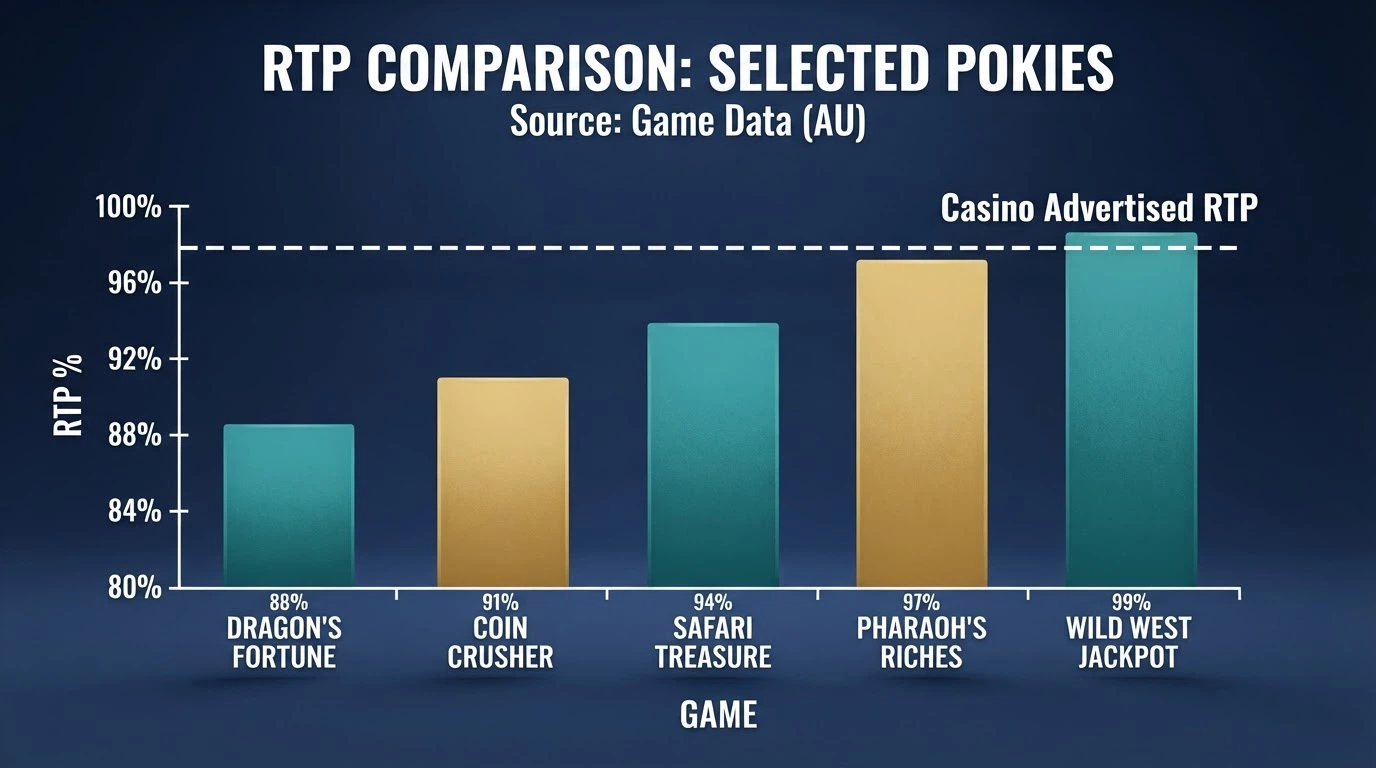
This is how a homepage headline of 97 % can be honest on average and misleading for the player who only ever plays pokies. The pokie floor at most offshore casinos carries a wide spread — titles sitting below 90 % at the bottom end, a handful of high-RTP releases above 98 % at the top. The 97 % the casino quotes is the average across both ends, weighted toward whichever games players actually open. If the games a player chooses pull toward the lower end of the spread, that 97 % does not describe their session at all.
Why the same casino returns 98 % on one pokie and 88 % on another
The variance inside one casino’s library is wider than most players realise. Game manufacturers set the return at the title level, often as a configurable range — the studio ships the game with several RTP profiles and the casino picks one. A high-volatility pokie running a smaller base-game return to fund the jackpot pool can sit two to five percentage points below a low-volatility release on the same provider’s back end.
The practical difference between an 88 % pokie and a 98 % pokie over a session is not one percentage point. It is the difference between a player losing A$12 for every A$100 wagered and a player losing A$2. The 10 % spread compounds quickly across hundreds of spins and across the lifetime of a bankroll. Two players at the same casino, on the same evening, playing different titles, can finish the night with results that have nothing to do with one another. That variance is the reason a casino-level RTP figure is a near-meaningless statistic for anyone choosing a single game to play.
Real-money play: why demo-mode RTP does not guarantee the same return
Some providers configure different RTP settings for real-money and demo versions of the same pokie. The free-play version, which a player can open in a browser without registering, can run a higher RTP than the version the casino has selected for paying customers. The studio sets the profiles; the operator picks which one to ship. A casino has no obligation to publish which profile it is running, and most do not.
The place to check is inside the game itself. Every legitimate pokie carries an information or paytable screen listing its return to player, usually reached by clicking a question-mark icon or a settings cog. The number on that screen is the one that governs the real-money session. If it is not there, the casino has decided not to display it — and that silence is information, just not the kind a player would choose.
What “highest paying” actually means for an Australian punter in 2026
In a market where every casino is offshore and no Australian licence exists, “highest paying” is a claim no Australian regulator verifies. The figure a casino publishes is not an audited return — it is a marketing number with no local authority behind it. An Australian player is reading a headline against a backdrop in which the only enforcement body, the Australian Communications and Media Authority, is engaged in directing ISPs to block the very sites that publish it.
What an Australian player can compare instead is narrower but real. The published RTP range for a particular pokie can be cross-referenced against independent testing house listings — usually eCOGRA, GLI or iTech Labs — though offshore casinos do not always publish those reports. The payment methods a casino accepts can be checked against Australian rules: any site asking for a credit card or crypto is operating outside Australian law from the moment of deposit. And the licence a casino does hold can be checked against the regulator’s own register — Curaçao, Anjouan, the Isle of Man, the Kahnawake Gaming Commission and the Malta Gaming Authority are the jurisdictions most often named by offshore operators, and each maintains a public licence lookup. None of those is an Australian check, but each is a real cross-reference a player can run in five minutes.
The pokies and table games where the return is genuinely higher
Game categories return different amounts to the player over the long run, and the spread between them is wider than the spread between casinos. Blackjack played with perfect basic strategy returns more than any pokie on the market. Baccarat returns more than most pokies. European roulette returns more than most pokies. The catch is that those table-game returns assume the player is making every decision correctly — and most punters, including experienced ones, deviate from optimal strategy often enough to give a meaningful share of the theoretical return back to the house.
The Australian-native term for what the rest of the world calls slot machines is pokies, and the term carries over to the online product. Online pokies are software-driven and use the same random-number-generator logic as the venue machines in pubs and clubs across the country, but the catalogue at an offshore casino is far wider than anything a venue floor can offer. That catalogue is also where the highest and lowest RTPs on the site tend to live.
Highest-paying online pokies available to Australians — and how to verify an RTP
The pokies that report the strongest return figures — in the high 90s and above — tend to be low-volatility titles with modest jackpots, fixed pay tables and a smaller house edge built into the base game. A high-volatility release with a headline progressive prize runs a lower base-game RTP by design, because a portion of every spin is diverted to the jackpot pool that pays out rarely and dramatically.
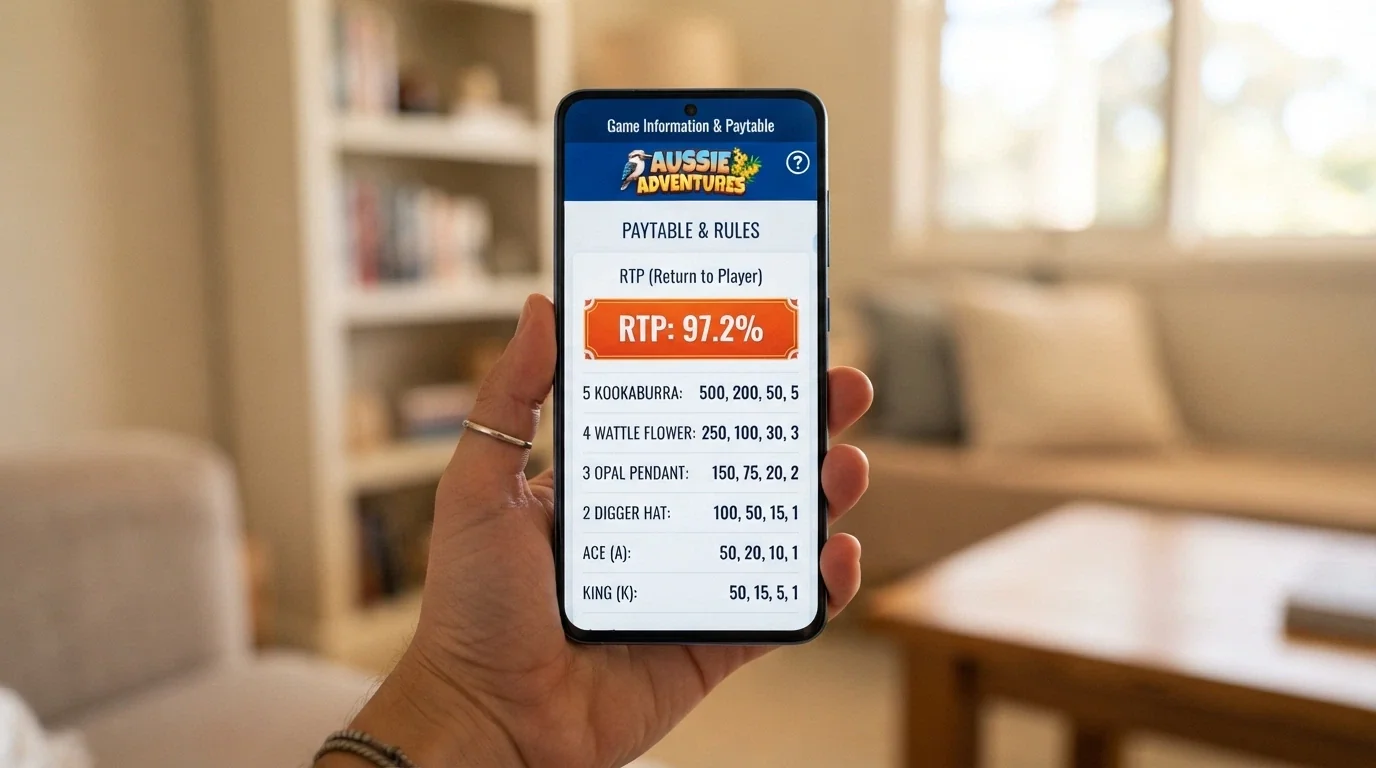
To verify a pokie’s RTP, the right place is the game-rules screen inside the title itself. Most reputable providers print the return percentage on the information page, sometimes alongside a hit-frequency figure and a volatility classification. The casino has chosen which RTP profile the game runs at — the studio ships several — so the figure on that page is the one for that casino, not the one for the game in general. Where the figure is not shown, the operator has decided not to display it, and most offshore casinos do not publish per-game audit reports from independent testing houses. That silence is a small tell: a casino confident in its payout claims tends to publish them; one that is not tends to bury the topic.
Table games vs pokies: which category genuinely returns more to the player
The theoretical RTP gap between table games and pokies is significant. Blackjack with basic strategy played to perfection returns around 99.5 %. Baccarat on the banker bet returns around 98.9 %. European roulette — the single-zero wheel — returns around 97.3 %. The average online pokie, weighted across the catalogue, runs materially below those figures, and a typical high-volatility pokie runs well below the table-game average.
The catch is the qualifier. The 99.5 % blackjack return assumes the player is hitting, standing, doubling and splitting on every hand exactly as basic strategy prescribes. Most players, even experienced ones, deviate from that strategy often enough — taking insurance, splitting tens, standing on a soft 17 — to give back a measurable share of the theoretical return. The pokie’s RTP, by contrast, is automatic: the game plays itself, and the player either accepts the return or moves to a different title. For a player who does not want to learn basic strategy, the highest-paying pokie on the catalogue can outperform the average table-game session, simply because the table game gives back the difference to the house every time the player fumbles a decision.
Progressive jackpots and what they do to the base-game return percentage
A pokie linked to a progressive jackpot — the network prize that climbs with every spin across every connected casino — funds that headline prize by shaving the base-game RTP. The diversion is typically two to five percentage points, which means the same pokie, run on its non-progressive version, can return noticeably more to the player on the base game than the jackpot-linked version does.
The trade is the trade every progressive player makes. The odds of landing the headline prize are roughly the odds of winning a major lottery: very long, very public, and rarely realised. The base-game return on every other spin pays for the chance of the rare one. A player who treats a progressive as entertainment — a small bet for a long-odds shot at a life-changing prize — is making a reasonable call. A player who treats a progressive as the highest-paying pokie in the catalogue is misreading the return. It is the lowest-paying pokie of its tier, by design.
10 offshore casinos Australian punters are searching in 2026
Every casino in this ranking is offshore. None holds an Australian licence for online casino games, because no such licence exists — not federally, not in any state or territory. The Interactive Gambling Act 2001 makes it an offence to provide an online casino, online pokies or in-play betting to a person in Australia, and the providers are the ones the law targets. The ten operators below are the offshore brands that reach the largest Australian audience. Their legal status in Australia is the same for every one of them.
| Operator | Legal status in Australia |
|---|---|
| Rocket Play | Offshore — not licensed in Australia for online casino |
| Skycrown | Offshore — not licensed in Australia for online casino |
| Royal Reels | Offshore — not licensed in Australia for online casino |
| Stake | Offshore — not licensed in Australia for online casino |
| WinSpirit | Offshore — not licensed in Australia for online casino |
| FairGO | Offshore — not licensed in Australia for online casino |
| Scream Casino | Offshore — not licensed in Australia for online casino |
| Rainbet | Offshore — not licensed in Australia for online casino |
| Bizzo Casino | Offshore — not licensed in Australia for online casino |
| Rocket Casino | Offshore — not licensed in Australia for online casino |
The table reads as a single repeated entry for a reason. There is no licence to differentiate them by, because no licence exists. The differences between the ten are about reach, payment rails, game catalogue depth and the practical experience of using the site — none of which change the legal status an Australian player holds when depositing.
Rocket Play: the offshore casino with the largest Australian player base reviewed here
Rocket Play sits at the top of the Australian-facing reach of the operators reviewed on this page, by a margin. Its Australian audience is the largest of the featured set, and the operator has clearly invested in product, payment rails and customer support aimed at the local market. The size of the audience does not, however, change what an Australian player is actually doing when they register: opening an account with an offshore provider for a product the Interactive Gambling Act 2001 makes illegal to supply to Australians in the first place.
What a player should verify before depositing is the same list that applies to every casino on this page — the licence the operator does hold, checked against that regulator’s own register, not the casino’s footer; the payment methods accepted, and whether any of them is a credit card or crypto, both of which are banned for online wagering under Australian law; the verification procedure on first withdrawal, and how long the casino typically takes to process a payout once the documents have cleared. Specific terms on the welcome offer, the wagering multiplier attached to it and the bonus-validity window could not be independently confirmed for this review; players should treat any headline number they see on the site as the operator’s claim and read the full terms before claiming.
The verdict in one line: largest Australian audience of the offshore set, same offshore legal status as every operator on the list, and a player should weigh the reach against the protection gap before signing up.
Skycrown: the second-largest offshore operator reaching Australian punters
Skycrown runs a close second to Rocket Play in Australian-facing reach, and the two brands share a similar market position — broad catalogues, aggressive welcome offers, a similar payment-rail mix aimed at Australian players. The same offshore legal reality applies: providing online casino games to a person in Australia is the prohibited activity the Interactive Gambling Act 2001 names, and Skycrown is the provider here, not the player. That distinction matters for who the ACMA can pursue, but it does not change what the player gives up.
The verification list before deposit is the same as Rocket Play’s, and the same gaps apply to the volatile fields on this page — the welcome-bonus terms, the wagering requirements attached to bonus funds, the validity window and the maximum cash-out cap on bonus-derived winnings could not be independently verified for this review. Where the operator’s own terms page names a figure, the figure stands as the operator’s claim; where it does not, the player should assume the offer is the kind that needs reading carefully before claiming.
The verdict: a comparable second-tier choice to Rocket Play, with similar scale, similar catalogue depth and similar exposure to the offshore protections gap — and no reason to choose one over the other on Australian-legal grounds alone.
Royal Reels: a fast-growing offshore casino with strong Australian brand recognition
Royal Reels occupies a position in the middle of our Australian-facing analysis, with a brand name that signals the local market plainly enough that the marketing intent is not subtle. The name on the casino tells an Australian player who it is for; the licence on the operator’s footer tells them who it is licensed by — and the two are not the same country.
The same offshore status applies. Royal Reels holds no Australian licence for online casino. It operates offshore, and the provider is the primary target of the Interactive Gambling Act 2001. Australian players face the same consumer-protection gap here as they do at every other offshore site reviewed.
The offer-specific terms on Royal Reels could not be independently verified for this review. A player who proceeds should treat the welcome offer on the operator’s own page as the source of truth, and should read the full bonus terms — wagering multiplier, contribution rates by game, maximum bet while a bonus is active, validity window and maximum cash-out cap — before claiming. Where any of those fields is unclear or absent, that absence is itself a piece of information.
Royal Reels sits as a mid-pack operator with clear Australian market intent, though it remains an offshore site without an Australian casino licence.
Stake: a crypto-native platform that has built a significant Australian following
Stake is built on digital currency. The platform was designed around crypto deposits and crypto play, and that design choice is the reason an Australian player should pay close attention before opening an account. Since 11 June 2024, credit cards, credit-related products and digital currency have been banned as payment methods for online wagering in Australia, under the Interactive Gambling Amendment (Credit and Other Measures) Act 2023. An Australian who deposits in crypto at Stake is using a payment method Australian law prohibits for online wagering — and the operator accepting it is operating outside Australian rules on that transaction, regardless of what the rest of the licence footer says.
The Interactive Gambling Act 2001 still applies to the supply of the casino product itself: Stake is offshore, not licensed in Australia for online casino, and the same offshore protections gap applies. The credit/crypto ban is a separate issue, and it is the payment-method tell on this page: any offshore casino asking an Australian player for credit card or crypto is doing so in violation of Australian rules. The penalty for operators that fail to enforce the ban runs up to A$247,500 under the 2023 amendment.
Stake attracts a significant Australian user base, yet it remains a crypto-native platform operating with a payment method (crypto) that Australian law has prohibited for online wagering.
WinSpirit: a mid-tier offshore casino with consistent Australian traffic
WinSpirit sits in the middle of the featured set on Australian-facing reach, and its position is steady rather than dominant. The brand has been visible in the AU market for long enough that it carries a stable audience, even if it does not top the rankings. As with all sites here, WinSpirit is offshore, and the same prohibition under the Interactive Gambling Act 2001 applies to the service.
The offer-specific terms on WinSpirit — welcome bonus structure, free-spin allocation, wagering multiplier, bonus validity and game contribution rates — could not be independently verified for this review. Where the operator’s own terms page names a figure, the figure stands as the operator’s claim; where it does not, the player should read the small print carefully before claiming. The offshore protections gap applies in full: an Australian player has no BetStop coverage here, no Australian complaints body to escalate to and no Australian regulator to enforce a withdrawal if the operator stalls.
WinSpirit is a steady mid-tier alternative for Australian players, carrying the same offshore status and lack of local consumer protection as the other featured brands.
FairGO: an offshore brand whose name signals its Australian target market
FairGO’s branding says “Australia” plainly enough that the marketing intent is not in doubt. The name, the visual identity and the way the site presents payment options all point at one country, even though the licence on the footer does not. FairGO is an offshore operator, and like all others in this list, it provides games prohibited under the Interactive Gambling Act 2001.
The brand-versus-licence gap is the whole story here, and it is a gap that should give any Australian player pause. The name promises a local product; the legal reality delivers an offshore one. What the operator has invested in branding for the Australian market it has not invested in for Australian regulation, and there is no licence regime in Australia that would have allowed it to do so.
The verdict: the brand says “Australia”, the licence says “elsewhere” — and an Australian player who picks FairGO on the strength of the name is buying exactly what the brand promises, which is offshore play in an Australian-flagged wrapper.
Scream Casino: a newer entrant gaining traction among Australian players
Scream Casino sits in the lower-mid range of the featured set on Australian-facing reach, with a smaller audience than the top-tier offshore brands. As an offshore site, it offers the same prohibited product and carries the same lack of local regulatory protection as the rest of the featured operators.
Newer does not mean safer on the offshore side of the market. A smaller, newer operator is harder to read on long-term withdrawal behaviour, slower to develop a public track record on complaint resolution and less likely to have the operational depth of a brand that has been processing Australian withdrawals for years. That is not a verdict against Scream Casino specifically — it is the general shape of the offshore-market risk that the absence of an Australian licence leaves unaddressed.
The offer-specific terms could not be independently verified for this review, and a player proceeding should read the full terms before claiming — wagering multiplier, game contribution rates, maximum bet while a bonus is active, validity window and any maximum cash-out cap on bonus-derived winnings.
Scream Casino brings a newer focus to the Australian offshore market, prioritising game variety over the established reputations of larger, longer-running operators.
Rainbet: an offshore operator with a growing Australian user base
Rainbet holds a mid-pack position in the featured set on Australian-facing reach, with a user base that is small relative to the top tier but growing. The same offshore legal status applies: Rainbet is not licensed in Australia for online casino, because no such licence exists. The Interactive Gambling Act 2001 names the supply of online casino games to Australian residents as the prohibited activity, and the provider is the target of the law.
The payment-rail check matters more here than the welcome offer. Any offshore casino asking an Australian player for a credit card or crypto deposit is operating outside Australian rules on that transaction — the credit and crypto ban for online wagering has been in force since 11 June 2024, with operator penalties running up to A$247,500 under the Interactive Gambling Amendment (Credit and Other Measures) Act 2023. Debit card, bank transfer and the local instant-payment rails (PayID, Osko and BPAY) are the legal routes for licensed wagering; an offshore casino accepting only crypto is not running to Australian rules at all.
Rainbet has built a small but growing Australian user base; however, its reliance on crypto as a primary payment rail places it outside the payment rules that licensed Australian operators must follow.
Bizzo Casino: a smaller offshore casino with a steady Australian player community
Bizzo Casino sits in the lower tier of the featured set on Australian-facing reach, with a smaller audience than the top brands and a steadier-than-growing position in the AU market. The same offshore legal status applies: not licensed in Australia for online casino, and the Interactive Gambling Act 2001 names the supply of the product to Australian residents as the prohibited activity.
The size of the audience does not change the protection gap. Every protection a licensed Australian wagering customer receives — BetStop coverage, the right to escalate a complaint to an Australian body, identity-verification safeguards, the ability to have a transaction reviewed by an Australian regulator — stops at the border. An Australian player at Bizzo Casino has none of them, for the same reason an Australian player at any other offshore casino has none of them.
The offer-specific terms on Bizzo Casino could not be independently verified for this review, and a player proceeding should treat the welcome-bonus headline as the operator’s claim rather than as a fact. The full terms — wagering multiplier, game contribution rates, maximum bet while a bonus is active, validity window and any maximum cash-out cap — should be read in full before claiming.
Bizzo Casino maintains a consistent community, yet it offers no extra protections or regulatory oversight compared to the larger sites, as it remains entirely offshore.
Rocket Casino: a compact offshore operator serving the Australian market
Rocket Casino sits at the bottom of the featured set on Australian-facing reach, with the smallest audience of the ten operators on this page. The brand carries the same offshore legal status as every other operator reviewed here: not licensed in Australia for online casino, because no such licence exists — not federally, not in any state or territory. The Interactive Gambling Act 2001 names the supply of online casino games to Australian residents as the prohibited activity, and the provider is the target of the law.
The smallest reach in the featured set does not mean the smallest legal exposure. If anything, the opposite is closer to true: a smaller, less-trafficked offshore operator is harder to hold accountable through public pressure, has a thinner track record on complaint resolution and offers fewer independent data points on which to base a judgement about withdrawal behaviour. None of that is a verdict against Rocket Casino as an operator — it is the general shape of the offshore risk that no Australian licence regime addresses.
The verdict: the smallest of the featured set by Australian reach, and the same offshore legal reality applies to every dollar deposited — a choice that relies on catalogue depth rather than a track record of Australian withdrawal history.
A high RTP means nothing if your cash never reaches you
Payout percentage and payout speed measure completely different things, and a sharp player learns to read them separately. A casino can advertise a 98 % RTP across its catalogue and still take three weeks to process a withdrawal once a player requests one. The two numbers live in different parts of the operation — one is a mathematical property of the games, the other is an operational decision by the casino — and the player cares about both.
A 98 % RTP that pays out in two days is worth more than a 99 % RTP that pays out in three weeks, for any player who plans to cash out during the lifetime of the bankroll. The arithmetic is simple: a player whose money is stuck in a withdrawal queue is a player not playing, and not playing is the only state in which the house edge does not compound.
Payout percentage vs payout speed: they measure completely different things
RTP is calculated over millions of spins, by the game studio, against an audited random number generator. It is a property of the title, set at the configuration the casino has chosen to ship. Payout speed depends on the casino’s verification queue, the payment rail the player has chosen and the operator’s own internal processing time. A casino with a lower advertised RTP but a track record of paying within 24 hours may be the better choice for a player who plans to play short sessions and cash out frequently — and that is a perfectly reasonable way to play.
The two figures do not move together. A casino can be strong on RTP because it sources the highest-paying versions of popular pokies, and weak on payout speed because its verification team is understaffed. A casino can be average on RTP and excellent on payout speed because its operations team is well-resourced and its payment-rail mix is built for fast settlement. Neither combination is unusual.
What a casino’s published payout rate actually covers — and what it quietly leaves out
The number on the homepage is an aggregate that buries the games returning the least. A casino can quote 97 % by giving the most weight to a small library of high-RTP blackjack variants, while the pokie floor — the part of the catalogue most players actually use — runs materially lower. The games a casino promotes most heavily on its homepage often carry the worst returns, because the casino earns more on a low-RTP title than on a high-RTP one and the marketing budget is paid for out of that difference.
The aggregate is also unaudited in this market. There is no Australian auditor for casino payout rates, because there is no Australian licence regime to attach an audit requirement to. The figure the casino publishes is the operator’s own measurement, on the operator’s own terms, for the operator’s own marketing. A player taking it at face value is reading a press release.
The withdrawal methods that get your money fastest from an offshore casino
- E-wallet (where supported): typically the fastest route for offshore withdrawals, with funds often arriving within hours once verification is complete.
- Bank transfer: dependable but slower, usually measured in business days rather than hours, with the actual time depending on the receiving bank.
- Crypto: fast on the operator’s side, but banned as a payment method for online wagering in Australia since 11 June 2024 — any offshore casino asking for crypto from an Australian is operating outside Australian rules.
- Credit card: banned as a deposit and withdrawal method for online wagering in Australia since 11 June 2024, with operator penalties for non-enforcement running up to A$247,500.
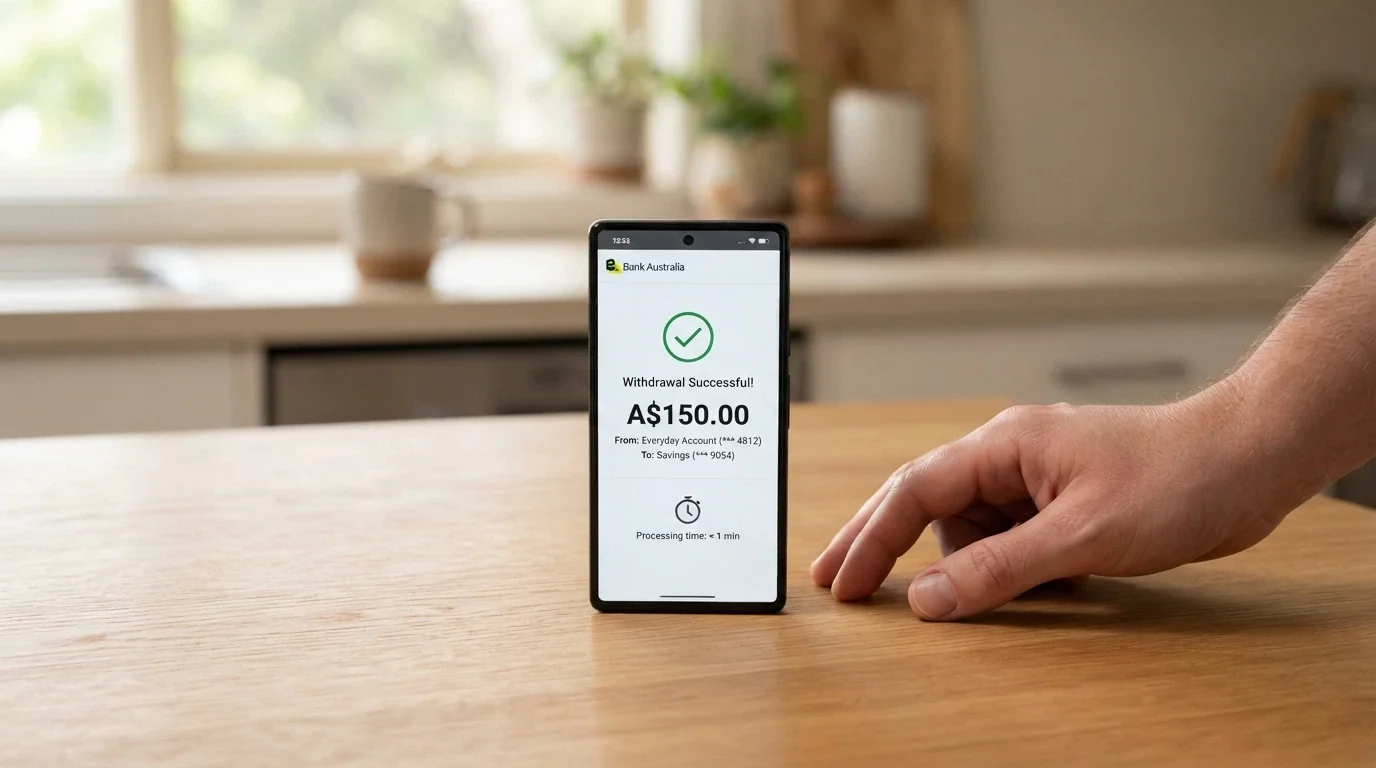
The legal payment routes for licensed wagering in Australia are debit card, bank transfer, PayID/Osko and BPAY, all subject to identity verification. PayID and Osko are legal instant-payment rails in Australia, but their availability at an offshore casino depends on whether the operator has integrated them — many have not. The first withdrawal at any offshore casino is the slowest, because the verification check (proof of identity, proof of address, sometimes proof of payment method) runs only on the first request and the casino will not release funds until it clears. After that, repeat withdrawals are faster — provided the operator’s queue has not changed.
No online casino holds an Australian licence — here is what that costs you
The Interactive Gambling Act 2001 makes it an offence to provide an online casino, online pokies or in-play betting to a person in Australia. The provider is the target of the law. The individual player is not prosecuted, but the player is also not protected by any of the safeguards Australia builds around its licensed wagering operators — and that gap is the real cost of playing offshore.
What an Australian player gives up is concrete. There is no BetStop coverage at an offshore casino, because BetStop binds Australian-licensed wagering services only. There is no Australian complaints body to escalate a dispute to. There is no Australian regulator with the power to compel a payout if the operator stalls or voids a win. There is no Australian consumer law to fall back on, because the operator is not an Australian company supplying an Australian-regulated product. The site can also be blocked by the ACMA at any time, with a balance still on it.
The Interactive Gambling Act 2001: why it prosecutes providers, not players
The Interactive Gambling Act 2001 makes it an offence for a provider to supply a prohibited interactive gambling service to a person in Australia. Online casino games, online pokies and in-play betting are the named prohibited services. The Act was strengthened by the Interactive Gambling Amendment Act 2017, which closed the loopholes offshore operators had been using and gave the Australian Communications and Media Authority enforcement powers including the ability to direct Australian internet service providers to block offending sites.
The ACMA has used those powers. Since November 2019, the ACMA has directed ISPs to block 1,564 illegal gambling and affiliate websites. More than 225 illegal services have withdrawn from the Australian market since 2017, either after ACMA action or in anticipation of it. The enforcement is real and ongoing. The 1,564 figure is current to March 2026.
The 2026 reform tightens the net further. The Interactive Gambling Amendment (Gambling Reform) Bill 2026 passed Parliament on 19 August 2026, with its measures commencing 1 January 2027. From that date, banks and payment providers gain express authority to block transactions to illegal gambling operators — meaning an Australian player’s deposit may not even reach the offshore casino if the player’s bank chooses to act on the new authority. The reform also caps wagering advertising (a maximum of three ads per hour between 6 am and 8:30 pm), introduces a live-sport blackout, bars athletes, celebrities and influencers from promoting wagering, and prohibits direct marketing of inducements for 14 days after sign-up and for three months after a person deregisters from BetStop.
The individual player is not prosecuted under the IGA — the Act targets the provider, not the punter. That is a real protection for the player, but it is a narrow one. It does not make offshore play safe; it makes offshore play unprosecuted for the player. The player still gives up every Australian consumer protection the moment the deposit leaves the bank account.
What you lose when you play offshore: every Australian consumer protection, side by side
The comparison below sets a licensed Australian wagering customer against an offshore casino player on the consumer protections that actually matter. It is not a complete list, but it is the list that decides whether a dispute gets heard somewhere.
| Player protection | Licensed Australian wagering | Offshore casino |
|---|---|---|
| Self-exclusion via BetStop | Yes — one registration excludes from every licensed service | No — BetStop does not bind offshore casinos |
| Australian complaints body | Yes — escalation available through state/territory regulator | No — no Australian body has jurisdiction |
| Regulator can compel a payout | Yes — Australian regulator has enforcement power | No — dispute sits in the operator’s hands |
| Credit/crypto deposits blocked | Yes — banned since 11 June 2024 | Frequently accepted — operator outside Australian rules |
| Bank can block transactions to operator | From 1 January 2027, yes — express authority under the 2026 reform | From 1 January 2027, yes — same reform applies |
| Site can be blocked by ACMA | No — licensed operator is not a blocking target | Yes — 1,564 sites blocked since November 2019 |
| Identity verification required | Yes — KYC mandatory for licensed wagering | Varies — depends on the operator’s own procedures |
| Tax treatment clarity | Yes — winnings not assessable, losses not deductible (ITAA 1997) | Same tax treatment, but with offshore dispute risk layered on |
The table reads as a list of protections a licensed Australian wagering customer has and an offshore casino player does not. The two columns are not symmetric. The right-hand column mostly says no, because the protections are the ones Australia builds around its own licensed operators — and offshore casinos are not in that system.
The concrete risk that catches players is the site-blocking one. An offshore casino can be added to the ACMA’s blocking list at any time, and the player has no Australian body to turn to for the balance on the account. The casino is not an Australian company, the product is not an Australian-regulated product and the player’s Australian consumer law does not reach it.
Staying in control when the house sits overseas
The responsible-gambling tools Australia has built stop at the border. BetStop, the National Self-Exclusion Register, is the most concrete example: one registration excludes a person from every Australian-licensed online and phone wagering service in the country. It does not exclude them from a single offshore casino. An offshore operator is not connected to BetStop and has no obligation to honour the registration. The tools a licensed Australian operator must offer — deposit limits, activity statements, take-a-break, reality-check prompts — are not required at offshore casinos, and the operators typically offer only what is in their commercial interest.
The help infrastructure that does exist for Australians, regardless of where they play, is real and free. The National Gambling Helpline (1800 858 858) is staffed 24 hours a day, 7 days a week, with online chat and counselling through Gambling Help Online. The prevalence data behind those services is not small: roughly 2.1 % of Australian adults — around 430,000 people — experience problem gambling, with the Australian Institute of Health and Welfare putting high-risk gambling at 1.8 % in 2022.
BetStop and the self-exclusion tools that every offshore casino ignores
BetStop has been live since August 2023. The register is operated under Australian Communications and Media Authority oversight, and a single registration excludes the person from every Australian-licensed online and phone wagering service in one step. There is no second form to fill in, no per-operator opt-out, no annual renewal required unless the person chose a fixed-term exclusion.

The numbers, current to 31 July 2026, are significant. BetStop recorded 67,480 registrations, of which 41,290 exclusions were still active — more than 60 % of everyone who ever registered was still excluded. 78 % of registrants were under 40, and 38 % chose lifetime exclusion rather than a fixed term. Those figures describe people who decided, often in a difficult moment, that they needed the boundary built for them.
The limitation is total. BetStop binds Australian-licensed wagering services only. An offshore casino is not connected to the register, has no obligation to check it, and will continue accepting a self-excluded person’s deposits. The boundary BetStop builds stops at the border. A player who needs the protection of self-exclusion and chooses to play offshore is choosing to step outside the boundary the moment they deposit.
Deposit limits, reality checks, and the help infrastructure that actually exists
Australian-licensed wagering operators are required to offer deposit limits, activity statements, take-a-break and reality-check tools, and to honour a customer’s request to set or change them. Offshore casinos are not required to offer any of these, and the practical reality is that most offer a subset — usually deposit limits and session timers — but no offshore operator is bound by an Australian code of practice.
The help infrastructure that exists for any Australian, regardless of where they gamble, is straightforward. The National Gambling Helpline is 1800 858 858, free, confidential and staffed 24 hours a day, 7 days a week. Gambling Help Online runs online chat and counselling through gamblinghelponline.org.au. The services are run by experienced counsellors and are not connected to any operator, offshore or licensed. The prevalence data behind the demand for those services is real: roughly 2.1 % of Australian adults — around 430,000 people — experience problem gambling, and the Australian Institute of Health and Welfare put high-risk gambling at 1.8 % in 2022. Those figures describe people, not statistics, and the services exist because they are needed.
How we selected and ranked every casino on this page
The ranking is ordered by verified presence in the Australian market, working from the operators skill data and from the public footprint of each brand. The criteria that ordered the ranking were: legal status (every operator on this page is offshore and none holds an Australian licence for online casino, because no such licence exists), verified reach among Australian players, transparency of payout and terms information, and the practical differences between the brands that matter to a player choosing between them.

The sources used for this review were the Australian Communications and Media Authority’s published enforcement data, the text of the Interactive Gambling Act 2001 and its amendments, the Northern Territory Racing and Wagering Commission’s published register of licensed wagering operators, the Australian Institute of Health and Welfare’s gambling prevalence data, and publicly available operator information. No operator on this page was contacted, paid or compensated for inclusion. The ranking is descriptive, not promotional.
The limitation is the most important line on the page. Every casino on this page is offshore. None holds an Australian licence for online casino games. The welcome-bonus terms, wagering multipliers, bonus-validity windows and per-game RTP configurations could not be independently confirmed for every operator this run — and where they could not, the article says so. A player who needs that information for a specific decision should treat the operator’s own terms page as the source of truth and should read it in full before depositing.
Why “highest payout” is a claim no Australian authority checks — and what we checked instead
Without an Australian licence audit, the payout figure a casino advertises is a claim, not a certified return. There is no Australian auditor for casino payout rates, because there is no Australian licence regime to attach one to. The figure a casino publishes is the operator’s own measurement, against the operator’s own methodology, on the operator’s own game library — and the player has no Australian body to escalate to if the number turns out to be wrong.
What was checked instead is narrower and real. The operators’ legal status was verified against the Australian regime: every one is offshore, and the credit and crypto ban for online wagering (in force since 11 June 2024) was carried across every operator reviewed. The payment rails each operator accepts were checked against the legal routes for licensed wagering (debit card, bank transfer, PayID/Osko and BPAY). The licence each operator does hold was checked against that regulator’s own register — Curaçao, Anjouan, the Isle of Man, the Kahnawake Gaming Commission and the Malta Gaming Authority are the most common jurisdictions named by offshore operators, and each maintains a public lookup. None of those is an Australian check, but each is a cross-reference a player can run in five minutes.
The honest gap is in the volatile fields. Welcome-bonus terms, wagering multipliers attached to bonus funds, free-spin allocations, bonus-validity windows, per-game RTP settings and game-contribution rates could not be independently confirmed for every operator this run. Where the article does not name a figure, the figure was not confirmable. Where the article names a figure, the figure came from the named source. A reader who needs the volatility for a specific decision should read the operator’s own terms page before depositing.
What chasing the highest payout actually means for your money as an Australian punter
The gap between a casino’s payout claim and what an Australian player actually keeps is wider than the marketing suggests, and the gap has three sources that have nothing to do with one another. The first is the mathematical reality: RTP is an average measured over millions of spins, not over the lifetime of a single session. A 98 % RTP pokie can pay out far above or far below 98 % in one session, and the player’s result is bounded only by the volatility profile of the title. The second is the legal reality: an offshore casino is not subject to Australian consumer law, and a player whose withdrawal stalls has no Australian body to escalate to. The third is the operational reality: payout speed depends on the payment rail, the verification queue and the operator’s own processing time — three things that have nothing to do with the percentage on the homepage.
Three things to check before depositing at any casino advertising a high payout rate. First, the per-game RTP of the titles actually played, verified from the game-rules or paytable screen inside the title rather than from the homepage. Second, the withdrawal method and its real-world timeline, including the first-withdrawal verification delay and the rail’s actual settlement time once verification is complete. Third, whether the operator is subject to any regulator that will hear a complaint, and whether that regulator’s register lists the operator in good standing. None of those checks is an Australian check, because no Australian check exists for online casino. All of them are cross-references a player can run in five minutes.
The market offers offshore play at scale and bans the licensed product outright. The two facts do not cancel each other out. The scale of the offshore market is the scale of an unregulated product reaching Australian players despite the prohibition, not the scale of a legitimate alternative to one. A player comparing two offshore casinos on a one-percentage-point difference in advertised RTP is missing the larger point. The legal status, the protection gap, the payment-rail check and the responsible-gambling coverage matter more than that difference does — and they all sit outside the RTP figure.
Frequently asked questions about the highest payout online casino in Australia
What online casino has the highest payout rate in Australia?
No Australian-licensed online casino exists, so no Australian regulator audits payout rates. The RTP figures published by offshore casinos are the operators’ own claims, weighted across their game libraries and not independently verified in Australia. A player comparing two offshore casinos on a one-percentage-point RTP difference is comparing unverified marketing figures against each other, with no Australian authority behind either number. The licensed Australian wagering market does not offer online casino games at all, so there is no Australian-licensed payout rate to anchor the comparison against.
How do I find the RTP of an online pokie?
Open the game-rules or paytable screen inside the pokie itself, usually behind a question-mark icon or settings cog. The RTP printed there is the figure the casino has selected for that title, because game studios ship pokies with several RTP profiles and the operator picks which one runs. If the figure is not displayed inside the game, the operator has decided not to show it, and that silence is information in itself. Independent testing house reports (eCOGRA, GLI, iTech Labs) sometimes publish per-game RTPs, but most offshore casinos do not link to them.
Which online casino pays out the fastest in Australia?
There is no Australian-licensed online casino, so no Australian benchmark for casino payout speed exists. The licensed Australian wagering market (sports and race betting) processes withdrawals through debit card, bank transfer, PayID/Osko and BPAY, with identity verification required on first withdrawal. Offshore casinos process withdrawals through their own payment rails, and the actual time depends on the operator’s verification queue and the rail chosen — e-wallets are typically fastest, bank transfers slower. The first withdrawal is always slower because verification runs only on the first request.
Do high payout casinos have higher wagering requirements?
Not necessarily, and the two figures measure different things. RTP is a mathematical property of the games; the wagering requirement is a condition attached to a bonus. A casino can offer a high-RTP library with a steep wagering multiplier on the welcome bonus, or a lower-RTP library with a lighter one. The two are independent decisions by the operator. A player comparing welcome offers should read the wagering multiplier, the game-contribution rates, the maximum bet while a bonus is active, the bonus-validity window and any maximum cash-out cap on bonus-derived winnings before claiming — and should treat those terms as the operator’s claim until they have been verified.
Can I use PayID to deposit at an online casino in Australia?
PayID and Osko are legal instant-payment rails for licensed Australian wagering operators. Whether an offshore casino accepts PayID depends on whether the operator has integrated the rail — many have not. An Australian player using PayID is typically choosing to deposit at an Australian-licensed wagering operator (sports and race betting only), as online casino products remain prohibited under the Interactive Gambling Act 2001.